
Degrees Baume' to Relative Density Calculator

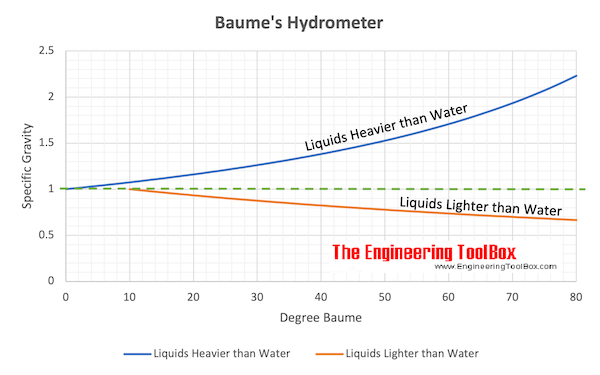
The Degrees Baume to Relative Density Calculator is a useful tool for converting between degrees Baume and relative density, also known as specific gravity. Degrees Baume is a scale used to measure the density of liquids, particularly in the industrial and scientific communities. This calculator provides a quick and accurate way to convert between these two important units, allowing users to easily determine the relative density of a substance given its degrees Baume reading, or vice versa, with high precision and reliability in various applications. It is widely used in various fields, including chemistry and engineering.
- Degree Baume to Relative Density Calculator: A Comprehensive Guide
- What is the density of Baume degrees?
- How do I calculate relative density?
- Is baume the same as density?
- How do you convert SG to density?
-
Frequently Asked Questions (FAQs)
- What is the Degrees Baume to Relative Density Calculator and how does it work?
- What are the benefits of using the Degrees Baume to Relative Density Calculator?
- How is the Degrees Baume to Relative Density Calculator used in different industries?
- What are the limitations and potential sources of error when using the Degrees Baume to Relative Density Calculator?
Degree Baume to Relative Density Calculator: A Comprehensive Guide
The Degree Baume to Relative Density Calculator is a tool used to calculate the relative density of a liquid based on its Baume reading. This calculator is essential in various industries, including petrochemical, pharmaceutical, and food processing, where accurate measurements of liquid densities are critical.
What is Degree Baume?
Degree Baume is a unit of measurement used to express the density of a liquid. It is defined as the weight of a liquid divided by the weight of an equal volume of water. The Baume scale is used to measure the density of liquids, with 0° Baume being the density of water and higher degrees indicating higher densities. The Baume reading is typically measured using a hydrometer.
How Does the Calculator Work?
The Degree Baume to Relative Density Calculator works by using a formula to convert the Baume reading to relative density. The formula is: Relative Density = (145 / (145 - °Baume)). This formula is based on the definition of relative density and the Baume scale. By entering the Baume reading into the calculator, the user can obtain the relative density of the liquid.
Applications of the Calculator
The Degree Baume to Relative Density Calculator has various applications in different industries. In the petrochemical industry, it is used to measure the density of crude oil and petroleum products. In the pharmaceutical industry, it is used to measure the density of liquids used in drug manufacturing. In the food processing industry, it is used to measure the density of food products such as juices and syrups.
Limitations of the Calculator
The Degree Baume to Relative Density Calculator has some limitations. It is only applicable to liquids and not to gases or solids. Additionally, the calculator assumes that the Baume reading is accurate and that the liquid is homogeneous. If the liquid is heterogeneous or if the Baume reading is inaccurate, the calculator may not provide an accurate relative density.
Comparison with Other Density Measurement Methods
The Degree Baume to Relative Density Calculator is one of several methods used to measure liquid density. Other methods include pycnometry, hydrostatic weighing, and vibrating tube densitometry. The choice of method depends on the accuracy required, the type of liquid, and the equipment available. The following table compares the different methods:
| Method | Accuracy | Equipment Required |
|---|---|---|
| Degree Baume to Relative Density Calculator | High | Hydrometer |
| Pycnometry | High | Pycnometer |
| Hydrostatic Weighing | Medium | Balance and Container |
| Vibrating Tube Densitometry | High | Vibrating Tube Densitometer |
The Degree Baume to Relative Density Calculator is a convenient and accurate method for measuring liquid density, but it is essential to consider the limitations and choose the correct method for the specific application. The key factors to consider are the type of liquid, the required accuracy, and the equipment available.
What is the density of Baume degrees?
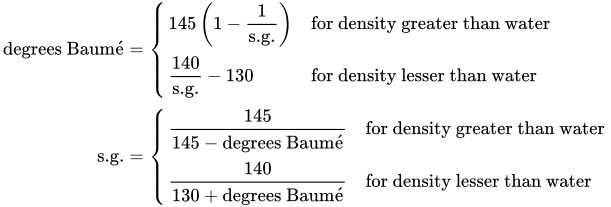
The density of Baume degrees is a measure of the density of a liquid, typically used to measure the concentration of a solution. The Baume scale is a hydrometer scale that measures the density of a liquid in relation to the density of water. The Baume scale is defined as the weight of a liquid per unit volume, with water being the reference point.
What is the Baume Scale?
The Baume scale is a hydrometer scale that measures the density of a liquid in relation to the density of water. The Baume scale is defined as the weight of a liquid per unit volume, with water being the reference point. Some key points about the Baume scale include:
- The Baume scale is used to measure the concentration of a solution.
- The Baume scale is defined as the weight of a liquid per unit volume.
- The Baume scale is used in various industries, including chemistry, pharmaceuticals, and food processing.
How is the Baume Scale Used?
The Baume scale is used to measure the density of a liquid, which can be used to determine the concentration of a solution. The Baume scale is used in various industries, including chemistry, pharmaceuticals, and food processing. Some key points about the use of the Baume scale include:
- The Baume scale is used to measure the concentration of a solution.
- The Baume scale is used to determine the density of a liquid.
- The Baume scale is used in quality control to ensure that products meet standards.
What are the Units of the Baume Scale?
The Baume scale is measured in degrees Baume (°Bé), which is a unit of density. The Baume scale is defined as the weight of a liquid per unit volume, with water being the reference point. Some key points about the units of the Baume scale include:
- The Baume scale is measured in degrees Baume (°Bé).
- The Baume scale is a unit of density.
- The Baume scale is used to measure the concentration of a solution.
How is the Baume Scale Calibrated?
The Baume scale is calibrated by comparing the density of a liquid to the density of water. The Baume scale is defined as the weight of a liquid per unit volume, with water being the reference point. Some key points about the calibration of the Baume scale include:
- The Baume scale is calibrated by comparing the density of a liquid to the density of water.
- The Baume scale is calibrated using a hydrometer.
- The Baume scale is calibrated to ensure accuracy and precision.
What are the Limitations of the Baume Scale?
The Baume scale has several limitations, including the fact that it is not linear and that it is not accurate for all types of liquids. The Baume scale is defined as the weight of a liquid per unit volume, with water being the reference point. Some key points about the limitations of the Baume scale include:
- The Baume scale is not linear.
- The Baume scale is not accurate for all types of liquids.
- The Baume scale is limited to measuring the density of liquids.
How do I calculate relative density?

To calculate relative density, you need to understand the concept of density and how it relates to different substances. Relative density is the ratio of the density of a substance to the density of water at a specific temperature and pressure. It is also known as specific gravity. The formula to calculate relative density is: relative density = density of substance / density of water.
Understanding Density
To calculate relative density, you need to understand what density is. Density is defined as the mass per unit volume of a substance. It is usually expressed in units of kilograms per cubic meter (kg/m³) or grams per cubic centimeter (g/cm³). The density of a substance can be calculated by dividing its mass by its volume. For example, if you have a cube of metal with a mass of 10 kg and a volume of 1 m³, its density would be 10 kg/m³. Here are the steps to calculate density:
- Measure the mass of the substance using a balance or scale.
- Measure the volume of the substance using a ruler or other measuring device.
- Divide the mass by the volume to get the density.
Measuring Volume
To calculate relative density, you need to measure the volume of the substance accurately. There are several ways to measure volume, including using a graduated cylinder or a displacement method. The displacement method involves measuring the volume of water displaced by the substance when it is submerged in a container of water. This method is useful for measuring the volume of irregularly shaped objects. Here are the steps to measure volume using the displacement method:
- Fill a container with water to a specific level.
- Submerge the substance in the water and measure the new water level.
- Calculate the volume of water displaced by the substance.
Calculating Relative Density
To calculate relative density, you need to divide the density of the substance by the density of water. The density of water is typically assumed to be 1 g/cm³ or 1000 kg/m³. Here are the steps to calculate relative density:
- Calculate the density of the substance using its mass and volume.
- Divide the density of the substance by the density of water.
- Express the result as a ratio or a decimal value.
Applications of Relative Density
Relative density has several practical applications in various fields, including engineering, chemistry, and physics. It is used to calculate the buoyancy of objects in water, to determine the concentration of solutions, and to measure the density of gases. Here are some examples of practical applications of relative density:
- Designing ships and submarines that can float or sink in water.
- Calculating the concentration of solutions in chemistry experiments.
- Measuring the density of gases in physics experiments.
Common Units and Conversions
When working with relative density, it is essential to understand the common units and conversions used to express density and volume. The most common units of density are kilograms per cubic meter (kg/m³) and grams per cubic centimeter (g/cm³). Here are some common units and conversions:
- 1 kg/m³ = 0.001 g/cm³.
- 1 g/cm³ = 1000 kg/m³.
- 1 relative density unit = 1 g/cm³ / 1 g/cm³.
Is baume the same as density?
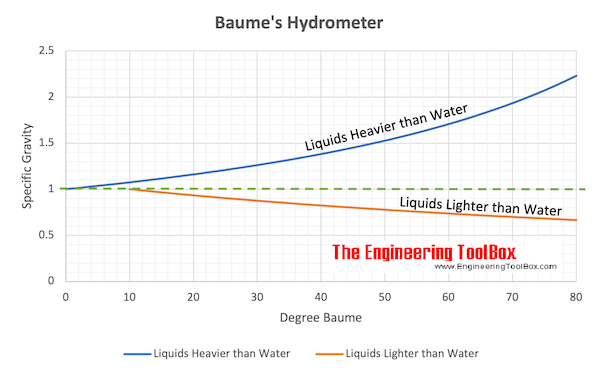
The terms baume and density are often used interchangeably, but they have slightly different meanings. Baume is a measure of the density of a liquid, typically used to express the concentration of a solution. It is defined as the weight of a liquid per unit volume, usually expressed in units of grams per milliliter (g/mL) or kilograms per liter (kg/L). Density, on the other hand, is a more general term that refers to the mass per unit volume of a substance.
Differences between Baume and Density
The main difference between baume and density is that baume is a relative measure, meaning it is compared to the density of water, while density is an absolute measure. Baume is used to express the density of a liquid relative to the density of water, which is set at 0° Baume. The following are some key differences between baume and density:
- Units: Baume is typically expressed in units of °Baume, while density is expressed in units of g/mL or kg/L.
- Reference point: Baume is relative to the density of water, while density is an absolute measure.
- Applications: Baume is commonly used in industries such as brewing, winemaking, and pharmaceuticals, while density is used in a wider range of applications, including physics, engineering, and chemistry.
How Baume is Measured
Baume is typically measured using a hydrometer, which is a device that measures the density of a liquid by floating it in the liquid. The hydrometer is calibrated to read the baume of the liquid, which is then used to calculate the density. The measurement process involves:
- Calibration: The hydrometer is calibrated to read the baume of a liquid with a known density.
- Measurement: The hydrometer is floated in the liquid to be measured, and the baume reading is taken.
- Calculation: The density of the liquid is calculated using the baume reading and a conversion factor.
Applications of Baume
Baume has several practical applications in various industries, including:
- Brewing: Baume is used to measure the density of wort and beer, which is essential for quality control and yield calculation.
- Winemaking: Baume is used to measure the density of grape juice and wine, which helps winemakers monitor the fermentation process.
- Pharmaceuticals: Baume is used to measure the density of pharmaceutical solutions, which is critical for dosage calculation and quality control.
Limitations of Baume
While baume is a useful measure of density, it has some limitations, including:
- Temperature dependence: Baume is temperature-dependent, meaning that the density of a liquid changes with temperature.
- Nonlinear relationship: The relationship between baume and density is nonlinear, making it difficult to convert between the two units.
- Limited range: Baume is only useful for measuring the density of liquids within a certain range, typically between 0° and 40° Baume.
Alternatives to Baume
In some cases, alternative methods may be used to measure density, including:
- Pycnometry: This involves measuring the volume of a liquid using a pycnometer, which is a device that measures the volume of a liquid with high accuracy.
- Vibrating tube densitometry: This involves measuring the density of a liquid using a vibrating tube, which is a device that measures the density of a liquid by detecting changes in the vibration frequency.
- Radiation densitometry: This involves measuring the density of a liquid using radiation, which is a non-destructive method that measures the density of a liquid by detecting changes in the absorption of radiation.
How do you convert SG to density?
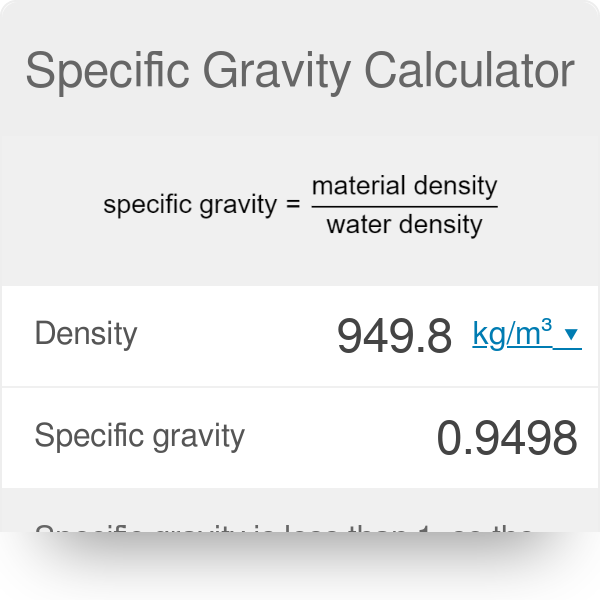
To convert Specific Gravity (SG) to density, you need to know the density of the reference substance, usually water. The density of water is approximately 1 gram per cubic centimeter (g/cm³) or 1000 kilograms per cubic meter (kg/m³) at standard conditions. The formula to convert SG to density is: density = SG x density of water. For example, if the SG of a substance is 1.2, its density would be 1.2 x 1000 kg/m³ = 1200 kg/m³.
Understanding Specific Gravity
Specific Gravity (SG) is the ratio of the density of a substance to the density of water at a reference temperature, usually 20°C. To convert SG to density, it's essential to understand the concept of SG and how it's measured. The process involves:
- Measuring the weight of a known volume of the substance
- Measuring the weight of the same volume of water
- Calculating the ratio of the two weights, which gives the SG
Importance of Reference Temperature
The reference temperature is crucial when converting SG to density because the density of substances changes with temperature. Most density measurements are done at 20°C, and the SG is calculated based on this temperature. If the temperature is different, it's necessary to use a density correction factor to get the accurate density. The factors to consider are:
- The thermal expansion of the substance
- The thermal expansion of water
- The change in density with temperature
Using the Conversion Formula
The conversion formula from SG to density is straightforward: density = SG x density of water. However, it's essential to ensure that the units are consistent. If the density of water is given in g/cm³, the resulting density will be in g/cm³. If the density of water is given in kg/m³, the resulting density will be in kg/m³. The key steps are:
- Ensure the units of SG and density of water are consistent
- Plug in the values into the conversion formula
- Calculate the density of the substance
Applications of Density Conversion
Converting SG to density has various applications in engineering, chemistry, and physics. For example, in chemical engineering, knowing the density of a substance is crucial for designing storage tanks and pipelines. In materials science, the density of a material is essential for understanding its mechanical properties. The applications include:
- Designing storage tanks and pipelines
- Understanding mechanical properties of materials
- Calculating buoyancy and floatation
Common Mistakes in Density Conversion
When converting SG to density, there are common mistakes to avoid, such as using the wrong units or not considering the reference temperature. It's also essential to ensure that the SG value is accurate and reliable. The mistakes to watch out for are:
- Using inconsistent units
- Not considering the reference temperature
- Using an inaccurate SG value
Frequently Asked Questions (FAQs)
What is the Degrees Baume to Relative Density Calculator and how does it work?
The Degrees Baume to Relative Density Calculator is a tool used to calculate the relative density of a liquid based on its Baume scale reading. The Baume scale is a measure of the density of a liquid, with higher numbers indicating a higher density. The calculator uses a complex formula to convert the Baume scale reading to a relative density value, which is a ratio of the density of the liquid to the density of water at the same temperature. This calculation is crucial in various industries, such as chemical engineering, petroleum engineering, and food processing, where the relative density of liquids plays a significant role in determining their properties and behavior. By using the Degrees Baume to Relative Density Calculator, users can quickly and accurately determine the relative density of a liquid, which is essential for various applications, including quality control, research and development, and process optimization.
What are the benefits of using the Degrees Baume to Relative Density Calculator?
The Degrees Baume to Relative Density Calculator offers several benefits to users, including accuracy, speed, and convenience. By using this calculator, users can eliminate errors associated with manual calculations, which can be time-consuming and prone to mistakes. The calculator also saves time, as it can perform complex calculations in a matter of seconds, allowing users to focus on other important tasks. Additionally, the calculator is easy to use, requiring only a simple input of the Baume scale reading, making it accessible to users with limited technical expertise. Furthermore, the calculator provides reliable results, which is essential in industries where precision and accuracy are critical. The Degrees Baume to Relative Density Calculator is also versatile, as it can be used in various applications, including laboratory settings, industrial processes, and quality control measures.
How is the Degrees Baume to Relative Density Calculator used in different industries?
The Degrees Baume to Relative Density Calculator has a wide range of applications in various industries, including chemical processing, petroleum refining, food processing, and pharmaceutical manufacturing. In the chemical industry, the calculator is used to determine the relative density of chemicals, which is essential for process optimization, quality control, and safety protocols. In the petroleum industry, the calculator is used to calculate the relative density of crude oil and refined products, which is critical for refining processes, transportation, and storage. In the food industry, the calculator is used to determine the relative density of ingredients and products, which is important for quality control, food safety, and regulatory compliance. In the pharmaceutical industry, the calculator is used to calculate the relative density of active ingredients and excipients, which is essential for formulation development, quality control, and regulatory compliance.
What are the limitations and potential sources of error when using the Degrees Baume to Relative Density Calculator?
While the Degrees Baume to Relative Density Calculator is a valuable tool, it is not without limitations and potential sources of error. One of the main limitations is that the calculator assumes a linear relationship between the Baume scale reading and the relative density value, which may not always be the case. Additionally, the calculator is only accurate within a certain range of Baume scale readings, and errors can occur if the input values are outside of this range. Furthermore, the calculator does not account for temperature variations, which can affect the relative density of liquids. Other potential sources of error include instrumental errors, sampling errors, and human errors, which can occur during the measurement and input of the Baume scale reading. To minimize these errors, users should ensure that the Baume scale reading is accurate and reliable, and that the calculator is used in conjunction with other quality control measures to verify the results. Regular calibration and maintenance of the calculator are also essential to ensure optimal performance and accuracy.
Deja una respuesta
Entradas Relacionadas