
Cylinder Stress Calculator and Deflection with Applied Torsion

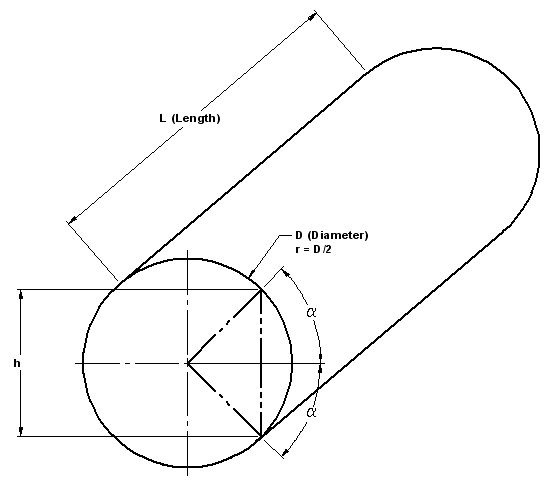
The Cylinder Stress Calculator is a valuable tool for engineers and designers to calculate the stresses and deflections that occur in cylindrical structures under various loads, including applied torsion. Torsion can cause significant stress and deformation in cylinders, and accurate calculations are crucial to ensure the safety and efficiency of the structure. This calculator takes into account factors such as cylinder geometry, material properties, and applied loads to provide precise calculations of stress and deflection, allowing designers to optimize their designs and prevent potential failures. It is a vital resource for numerous industries.
- Cylinder Stress Calculator and Deflection with Applied Torsion
- Understanding the Impact of Torsion on Cylindrical Structures
-
Frequently Asked Questions (FAQs)
- What is the purpose of the Cylinder Stress Calculator and Deflection with Applied Torsion?
- What types of calculations can be performed using the Cylinder Stress Calculator and Deflection with Applied Torsion?
- What are the key inputs and assumptions required for the Cylinder Stress Calculator and Deflection with Applied Torsion?
- What are the limitations and potential sources of error for the Cylinder Stress Calculator and Deflection with Applied Torsion?
Cylinder Stress Calculator and Deflection with Applied Torsion
The Cylinder Stress Calculator and Deflection with Applied Torsion is a powerful tool used to calculate the stress and deflection of a cylinder under various types of loading, including torsion. This calculator is widely used in the field of mechanical engineering to design and analyze cylindrical structures such as pipes, tanks, and pressure vessels. The calculator takes into account the material properties, dimensions, and loading conditions of the cylinder to provide accurate results.
Introduction to Cylinder Stress Calculator
The Cylinder Stress Calculator is a user-friendly tool that allows users to input the necessary parameters and obtain the stress and deflection values. The calculator is based on the theory of elasticity and uses formulas and equations to calculate the stress and deflection of the cylinder. The calculator can handle various types of loading, including axial, radial, and torsional loading.
Types of Loading and Stress
The Cylinder Stress Calculator can handle various types of loading, including:
| Loading Type | Description |
|---|---|
| Axial Loading | Loading applied along the axis of the cylinder |
| Radial Loading | Loading applied perpendicular to the axis of the cylinder |
| Torsional Loading | Loading applied in a twisting motion |
Material Properties and Dimensions
The Cylinder Stress Calculator requires the user to input the material properties and dimensions of the cylinder. The material properties include the Young's modulus, Poisson's ratio, and yield strength. The dimensions include the inner radius, outer radius, and length of the cylinder. The calculator uses these values to calculate the stress and deflection of the cylinder.
Applied Torsion and Deflection
The Cylinder Stress Calculator can also calculate the deflection of the cylinder due to applied torsion. The calculator uses the torsional stiffness and rotational stiffness to calculate the deflection of the cylinder. The deflection is measured in degrees or radians and is an important factor in designing cylindrical structures.
Applications and Limitations
The Cylinder Stress Calculator has various applications in the field of mechanical engineering, including the design and analysis of pipes, tanks, and pressure vessels. However, the calculator also has some limitations, including the assumption of linear elasticity and small deformations. The calculator is not suitable for non-linear or dynamic analysis and should be used in conjunction with other analysis tools to ensure accurate results.
Understanding the Impact of Torsion on Cylindrical Structures
The calculation of stress and deflection in cylindrical structures under applied torsion is a critical aspect of engineering design. This involves understanding the complex interactions between the material properties, geometry, and external loads. The Cylinder Stress Calculator and Deflection with Applied Torsion is a tool designed to simplify this process, providing engineers with a straightforward method to analyze and predict the behavior of cylindrical structures under various loading conditions. By leveraging this tool, engineers can ensure the integrity and reliability of their designs, minimizing the risk of failure and optimizing performance.
Calculating Torsional Stress in Cylinders
Calculating torsional stress in cylinders is fundamental to assessing the structural integrity of cylindrical components subjected to twisting forces. The formula for torsional stress involves the torque applied, the polar moment of inertia of the cross-section, and the radius of the cylinder. The accurate calculation of torsional stress is crucial because excessive stress can lead to material failure, which might manifest as cracking, deformation, or even catastrophic failure. The Cylinder Stress Calculator simplifies this calculation by allowing users to input the necessary parameters and obtain the resulting torsional stress, thus facilitating the design and analysis process.
Assessing Deflection Under Torsion
Assessing deflection under torsion is another critical aspect of analyzing cylindrical structures. Deflection refers to the deformation of the cylinder due to the applied torque, and it is essential to ensure that this deformation does not compromise the structure's functionality or lead to instability. The calculation of deflection under torsion involves the length of the cylinder, the modulus of rigidity of the material, and the polar moment of inertia of the cross-section. By using the Cylinder Stress Calculator and Deflection with Applied Torsion, engineers can predict the deflection of their designs under specified loading conditions, thereby ensuring structural stability and performance.
Material Selection for Cylindrical Structures
Material selection plays a pivotal role in the design of cylindrical structures subjected to torsion. Different materials exhibit varied properties, such as yield strength, ultimate strength, and modulus of elasticity, which significantly influence the structure's ability to withstand stress and deflection. The choice of material must balance strength, weight, cost, and corrosion resistance, among other factors. The Cylinder Stress Calculator can aid in material selection by allowing engineers to compare the performance of different materials under the same loading conditions, thus enabling the selection of the most suitable material for the application.
Design Considerations for Torsional Loading
Design considerations for torsional loading are essential to ensure that cylindrical structures can safely and efficiently withstand the applied torque. These considerations include optimizing the cross-sectional geometry to maximize the polar moment of inertia, minimizing stress concentrations through the avoidance of sharp corners or abrupt changes in section, and selecting materials and manufacturing processes that minimize the risk of flaws or defects. By carefully considering these factors and utilizing the Cylinder Stress Calculator and Deflection with Applied Torsion, engineers can develop designs that are robust, efficient, and reliable.
Applications of Cylinder Stress Calculator and Deflection with Applied Torsion
The applications of the Cylinder Stress Calculator and Deflection with Applied Torsion are diverse and span various industries, including aerospace, automotive, mechanical engineering, and civil engineering. In these fields, cylindrical structures such as shafts, pipes, and tubes are commonly used and must be designed to withstand torsional loads. The calculator is particularly useful for optimizing the design of drive shafts, gears, and other mechanical components that are subject to twisting forces. By leveraging this tool, engineers can improve the performance, safety, and efficiency of their designs, contributing to the development of more advanced and reliable systems and machines.
Frequently Asked Questions (FAQs)
What is the purpose of the Cylinder Stress Calculator and Deflection with Applied Torsion?
The Cylinder Stress Calculator is a tool designed to calculate the stress and deflection of a cylinder under various loads, including torsion. The purpose of this calculator is to provide engineers and designers with a quick and accurate way to determine the structural integrity of a cylinder when subjected to different types of forces. By inputting the dimensions and material properties of the cylinder, as well as the applied loads, users can calculate the stress and deflection of the cylinder and determine whether it can withstand the applied forces without failing. This calculator is particularly useful in the design and analysis of pressure vessels, pipelines, and other cylindrical structures that are subject to internal pressure, external loads, and torsion.
What types of calculations can be performed using the Cylinder Stress Calculator and Deflection with Applied Torsion?
The Cylinder Stress Calculator can perform a variety of calculations, including stress calculations, deflection calculations, and stability analysis. Users can calculate the hoop stress, longitudinal stress, and torsional stress of a cylinder, as well as the deflection and rotation of the cylinder under applied loads. The calculator can also perform stability analysis to determine the critical load at which the cylinder will buckle or become unstable. Additionally, the calculator can calculate the stress concentration around discontinuities such as holes or notches, and the fatigue life of the cylinder under cyclic loading. By performing these calculations, users can gain a better understanding of the behavior of the cylinder under different loading conditions and make informed decisions about the design and operation of the cylinder.
What are the key inputs and assumptions required for the Cylinder Stress Calculator and Deflection with Applied Torsion?
The Cylinder Stress Calculator requires several key inputs and assumptions to perform accurate calculations. These include the dimensions of the cylinder, such as the length, diameter, and wall thickness, as well as the material properties, such as the modulus of elasticity, Poisson's ratio, and yield strength. Users must also input the applied loads, including the internal pressure, external loads, and torsional moment. Additionally, the calculator assumes that the cylinder is cylindrical in shape and that the loads are static and uniformly distributed. The calculator also assumes that the material is isotropic and homogeneous, and that the stress-strain behavior is linear elastic. By understanding these inputs and assumptions, users can ensure that the calculations performed by the Cylinder Stress Calculator are accurate and reliable.
What are the limitations and potential sources of error for the Cylinder Stress Calculator and Deflection with Applied Torsion?
The Cylinder Stress Calculator has several limitations and potential sources of error that users should be aware of. One limitation is that the calculator assumes a simplified model of the cylinder, which may not accurately represent the complexities of the real-world system. Additionally, the calculator relies on theoretical equations and empirical formulas, which may not always accurately predict the behavior of the cylinder. Users should also be aware of the potential for numerical errors, such as rounding errors or truncation errors, which can affect the accuracy of the calculations. Furthermore, the calculator assumes that the material properties are constant, which may not be the case in reality, where material properties can vary with temperature, humidity, and other environmental factors. By understanding these limitations and potential sources of error, users can use the Cylinder Stress Calculator with caution and validate the results against experimental data or other analytical methods.
Deja una respuesta
Entradas Relacionadas