
Beam Deflection and Stress Equations Calculator Supported on One End, Rigid one End With Uniform Load

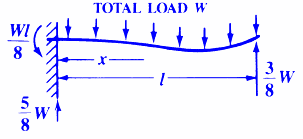
The calculation of beam deflection and stress is a crucial aspect of structural analysis in engineering. When a beam is supported on one end and rigidly fixed at the other, with a uniform load applied, it is essential to determine the resulting deflection and stress to ensure the beam's integrity. This article presents a calculator and equations for beam deflection and stress, enabling engineers to quickly and accurately assess the behavior of such beams under various loading conditions, thereby facilitating the design of safe and reliable structures. The calculator supports beams with uniform loads and one rigid end.
- Beam Deflection and Stress Equations Calculator Supported on One End, Rigid one End With Uniform Load
-
Understanding Beam Deflection and Stress Equations for a Uniformly Loaded Beam Supported on One End
- Introduction to Beam Deflection and Stress Equations
- Calculating Beam Deflection with a Uniform Load
- Understanding the Effects of Rigid Support on Beam Deflection
- Calculating Beam Stress with a Uniform Load
- What is the purpose of the Beam Deflection and Stress Equations Calculator?
- How does the calculator handle the uniform load applied to the beam?
- What are the support conditions assumed by the calculator?
- What are the material properties required by the calculator?
Beam Deflection and Stress Equations Calculator Supported on One End, Rigid one End With Uniform Load
The Beam Deflection and Stress Equations Calculator is a tool used to calculate the deflection and stress of a beam that is supported on one end and rigid on the other end with a uniform load. This calculator is useful for engineers and designers who need to determine the structural integrity of a beam under various loads. The calculator takes into account the length of the beam, the uniform load applied to the beam, and the material properties of the beam.
Introduction to Beam Deflection and Stress Equations
Beam deflection and stress equations are used to calculate the deflection and stress of a beam under various loads. The deflection of a beam is the amount of bending or curvature that occurs when a load is applied to the beam. The stress of a beam is the internal force that is exerted on the beam due to the load. The beam deflection and stress equations are based on the elasticity theory and are used to determine the structural integrity of a beam.
Types of Loads and Support Conditions
There are several types of loads and support conditions that can be applied to a beam. The most common types of loads are uniform loads, point loads, and moment loads. The most common support conditions are simply supported, fixed, and cantilevered. The uniform load is a load that is evenly distributed over the length of the beam. The point load is a load that is applied to a single point on the beam. The moment load is a load that causes a rotational force on the beam.
Equations for Beam Deflection and Stress
The equations for beam deflection and stress are based on the elasticity theory. The deflection equation is used to calculate the deflection of the beam, while the stress equation is used to calculate the stress of the beam. The deflection equation is given by: δ = (w L^4) / (8 E I), where δ is the deflection, w is the uniform load, L is the length of the beam, E is the modulus of elasticity, and I is the moment of inertia. The stress equation is given by: σ = (w L) / (2 I), where σ is the stress, w is the uniform load, L is the length of the beam, and I is the moment of inertia.
| Variable | Description |
|---|---|
| δ | Deflection of the beam |
| w | Uniform load applied to the beam |
| L | Length of the beam |
| E | Modulus of elasticity of the beam material |
| I | Moment of inertia of the beam cross-section |
Material Properties and Their Effects on Beam Deflection and Stress
The material properties of a beam can have a significant effect on its deflection and stress. The modulus of elasticity (E) is a measure of a material's ability to withstand elastic deformation. The yield strength (σy) is the stress at which a material begins to plastically deform. The ultimate strength (σu) is the stress at which a material fails. The density (ρ) of a material can also affect the deflection and stress of a beam.
Calculating Beam Deflection and Stress Using the Calculator
To calculate the deflection and stress of a beam using the calculator, the user must input the length of the beam, the uniform load applied to the beam, and the material properties of the beam. The calculator will then use the deflection equation and stress equation to calculate the deflection and stress of the beam. The calculator will also provide a graphical representation of the deflection and stress of the beam, allowing the user to visualize the structural integrity of the beam. The calculator is a useful tool for engineers and designers who need to determine the structural integrity of a beam under various loads.
Understanding Beam Deflection and Stress Equations for a Uniformly Loaded Beam Supported on One End
The beam deflection and stress equations calculator is a valuable tool for engineers and designers to calculate the deflection and stress of a beam supported on one end with a uniform load. This type of beam is commonly used in construction, mechanical engineering, and other fields where a rigid structure is required to support a load. The calculator takes into account the material properties, beam dimensions, and load conditions to provide accurate calculations of the beam's deflection and stress.
Introduction to Beam Deflection and Stress Equations
The beam deflection and stress equations are used to calculate the deflection and stress of a beam under various load conditions. The equations take into account the beam's length, cross-sectional area, and moment of inertia, as well as the load's magnitude and distribution. The deflection of a beam is calculated using the deflection equation, which is based on the beam theory and takes into account the boundary conditions. The stress of a beam is calculated using the stress equation, which is based on the material's properties and the load conditions. The beam deflection and stress equations calculator is a useful tool for engineers and designers to quickly and accurately calculate the deflection and stress of a beam.
Calculating Beam Deflection with a Uniform Load
Calculating the beam deflection of a uniformly loaded beam supported on one end requires the use of the deflection equation. The deflection equation is based on the beam theory and takes into account the beam's length, cross-sectional area, and moment of inertia, as well as the load's magnitude and distribution. The deflection of a uniformly loaded beam supported on one end is calculated using the formula: δ = (w * L^4) / (8 * E * I), where δ is the deflection, w is the load per unit length, L is the beam's length, E is the modulus of elasticity, and I is the moment of inertia. The beam deflection and stress equations calculator can be used to quickly and accurately calculate the deflection of a uniformly loaded beam supported on one end.
Understanding the Effects of Rigid Support on Beam Deflection
The rigid support of a beam has a significant effect on its deflection. A rigid support provides a fixed boundary condition, which means that the beam is not allowed to move or rotate at that point. This can result in a reduction in deflection compared to a beam with a non-rigid support. The beam deflection and stress equations calculator takes into account the boundary conditions of the beam, including the rigid support, to provide accurate calculations of the beam's deflection and stress. The rigid support also affects the stress distribution in the beam, with the highest stresses typically occurring near the support.
Calculating Beam Stress with a Uniform Load
beam stress of a uniformly loaded beam supported on one end requires the use of the stress equation. The stress equation is based on the material's properties and the load conditions. The stress of a uniformly loaded beam supported on one end is calculated using the formula: σ = (M * y) / I, where σ is the stress, M is the bending moment, y is the distance from the neutral axis, and I is the moment of inertia. The beam deflection and stress equations calculator can be used to quickly and accurately calculate the stress of a uniformly loaded beam supported on one end. The stress calculation is critical in determining the beam's safety factor and ensuring that it can withstand the applied load without failing.Applications of Beam Deflection and Stress Equations in Engineering
beam deflection and stress equations have numerous applications in engineering, including the design of bridges, buildings, and machinery. The equations are used to calculate the deflection and stress of beams and columns under various load conditions, ensuring that the structures are safe and can withstand the applied loads. The beam deflection and stress equations calculator is a valuable tool for engineers and designers, allowing them to quickly and accurately calculate the deflection and stress of a beam. The calculator can be used to optimize the design of a beam, reducing the material costs and weight while ensuring that the structure is safe and meets the required safety standards. The beam deflection and stress equations are also used in research and development, where they are used to study the behavior of materials and structures under various load conditions.Frequently Asked Questions (FAQs)
What is the purpose of the Beam Deflection and Stress Equations Calculator?
The Beam Deflection and Stress Equations Calculator is a tool designed to calculate the deflection and stress of a beam that is supported on one end and has a rigid support at the other end, with a uniform load applied to it. This calculator is useful for engineers and architects who need to design and analyze beams in various structures, such as buildings, bridges, and mechanical systems. The calculator takes into account the length of the beam, the load applied to it, the material properties of the beam, and the support conditions to calculate the deflection and stress at any point along the beam. By using this calculator, engineers can determine the maximum deflection and maximum stress that the beam will experience, which is critical in ensuring the structural integrity and safety of the beam.
How does the calculator handle the uniform load applied to the beam?
The calculator handles the uniform load applied to the beam by integrating the load distribution over the length of the beam. The uniform load is assumed to be distributed evenly along the beam, and the calculator calculates the total load applied to the beam. The calculator then uses the beam theory equations to calculate the deflection and stress at any point along the beam, taking into account the load distribution and the support conditions. The calculator also allows users to input the load intensity, which is the load per unit length of the beam. By using the uniform load assumption, the calculator can provide accurate results for the deflection and stress of the beam, which is critical in designing and analyzing beams in various structures.
What are the support conditions assumed by the calculator?
The calculator assumes that the beam is supported on one end and has a rigid support at the other end. The rigid support is assumed to be immovable, meaning that it does not allow any deflection or rotation of the beam at that point. The calculator also assumes that the support at the other end is a pin support, which allows rotation but not deflection of the beam. These support conditions are critical in determining the deflection and stress of the beam, as they affect the boundary conditions of the beam. By assuming these support conditions, the calculator can provide accurate results for the deflection and stress of the beam, which is essential in designing and analyzing beams in various structures.
What are the material properties required by the calculator?
The calculator requires the user to input the material properties of the beam, including the modulus of elasticity (E), the moment of inertia (I), and the cross-sectional area (A). The modulus of elasticity is a measure of the stiffness of the material, while the moment of inertia is a measure of the resistance of the beam to bending. The cross-sectional area is required to calculate the stress in the beam. By inputting these material properties, the calculator can provide accurate results for the deflection and stress of the beam, taking into account the material behavior under load. The calculator also allows users to select from a range of common materials, such as steel, aluminum, and wood, which have predefined material properties. By using these material properties, the calculator can provide accurate and reliable results for the deflection and stress of the beam.
Deja una respuesta
Entradas Relacionadas