
Beam with Distributed Loading on Elastic Foundation Calculator and Equations

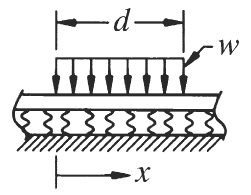
The Beam with Distributed Loading on Elastic Foundation Calculator is a comprehensive tool designed to analyze and calculate the deflection and stress of beams subjected to distributed loads and supported by an elastic foundation. This calculator is based on the Winkler foundation model, which assumes that the elastic foundation reacts to the distributed load with a linear relationship between the soil pressure and the beam deflection. The calculator uses advanced equations to determine the beam's behavior, including the differential equation for the deflection of the beam and the corresponding boundary conditions.
- Beam with Distributed Loading on Elastic Foundation Calculator and Equations
- Understanding the Concept of Beam with Distributed Loading on Elastic Foundation
-
Frequently Asked Questions (FAQs)
- What is the Beam with Distributed Loading on Elastic Foundation Calculator and how does it work?
- What are the key equations used in the Beam with Distributed Loading on Elastic Foundation Calculator?
- How do I use the Beam with Distributed Loading on Elastic Foundation Calculator to analyze a beam under a uniform distributed load?
- What are the limitations and assumptions of the Beam with Distributed Loading on Elastic Foundation Calculator?
Beam with Distributed Loading on Elastic Foundation Calculator and Equations
The Beam with Distributed Loading on Elastic Foundation Calculator and Equations is a complex engineering tool used to analyze and design beams subjected to distributed loads and supported by an elastic foundation. This calculator is essential in various fields, including civil, mechanical, and aerospace engineering, as it helps engineers to determine the stress, strain, and deflection of beams under different loading conditions.
Introduction to Beam Theory and Elastic Foundation
The beam theory is a fundamental concept in engineering that deals with the analysis of beams under various loading conditions. An elastic foundation is a type of support that provides a continuous and uniform reaction to the beam. The elastic foundation can be modeled using the Winkler foundation model, which assumes that the foundation is composed of a series of closely spaced springs. The calculator uses this model to determine the reaction of the foundation and the deflection of the beam.
Distributed Loading and Beam Equations
Distributed loading refers to a type of loading where the load is applied continuously along the length of the beam. The beam equations for distributed loading on an elastic foundation are complex and involve partial differential equations. The calculator uses these equations to determine the bending moment, shear force, and deflection of the beam. The equations also take into account the material properties of the beam, such as the modulus of elasticity and the moment of inertia.
Calculator Inputs and Outputs
The Beam with Distributed Loading on Elastic Foundation Calculator requires several inputs, including the length of the beam, the distributed load, the modulus of elasticity, and the moment of inertia. The calculator outputs the deflection, bending moment, and shear force of the beam at various points along its length. The calculator also provides a plot of the deflection and bending moment diagrams.
| Input | Unit | Description |
|---|---|---|
| Length | m | The length of the beam |
| Distributed Load | N/m | The distributed load applied to the beam |
| Modulus of Elasticity | Pa | The modulus of elasticity of the beam material |
| Moment of Inertia | m^4 | The moment of inertia of the beam cross-section |
Elastic Foundation Models and Parameters
The elastic foundation model used in the calculator is the Winkler foundation model, which assumes that the foundation is composed of a series of closely spaced springs. The model requires several parameters, including the foundation modulus, which represents the stiffness of the foundation. The calculator uses these parameters to determine the reaction of the foundation and the deflection of the beam.
Applications and Limitations of the Calculator
The Beam with Distributed Loading on Elastic Foundation Calculator has several applications in engineering, including the design of foundations, beams, and frames. However, the calculator has several limitations, including the assumption of a linear elastic material behavior and the neglect of dynamic and nonlinear effects. The calculator should be used in conjunction with other analysis tools and experimental data to ensure accurate and reliable results. The results of the calculator should be carefully evaluated and interpreted to ensure that they are consistent with the physical behavior of the beam and the foundation.
Understanding the Concept of Beam with Distributed Loading on Elastic Foundation
The concept of a beam with distributed loading on an elastic foundation is a fundamental aspect of structural engineering and mechanics. It involves the analysis of a beam that is subjected to a uniform or non-uniform distribution of load along its length, while also being supported by an elastic foundation. The elastic foundation can be thought of as a continuous spring that provides a resisting force to the beam, the magnitude of which is proportional to the deflection of the beam. This type of problem is commonly encountered in the design of roads, railways, and other infrastructure, where the beam is subjected to a distributed load from traffic or other sources.
Mathematical Formulation of the Problem
The mathematical formulation of the problem involves the use of differential equations to describe the behavior of the beam. The governing equation for a beam on an elastic foundation is typically a fourth-order differential equation, which takes into account the bending moment, shear force, and deflection of the beam. The equation is usually expressed in terms of the beam's flexural rigidity, the elastic foundation's modulus, and the distributed load. The solution to this equation provides the deflection, slope, and moment diagrams for the beam, which are essential in determining the beam's stress and deformation.
Types of Distributed Loading
There are several types of distributed loading that can be applied to a beam on an elastic foundation. These include uniformly distributed load, non-uniformly distributed load, and concentrated load. The uniformly distributed load is the most common type, where the load is evenly distributed along the length of the beam. The non-uniformly distributed load, on the other hand, can be represented by a linear or non-linear function, where the load varies along the length of the beam. The concentrated load is a special case, where the load is applied at a single point along the beam.
Calculator and Equations for Beam with Distributed Loading
The calculator and equations for beam with distributed loading on an elastic foundation are based on the classical beam theory. The calculator typically takes into account the beam's length, width, and thickness, as well as the elastic foundation's modulus and the distributed load. The equations used in the calculator are derived from the governing differential equation, which is solved using numerical methods or analytical techniques. The calculator provides the deflection, slope, and moment diagrams for the beam, as well as the stress and deformation at critical points.
Assumptions and Limitations of the Calculator
The calculator and equations for beam with distributed loading on an elastic foundation are based on several simplifying assumptions. These include the assumption of a linear elastic material, a small deflection, and a uniform elastic foundation. The calculator also assumes that the load is applied in a static manner, and that the beam is prismatic and homogeneous. The limitations of the calculator include the inability to account for non-linear material behavior, large deflections, and non-uniform elastic foundations. Additionally, the calculator may not be able to capture the dynamical behavior of the beam, or the interaction between the beam and the elastic foundation.
Applications and Case Studies
The calculator and equations for beam with distributed loading on an elastic foundation have numerous applications in civil engineering, mechanical engineering, and aerospace engineering. The calculator can be used to design roads, railways, and bridges, as well as buildings and structures that are subjected to distributed loads. The calculator can also be used to analyze the behavior of beams and plates that are used in aerospace and automotive applications. Case studies have shown that the calculator can provide accurate and reliable results, which can be used to optimize the design of structures and reduce the risk of failure. The calculator can also be used to investigate the effect of different loading conditions, material properties, and geometric parameters on the behavior of the beam.
Frequently Asked Questions (FAQs)
What is the Beam with Distributed Loading on Elastic Foundation Calculator and how does it work?
The Beam with Distributed Loading on Elastic Foundation Calculator is a tool designed to calculate the deflection and stress of a beam under a distributed load that is supported by an elastic foundation. This calculator uses equations based on the theory of elasticity to determine the behaviors of the beam under different types of loads. The calculator takes into account the properties of the beam, such as its length, width, and thickness, as well as the properties of the elastic foundation, including its modulus of elasticity and Poisson's ratio. By inputting these values, the calculator can provide accurate calculations of the deflection and stress of the beam, allowing engineers to design and analyze structures that are subjected to distributed loads.
What are the key equations used in the Beam with Distributed Loading on Elastic Foundation Calculator?
The Beam with Distributed Loading on Elastic Foundation Calculator uses several key equations to calculate the deflection and stress of the beam. One of the most important equations is the differential equation for the deflection of the beam, which is given by the fourth-order differential equation: EI(d^4w/dx^4) + kw = q, where E is the modulus of elasticity of the beam, I is the moment of inertia of the beam, k is the foundation modulus, w is the deflection of the beam, and q is the distributed load. Another important equation is the stress equation, which is given by: σ = (E y) / (ρ L), where σ is the stress, y is the distance from the neutral axis, ρ is the density of the beam, and L is the length of the beam. These equations are used in conjunction with the boundary conditions of the problem to determine the deflection and stress of the beam.
How do I use the Beam with Distributed Loading on Elastic Foundation Calculator to analyze a beam under a uniform distributed load?
To use the Beam with Distributed Loading on Elastic Foundation Calculator to analyze a beam under a uniform distributed load, you need to input the properties of the beam and the properties of the elastic foundation. First, you need to input the length, width, and thickness of the beam, as well as the modulus of elasticity and Poisson's ratio of the beam. Next, you need to input the foundation modulus and the distributed load. You also need to select the boundary conditions of the problem, such as the simply supported or clamped conditions. Once you have input all the necessary values, the calculator will provide you with the deflection and stress of the beam under the uniform distributed load. You can then use these values to analyze the behaviors of the beam and design a structure that can withstand the load. The calculator also allows you to plot the deflection and stress diagrams of the beam, which can be useful for visualizing the behaviors of the beam.
What are the limitations and assumptions of the Beam with Distributed Loading on Elastic Foundation Calculator?
The Beam with Distributed Loading on Elastic Foundation Calculator is based on several assumptions and has some limitations. One of the main assumptions is that the beam is a prismatic beam, meaning that its cross-sectional area is constant along its length. Another assumption is that the elastic foundation is a Winkler foundation, which means that the foundation can be modeled as a series of independent springs. The calculator also assumes that the distributed load is uniform and static, meaning that it does not change over time. In terms of limitations, the calculator is only applicable to beams that are subjected to small deflections, meaning that the deflection of the beam is much smaller than its length. The calculator is also limited to linear elastic materials, meaning that the stress-strain relationship of the beam is linear. Additionally, the calculator does not take into account dynamical effects, such as vibrations or impact loads, which can be important in some engineering applications. Despite these limitations and assumptions, the calculator can still be a useful tool for analyzing the behaviors of beams under distributed loads.
Deja una respuesta
Entradas Relacionadas