
Volume of a Ellipsoid Ellipse Calculator

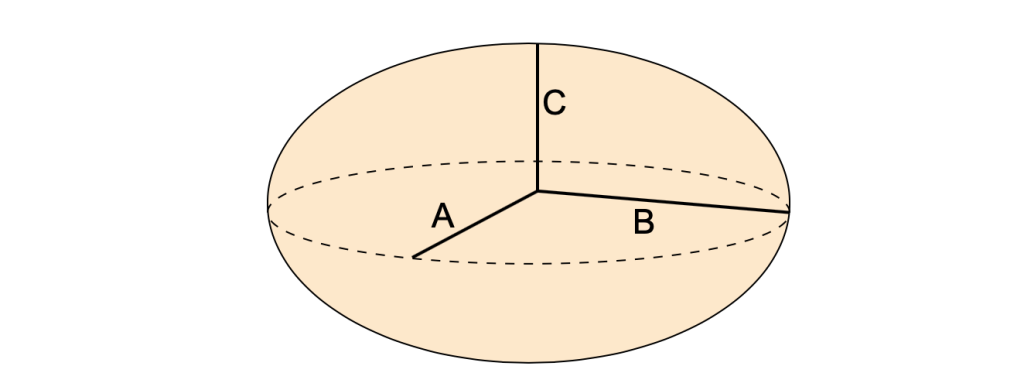
The volume of an ellipsoid is a fundamental concept in mathematics and physics, and calculating it accurately is crucial in various fields. An ellipsoid is a three-dimensional shape that is symmetrical about its three axes, and its volume can be calculated using a specific formula. This ellipsoid ellipse calculator is designed to simplify the process of calculating the volume of an ellipsoid, providing a quick and accurate solution for users. With its user-friendly interface, the calculator allows users to input the necessary parameters and obtain the volume of the ellipsoid instantly.
- Volume of a Ellipsoid Ellipse Calculator: A Comprehensive Guide
- What is the formula for the volume of an ellipsoid?
- What is the volume of the elliptical pipe?
- What is the formula for an ellipsoid?
- What is the volume of the circular ellipsoid?
-
Frequently Asked Questions (FAQs)
- What is the Volume of a Ellipsoid Ellipse Calculator and how does it work?
- What are the key features of the Volume of a Ellipsoid Ellipse Calculator?
- How is the Volume of a Ellipsoid Ellipse Calculator used in real-world applications?
- What are the advantages of using the Volume of a Ellipsoid Ellipse Calculator?
Volume of a Ellipsoid Ellipse Calculator: A Comprehensive Guide
The Volume of a Ellipsoid Ellipse Calculator is a mathematical tool used to calculate the volume of an ellipsoid, which is a three-dimensional shape that is symmetrical about its three axes. The calculator uses the formula for the volume of an ellipsoid, which is (4/3)πabc, where a, b, and c are the lengths of the three axes.
What is an Ellipsoid?
An ellipsoid is a three-dimensional shape that is symmetrical about its three axes. It is a closed surface that is curved in all directions, and its shape can be described by three orthogonal axes. The ellipsoid is a fundamental concept in mathematics, physics, and engineering, and is used to model a wide range of real-world objects, from planets to footballs.
How to Calculate the Volume of an Ellipsoid
To calculate the volume of an ellipsoid, you need to know the lengths of its three axes. The formula for the volume of an ellipsoid is (4/3)πabc, where a, b, and c are the lengths of the three axes. This formula can be used to calculate the volume of any ellipsoid, regardless of its size or shape.
Applications of the Volume of a Ellipsoid Ellipse Calculator
The Volume of a Ellipsoid Ellipse Calculator has a wide range of applications in physics, engineering, and mathematics. It can be used to calculate the volume of a planet, the volume of a football, or the volume of any other ellipsoidal object. The calculator can also be used to solve problems in calculus, geometry, and algebra.
Features of the Volume of a Ellipsoid Ellipse Calculator
The Volume of a Ellipsoid Ellipse Calculator has several features that make it a powerful tool for calculating the volume of an ellipsoid. These features include:
| Feature | Description |
|---|---|
| Easy to use | The calculator is easy to use, even for those with limited mathematical knowledge. |
| Accurate results | The calculator provides accurate results, using the formula (4/3)πabc. |
| Flexible input | The calculator allows for flexible input, including the ability to enter the lengths of the three axes in any units. |
| Step-by-step solution | The calculator provides a step-by-step solution, showing how the volume of the ellipsoid is calculated. |
| Graphical representation | The calculator provides a graphical representation of the ellipsoid, showing its shape and size. |
Limitations of the Volume of a Ellipsoid Ellipse Calculator
The Volume of a Ellipsoid Ellipse Calculator has several limitations that should be considered when using it. These limitations include:
The calculator assumes that the ellipsoid is symmetrical about its three axes.
The calculator uses a simplified formula for the volume of an ellipsoid, which may not be accurate for all shapes and sizes.
The calculator requires the user to enter the lengths of the three axes, which may not always be known or easily measured.
What is the formula for the volume of an ellipsoid?
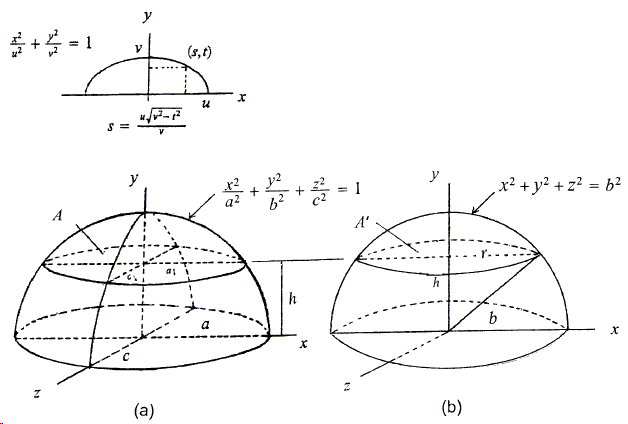
The formula for the volume of an ellipsoid is (4/3) π a b c, where a, b, and c are the lengths of the three axes of the ellipsoid.
Introduction to Ellipsoid Volume Formula
The formula for the volume of an ellipsoid is used to calculate the volume of an ellipsoid, which is a three-dimensional shape that is symmetrical about its three axes. The volume of an ellipsoid is determined by the lengths of its three axes, and the formula takes into account the pi (π) value, which is approximately 3.14159. The formula is often used in mathematics and physics to calculate the volume of ellipsoids in various applications.
- The formula is used to calculate the volume of an ellipsoid in engineering and architecture.
- The formula is also used in astronomy to calculate the volume of planets and stars.
- The formula is used in computer graphics to create 3D models of ellipsoids.
Derivation of the Ellipsoid Volume Formula
The formula for the volume of an ellipsoid can be derived using integral calculus and vector calculus. The derivation involves integrating the area of the ellipsoid's cross-sections with respect to the axis of rotation. The resulting formula is (4/3) π a b c, which is a simple and effective way to calculate the volume of an ellipsoid.
- The derivation of the formula involves using triple integrals to integrate the area of the ellipsoid's cross-sections.
- The formula can be derived using spherical coordinates or cylindrical coordinates.
- The derivation of the formula requires a good understanding of multivariable calculus.
Applications of the Ellipsoid Volume Formula
The formula for the volume of an ellipsoid has many practical applications in various fields, including engineering, architecture, and astronomy. The formula can be used to calculate the volume of buildings, bridges, and other structures that are shaped like ellipsoids. The formula can also be used to calculate the volume of planets and stars in astronomy.
- The formula is used to calculate the volume of elliptical tanks and pipes in chemical engineering.
- The formula is used to calculate the volume of elliptical beams and columns in civil engineering.
- The formula is used to calculate the volume of elliptical galaxies and star clusters in astronomy.
Limitations of the Ellipsoid Volume Formula
The formula for the volume of an ellipsoid has some limitations and restrictions. The formula assumes that the ellipsoid is a perfect and symmetrical shape, which may not always be the case in real-world applications. The formula also assumes that the axes of the ellipsoid are mutually perpendicular, which may not always be the case.
- The formula may not be accurate for irregularly-shaped ellipsoids.
- The formula may not be accurate for ellipsoids with non-perpendicular axes.
- The formula may not be accurate for ellipsoids with non-uniform density.
Numerical Methods for Calculating Ellipsoid Volume
There are several numerical methods that can be used to calculate the volume of an ellipsoid, including the Monte Carlo method and the finite element method. These methods can be used to calculate the volume of complex-shaped ellipsoids that cannot be calculated using the standard formula.
- The Monte Carlo method involves using random sampling to estimate the volume of the ellipsoid.
- The finite element method involves dividing the ellipsoid into small elements and calculating the volume of each element.
- The numerical methods can be used to calculate the volume of ellipsoids with non-uniform density.
What is the volume of the elliptical pipe?
The volume of an elliptical pipe can be calculated using the formula for the volume of an ellipsoid, which is given by V = (4/3)πabc, where a, b, and c are the lengths of the three axes of the ellipsoid. However, for an elliptical pipe, we need to consider the cross-sectional area of the pipe and the length of the pipe. The cross-sectional area of an elliptical pipe can be calculated using the formula A = πab, where a and b are the lengths of the semi-axes of the ellipse.
Understanding the Formula for Volume of Elliptical Pipe
The formula for the volume of an elliptical pipe is V = A × L, where A is the cross-sectional area of the pipe and L is the length of the pipe. To calculate the volume, we need to know the values of A and L. The cross-sectional area A can be calculated using the formula A = πab, where a and b are the lengths of the semi-axes of the ellipse. The length of the pipe can be measured directly.
- The semi-axes of the ellipse are the lengths of the two axes that are perpendicular to each other and intersect at the center of the ellipse.
- The cross-sectional area of the pipe is the area of the ellipse that is perpendicular to the length of the pipe.
- The length of the pipe is the distance along the pipe from one end to the other.
Calculating the Cross-Sectional Area of Elliptical Pipe
The cross-sectional area of an elliptical pipe can be calculated using the formula A = πab, where a and b are the lengths of the semi-axes of the ellipse. This formula is derived from the definition of an ellipse as the set of all points in a plane such that the sum of the distances from two fixed points (the foci) is constant. The semi-axes of the ellipse are the lengths of the two axes that are perpendicular to each other and intersect at the center of the ellipse.
- The semi-major axis is the length of the semi-axis that is parallel to the major axis of the ellipse.
- The semi-minor axis is the length of the semi-axis that is parallel to the minor axis of the ellipse.
- The area of the ellipse is proportional to the product of the lengths of the semi-axes.
Determining the Length of Elliptical Pipe
The length of an elliptical pipe can be measured directly using a ruler or tape measure. The length of the pipe is the distance along the pipe from one end to the other. It is important to measure the length accurately to ensure that the calculated volume is correct.
- The length of the pipe can be measured along the centerline of the pipe.
- The centerline of the pipe is an imaginary line that runs along the center of the pipe.
- The measurement of the length should be taken from one end of the pipe to the other.
Applications of Elliptical Pipes
Elliptical pipes have several applications in engineering and architecture, including sewer systems, water supply systems, and HVAC systems. The volume of the pipe is an important factor in designing these systems, as it determines the amount of fluid that can flow through the pipe.
- Sewer systems use elliptical pipes to transport wastewater and stormwater.
- Water supply systems use elliptical pipes to distribute drinking water.
- HVAC systems use elliptical pipes to transport heated or cooled air.
Design Considerations for Elliptical Pipes
When designing an elliptical pipe, several factors must be considered, including the material, size, and shape of the pipe. The volume of the pipe is also an important consideration, as it affects the flow rate and pressure of the fluid flowing through the pipe.
- The material of the pipe must be strong and durable to withstand the pressure and flow rate of the fluid.
- The size of the pipe must be large enough to accommodate the required flow rate.
- The shape of the pipe must be smooth and consistent to minimize friction and turbulence.
What is the formula for an ellipsoid?

The formula for an ellipsoid is a mathematical representation of its shape and size. The general equation of an ellipsoid in three-dimensional space is given by: (x/a)^2 + (y/b)^2 + (z/c)^2 = 1, where a, b, and c are the lengths of the semi-axes of the ellipsoid.
Equation of an Ellipsoid
The equation of an ellipsoid can be written in various forms, but the most common one is the Cartesian equation, which is given by: (x^2/a^2) + (y^2/b^2) + (z^2/c^2) = 1. This equation represents an ellipsoid centered at the origin (0,0,0) with semi-axes of length a, b, and c along the x, y, and z axes, respectively. Some key points about the equation of an ellipsoid are:
- The equation is a quadratic equation in three variables: x, y, and z.
- The coefficients of the equation are the reciprocals of the squares of the semi-axes lengths.
- The equation can be used to determine the shape and size of the ellipsoid.
Properties of an Ellipsoid
An ellipsoid has several properties that can be derived from its equation. These properties include its volume, surface area, and moments of inertia. The volume of an ellipsoid is given by: V = (4/3)πabc, where a, b, and c are the lengths of the semi-axes. Some key points about the properties of an ellipsoid are:
- The volume of an ellipsoid is proportional to the product of its semi-axes lengths.
- The surface area of an ellipsoid is a more complex function of its semi-axes lengths.
- The moments of inertia of an ellipsoid depend on the distribution of its mass around its axes.
Types of Ellipsoids
There are several types of ellipsoids, each with its own unique properties and applications. These include:
spheroids, which are ellipsoids with two or more equal semi-axes lengths
prolate spheroids, which are ellipsoids with one semi-axis longer than the other two
oblate spheroids, which are ellipsoids with one semi-axis shorter than the other two. Some key points about the types of ellipsoids are:
- Spheroids are the most symmetric type of ellipsoid.
- Prolate spheroids are commonly used to model football-shaped objects.
- Oblate spheroids are commonly used to model disk-shaped objects.
Applications of Ellipsoids
Ellipsoids have many applications in various fields, including physics, engineering, and computer science. These applications include:
modeling the shape of planets and stars
designing aerodynamic and hydrodynamic shapes
simulating the motion of objects in 3D space. Some key points about the applications of ellipsoids are:
- Ellipsoids are used to model the shape of celestial bodies.
- Ellipsoids are used to design efficient and stable shapes for vehicles and aircraft.
- Ellipsoids are used to simulate the motion of objects in 3D space for video games and animations.
Mathematical Operations on Ellipsoids
Ellipsoids can be subjected to various mathematical operations, including translation, rotation, and scaling. These operations can be used to transform the ellipsoid into a new position or orientation. Some key points about the mathematical operations on ellipsoids are:
- Translation involves moving the ellipsoid to a new position in 3D space.
- Rotation involves rotating the ellipsoid around one or more axes.
- Scaling involves changing the size of the ellipsoid by multiplying its semi-axes lengths by a scale factor.
What is the volume of the circular ellipsoid?
The volume of a circular ellipsoid can be calculated using the formula V = (4/3)πabc, where a, b, and c are the lengths of the three axes of the ellipsoid. In the case of a circular ellipsoid, two of the axes are equal, so the formula simplifies to V = (4/3)πa^2b, where a is the length of the two equal axes and b is the length of the third axis. This formula is used to calculate the volume of the ellipsoid, which is an important property in mathematics and physics.
Calculating the Volume of a Circular Ellipsoid
To calculate the volume of a circular ellipsoid, we need to know the lengths of its axes. The formula V = (4/3)πa^2b can be used to calculate the volume, where a is the length of the two equal axes and b is the length of the third axis. The steps to calculate the volume are:
- Measure the length of the two equal axes (a) and the length of the third axis (b)
- Plug these values into the formula V = (4/3)πa^2b
- Calculate the volume using the formula
The volume of the circular ellipsoid is an important property that is used in various mathematical and physical applications.
Properties of a Circular Ellipsoid
A circular ellipsoid has several properties that make it an important shape in mathematics and physics. Some of these properties include:
- The symmetry of the ellipsoid, which means that it looks the same when rotated around its axes
- The volume of the ellipsoid, which can be calculated using the formula V = (4/3)πa^2b
- The surface area of the ellipsoid, which can be calculated using the formula A = 4πab
These properties make the circular ellipsoid a useful shape in various mathematical and physical applications.
Applications of Circular Ellipsoids
Circular ellipsoids have several applications in mathematics, physics, and engineering. Some of these applications include:
- Modeling the shape of atoms and molecules in chemistry
- Designing structures and buildings in architecture and engineering
- Calculating the volume and surface area of objects in mathematics and physics
The circular ellipsoid is a useful shape that is used in various applications.
Mathematical Representation of a Circular Ellipsoid
A circular ellipsoid can be mathematically represented using the equation (x^2/a^2) + (y^2/a^2) + (z^2/b^2) = 1, where a is the length of the two equal axes and b is the length of the third axis. This equation can be used to calculate the volume and surface area of the ellipsoid, as well as to model its shape in mathematics and physics. The mathematical representation of the circular ellipsoid is:
- The equation (x^2/a^2) + (y^2/a^2) + (z^2/b^2) = 1
- The formula V = (4/3)πa^2b for the volume
- The formula A = 4πab for the surface area
The mathematical representation of the circular ellipsoid is an important tool in mathematics and physics.
Real-World Examples of Circular Ellipsoids
There are several real-world examples of circular ellipsoids, including:
- The Earth, which is approximately a circular ellipsoid in shape
- The Moon, which is also approximately a circular ellipsoid in shape
- Atoms and molecules, which can be modeled as circular ellipsoids in chemistry
These real-world examples illustrate the importance of the circular ellipsoid in mathematics, physics, and engineering. The circular ellipsoid is a useful shape that is used to model and calculate the volume and surface area of objects in various fields.
Frequently Asked Questions (FAQs)
What is the Volume of a Ellipsoid Ellipse Calculator and how does it work?
The Volume of a Ellipsoid Ellipse Calculator is an online tool designed to calculate the volume of an ellipsoid, which is a three-dimensional shape that is symmetrical about its three axes. The calculator uses the formula for the volume of an ellipsoid, which is given by ( V = frac{4}{3} pi a b c ), where ( a ), ( b ), and ( c ) are the lengths of the three axes of the ellipsoid. To use the calculator, simply enter the values of ( a ), ( b ), and ( c ) into the input fields, and the calculator will instantly display the calculated volume. The calculator is useful for a variety of applications, including mathematics, physics, and engineering, where the volume of an ellipsoid needs to be calculated.
What are the key features of the Volume of a Ellipsoid Ellipse Calculator?
The Volume of a Ellipsoid Ellipse Calculator has several key features that make it a powerful tool for calculating the volume of an ellipsoid. One of the main features is its ease of use, as it allows users to simply enter the values of ( a ), ( b ), and ( c ) and automatically calculates the volume. The calculator also displays the calculated volume in a clear and concise manner, making it easy to understand and interpret the results. Additionally, the calculator is highly accurate, as it uses the exact formula for the volume of an ellipsoid, ensuring that the calculated volume is precise and reliable. The calculator is also flexible, as it allows users to enter values in a variety of units, including meters, centimeters, and inches.
How is the Volume of a Ellipsoid Ellipse Calculator used in real-world applications?
The Volume of a Ellipsoid Ellipse Calculator is used in a variety of real-world applications, including mathematics, physics, and engineering. In mathematics, the calculator is used to calculate the volume of ellipsoids and other three-dimensional shapes, which is essential for understanding and analyzing geometric shapes. In physics, the calculator is used to calculate the volume of objects, such as planets and stars, which is critical for understanding their properties and behavior. In engineering, the calculator is used to calculate the volume of materials and structures, which is vital for designing and building safe and efficient systems. The calculator is also used in other fields, such as architecture and computer science, where the volume of shapes and objects needs to be calculated.
What are the advantages of using the Volume of a Ellipsoid Ellipse Calculator?
The Volume of a Ellipsoid Ellipse Calculator has several advantages that make it a valuable tool for calculating the volume of an ellipsoid. One of the main advantages is its speed and efficiency, as it allows users to quickly and easily calculate the volume of an ellipsoid, saving time and effort. The calculator is also accurate and reliable, as it uses the exact formula for the volume of an ellipsoid, ensuring that the calculated volume is precise and trustworthy. Additionally, the calculator is easy to use, as it has a simple and intuitive interface that makes it easy to enter values and interpret results. The calculator is also free and accessible, as it can be used online without the need for specialized software or equipment, making it a convenient and cost-effective solution for calculating the volume of an ellipsoid.
Deja una respuesta
Entradas Relacionadas