
Volume of a Ellipsoid Calculator

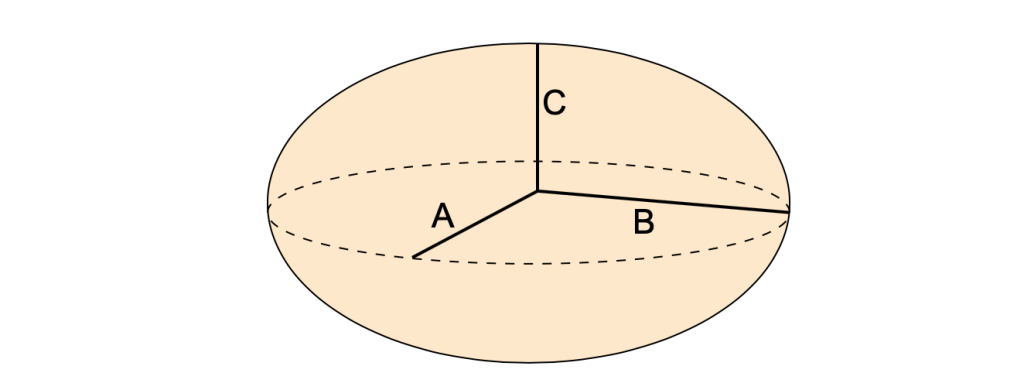
The Volume of a Ellipsoid Calculator is a mathematical tool designed to calculate the volume of an ellipsoid, a three-dimensional shape that is symmetrical about its center. This calculator uses the formula for the volume of an ellipsoid, which is given by (4/3)πabc, where a, b, and c are the lengths of the semi-axes. By inputting the values of a, b, and c, users can quickly and easily calculate the volume of the ellipsoid, making it a useful resource for students, engineers, and researchers in various fields of study. The calculator provides accurate results instantly.
- Volume of a Ellipsoid Calculator: A Comprehensive Guide
- What is the formula for the volume of an ellipsoid?
- What is the formula for an ellipsoid?
- What is the volume of the elliptical pipe?
- What is the formula for ellipsoid volume of the prostate?
-
Frequently Asked Questions (FAQs)
- What is the Volume of a Ellipsoid Calculator and how does it work?
- What are the key features of the Volume of a Ellipsoid Calculator?
- How is the Volume of a Ellipsoid Calculator used in real-world applications?
- What are the limitations and potential sources of error of the Volume of a Ellipsoid Calculator?
Volume of a Ellipsoid Calculator: A Comprehensive Guide
The volume of an ellipsoid is a fundamental concept in mathematics and physics, and calculating it can be a complex task. An ellipsoid is a three-dimensional shape that is symmetrical about its three axes, and its volume can be calculated using a specific formula.
Introduction to Ellipsoid Volume Calculation
Calculating the volume of an ellipsoid involves using the formula: V = (4/3) π a b c, where a, b, and c are the lengths of the ellipsoid's three axes. This formula is used in various fields, including engineering, architecture, and physics, to calculate the volume of complex shapes.
Understanding the Formula for Ellipsoid Volume
The formula for calculating the volume of an ellipsoid is based on the principle of integration, which involves dividing the ellipsoid into small, infinitesimal parts and summing up their volumes. The resulting formula is a mathematical representation of the ellipsoid's volume, which can be used to calculate the volume of any ellipsoid.
Applications of Ellipsoid Volume Calculation
The calculation of ellipsoid volume has numerous applications in various fields, including:
| Field | Application |
|---|---|
| Engineering | Designing elliptical tanks and containers |
| Architecture | Designing elliptical buildings and structures |
| Physics | Calculating the volume of elliptical shapes in physics experiments |
Step-by-Step Guide to Using an Ellipsoid Volume Calculator
Using an ellipsoid volume calculator involves entering the lengths of the ellipsoid's three axes and calculating the volume using the formula: V = (4/3) π a b c. The calculator then returns the calculated volume, which can be used in various applications.
Common Mistakes to Avoid When Calculating Ellipsoid Volume
When calculating the volume of an ellipsoid, it is essential to avoid common mistakes, such as incorrect units or dimensions. Ensuring that the input values are correct and using the correct formula is crucial to obtaining an accurate volume calculation. Double-checking the calculation and using a reliable calculator can help minimize errors and ensure accurate results.
What is the formula for the volume of an ellipsoid?
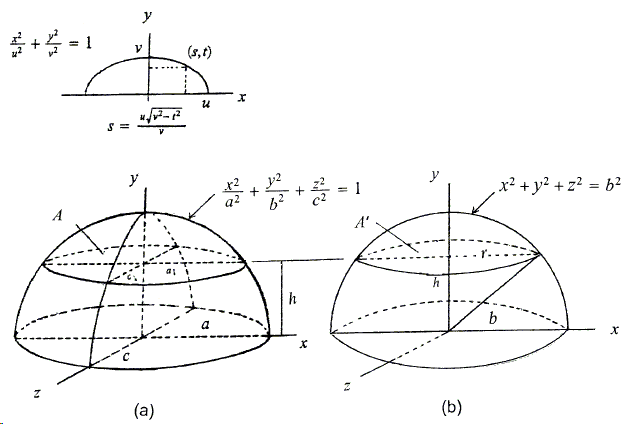
The formula for the volume of an ellipsoid is (frac{4}{3}pi abc), where (a), (b), and (c) are the lengths of the three axes of the ellipsoid. This formula is used to calculate the volume of an ellipsoid by simply multiplying the product of the lengths of its axes by (frac{4}{3}pi).
Understanding Ellipsoid Dimensions
To apply the formula, it's essential to understand the dimensions of an ellipsoid. These dimensions are represented by (a), (b), and (c), which are the lengths of the three axes. The axes of an ellipsoid are the lines that pass through its center and extend to the edges of the shape. Understanding these dimensions is crucial for calculating the volume. Here are the key points to consider:
- The axes of the ellipsoid must be measured accurately to calculate the volume.
- The formula assumes that the ellipsoid is a perfect, symmetrical shape.
- Any deviations from this symmetry will affect the accuracy of the calculated volume.
Application of the Formula
Applying the formula for the volume of an ellipsoid involves substituting the values of (a), (b), and (c) into the equation (frac{4}{3}pi abc). This calculation yields the volume in cubic units. For example, if (a = 5), (b = 3), and (c = 2), the volume would be (frac{4}{3}pi (5)(3)(2)). The precision of this calculation depends on the accuracy of the measurements of (a), (b), and (c). Key considerations include:
- Precision in measuring the axes lengths is crucial for accurate volume calculation.
- The formula is straightforward but requires careful substitution of the values.
- Calculators or computers can be used to simplify the calculation process.
Real-World Applications
The formula for the volume of an ellipsoid has numerous real-world applications. For instance, in geology, the volume of ellipsoidal stones or mineral deposits can be calculated. In engineering, the volume of ellipsoidal tanks or containers is crucial for design and operational purposes. The applications span various fields, including:
- Architecture, where the volume of ellipsoidal structures is essential for design.
- Physics, where the volume of ellipsoidal objects is necessary for understanding their properties.
- Biology, where the volume of ellipsoidal cells or organs can be significant.
Mathematical Derivation
The mathematical derivation of the formula for the volume of an ellipsoid involves integrating the area of the ellipsoid's cross-sections with respect to one of its axes. This process can be complex and requires a good understanding of calculus. The derivation demonstrates that the volume of an ellipsoid is indeed (frac{4}{3}pi abc). Key aspects of the derivation include:
- Integration of the area of cross-sections to find the volume.
- Calculus is essential for understanding the derivation process.
- Geometric principles are fundamental to the mathematical derivation.
Computational Tools
Computational tools, such as calculators and computer software, can simplify the process of calculating the volume of an ellipsoid using the formula. These tools can perform the calculations quickly and accurately, reducing the chance of human error. Additionally, they can handle complex variations of the formula for different types of ellipsoids. Considerations when using these tools include:
- Accuracy of the input values is crucial for obtaining the correct volume.
- Software should be chosen based on its ability to handle ellipsoidal calculations.
- Practice with different scenarios to become proficient in using the tools.
What is the formula for an ellipsoid?

The formula for an ellipsoid is a mathematical equation that describes its shape and size. The general equation of an ellipsoid in three-dimensional space is given by: (x^2/a^2) + (y^2/b^2) + (z^2/c^2) = 1, where a, b, and c are the lengths of the semi-axes of the ellipsoid. This equation can be used to describe a wide range of ellipsoidal shapes, from a sphere (where a = b = c) to a highly eccentric ellipsoid (where a, b, and c are very different).
Equation of an Ellipsoid
The equation of an ellipsoid can be written in various forms, depending on the coordinate system used. In Cartesian coordinates, the equation of an ellipsoid is given by: (x^2/a^2) + (y^2/b^2) + (z^2/c^2) = 1. This equation can be used to find the intersection of the ellipsoid with a plane or to determine the volume of the ellipsoid. Some key points to consider when working with the equation of an ellipsoid include:
- The semi-axes a, b, and c are the lengths of the axes of the ellipsoid.
- The center of the ellipsoid is at the origin (0, 0, 0) of the coordinate system.
- The orientation of the ellipsoid is determined by the rotation of the coordinate system.
Properties of an Ellipsoid
An ellipsoid has several geometric properties that are important in mathematics and physics. Some of the key properties of an ellipsoid include its volume, surface area, and eccentricity. The volume of an ellipsoid is given by: V = (4/3)πabc, where a, b, and c are the lengths of the semi-axes. The surface area of an ellipsoid is more complicated to calculate and involves elliptical integrals. Some key points to consider when working with the properties of an ellipsoid include:
- The volume of an ellipsoid is proportional to the product of its semi-axes.
- The surface area of an ellipsoid is proportional to the square of the lengths of its semi-axes.
- The eccentricity of an ellipsoid is a measure of how elongated it is.
Applications of Ellipsoids
Ellipsoids have many practical applications in science and engineering. Some examples include:
- Geodesy: Ellipsoids are used to model the shape of the Earth and other planets.
- Astronomy: Ellipsoids are used to describe the orbits of planets and stars.
- Computer graphics: Ellipsoids are used to create 3D models of objects and scenes.
The mathematical properties of ellipsoids make them useful for modeling and simulating a wide range of phenomena.
Types of Ellipsoids
There are several types of ellipsoids, each with its own unique properties. Some examples include:
- Spheroids: A spheroid is an ellipsoid that is symmetric about its axes.
- Triaxial ellipsoids: A triaxial ellipsoid is an ellipsoid with three distinct axes.
- Oblate ellipsoids: An oblate ellipsoid is an ellipsoid that is flattened at the poles.
Each type of ellipsoid has its own equation and properties, and is used to model different types of objects and phenomena.
Calculating Ellipsoid Parameters
To calculate the parameters of an ellipsoid, such as its volume and surface area, it is necessary to know the lengths of its semi-axes. These can be measured directly, or calculated from other parameters such as the eccentricity and orientation of the ellipsoid. Some key points to consider when calculating ellipsoid parameters include:
- The semi-axes a, b, and c are the fundamental parameters of an ellipsoid.
- The eccentricity of an ellipsoid is a measure of its elongation.
- The orientation of an ellipsoid is important for calculating its properties.
The parameters of an ellipsoid can be used to model and simulate a wide range of phenomena, from the orbits of planets to the shape of molecules.
What is the volume of the elliptical pipe?
The volume of an elliptical pipe can be calculated using the formula for the volume of an ellipsoid, which is given by length times width times height times pi divided by 6, but for an elliptical pipe, we need to consider the cross-sectional area and the length of the pipe. The cross-sectional area of an ellipse is given by pi times the semi-major axis times the semi-minor axis.
Calculating the Volume of an Elliptical Pipe
To calculate the volume of an elliptical pipe, we need to multiply the cross-sectional area by the length of the pipe. The formula for the volume of an elliptical pipe is given by V = pi a b L, where a and b are the semi-major axis and semi-minor axis of the ellipse, and L is the length of the pipe.
- We need to know the dimensions of the ellipse, including the semi-major axis and semi-minor axis.
- The length of the pipe is also necessary to calculate the volume.
- The pi value is a constant that is approximately equal to 3.14.
Understanding the Cross-Sectional Area
The cross-sectional area of an elliptical pipe is given by the formula A = pi a b, where a and b are the semi-major axis and semi-minor axis of the ellipse. This area is the area of the ellipse that is perpendicular to the length of the pipe.
- The semi-major axis is the longer radius of the ellipse.
- The semi-minor axis is the shorter radius of the ellipse.
- The pi value is a constant that is approximately equal to 3.14.
Importance of Accurate Dimensions
It is crucial to have accurate dimensions of the elliptical pipe to calculate its volume. The dimensions of the pipe, including the length, semi-major axis, and semi-minor axis, must be measured carefully to ensure accuracy.
- The dimensions of the pipe can be measured using various tools and techniques.
- The accuracy of the dimensions can be verified by checking the measurements multiple times.
- The precision of the dimensions can be improved by using specialized equipment.
Applications of Elliptical Pipes
Elliptical pipes have various applications in engineering and architecture, including water supply systems, sewage systems, and structural supports. The volume of an elliptical pipe is an important factor in designing and optimizing these systems.
- Elliptical pipes can be used to maximize the flow rate of fluids.
- The volume of an elliptical pipe can be used to calculate the pressure and velocity of fluids.
- The dimensions of an elliptical pipe can be optimized to minimize the cost and materials used.
Challenges in Calculating the Volume
Calculating the volume of an elliptical pipe can be challenging due to the complexity of the elliptical shape. The formula for the volume of an elliptical pipe requires accurate values of the semi-major axis, semi-minor axis, and length of the pipe.
- The elliptical shape can be difficult to model and simulate.
- The dimensions of the pipe can be hard to measure and verify.
- The pi value can be approximated, but it can also be a source of error if not used correctly.
What is the formula for ellipsoid volume of the prostate?

The formula for ellipsoid volume of the prostate is given by the equation: Volume = (π/6) length width height. This formula is used to estimate the volume of the prostate gland, which is an important factor in the diagnosis and treatment of various prostate-related conditions. The formula assumes that the prostate gland is roughly ellipsoidal in shape, and that the length, width, and height of the gland can be measured accurately using imaging techniques such as ultrasound or MRI.
Importance of Accurate Prostate Volume Measurement
Accurate measurement of prostate volume is crucial for diagnosing and treating conditions such as benign prostatic hyperplasia (BPH) and prostate cancer. The volume of the prostate gland can help doctors determine the severity of these conditions and develop effective treatment plans. The formula for ellipsoid volume of the prostate provides a reliable estimate of prostate volume, which can be used in conjunction with other diagnostic tools to guide treatment decisions. Some key points to consider when measuring prostate volume include:
- Imaging modality: The choice of imaging modality, such as ultrasound or MRI, can affect the accuracy of prostate volume measurements.
- Measurement technique: The technique used to measure prostate length, width, and height can also impact the accuracy of volume estimates.
- Gland shape: The shape of the prostate gland can vary significantly, which can affect the accuracy of ellipsoid volume estimates.
Procedure for Measuring Prostate Volume
Measuring prostate volume using the ellipsoid formula typically involves several steps. First, imaging studies are used to obtain accurate measurements of prostate length, width, and height. These measurements are then used to calculate the volume of the prostate gland using the ellipsoid formula. The procedure for measuring prostate volume may vary depending on the specific imaging modality used, but generally involves:
- Patient preparation: The patient is prepared for imaging by removing any clothing or jewelry that may interfere with the imaging process.
- Image acquisition: Images of the prostate gland are acquired using the chosen imaging modality.
- Measurement: Prostate length, width, and height are measured from the acquired images.
Advantages of the Ellipsoid Formula
The ellipsoid formula for prostate volume has several advantages over other methods of volume estimation. One of the main advantages is that it provides a simple and accurate estimate of prostate volume, which can be used to guide treatment decisions. Additionally, the ellipsoid formula is widely used and accepted in the medical community, making it a standardized method for estimating prostate volume. Some other advantages of the ellipsoid formula include:
- Ease of use: The formula is relatively simple to apply, making it accessible to a wide range of healthcare professionals.
- High accuracy: The formula provides a high degree of accuracy, especially when used in conjunction with high-quality imaging.
- Wide applicability: The formula can be used to estimate prostate volume in a variety of clinical contexts.
Limitations of the Ellipsoid Formula
While the ellipsoid formula is a widely used and accepted method for estimating prostate volume, it is not without its limitations. One of the main limitations is that it assumes a simplified shape of the prostate gland, which may not always be accurate. Additionally, the formula may not account for variations in gland shape or irregularities in gland size. Some other limitations of the ellipsoid formula include:
- Shape assumptions: The formula assumes a roughly ellipsoidal shape, which may not always be accurate.
- Measurement errors: Errors in measuring prostate length, width, and height can affect the accuracy of volume estimates.
- Gland heterogeneity: The formula may not account for variations in gland density or composition.
Future Directions for Prostate Volume Measurement
Despite the limitations of the ellipsoid formula, it remains a widely used and accepted method for estimating prostate volume. However, advances in imaging technology and new techniques for volume estimation are being developed, which may offer even greater accuracy and precision. Some potential future directions for prostate volume measurement include:
- 3D imaging: The use of 3D imaging techniques, such as MRI, to provide more accurate estimates of prostate volume.
- Artificial intelligence: The use of artificial intelligence algorithms to analyze imaging data and provide more accurate estimates of prostate volume.
- Multimodal imaging: The use of multiple imaging modalities, such as ultrasound and MRI, to provide more comprehensive estimates of prostate volume.
Frequently Asked Questions (FAQs)
What is the Volume of a Ellipsoid Calculator and how does it work?
The Volume of a Ellipsoid Calculator is an online tool designed to calculate the volume of an ellipsoid, which is a three-dimensional shape that is symmetrical about its three axes. The calculator uses the formula for the volume of an ellipsoid, which is (4/3)πabc, where a, b, and c are the lengths of the three axes of the ellipsoid. To use the calculator, simply enter the values of a, b, and c into the input fields, and the calculator will automatically calculate the volume of the ellipsoid. The calculator can be used for a variety of applications, including engineering, physics, and mathematics, where the volume of an ellipsoid needs to be calculated.
What are the key features of the Volume of a Ellipsoid Calculator?
The Volume of a Ellipsoid Calculator has several key features that make it a useful tool for calculating the volume of an ellipsoid. One of the main features is its ease of use, which allows users to simply enter the values of a, b, and c into the input fields and receive the calculated volume. The calculator also has high accuracy, which ensures that the calculated volume is precise and reliable. Additionally, the calculator can handle a wide range of input values, making it a versatile tool for calculating the volume of ellipsoids with different sizes and shapes. The calculator also includes detailed instructions and examples to help users understand how to use it and interpret the results.
How is the Volume of a Ellipsoid Calculator used in real-world applications?
The Volume of a Ellipsoid Calculator has a variety of real-world applications where it is used to calculate the volume of an ellipsoid. In engineering, the calculator can be used to design and optimize ellipsoidal structures, such as tanks and containers, by calculating their volume and surface area. In physics, the calculator can be used to calculate the volume and density of ellipsoidal objects, such as planets and stars. In mathematics, the calculator can be used to illustrate and explore the properties of ellipsoids, such as their symmetry and curvature. The calculator can also be used in architecture and design to create ellipsoidal shapes and forms with specific volumes and proportions.
What are the limitations and potential sources of error of the Volume of a Ellipsoid Calculator?
The Volume of a Ellipsoid Calculator has several limitations and potential sources of error that users should be aware of. One of the main limitations is that the calculator assumes that the input values are accurate and precise, which may not always be the case. Additionally, the calculator uses a simplified formula for the volume of an ellipsoid, which may not account for complexities and irregularities in the shape. The calculator also relies on user input, which can be a source of error if the input values are not entered correctly. Furthermore, the calculator may not be suitable for very large or very small ellipsoids, where the calculated volume may be inaccurate due to rounding errors or numerical instability. Users should therefore carefully evaluate the results and consider potential sources of error when using the calculator.
Deja una respuesta
Entradas Relacionadas