
Torque Wrench Calculator for Extended Adapter with Formulas

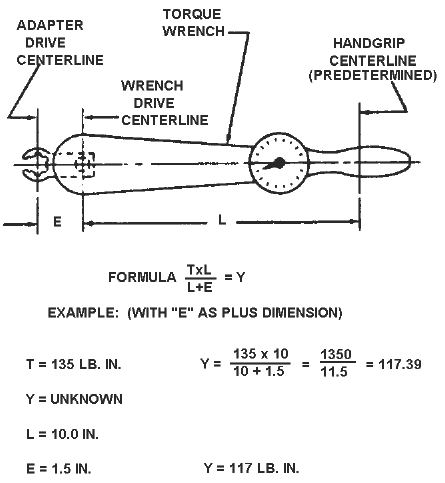
The Torque Wrench Calculator for Extended Adapter is a vital tool for professionals and DIY enthusiasts alike. It provides accurate calculations for torque values, taking into account the extended adapter's length and other critical factors. With this calculator, users can ensure precise torque application, reducing the risk of damage to equipment or injury. By utilizing the calculator's formulas, individuals can confidently determine the correct torque settings for their specific applications, promoting safety and efficiency in various industries, including automotive, construction, and manufacturing. The calculator's formulas serve as the foundation for accurate torque calculations.
- Understanding the Torque Wrench Calculator for Extended Adapter with Formulas
- What is the formula for the extended torque wrench?
- Does using an adapter on a torque wrench change the torque?
-
Frequently Asked Questions (FAQs)
- What is the purpose of a Torque Wrench Calculator for Extended Adapter with Formulas?
- How does the Torque Wrench Calculator for Extended Adapter with Formulas work?
- What are the benefits of using a Torque Wrench Calculator for Extended Adapter with Formulas?
- Can the Torque Wrench Calculator for Extended Adapter with Formulas be used for different types of fasteners and applications?
Understanding the Torque Wrench Calculator for Extended Adapter with Formulas
The Torque Wrench Calculator is a tool used to determine the torque required to tighten or loosen a bolt or nut using a torque wrench with an extended adapter. The calculator takes into account the length of the adapter, the torque setting on the wrench, and the angle of the adapter to provide an accurate calculation. This is particularly important in industries where precision and accuracy are crucial, such as in automotive, aerospace, and manufacturing.
Introduction to Torque Wrench Calculations
Torque calculations are essential in ensuring that bolts and nuts are tightened or loosened to the correct specification. The torque wrench calculator uses formulas to determine the required torque, taking into account the coefficient of friction, bolt diameter, and thread pitch. The calculator provides a precise calculation, reducing the risk of over-tightening or under-tightening, which can lead to damage or failure.
Understanding the Importance of Extended Adapters
Extended adapters are used to increase the reach of the torque wrench, allowing for tightening or loosening of bolts and nuts in confined or hard-to-reach areas. The adapter must be taken into account when calculating the torque, as it can affect the accuracy of the calculation. The torque wrench calculator for extended adapters provides a reliable and accurate calculation, ensuring that the bolt or nut is tightened or loosened to the correct specification.
Formulas Used in Torque Wrench Calculations
The torque wrench calculator uses formulas to determine the required torque, including:
| Formula | Description |
|---|---|
| T = (F x D) / 2 | Torque (T) calculation, where F is the force and D is the distance |
| T = (μ x F x D) / 2 | Torque (T) calculation, where μ is the coefficient of friction, F is the force, and D is the distance |
These formulas provide a precise calculation, taking into account the variables that affect the torque required.
Benefits of Using a Torque Wrench Calculator
The torque wrench calculator provides several benefits, including:
Increased accuracy and precision in torque calculations
Reduced risk of over-tightening or under-tightening
Improved efficiency and productivity in tightening and loosening operations
Enhanced safety and reliability in critical applications
Applications of Torque Wrench Calculators
Torque wrench calculators are used in a variety of industries, including:
Automotive: for tightening and loosening bolts and nuts on vehicles
Aerospace: for tightening and loosening bolts and nuts on aircraft and spacecraft
Manufacturing: for tightening and loosening bolts and nuts on machinery and equipment
The torque wrench calculator is an essential tool in these industries, providing a reliable and accurate calculation of the required torque.
What is the formula for the extended torque wrench?
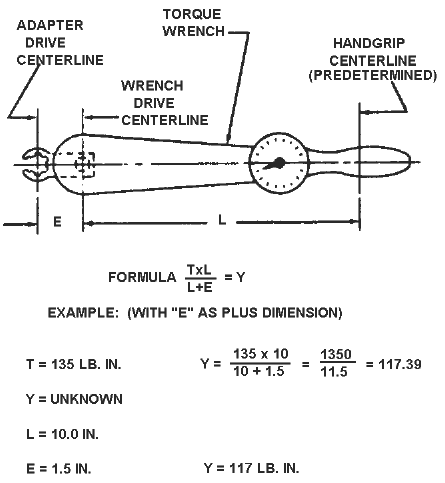
The formula for the extended torque wrench is a mathematical representation of the relationship between the torque applied to an object, the distance from the axis of rotation to the point where the force is applied, and the force applied. The formula is: Torque (T) = Force (F) x Distance (r). This formula is used to calculate the torque required to achieve a specific rotation or to determine the force needed to overcome a certain resistance.
Understanding the Extended Torque Wrench Formula
The extended torque wrench formula is based on the principle of mechanical advantage, which states that the torque applied to an object is equal to the force applied multiplied by the distance from the axis of rotation to the point where the force is applied. This formula is essential in various engineering and mechanical applications, where torque and rotation play a critical role. Some key points to consider when using this formula include:
- Units of measurement: Ensure that the units of measurement for torque, force, and distance are consistent, such as Newton-meters (Nm) for torque, Newtons (N) for force, and meters (m) for distance.
- Axis of rotation: Identify the axis of rotation and ensure that the distance is measured from this point to the point where the force is applied.
- Force application: Consider the direction and magnitude of the force applied, as these factors can significantly impact the resulting torque.
Applications of the Extended Torque Wrench Formula
The extended torque wrench formula has various practical applications in fields such as automotive, aerospace, and industrial engineering. This formula is used to calculate the torque required to achieve a specific rotation or to determine the force needed to overcome a certain resistance. Some key applications include:
- Tightening bolts and screws: The extended torque wrench formula is used to determine the torque required to tighten bolts and screws to a specific tightness.
- Designing mechanical systems: This formula is used to design mechanical systems, such as gears and bearings, that require a specific torque and rotation.
- Analyzing mechanical failures: The extended torque wrench formula is used to analyze mechanical failures and determine the cause of the failure.
Limitations of the Extended Torque Wrench Formula
While the extended torque wrench formula is a powerful tool for calculating torque and rotation, it has several limitations. Some key limitations include:
- Assumes a rigid body: The formula assumes that the object being rotated is a rigid body, which may not always be the case in real-world applications.
- Ignores friction and other losses: The formula ignores friction and other losses that can occur in mechanical systems, which can significantly impact the resulting torque and rotation.
- Requires accurate measurements: The formula requires accurate measurements of force, distance, and torque, which can be challenging to obtain in practical applications.
Derivations of the Extended Torque Wrench Formula
The extended torque wrench formula can be derived from the fundamental principles of mechanics and physics. One common derivation involves:
- Defining torque: Torque is defined as the cross product of the force vector and the distance vector from the axis of rotation to the point where the force is applied.
- Applying the principle of mechanical advantage: The principle of mechanical advantage states that the torque applied to an object is equal to the force applied multiplied by the distance from the axis of rotation to the point where the force is applied.
- Simplifying the formula: The resulting formula can be simplified to T = F x r, where T is the torque, F is the force, and r is the distance from the axis of rotation to the point where the force is applied.
Real-World Examples of the Extended Torque Wrench Formula
The extended torque wrench formula has numerous real-world applications in various fields, including:
- Automotive repair: The formula is used to calculate the torque required to tighten bolts and screws in automotive repair.
- Aerospace engineering: The formula is used to design and analyze mechanical systems in aerospace engineering, such as rocket propulsion and aircraft control systems.
- Industrial manufacturing: The formula is used to design and optimize mechanical systems in industrial manufacturing, such as assembly lines and material handling systems.
Does using an adapter on a torque wrench change the torque?

Using an adapter on a torque wrench can indeed change the torque applied to a bolt or nut. The adapter can affect the accuracy and precision of the torque measurement, leading to potential errors in the tightening process. This is because the adapter can introduce additional friction and resistance into the system, which can alter the amount of torque applied to the bolt or nut.
Understanding Torque Wrench Adapters
When using an adapter on a torque wrench, it is essential to consider the design and material of the adapter. A well-designed adapter can minimize the impact on torque accuracy, while a poorly designed adapter can lead to significant errors. The material of the adapter can also affect the friction and resistance introduced into the system. For example, an adapter made of a low-friction material can help reduce the impact on torque accuracy. Some key factors to consider when using a torque wrench adapter include:
- Adapter design: The design of the adapter can significantly impact the torque accuracy, so it is crucial to choose an adapter that is specifically designed for use with a torque wrench.
- Material selection: The material of the adapter can affect the friction and resistance introduced into the system, so it is essential to choose a material that minimizes these effects.
- Adapter size: The size of the adapter can also impact the torque accuracy, so it is crucial to choose an adapter that is the correct size for the application.
Torque Wrench Calibration and Adapters
When using an adapter on a torque wrench, it is essential to consider the calibration of the torque wrench. The calibration of the torque wrench can be affected by the adapter, leading to potential errors in the torque measurement. To ensure accuracy, it is crucial to calibrate the torque wrench with the adapter attached. This can help ensure that the torque measurement is accurate and reliable. Some key factors to consider when calibrating a torque wrench with an adapter include:
- Calibration procedure: The calibration procedure should be followed carefully to ensure that the torque wrench is accurately calibrated with the adapter attached.
- Adapter selection: The adapter selected should be specifically designed for use with a torque wrench and should be accurately calibrated.
- Torque wrench maintenance: Regular maintenance of the torque wrench is essential to ensure that it remains accurate and reliable.
Effects of Adapters on Torque Wrench Accuracy
The use of an adapter on a torque wrench can have a significant impact on the accuracy of the torque measurement. The adapter can introduce additional friction and resistance into the system, which can alter the amount of torque applied to the bolt or nut. This can lead to potential errors in the tightening process, which can have serious consequences. Some key factors to consider when assessing the impact of an adapter on torque wrench accuracy include:
- Friction and resistance: The friction and resistance introduced by the adapter can significantly impact the torque accuracy, so it is essential to minimize these effects.
- Adapter design: The design of the adapter can also impact the torque accuracy, so it is crucial to choose an adapter that is specifically designed for use with a torque wrench.
- Material selection: The material of the adapter can also affect the friction and resistance introduced into the system, so it is essential to choose a material that minimizes these effects.
Choosing the Right Adapter for Your Torque Wrench
When choosing an adapter for a torque wrench, it is essential to consider several key factors. The adapter should be specifically designed for use with a torque wrench and should be accurately calibrated. The material of the adapter should also be considered, as it can affect the friction and resistance introduced into the system. Some key factors to consider when choosing a torque wrench adapter include:
- Adapter design: The design of the adapter should be specifically designed for use with a torque wrench and should minimize the impact on torque accuracy.
- Material selection: The material of the adapter should be chosen to minimize the friction and resistance introduced into the system.
- Size and fit: The size and fit of the adapter should be carefully considered to ensure that it is the correct size for the application.
Best Practices for Using Adapters with Torque Wrenches
When using an adapter with a torque wrench, it is essential to follow best practices to ensure accuracy and reliability. The adapter should be specifically designed for use with a torque wrench and should be accurately calibrated. The torque wrench should also be regularly maintained to ensure that it remains accurate and reliable. Some key factors to consider when using a torque wrench adapter include:
- Regular maintenance: Regular maintenance of the torque wrench is essential to ensure that it remains accurate and reliable.
- Adapter selection: The adapter selected should be specifically designed for use with a torque wrench and should be accurately calibrated.
- Torque wrench calibration: The torque wrench should be calibrated with the adapter attached to ensure accuracy.
Frequently Asked Questions (FAQs)
What is the purpose of a Torque Wrench Calculator for Extended Adapter with Formulas?
The Torque Wrench Calculator for Extended Adapter with Formulas is a tool designed to help users calculate the torque required to tighten or loosen a fastener using an extended adapter. This calculator is essential in various industries, including mechanics, engineering, and construction, where accurate torque measurements are crucial to ensure the safety and reliability of equipment and structures. By using the calculator, users can input the formula and variables specific to their application, such as the length of the adapter, the angle of the wrench, and the desired torque. The calculator then provides the required torque value, taking into account the mechanical advantage of the extended adapter. This helps to prevent over-tightening or under-tightening, which can lead to equipment failure or injury.
How does the Torque Wrench Calculator for Extended Adapter with Formulas work?
The Torque Wrench Calculator for Extended Adapter with Formulas uses a combination of mathematical formulas and physical principles to calculate the torque required. The calculator takes into account the geometry of the extended adapter, including its length, diameter, and thread pitch, as well as the friction and wear characteristics of the fastener. The user inputs the desired torque value and the calculator uses the formula to calculate the required torque. The calculator also considers the efficiency of the wrench and the adapter, as well as any losses due to friction or slip. The result is a precise calculation of the torque required to achieve the desired level of tightening or loosening. This ensures that the user can apply the correct amount of torque to the fastener, minimizing the risk of equipment damage or personal injury.
What are the benefits of using a Torque Wrench Calculator for Extended Adapter with Formulas?
The Torque Wrench Calculator for Extended Adapter with Formulas offers several benefits to users. One of the primary advantages is the accuracy of the calculations, which ensures that the user applies the correct amount of torque to the fastener. This helps to prevent over-tightening or under-tightening, which can lead to equipment failure or injury. Additionally, the calculator saves time and effort by eliminating the need for manual calculations or trial and error methods. The calculator also provides a record of the calculations, which can be used for quality control or regulatory compliance purposes. Furthermore, the calculator can be used to optimize the design of the extended adapter and the wrench, allowing for improved performance and efficiency. Overall, the Torque Wrench Calculator for Extended Adapter with Formulas is an essential tool for anyone working with fasteners and extended adapters.
Can the Torque Wrench Calculator for Extended Adapter with Formulas be used for different types of fasteners and applications?
The Torque Wrench Calculator for Extended Adapter with Formulas is a versatile tool that can be used for a wide range of fasteners and applications. The calculator can be used for standard and metric fasteners, as well as for specialized fasteners such as hex keys or socket heads. The calculator can also be used for different materials, including steel, aluminum, and copper, and for various environments, such as high-temperature or high-pressure applications. Additionally, the calculator can be used for different types of wrenches, including manual and powered wrenches, and for various adapter lengths and configurations. The calculator's flexibility and adaptability make it an essential tool for anyone working with fasteners and extended adapters in a variety of applications, including mechanics, engineering, construction, and manufacturing. By using the Torque Wrench Calculator for Extended Adapter with Formulas, users can ensure accurate and precise calculations, regardless of the specific application or fastener type.
Deja una respuesta
Entradas Relacionadas