
Temperature Rise Across Fan Calculator

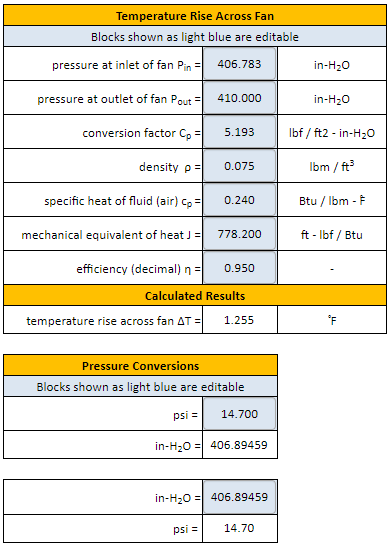
The Temperature Rise Across Fan Calculator is a crucial tool for engineers and technicians working with electronic devices and systems. It helps to determine the temperature increase across a fan, which is essential for ensuring the reliability and performance of the device. By calculating the temperature rise, users can optimize fan selection, improve system design, and prevent overheating. This calculator takes into account various factors, including fan speed, airflow, and heat load, to provide accurate and reliable results. Its application is vital in various industries, including electronics, aerospace, and automotive. Accurate calculations are essential for safety and efficiency.
-
Understanding Temperature Rise Across Fan Calculator
- Introduction to Temperature Rise Across Fan Calculator
- Key Factors Affecting Temperature Rise Across Fan Calculator
- Applications of Temperature Rise Across Fan Calculator
- Benefits of Using Temperature Rise Across Fan Calculator
- Limitations and Future Developments of Temperature Rise Across Fan Calculator
- How much does the temperature rise across a fan?
- How do you calculate CFM using temperature rise?
- What is the maximum temperature rise allowed in a fan?
- What is the formula for temperature rise in airflow?
-
Frequently Asked Questions (FAQs)
- What is the Temperature Rise Across Fan Calculator and how does it work?
- How do I use the Temperature Rise Across Fan Calculator to determine the temperature increase of my fan?
- What are the factors that affect the temperature rise across a fan, and how do they impact the calculation?
- What are the applications of the Temperature Rise Across Fan Calculator, and how can it be used in real-world scenarios?
Understanding Temperature Rise Across Fan Calculator
The Temperature Rise Across Fan Calculator is a tool used to calculate the temperature rise of a fan in a given system. This calculator is essential in determining the performance and efficiency of a fan in various applications, including industrial, commercial, and residential settings. The calculator takes into account several factors, including the fan's power consumption, airflow rate, and system resistance, to provide an accurate estimate of the temperature rise.
Introduction to Temperature Rise Across Fan Calculator
The Temperature Rise Across Fan Calculator is based on the principle that the temperature rise of a fan is directly proportional to the power consumption of the fan and inversely proportional to the airflow rate. The calculator uses a complex algorithm to calculate the temperature rise, taking into account various factors, including the fan's design, size, and operating conditions. The calculator provides a detailed analysis of the fan's performance, allowing users to optimize the fan's design and operation for maximum efficiency and performance.
Key Factors Affecting Temperature Rise Across Fan Calculator
Several factors affect the temperature rise of a fan, including:
| Factor | Description |
|---|---|
| Power Consumption | The amount of power consumed by the fan, which directly affects the temperature rise. |
| Airflow Rate | The rate at which air flows through the fan, which inversely affects the temperature rise. |
| System Resistance | The resistance offered by the system, which affects the fan's performance and temperature rise. |
Applications of Temperature Rise Across Fan Calculator
The Temperature Rise Across Fan Calculator has various applications, including:
Industrial ventilation systems, where the calculator helps to optimize the fan's design and operation for maximum efficiency and performance.
Commercial HVAC systems, where the calculator helps to determine the temperature rise and airflow rate required for comfortable indoor conditions.
Residential ventilation systems, where the calculator helps to optimize the fan's design and operation for maximum efficiency and performance.
Benefits of Using Temperature Rise Across Fan Calculator
The Temperature Rise Across Fan Calculator offers several benefits, including:
Improved fan performance, by optimizing the fan's design and operation for maximum efficiency and performance.
Increased energy savings, by reducing the power consumption of the fan and minimizing the temperature rise.
Enhanced system reliability, by providing a detailed analysis of the fan's performance and identifying potential issues before they occur.
Limitations and Future Developments of Temperature Rise Across Fan Calculator
While the Temperature Rise Across Fan Calculator is a valuable tool, it has some limitations, including:
Complexity, as the calculator requires a detailed understanding of the fan's design and operation.
Assumptions, as the calculator makes assumptions about the fan's performance and operating conditions.
Future developments of the calculator may include improved algorithms and advanced modeling techniques to provide more accurate estimates of the temperature rise and enhanced user interfaces to make the calculator more user-friendly.
How much does the temperature rise across a fan?
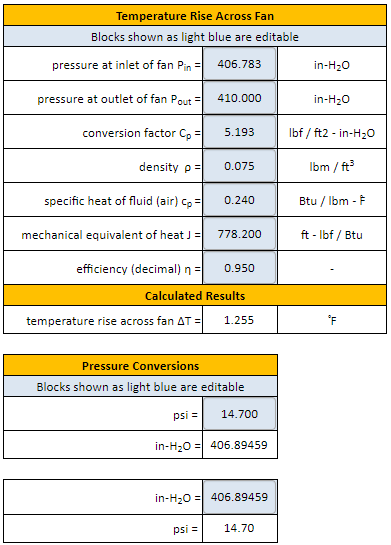
The temperature rise across a fan can vary depending on several factors, including the type of fan, its efficiency, and the air density it is operating in. In general, the temperature rise across a fan is relatively small, typically in the range of 1-5°C. This is because fans are designed to move air with minimal energy loss, and the heat transfer that occurs as the air passes through the fan is usually limited. However, the temperature rise can be more significant in certain applications, such as in high-temperature environments or when the fan is operating at high speeds.
Factors Affecting Temperature Rise
The temperature rise across a fan is influenced by several factors, including the fan design, motor efficiency, and operating conditions. Some of the key factors that affect the temperature rise include:
- The type of fan, with axial fans typically having a lower temperature rise than centrifugal fans
- The fan speed, with higher speeds resulting in a greater temperature rise
- The air density, with lower air densities resulting in a greater temperature rise
These factors can all contribute to the overall temperature rise across the fan, and understanding their impact is crucial for designing and optimizing fan systems.
Temperature Rise in Different Fan Types
Different types of fans can exhibit varying levels of temperature rise, depending on their design and construction. For example, centrifugal fans tend to have a higher temperature rise than axial fans, due to the greater energy losses associated with their impeller design. In contrast, mixed-flow fans can offer a compromise between the two, with a lower temperature rise than centrifugal fans but a higher pressure increase than axial fans. The temperature rise in different fan types can be affected by factors such as:
- The fan's efficiency, with more efficient fans typically having a lower temperature rise
- The fan's motor power, with more powerful motors resulting in a greater temperature rise
- The fan's operating conditions, with higher temperatures and pressures resulting in a greater temperature rise
Measuring Temperature Rise
Measuring the temperature rise across a fan is crucial for evaluating its performance and ensuring that it is operating within safe and efficient parameters. There are several methods for measuring temperature rise, including the use of thermocouples, infrared cameras, and data loggers. These methods can provide accurate and reliable data on the temperature rise across the fan, allowing for informed decisions to be made about its operation and maintenance. Some common methods for measuring temperature rise include:
- Using thermocouples to measure the temperature difference between the fan's inlet and outlet
- Using infrared cameras to visualize the temperature distribution across the fan
- Using data loggers to record the temperature data over time
Reducing Temperature Rise
In some applications, it may be necessary to reduce the temperature rise across a fan, such as in high-temperature environments or when the fan is operating at high speeds. There are several strategies for reducing temperature rise, including improving the fan's efficiency, reducing the fan's speed, and increasing the air density. Additionally, active cooling methods, such as air jets or water sprays, can be used to reduce the temperature of the fan and its surrounding components. Some common methods for reducing temperature rise include:
- Optimizing the fan's design to minimize energy losses and heat transfer
- Using high-efficiency motors to reduce the energy input to the fan
- Implementing active cooling methods to reduce the temperature of the fan and its surrounding components
Applications with High Temperature Rise
There are several applications where the temperature rise across a fan can be a significant concern, such as in high-temperature environments, chemical processing, and power generation. In these applications, the temperature rise can have a major impact on the performance and reliability of the fan and its surrounding components. To mitigate this, specialized fans can be used, such as high-temperature fans or explosion-proof fans, which are designed to operate in harsh environments. Some common applications with high temperature rise include:
- Chemical processing, where the fan must operate in a high-temperature and corrosive environment
- Power generation, where the fan must operate at high speeds and high temperatures
- Aerospace, where the fan must operate in a high-temperature and high-stress environment
How do you calculate CFM using temperature rise?
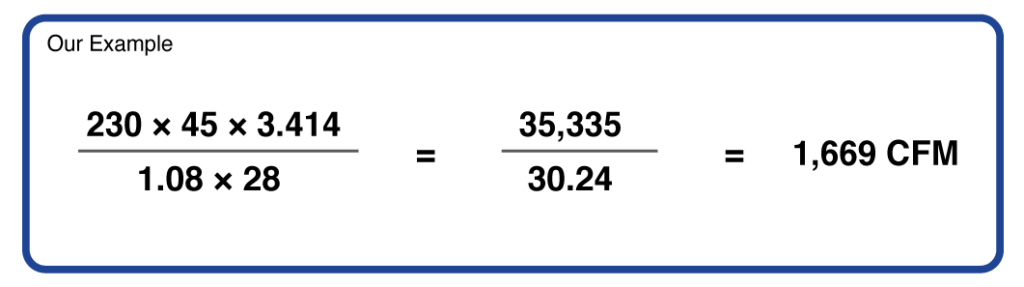
To calculate CFM (cubic feet per minute) using temperature rise, you need to understand the relationship between the temperature difference and the airflow rate. The calculation involves using the specific heat of air and the density of air to determine the CFM. The formula to calculate CFM using temperature rise is: CFM = (Q / (1.10 x ΔT)), where Q is the heat transfer rate in BTUs per hour, and ΔT is the temperature difference in degrees Fahrenheit.
Understanding the Formula
The formula to calculate CFM using temperature rise is based on the principle of heat transfer and the physical properties of air. To apply this formula, you need to know the heat transfer rate and the temperature difference. Here are the key factors involved in the calculation:
- The specific heat of air, which is the amount of heat required to raise the temperature of a unit mass of air by one degree.
- The density of air, which affects the airflow rate and the heat transfer rate.
- The temperature difference between the supply and return air, which drives the heat transfer process.
Calculating Heat Transfer Rate
The heat transfer rate is a critical factor in calculating CFM using temperature rise. To determine the heat transfer rate, you need to know the power consumption of the heating or cooling system and the efficiency of the system. Here are the steps to calculate the heat transfer rate:
- Determine the power consumption of the heating or cooling system in BTUs per hour.
- Calculate the efficiency of the system, which is the ratio of the output to the input.
- Use the efficiency to adjust the power consumption and determine the heat transfer rate.
Measuring Temperature Difference
The temperature difference is another crucial factor in calculating CFM using temperature rise. To measure the temperature difference, you need to use thermometers or temperature sensors to record the supply and return air temperatures. Here are the steps to measure the temperature difference:
- Install thermometers or temperature sensors in the supply and return air ducts.
- Record the temperature readings at regular intervals to ensure accuracy.
- Calculate the temperature difference by subtracting the return air temperature from the supply air temperature.
Applying the Calculation
To apply the calculation, you need to plug in the values for the heat transfer rate and the temperature difference into the formula. Here are the steps to apply the calculation:
- Enter the heat transfer rate in BTUs per hour into the formula.
- Enter the temperature difference in degrees Fahrenheit into the formula.
- Calculate the CFM using the formula and the given values.
Interpreting the Results
The calculated CFM value indicates the airflow rate required to achieve the desired temperature difference. Here are the factors to consider when interpreting the results:
- The CFM value should be compared to the design CFM to ensure that the system is operating within the design parameters.
- The temperature difference should be within the acceptable range to ensure comfort and energy efficiency.
- The heat transfer rate should be adjusted to achieve the desired temperature difference and CFM.
What is the maximum temperature rise allowed in a fan?

The maximum temperature rise allowed in a fan is a critical parameter that determines the fan's performance, efficiency, and safety. It is typically specified by the fan manufacturer and is affected by factors such as the fan's design, materials, and operating conditions. The maximum temperature rise is usually measured at the fan's motor or bearings, and it should not exceed a certain limit to prevent overheating, damage, or failure. The maximum temperature rise allowed in a fan can vary depending on the application, but it is typically around 40°C to 60°C (104°F to 140°F) above the ambient temperature.
Design Considerations for Temperature Rise
The design of a fan plays a crucial role in determining the maximum temperature rise allowed. Factors such as the fan blade design, motor type, and cooling system can all impact the temperature rise. To minimize temperature rise, fan designers use techniques such as:
- Aerodynamic optimization to reduce friction and heat generation
- Material selection to choose high-temperature materials with low thermal resistance
- Cooling system design to provide adequate heat dissipation
Effects of Temperature Rise on Fan Performance
The maximum temperature rise allowed in a fan can significantly impact its performance. As the temperature rises, the fan's efficiency and output can decrease, leading to reduced airflow and pressure. Additionally, high temperatures can cause motor failure, bearing damage, and electrical component failure. To mitigate these effects, fan manufacturers use techniques such as:
- Temperature monitoring to detect overheating and shutdown the fan if necessary
- Cooling system optimization to maximize heat dissipation
- Material selection to choose high-temperature materials with low thermal expansion
Temperature Rise Limits for Different Fan Types
The maximum temperature rise allowed in a fan can vary depending on the fan type and application. For example:
- Centrifugal fans typically have a higher temperature rise limit than axial fans due to their design and operating conditions
- Induced draft fans may have a lower temperature rise limit than forced draft fans due to their application and operating conditions
- High-temperature fans are designed to operate at extremely high temperatures, often with specialized materials and cooling systems
Consequences of Exceeding the Maximum Temperature Rise
Exceeding the maximum temperature rise allowed in a fan can have severe consequences, including:
- Motor failure due to overheating or electrical component failure
- Bearing damage or failure due to excessive heat or wear
- Reduced fan life or premature failure due to excessive heat or wear
Testing and Validation of Temperature Rise Limits
To ensure that a fan operates within the allowed temperature rise limits, manufacturers perform rigorous testing and validation. This includes:
- Temperature monitoring during performance testing to ensure that the fan operates within the allowed temperature rise limits
- Accelerated life testing to simulate real-world operating conditions and validate the fan's reliability and durability
- Materials testing to validate the thermal properties and performance of the fan's materials
What is the formula for temperature rise in airflow?
The formula for temperature rise in airflow is given by the equation: ΔT = (P / (ρ c_p V)), where:
- ΔT is the temperature rise
- P is the power dissipated in the airflow
- ρ is the density of the air
- c_p is the specific heat capacity at constant pressure
- V is the volume flow rate of the air
Understanding the Variables
To calculate the temperature rise in airflow, it's essential to understand the variables involved in the formula. These variables include power, density, specific heat capacity, and volume flow rate. The power dissipated in the airflow can come from various sources such as friction or electrical resistance. The density of the air is affected by temperature and pressure. The specific heat capacity is a measure of the amount of heat energy required to raise the temperature of a unit mass of air by one degree. The volume flow rate is the rate at which air flows through a given area.
- Power: The rate at which energy is transferred or converted
- Density: The mass per unit volume of the air
- Specific heat capacity: The amount of heat energy required to raise the temperature of a unit mass of air by one degree
Calculating Temperature Rise
Calculating the temperature rise in airflow involves substituting the given values into the formula: ΔT = (P / (ρ c_p V)). It's crucial to ensure that all values are in the correct units to obtain an accurate result. The power should be in watts, the density in kilograms per cubic meter, the specific heat capacity in joules per kilogram per degree Celsius, and the volume flow rate in cubic meters per second.
- Convert units: Ensure all values are in the correct units
- Substitute values: Plug the values into the formula
- Calculate: Perform the calculation to find the temperature rise
Factors Affecting Temperature Rise
Several factors can affect the temperature rise in airflow, including the properties of the air, the design of the system, and the ambient conditions. The properties of the air, such as density and specific heat capacity, can influence the temperature rise. The design of the system, including the geometry and materials, can also impact the temperature rise. Ambient conditions, such as temperature and humidity, can also play a role.
- Air properties: Density and specific heat capacity of the air
- System design: Geometry and materials used in the system
- Ambient conditions: Temperature and humidity of the surrounding environment
Applications of Temperature Rise Calculation
Calculating the temperature rise in airflow has various practical applications, including heating, ventilation, and air conditioning (HVAC) systems, electronic cooling systems, and aerospace engineering. In HVAC systems, calculating the temperature rise helps in designing and optimizing the system for efficient heating and cooling. In electronic cooling systems, it's crucial for preventing overheating and ensuring reliable operation. In aerospace engineering, it's used to design and test aircraft and spacecraft systems.
- HVAC systems: Designing and optimizing heating and cooling systems
- Electronic cooling systems: Preventing overheating and ensuring reliable operation
- Aerospace engineering: Designing and testing aircraft and spacecraft systems
Importance of Accurate Calculation
Accurate calculation of the temperature rise in airflow is critical for ensuring safety, optimizing performance, and reducing costs. Inaccurate calculations can lead to overheating, equipment failure, and reduced lifespan of the system. Accurate calculations help in identifying potential issues and optimizing the design of the system for efficient operation.
- Ensuring safety: Preventing overheating and equipment failure
- Optimizing performance: Improving efficiency and reducing costs
- Reducing costs: Minimizing maintenance and extending lifespan
Frequently Asked Questions (FAQs)
What is the Temperature Rise Across Fan Calculator and how does it work?
The Temperature Rise Across Fan Calculator is a tool designed to calculate the temperature increase of air as it passes through a fan or blower. This calculator takes into account the fan's power consumption, air density, and flow rate to determine the temperature rise. The calculation is based on the first law of thermodynamics, which states that energy cannot be created or destroyed, only converted from one form to another. In this case, the electrical energy consumed by the fan is converted into thermal energy, causing the air temperature to rise. The calculator uses a complex algorithm to calculate the temperature increase, taking into account the fan's efficiency and other factors that may affect the temperature rise.
How do I use the Temperature Rise Across Fan Calculator to determine the temperature increase of my fan?
To use the Temperature Rise Across Fan Calculator, you need to input the required parameters, such as the fan's power consumption, air density, and flow rate. You can find these values in the fan's documentation or by measuring them directly. Once you have input the values, the calculator will calculate the temperature rise and display the result. You can then use this value to determine the temperature increase of your fan and design your system accordingly. It is essential to note that the accuracy of the calculation depends on the accuracy of the input values, so make sure to measure them carefully. Additionally, the calculator assumes that the fan is operating in a steady-state condition, meaning that the air flow and temperature are constant.
What are the factors that affect the temperature rise across a fan, and how do they impact the calculation?
The temperature rise across a fan is affected by several factors, including the fan's power consumption, air density, flow rate, and efficiency. The fan's power consumption is the most significant factor, as it directly affects the amount of energy converted into thermal energy. The air density and flow rate also play a crucial role, as they determine the amount of air that is heated by the fan. The fan's efficiency is also important, as it determines how much of the electrical energy is converted into useful work, rather than being wasted as heat. Other factors, such as the fan's design and operating conditions, can also impact the temperature rise. The Temperature Rise Across Fan Calculator takes these factors into account to provide an accurate calculation of the temperature increase.
What are the applications of the Temperature Rise Across Fan Calculator, and how can it be used in real-world scenarios?
The Temperature Rise Across Fan Calculator has several applications in real-world scenarios, including HVAC system design, electronic cooling, and industrial processes. In HVAC system design, the calculator can be used to determine the temperature rise of air as it passes through a fan or blower, allowing designers to size the system accordingly. In electronic cooling, the calculator can be used to determine the temperature increase of air as it passes through a heat sink or fan, allowing designers to optimize the cooling system. In industrial processes, the calculator can be used to determine the temperature rise of air or gases as they pass through a fan or blower, allowing operators to monitor and control the process parameters. The calculator can also be used in research and development to study the behavior of fans and blowers and to develop new designs and technologies.
Deja una respuesta
Entradas Relacionadas