
Stress Deflection Strain Equations and Calculator Beam Supported Tapering Load Applied

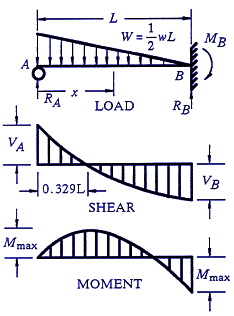
The stress deflection strain equations and calculator for a beam supported with a tapering load applied are crucial in understanding the structural behavior of beams under various load conditions. These equations enable engineers to calculate the maximum stress, deflection, and strain that a beam can withstand, ensuring the safety and durability of the structure. The calculator provides a simplified approach to solving complex beam problems, allowing for quick and accurate calculations of beam behavior under tapering loads, which is essential in designing and analyzing beams in various engineering applications. This Calculator is very useful in civil engineering.
- Stress Deflection Strain Equations and Calculator Beam Supported Tapering Load Applied
- Understanding the Fundamentals of Stress Deflection Strain Equations and Calculator Beam Supported Tapering Load Applied
-
Frequently Asked Questions (FAQs)
- What are the key factors to consider when using Stress Deflection Strain Equations and Calculator for a Beam Supported Tapering Load Applied?
- How do Stress Deflection Strain Equations and Calculator account for the effects of tapering load on a beam supported?
- What are the limitations of using Stress Deflection Strain Equations and Calculator for a beam supported tapering load applied?
- How can engineers use Stress Deflection Strain Equations and Calculator to optimize the design of a beam supported tapering load applied?
Stress Deflection Strain Equations and Calculator Beam Supported Tapering Load Applied
The Stress Deflection Strain Equations and Calculator Beam Supported Tapering Load Applied is a complex topic that involves the calculation of stress, deflection, and strain on a beam that is supported at both ends and subjected to a tapering load. This type of beam is commonly used in engineering applications, such as bridges, buildings, and mechanical systems. The calculation of stress, deflection, and strain is crucial to ensure the safety and stability of the beam.
Introduction to Beam Theory
Beam theory is a fundamental concept in engineering that deals with the calculation of stress, deflection, and strain on beams. A beam is a structural element that is designed to withstand loads, which can be either external or internal. The beam theory takes into account the material properties, such as the Young's modulus and Poisson's ratio, as well as the geometric properties, such as the length, width, and thickness of the beam. The beam theory is used to calculate the bending stress, shear stress, and deflection of the beam.
Stress Deflection Strain Equations
The stress deflection strain equations are used to calculate the stress, deflection, and strain on a beam. These equations take into account the material properties, geometric properties, and the load applied to the beam. The equations are as follows:
| Equation | Description |
| --- | --- |
| σ = (M y) / I | Bending stress equation |
| τ = (V Q) / (I b) | Shear stress equation |
| δ = (W L^3) / (3 E I) | Deflection equation |
| ε = (σ L) / (E I) | Strain equation |
where σ is the bending stress, τ is the shear stress, δ is the deflection, ε is the strain, M is the moment, y is the distance from the neutral axis, I is the moment of inertia, V is the shear force, Q is the first moment of area, b is the width of the beam, W is the load, L is the length of the beam, E is the Young's modulus, and I is the moment of inertia.
Tapering Load Applied
A tapering load is a type of load that varies along the length of the beam. The load can be either increasing or decreasing, and it can be applied at any point along the length of the beam. The tapering load can be calculated using the following equation:
| Load | Description |
| --- | --- |
| w(x) = w0 (1 - x/L) | Tapering load equation |
where w(x) is the load at a distance x from the left end of the beam, w0 is the maximum load, and L is the length of the beam.
Calculator Beam Supported
A calculator beam supported is a type of beam that is supported at both ends. The calculator beam supported is commonly used in engineering applications, such as bridges and buildings. The calculator beam supported can be analyzed using the beam theory, which takes into account the material properties, geometric properties, and the load applied to the beam. The calculator beam supported can be designed to withstand various types of loads, including point loads, uniformly distributed loads, and tapering loads.
Beam Supported Tapering Load Applied Applications
The beam supported tapering load applied has various applications in engineering, including:
| Application | Description |
| --- | --- |
| Bridges | The beam supported tapering load applied is used in bridge design to calculate the stress, deflection, and strain on the bridge deck and piers. |
| Buildings | The beam supported tapering load applied is used in building design to calculate the stress, deflection, and strain on the floor and roof beams. |
| Mechanical systems | The beam supported tapering load applied is used in mechanical systems to calculate the stress, deflection, and strain on the mechanical components, such as gears and shafts. |
| Aerospace engineering | The beam supported tapering load applied is used in aerospace engineering to calculate the stress, deflection, and strain on the aircraft and spacecraft components. |
| Civil engineering | The beam supported tapering load applied is used in civil engineering to calculate the stress, deflection, and strain on the infrastructure components, such as roads and highways. |
Understanding the Fundamentals of Stress Deflection Strain Equations and Calculator Beam Supported Tapering Load Applied
The stress deflection strain equations are a crucial aspect of engineering, particularly in the field of mechanics of materials. These equations help engineers and researchers to calculate the stress and strain on a beam or any other structural element when it is subjected to various types of loads. In the case of a tapering load, the beam is subjected to a load that varies along its length, making the calculation of stress and strain more complex. The calculator beam supported is a tool used to simplify these calculations and provide accurate results.
Derivation of Stress Deflection Strain Equations
The derivation of stress deflection strain equations involves the use of differential equations and integration. The beam is divided into small elements, and the stress and strain are calculated for each element. The equations are then combined to form a single equation that describes the behavior of the beam under the applied load. The tapering load is taken into account by using a variable load function that varies along the length of the beam. The stress deflection strain equations are then used to calculate the deflection and rotation of the beam at any point.
Types of Loading Conditions
There are several types of loading conditions that can be applied to a beam, including point loads, uniformly distributed loads, and tapering loads. Each type of load requires a different approach to calculate the stress and strain on the beam. The stress deflection strain equations can be used to calculate the response of the beam to any type of load. The tapering load is a type of load that is commonly encountered in engineering applications, such as in the design of bridges and buildings.
Importance of Boundary Conditions
The boundary conditions play a crucial role in the calculation of stress and strain on a beam. The boundary conditions specify the constraints on the beam, such as the supports and the loads. The stress deflection strain equations must be solved subject to the boundary conditions to obtain the correct solution. The boundary conditions can be simply supported, fixed, or free, and each type of boundary condition requires a different approach to solve the equations.
Applications of Stress Deflection Strain Equations
The stress deflection strain equations have numerous applications in engineering, including the design of bridges, buildings, and machinery. The equations can be used to calculate the response of a beam to various types of loads, including static and dynamic loads. The stress deflection strain equations can also be used to calculate the fatigue life of a beam under repeated loading. The calculator beam supported is a tool that can be used to simplify the calculations and provide accurate results.
Numerical Methods for Solving Stress Deflection Strain Equations
The stress deflection strain equations can be solved using numerical methods, such as the finite element method and the finite difference method. These methods involve discretizing the beam into small elements and solving the equations using algorithms. The numerical methods can be used to solve complex problems that involve nonlinear behavior and large deformations. The calculator beam supported can be used to implement these numerical methods and provide accurate results. The stress deflection strain equations can be solved using software packages, such as MATLAB and ANSYS, which provide tools for solving differential equations and integrating functions.
Frequently Asked Questions (FAQs)
What are the key factors to consider when using Stress Deflection Strain Equations and Calculator for a Beam Supported Tapering Load Applied?
When using Stress Deflection Strain Equations and Calculator for a Beam Supported Tapering Load Applied, there are several key factors to consider. The first factor is the material properties of the beam, including its elastic modulus, Poisson's ratio, and density. These properties will affect the beam's ability to resist deformation and stress. Another important factor is the geometry of the beam, including its length, width, and thickness. The tapering load applied to the beam will also have a significant impact on the stress and strain experienced by the beam. Additionally, the support conditions of the beam, including the type of supports and their location, will also affect the stress and strain distribution. By considering these factors, engineers can use the Stress Deflection Strain Equations and Calculator to accurately predict the behavior of the beam under tapering load.
How do Stress Deflection Strain Equations and Calculator account for the effects of tapering load on a beam supported?
The Stress Deflection Strain Equations and Calculator account for the effects of tapering load on a beam supported by incorporating the load distribution into the calculations. The tapering load is applied to the beam in a non-uniform manner, with the load increasing or decreasing along the length of the beam. The equations and calculator take into account the load distribution and calculate the resulting stress and strain on the beam. The calculations involve integrating the load distribution over the length of the beam to determine the shear force and bending moment at each point. The stress and strain are then calculated using the material properties and geometry of the beam. By accounting for the tapering load, the Stress Deflection Strain Equations and Calculator provide a more accurate prediction of the beam's behavior under non-uniform loading.
What are the limitations of using Stress Deflection Strain Equations and Calculator for a beam supported tapering load applied?
There are several limitations to using the Stress Deflection Strain Equations and Calculator for a beam supported tapering load applied. One of the main limitations is that the equations and calculator assume a linear elastic behavior of the material, which may not be accurate for all materials or loading conditions. Additionally, the equations and calculator do not account for non-linear effects such as plasticity or large deformations. Another limitation is that the calculations are based on a simplified model of the beam, which may not capture all the complexities of the real-world structure. Furthermore, the equations and calculator require accurate input data, including the material properties, geometry, and load distribution, which can be difficult to obtain or measure. By understanding these limitations, engineers can use the Stress Deflection Strain Equations and Calculator in conjunction with other analysis tools and experimental methods to gain a more comprehensive understanding of the beam's behavior under tapering load.
How can engineers use Stress Deflection Strain Equations and Calculator to optimize the design of a beam supported tapering load applied?
Engineers can use the Stress Deflection Strain Equations and Calculator to optimize the design of a beam supported tapering load applied by iteratively analyzing and refining the design parameters. The equations and calculator can be used to analyze the stress and strain distribution on the beam under tapering load, and to identify areas of high stress or deformation. By modifying the design parameters, such as the geometry, material properties, or support conditions, engineers can reduce the stress and strain on the beam and optimize its performance. The calculator can also be used to compare the performance of different design options, and to select the optimal design based on criteria such as weight, cost, or structural integrity. Additionally, the equations and calculator can be used to analyze the sensitivity of the beam's behavior to variations in the design parameters, and to identify the most critical design variables. By using the Stress Deflection Strain Equations and Calculator in this way, engineers can create optimized designs that meet the performance requirements while minimizing weight, cost, and risk.
Deja una respuesta
Entradas Relacionadas