
Shear Webs with Beads Stress Formula and Calculator


Shear webs with beads are commonly used in various engineering applications, including mechanical and aerospace engineering. The stress distribution in these webs is crucial for design and analysis purposes. The shear web with beads stress formula provides a mathematical approach to calculate the stress concentrations and distributions in these structural elements. This article will delve into the shear web with beads stress formula, its derivation, and the application of a calculator to simplify the calculation process, making it easier for engineers to analyze and design these critical components. The calculator will be explained in detail, enabling accurate calculations.
- Understanding Shear Webs with Beads Stress Formula and Calculator
- What is the formula for calculating shear stress?
- How do you calculate shear stress force?
- How do you calculate shear stress test?
- How do you calculate shear stress distribution?
-
Frequently Asked Questions (FAQs)
- What is the Shear Webs with Beads Stress Formula and how is it used in engineering applications?
- How does the Shear Webs with Beads Stress Calculator work and what are its limitations?
- What are the key factors that affect the stress and strain on shear webs with beads, and how can they be optimized?
- How can the Shear Webs with Beads Stress Formula and Calculator be used in conjunction with other tools and techniques to enhance the design and analysis of complex structures?
Understanding Shear Webs with Beads Stress Formula and Calculator
The Shear Webs with Beads Stress Formula and Calculator is a tool used to calculate the stress and strain on shear webs with beads. Shear webs are structural elements used in various engineering applications, such as aircraft and bridge construction. The beads are small protrusions on the surface of the web that help to reinforce it and prevent buckling. The stress formula takes into account the geometry of the web and the beads, as well as the material properties of the web.
Introduction to Shear Webs with Beads
Shear webs with beads are structural elements used to resist shear forces and moments. They are commonly used in aerospace and civil engineering applications. The beads on the surface of the web help to increase the stiffness and strength of the web, reducing the risk of buckling and failure. The shear webs with beads stress formula is used to calculate the stress and strain on the web due to various loads.
Shear Webs with Beads Stress Formula
The shear webs with beads stress formula is based on the theory of elasticity and the geometry of the web and beads. The formula takes into account the material properties of the web, such as the modulus of elasticity and the Poisson's ratio. The formula is used to calculate the stress and strain on the web due to shear forces and moments. The formula is as follows:
| Variable | Description |
|---|---|
| σ | stress on the web |
| τ | shear stress on the web |
| E | modulus of elasticity of the web |
| ν | Poisson's ratio of the web |
| t | thickness of the web |
Shear Webs with Beads Calculator
The shear webs with beads calculator is a tool used to calculate the stress and strain on the web using the shear webs with beads stress formula. The calculator takes into account the geometry of the web and beads, as well as the material properties of the web. The calculator is used to determine the safe load that can be applied to the web without causing failure.
Applications of Shear Webs with Beads
Shear webs with beads are used in various engineering applications, such as aircraft and bridge construction. They are used to resist shear forces and moments, and to provide structural support to the web. The beads on the surface of the web help to increase the stiffness and strength of the web, reducing the risk of buckling and failure.
Advantages and Limitations of Shear Webs with Beads
The shear webs with beads have several advantages, including increased stiffness and strength, and reduced risk of buckling and failure. However, they also have some limitations, such as increased weight and complexity. The shear webs with beads stress formula and calculator are used to determine the safe load that can be applied to the web without causing failure, and to optimize the design of the web and beads. The material properties of the web, such as the modulus of elasticity and the Poisson's ratio, play a critical role in determining the stress and strain on the web.
What is the formula for calculating shear stress?
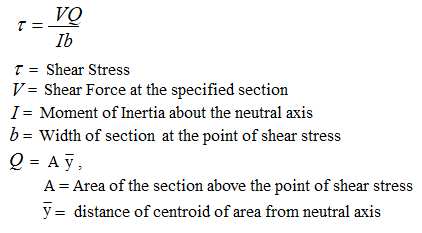
The formula for calculating shear stress is given by the equation: τ = F/A, where τ is the shear stress, F is the force applied, and A is the cross-sectional area of the material. This formula is widely used in mechanics of materials to determine the shear stress that a material is subjected to.
Understanding Shear Stress Formula
The shear stress formula is used to calculate the stress that a material experiences when a force is applied parallel to one of its faces. The formula is simple, yet it requires a good understanding of the parameters involved. The force (F) is the external load applied to the material, and the cross-sectional area (A) is the area of the material that is perpendicular to the force. The shear stress (τ) is then calculated by dividing the force by the cross-sectional area.
- The formula is τ = F/A, where τ is the shear stress.
- The force (F) is the external load applied to the material.
- The cross-sectional area (A) is the area of the material that is perpendicular to the force.
Importance of Shear Stress in Engineering
Shear stress is a critical parameter in engineering as it helps to determine the strength and stability of a material or a structure. When a material is subjected to shear stress, it can lead to deformation or even failure. Therefore, engineers need to calculate the shear stress to ensure that the material or structure can withstand the loads and stresses that it will be subjected to.
- Shear stress is a critical parameter in engineering.
- It helps to determine the strength and stability of a material or a structure.
- Engineers need to calculate the shear stress to ensure that the material or structure can withstand the loads and stresses.
Factors Affecting Shear Stress
There are several factors that can affect the shear stress of a material, including the type of material, the size and shape of the material, and the temperature and environmental conditions. The type of material is an important factor as different materials have different properties and strengths. The size and shape of the material can also affect the shear stress as it can change the cross-sectional area and the distribution of forces.
- The type of material is an important factor that affects the shear stress.
- The size and shape of the material can affect the shear stress.
- The temperature and environmental conditions can also affect the shear stress.
Calculating Shear Stress in Real-World Scenarios
Calculating shear stress in real-world scenarios requires a good understanding of the parameters involved and the formulas used. In real-world scenarios, the forces and loads can be complex and dynamic, making it challenging to calculate the shear stress. However, by using the formulas and principles of mechanics of materials, engineers can calculate the shear stress and design structures and materials that can withstand the loads and stresses.
- Calculating shear stress in real-world scenarios requires a good understanding of the parameters involved.
- The forces and loads can be complex and dynamic in real-world scenarios.
- Engineers can calculate the shear stress using the formulas and principles of mechanics of materials.
Applications of Shear Stress in Various Fields
The concept of shear stress has applications in various fields, including civil engineering, mechanical engineering, and materials science. In civil engineering, shear stress is used to design buildings and bridges that can withstand natural disasters such as earthquakes and hurricanes. In mechanical engineering, shear stress is used to design machines and mechanisms that can withstand the forces and stresses involved.
- The concept of shear stress has applications in various fields.
- Shear stress is used in civil engineering to design buildings and bridges.
- Shear stress is used in mechanical engineering to design machines and mechanisms.
How do you calculate shear stress force?
To calculate shear stress force, you need to use the formula: shear stress (τ) = force (F) / area (A). This formula is commonly used in engineering and physics to determine the amount of deformation that occurs when a force is applied parallel to a surface. The unit of measurement for shear stress is typically pascals (Pa) or newtons per square meter (N/m²).
Understanding Shear Stress
Shear stress is a type of stress that occurs when a force is applied parallel to a surface, causing the material to deform. To calculate shear stress, you need to know the force applied and the area over which it is applied. The formula for shear stress is: τ = F / A. Some key points to consider when calculating shear stress include:
- Force: The amount of force applied parallel to the surface.
- Area: The area over which the force is applied.
- Material properties: The properties of the material, such as its elastic modulus and poisson's ratio, can affect the amount of deformation that occurs.
Shear Stress in Different Materials
The calculation of shear stress can vary depending on the type of material being used. For example, metals and alloys tend to have a linear elastic response to shear stress, while polymers and composites may exhibit non-linear behavior. To calculate shear stress in different materials, you need to consider the material properties, such as its yield strength and ultimate strength. Some key points to consider include:
- Material type: The type of material being used, such as metal, polymer, or composite.
- Yield strength: The amount of stress required to cause the material to yield or deform.
- Ultimate strength: The maximum amount of stress that the material can withstand before failing.
Calculating Shear Stress in Beams
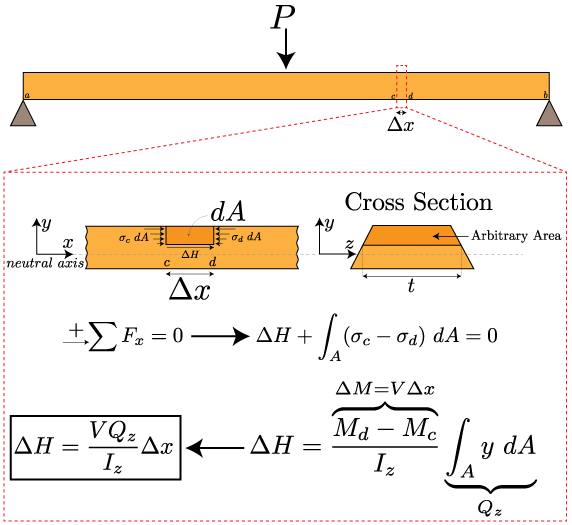
When calculating shear stress in beams, you need to consider the bending moment and the shear force. The formula for shear stress in beams is: τ = V / (t b), where V is the shear force, t is the thickness of the beam, and b is the width of the beam. Some key points to consider include:
- Bending moment: The amount of moment applied to the beam, which can cause it to bend.
- Shear force: The amount of force applied parallel to the surface of the beam.
- Beam dimensions: The dimensions of the beam, such as its length, width, and thickness.
Shear Stress in Fluids
Shear stress can also occur in fluids, such as liquids and gases. In fluids, shear stress is caused by the viscosity of the fluid, which is a measure of its resistance to flow. The formula for shear stress in fluids is: τ = μ (du/dy), where μ is the dynamic viscosity of the fluid, and du/dy is the velocity gradient. Some key points to consider include:
- Viscosity: The measure of a fluid's resistance to flow.
- Velocity gradient: The rate of change of velocity with respect to distance.
- Fluid properties: The properties of the fluid, such as its density and surface tension.
Applications of Shear Stress Calculation
The calculation of shear stress has many practical applications in various fields, such as engineering, architecture, and materials science. For example, it is used to design buildings, bridges, and aircraft, as well as to predict the failure of materials under stress. Some key points to consider include:
- Design: The calculation of shear stress is used to design structures and machines.
- Materials selection: The calculation of shear stress is used to select the materials for a particular application.
- Failure prediction: The calculation of shear stress is used to predict the failure of materials under stress.
How do you calculate shear stress test?

To calculate shear stress, you need to understand the forces acting on a material and how they cause it to deform. Shear stress is a measure of the force that causes a material to deform by sliding along a plane parallel to the direction of the force. The formula to calculate shear stress is: τ = F / A, where τ is the shear stress, F is the force applied, and A is the cross-sectional area of the material.
Understanding Shear Stress Test
The shear stress test is a critical experiment in materials science that helps determine the mechanical properties of a material. To calculate shear stress, you need to know the force applied and the cross-sectional area of the material. The shear stress test involves applying a force to a material and measuring the resulting deformation. The test can be performed using various techniques, including:
- Torsion test: This involves twisting a material to measure its shear properties.
- Bending test: This involves bending a material to measure its shear properties.
- Shear test: This involves applying a force parallel to the surface of a material to measure its shear properties.
Importance of Shear Stress Test
The shear stress test is essential in various fields, including engineering and materials science. It helps determine the strength and durability of a material, which is critical in designing and building structures, machines, and other products. The test also helps identify the failure mode of a material, which is essential in understanding its behavior under different loading conditions. Some of the key applications of shear stress test include:
- Designing aircraft: The shear stress test is used to determine the structural integrity of aircraft components.
- Building construction: The test is used to determine the strength of building materials, such as beams and columns.
- Automotive engineering: The test is used to determine the durability of automotive components, such as engine mounts and suspension systems.
Factors Affecting Shear Stress Test
Several factors can affect the results of a shear stress test, including the temperature, humidity, and loading rate. The test can also be influenced by the material properties, such as its elastic modulus and poisson's ratio. Additionally, the test methodology and equipment used can also impact the results. Some of the key factors to consider when performing a shear stress test include:
- Temperature control: The test should be performed at a controlled temperature to ensure accurate results.
- Humidity control: The test should be performed in a controlled humidity environment to ensure accurate results.
- Loading rate control: The test should be performed at a controlled loading rate to ensure accurate results.
Interpreting Shear Stress Test Results
Interpreting the results of a shear stress test requires a thorough understanding of the material properties and the test methodology. The results can provide valuable insights into the mechanical behavior of a material, including its strength, stiffness, and ductility. The results can also be used to predict the behavior of a material under different loading conditions. Some of the key aspects to consider when interpreting shear stress test results include:
- Stress-strain curve: The stress-strain curve can provide valuable insights into the material's mechanical behavior.
- Ultimate shear strength: The ultimate shear strength can provide valuable insights into the material's strength.
- Shear modulus: The shear modulus can provide valuable insights into the material's stiffness.
Applications of Shear Stress Test
The shear stress test has numerous applications in various fields, including aerospace, automotive, and construction. The test can be used to design and optimize structures, machines, and other products. It can also be used to evaluate the performance of materials and components. Some of the key applications of shear stress test include:
- Structural analysis: The test can be used to analyze the structural integrity of buildings, bridges, and other structures.
- Machine design: The test can be used to design and optimize machines, such as gears, bearings, and other mechanical components.
- Material selection: The test can be used to evaluate the performance of different materials and select the most suitable one for a specific application.
How do you calculate shear stress distribution?

To calculate shear stress distribution, it's essential to understand the mechanics of materials and the stress that occurs within a material when it's subjected to an external force. Shear stress is a type of stress that causes a material to deform by sliding along a plane parallel to the direction of the force. The distribution of shear stress within a material can be calculated using various mathematical models and equations, taking into account the material's geometry, properties, and the applied load.
Understanding Shear Stress Basics
Shear stress is calculated as the force per unit area of a material, and it's typically denoted by the symbol τ (tau). The distribution of shear stress within a material can be determined by analyzing the internal forces that act on the material. This can be done by using the equilibrium equations, which state that the sum of all forces acting on a material must be equal to zero. The calculation of shear stress distribution involves the following steps:
- Define the geometry of the material and the applied load
- Determine the internal forces that act on the material
- Use the equilibrium equations to calculate the shear stress at different points within the material
Calculating Shear Stress using the Beam Theory
The beam theory is a widely used method for calculating shear stress distribution in beams and columns. This theory assumes that the material is linear elastic and that the load is applied in a static manner. The shear stress is calculated using the formula: τ = VQ/It, where V is the shear force, Q is the first moment of area, I is the moment of inertia, and t is the thickness of the material. The calculation involves the following steps:
- Determine the shear force and bending moment diagrams for the beam
- Calculate the first moment of area and moment of inertia for the beam's cross-section
- Use the formula to calculate the shear stress at different points along the beam
Using the Finite Element Method for Shear Stress Calculation
The finite element method is a numerical technique used to calculate shear stress distribution in complex geometries and non-linear materials. This method involves dividing the material into small elements and solving the equilibrium equations for each element. The shear stress is calculated using the principle of virtual work, which states that the virtual work done by the internal forces must be equal to the virtual work done by the external forces. The calculation involves the following steps:
- Divide the material into small elements using a meshing algorithm
- Define the material properties and boundary conditions for each element
- Solve the equilibrium equations for each element using a numerical method
Accounting for Material Non-Linearity in Shear Stress Calculation
Material non-linearity can significantly affect the shear stress distribution within a material. Non-linear materials exhibit a non-linear stress-strain relationship, which means that the stress is not directly proportional to the strain. To account for material non-linearity, non-linear material models can be used, such as the Ramberg-Osgood model or the Ludwik model. The calculation involves the following steps:
- Define the non-linear material model and its parameters
- Calculate the stress-strain relationship for the material using the non-linear model
- Use the non-linear stress-strain relationship to calculate the shear stress at different points within the material
Experimental Methods for Measuring Shear Stress Distribution
Experimental methods can be used to measure the shear stress distribution within a material. These methods include strain gauges, photoelasticity, and digital image correlation. Strain gauges measure the strain at specific points on the material's surface, while photoelasticity and digital image correlation measure the strain and stress fields within the material. The calculation involves the following steps:
- Apply strain gauges or photoelastic coatings to the material's surface
- Measure the strain or stress fields using a data acquisition system
- Use the measured data to calculate the shear stress distribution within the material
Frequently Asked Questions (FAQs)
What is the Shear Webs with Beads Stress Formula and how is it used in engineering applications?
The Shear Webs with Beads Stress Formula is a mathematical equation used to calculate the stress and strain on webs with beads in various engineering applications, such as aerospace, automotive, and civil engineering. This formula takes into account the geometric parameters of the web, including the thickness, width, and length, as well as the material properties, such as the Young's modulus and Poisson's ratio. By using this formula, engineers can predict the stress and strain on the web and optimize the design to minimize the risk of failure. The Shear Webs with Beads Stress Formula is a powerful tool for engineers to analyze and design complex structures, and it has been widely used in various fields, including mechanical engineering, structural engineering, and materials science.
How does the Shear Webs with Beads Stress Calculator work and what are its limitations?
The Shear Webs with Beads Stress Calculator is a computational tool that uses the Shear Webs with Beads Stress Formula to calculate the stress and strain on webs with beads. This calculator takes into account the input parameters, such as the geometric parameters and material properties, and uses numerical methods to solve the equation and obtain the results. The calculator is user-friendly and easy to use, and it provides accurate and reliable results. However, the calculator has some limitations, such as the assumptions made in the formula, which may not be valid in all cases. For example, the formula assumes that the material is isotropic and homogeneous, which may not be true for all materials. Additionally, the calculator may not be able to handle complex geometries or nonlinear materials, and it may require additional input or simplifications to obtain accurate results.
What are the key factors that affect the stress and strain on shear webs with beads, and how can they be optimized?
The stress and strain on shear webs with beads are affected by several key factors, including the geometric parameters, such as the thickness, width, and length, as well as the material properties, such as the Young's modulus and Poisson's ratio. The size and shape of the beads also play a crucial role in determining the stress and strain on the web. To optimize the design, engineers can use parametric studies to investigate the effect of different parameters on the stress and strain. For example, they can vary the thickness of the web or the size of the beads to minimize the stress and maximize the strength. Additionally, engineers can use optimization techniques, such as genetic algorithms or finite element methods, to find the optimal design that meets the requirements.
How can the Shear Webs with Beads Stress Formula and Calculator be used in conjunction with other tools and techniques to enhance the design and analysis of complex structures?
The Shear Webs with Beads Stress Formula and Calculator can be used in conjunction with other tools and techniques to enhance the design and analysis of complex structures. For example, engineers can use finite element methods to model the behavior of the structure under different loading conditions, and then use the Shear Webs with Beads Stress Formula to calculate the stress and strain on the web. Additionally, engineers can use computational fluid dynamics to simulate the flow of fluids around the structure, and then use the Shear Webs with Beads Stress Formula to calculate the stress and strain on the web due to fluid loading. By combining these tools and techniques, engineers can gain a more comprehensive understanding of the behavior of complex structures and optimize their design to meet the requirements. The Shear Webs with Beads Stress Formula and Calculator can also be used in conjunction with machine learning algorithms to predict the stress and strain on the web based on historical data and sensor readings.
Deja una respuesta
Entradas Relacionadas