
Sample Size Calculator for Prevalence Studies


Determining the appropriate sample size is crucial in prevalence studies to ensure accurate and reliable estimates. A sample size calculator can be a valuable tool in achieving this goal. By inputting key parameters such as expected prevalence, desired precision, and confidence level, researchers can calculate the required sample size to detect statistically significant results. This calculator can help researchers design efficient studies, minimize costs, and increase the validity of their findings, ultimately contributing to better decision-making in various fields, including public health, epidemiology, and social sciences. Accurate sample size calculation is essential for meaningful research outcomes.
- Sample Size Calculator for Prevalence Studies: A Comprehensive Guide
- How to calculate sample size for a prevalence study?
- What is the sampling technique for prevalence study?
- How to calculate sample size for rare disease?
- How to calculate sample size needed for a study?
-
Frequently Asked Questions (FAQs)
- What is the purpose of a Sample Size Calculator for Prevalence Studies?
- How do I use a Sample Size Calculator for Prevalence Studies?
- What are the key factors that affect the sample size calculation for Prevalence Studies?
- Can I use a Sample Size Calculator for Prevalence Studies for other types of research studies?
Sample Size Calculator for Prevalence Studies: A Comprehensive Guide
The sample size calculator for prevalence studies is a statistical tool used to determine the required sample size for a study to achieve a certain level of precision and confidence in estimating the prevalence of a particular outcome or characteristic. This calculator takes into account several factors, including the expected prevalence, confidence level, and margin of error, to provide an accurate estimate of the required sample size.
Understanding the Importance of Sample Size in Prevalence Studies
In prevalence studies, the sample size is crucial in ensuring that the results are generalizable to the population of interest. A sample that is too small may not accurately represent the population, leading to biased estimates of prevalence. On the other hand, a sample that is too large may be cost-prohibitive and inefficient. Therefore, it is essential to determine the optimal sample size to achieve a balance between precision and feasibility.
Key Factors Affecting Sample Size Calculations
Several factors affect the sample size calculations for prevalence studies, including:
Expected prevalence: The anticipated prevalence of the outcome or characteristic of interest.
Confidence level: The desired level of confidence in the estimates, typically set at 95%.
Margin of error: The acceptable level of error in the estimates, typically set at 5%.
Sample design: The method of selecting the sample, such as random sampling or stratified sampling.
Using a Sample Size Calculator for Prevalence Studies
A sample size calculator for prevalence studies can be used to determine the required sample size based on the input parameters. The calculator typically requires the user to input the expected prevalence, confidence level, and margin of error, and then provides an estimate of the required sample size. For example:
| Expected Prevalence | Confidence Level | Margin of Error | Required Sample Size |
|---|---|---|---|
| 0.1 | 95% | 5% | 384 |
| 0.2 | 95% | 5% | 246 |
| 0.3 | 95% | 5% | 171 |
Advantages and Limitations of Sample Size Calculators
The use of sample size calculators for prevalence studies has several advantages, including:
Increased accuracy: Sample size calculators provide an accurate estimate of the required sample size.
Improved efficiency: Sample size calculators help to avoid over-sampling or under-sampling.
However, there are also some limitations, including:
Assuming a fixed population size: Sample size calculators assume a fixed population size, which may not always be the case.
Ignoring other sources of error: Sample size calculators may not account for other sources of error, such as non-response bias.
Best Practices for Using Sample Size Calculators in Prevalence Studies
To get the most out of sample size calculators for prevalence studies, it is essential to follow best practices, including:
Using a reliable calculator: Choose a calculator that is based on sound statistical principles.
Inputting accurate parameters: Ensure that the input parameters, such as expected prevalence and confidence level, are accurate and reliable.
Considering other sources of error: Take into account other sources of error, such as non-response bias, when interpreting the results.
How to calculate sample size for a prevalence study?
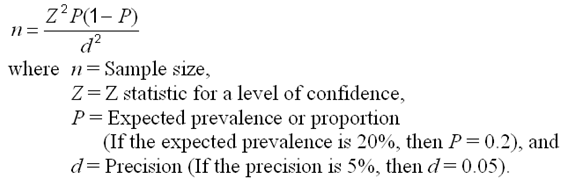
To calculate the sample size for a prevalence study, you need to consider several factors, including the expected prevalence of the condition, the desired level of precision, and the confidence level. The sample size calculation is typically done using a formula that takes into account these factors. The formula is: n = (Z^2 p (1-p)) / E^2, where n is the sample size, Z is the Z-score corresponding to the desired confidence level, p is the expected prevalence, and E is the desired level of precision.
Understanding the Formula
The formula for calculating the sample size for a prevalence study is based on the confidence interval and the margin of error. The confidence interval is the range of values within which the true prevalence is likely to lie, and the margin of error is the amount of error that is allowed in the estimate. To use the formula, you need to specify the confidence level and the desired level of precision. For example, if you want to estimate the prevalence of a condition with a confidence level of 95% and a margin of error of 5%, you would use the formula to calculate the required sample size.
- The confidence level is the probability that the true prevalence lies within the confidence interval.
- The margin of error is the amount of error that is allowed in the estimate.
- The sample size is the number of individuals that need to be included in the study to achieve the desired level of precision.
Factors Affecting Sample Size
Several factors can affect the sample size required for a prevalence study, including the expected prevalence of the condition, the desired level of precision, and the confidence level. The sample size will be larger if the expected prevalence is low, the desired level of precision is high, or the confidence level is high. Additionally, the sample size may need to be adjusted for non-response or missing data.
- The expected prevalence of the condition affects the sample size, with lower prevalences requiring larger sample sizes.
- The desired level of precision affects the sample size, with higher levels of precision requiring larger sample sizes.
- The confidence level affects the sample size, with higher confidence levels requiring larger sample sizes.
Calculating Sample Size for a Prevalence Study
To calculate the sample size for a prevalence study, you need to follow several steps. First, specify the expected prevalence of the condition, the desired level of precision, and the confidence level. Then, use the formula to calculate the required sample size. You may also need to adjust the sample size for non-response or missing data.
- Specify the expected prevalence of the condition.
- Specify the desired level of precision.
- Specify the confidence level.
Using a Sample Size Calculator
A sample size calculator can be used to calculate the sample size required for a prevalence study. The calculator typically requires you to input the expected prevalence, the desired level of precision, and the confidence level. The calculator then uses the formula to calculate the required sample size.
- The sample size calculator is a useful tool for calculating the required sample size.
- The calculator requires input of the expected prevalence, the desired level of precision, and the confidence level.
- The calculator uses the formula to calculate the required sample size.
Interpreting the Results
Once you have calculated the sample size required for a prevalence study, you need to interpret the results. The sample size will give you an estimate of the number of individuals that need to be included in the study to achieve the desired level of precision. You should also consider the confidence interval and the margin of error when interpreting the results.
- The sample size gives an estimate of the number of individuals that need to be included in the study.
- The confidence interval gives the range of values within which the true prevalence is likely to lie.
- The margin of error gives the amount of error that is allowed in the estimate.
What is the sampling technique for prevalence study?

The sampling technique for a prevalence study is a crucial aspect of epidemiological research. It involves selecting a representative sample of the population to estimate the prevalence of a particular disease, condition, or characteristic. The goal of the sampling technique is to ensure that the sample is generalizable to the larger population, allowing researchers to make inferences about the prevalence of the condition being studied.
Types of Sampling Techniques
The most common sampling techniques used in prevalence studies are probability sampling and non-probability sampling. Probability sampling involves selecting participants randomly from the population, while non-probability sampling involves selecting participants based on certain characteristics or criteria. Some common types of sampling techniques include:
- Simple Random Sampling: involves selecting participants randomly from the population
- Stratified Sampling: involves dividing the population into subgroups and selecting participants randomly from each subgroup
- Cluster Sampling: involves selecting groups of participants from the population and then selecting individuals from within those groups
Advantages of Probability Sampling
Probability sampling has several advantages in prevalence studies, including the ability to produce unbiased estimates of the population parameter and to allow for the calculation of confidence intervals. Additionally, probability sampling allows researchers to generalize their findings to the larger population. Some key benefits of probability sampling include:
- Representativeness: probability sampling ensures that the sample is representative of the population
- Unbiasedness: probability sampling reduces the risk of bias in the sample
- Generalizability: probability sampling allows researchers to make inferences about the population
Challenges of Non-Probability Sampling
Non-probability sampling, on the other hand, has several challenges in prevalence studies, including the risk of bias and the difficulty of generalizing findings to the larger population. Non-probability sampling methods, such as convenience sampling and snowball sampling, can be prone to selection bias and may not produce representative samples. Some common challenges of non-probability sampling include:
- : non-probability sampling methods can be prone to selection bias
- Lack of Generalizability: non-probability sampling methods may not allow for generalization to the larger population
- Limited Representativeness: non-probability sampling methods may not produce representative samples
Importance of Sample Size
The sample size is a critical aspect of prevalence studies, as it affects the precision of the estimates and the ability to detect statistically significant differences. A larger sample size provides more precise estimates and increases the power of the study to detect significant differences. Some key considerations for determining sample size include:
- Precision: a larger sample size provides more precise estimates
- Power: a larger sample size increases the power of the study to detect significant differences
- Alpha Level: the alpha level, or significance level, affects the required sample size
Role of Statistics in Prevalence Studies
Statistics play a crucial role in prevalence studies, as they provide a way to analyze and interpret the data. Statistical methods, such as confidence intervals and hypothesis testing, allow researchers to make inferences about the population and to estimate the prevalence of the condition being studied. Some common statistical methods used in prevalence studies include:
- Confidence Intervals: provide a range of values within which the true population parameter is likely to lie
- Hypothesis Testing: allows researchers to test hypotheses about the population parameter
- Regression Analysis: allows researchers to model the relationship between variables
How to calculate sample size for rare disease?

To calculate the sample size for a rare disease, it is essential to consider the prevalence of the disease, the desired precision, and the confidence level. The sample size calculation depends on the study design, whether it is a prevalence study, incidence study, or clinical trial. The rare disease is typically defined as a disease that affects less than 1 in 2,000 people, making it challenging to recruit a sufficient number of participants. The sample size calculation should take into account the expected effect size, the variability of the outcome measure, and the statistical power.
Understanding the Study Design
The study design plays a crucial role in determining the sample size for a rare disease. The researcher must decide on the type of study, whether it is a case-control study, cohort study, or clinical trial. The study design will influence the sample size calculation, as each design has its own set of assumptions and requirements. For example, a case-control study requires a different sample size calculation than a clinical trial. The following are some key points to consider:
- The study design should be chosen based on the research question and the availability of data.
- The sample size calculation should take into account the study design and its assumptions.
- The researcher should consult with a statistician to ensure the study design is appropriate and the sample size calculation is accurate.
Determining the Desired Precision
The desired precision is the margin of error that the researcher is willing to accept. The desired precision will influence the sample size calculation, as a smaller margin of error requires a larger sample size. The researcher must balance the desired precision with the feasibility of recruiting a sufficient number of participants. The following are some key points to consider:
- The desired precision should be determined based on the research question and the importance of the results.
- A smaller margin of error requires a larger sample size, which can be challenging for rare diseases.
- The researcher should consider the trade-offs between precision and feasibility when determining the desired precision.
Considering the Confidence Level
The confidence level is the probability that the sample estimate will fall within the desired precision of the true population parameter. The confidence level will influence the sample size calculation, as a higher confidence level requires a larger sample size. The researcher must choose a confidence level that balances the need for precision with the feasibility of recruiting a sufficient number of participants. The following are some key points to consider:
- The confidence level should be determined based on the research question and the importance of the results.
- A higher confidence level requires a larger sample size, which can be challenging for rare diseases.
- The researcher should consult with a statistician to ensure the confidence level is appropriate and the sample size calculation is accurate.
Estimating the Prevalence of the Disease
The prevalence of the rare disease is essential for calculating the sample size. The prevalence can be estimated from previous studies, registry data, or expert opinion. The researcher must ensure that the prevalence estimate is accurate and up-to-date, as this will influence the sample size calculation. The following are some key points to consider:
- The prevalence estimate should be based on reliable sources, such as previous studies or registry data.
- The prevalence estimate should be updated regularly to reflect changes in the disease burden.
- The researcher should consult with a statistician to ensure the prevalence estimate is accurate and the sample size calculation is reliable.
Using Software for Sample Size Calculation
There are several software programs available for calculating the sample size for a rare disease. These programs can help researchers ensure that their sample size calculation is accurate and reliable. The following are some key points to consider:
- The software program should be chosen based on the study design and the type of data.
- The software program should be validated to ensure that it produces accurate results.
- The researcher should consult with a statistician to ensure the software program is used correctly and the sample size calculation is reliable.
How to calculate sample size needed for a study?
To calculate the sample size needed for a study, you need to consider several factors, including the research question, the study design, and the desired level of precision. The sample size calculation is a critical step in the research process, as it determines the number of participants or observations required to achieve statistically significant results. A sample size that is too small may not provide reliable results, while a sample size that is too large may be unnecessary and resource-intensive.
Understanding the Research Question
The research question is the foundation of the study, and it guides the sample size calculation. To determine the sample size, you need to understand the research objective, the study population, and the outcomes of interest. A clear research question helps to identify the target population, the sampling frame, and the inclusion and exclusion criteria. For example, a study on the effectiveness of a new treatment may require a sample size calculation based on the expected treatment effect, the variability of the outcome, and the desired level of precision.
- Define the research question and objectives
- Identify the study population and sampling frame
- Determine the outcomes of interest and the desired level of precision
Types of Sample Size Calculations
There are several types of sample size calculations, including proportion, mean, and regression. The type of calculation depends on the research question, the study design, and the data type. For example, a study on the prevalence of a disease may require a proportion sample size calculation, while a study on the relationship between a predictor and an outcome may require a regression sample size calculation.
- Determine the type of sample size calculation needed
- Identify the relevant parameters and assumptions
- Use a sample size calculation formula or software to determine the required sample size
Factors Affecting Sample Size
Several factors can affect the sample size calculation, including the alpha level, the power, and the effect size. The alpha level, also known as the significance level, determines the type I error rate, while the power determines the type II error rate. The effect size, also known as the treatment effect, determines the magnitude of the difference between the treatment and control groups.
- Determine the alpha level and power for the study
- Estimate the effect size and its variability
- Consider other factors that may affect the sample size, such as missing data and dropout rates
Sample Size Calculation Formulas
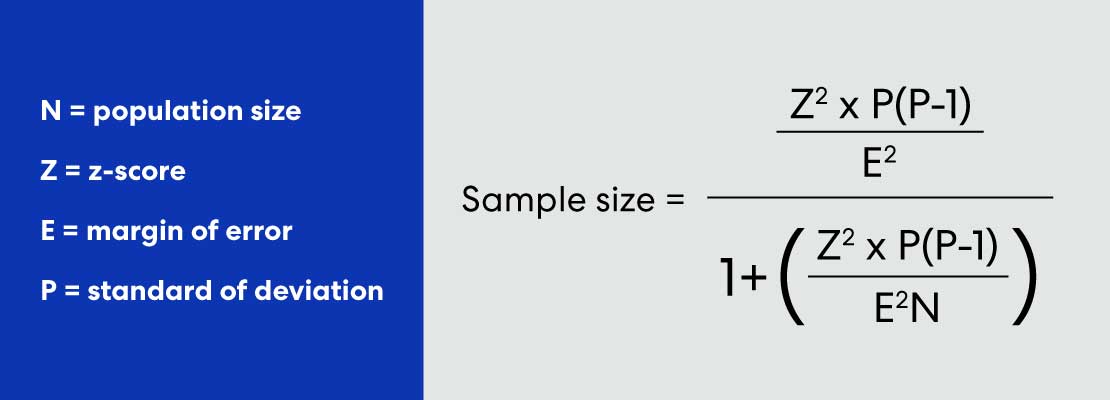
There are several sample size calculation formulas available, including the Z-test and the t-test. These formulas require input parameters, such as the alpha level, power, and effect size, to calculate the required sample size. For example, the Z-test formula for a proportion sample size calculation is: n = (Z^2 p (1-p)) / E^2, where n is the sample size, Z is the Z-score, p is the proportion, and E is the margin of error.
- Choose a sample size calculation formula or software
- Input the required parameters and assumptions
- Calculate the required sample size and consider sensitivity analyses
Software for Sample Size Calculation
There are several software programs available for sample size calculation, including GPower, R, and SAS. These programs provide user-friendly interfaces and statistical algorithms to calculate the required sample size. For example, GPower provides a sample size calculation module that allows users to input parameters and assumptions to calculate the required sample size.
- Choose a software program for sample size calculation
- Input the required parameters and assumptions
- Calculate the required sample size and consider validation and verification
Frequently Asked Questions (FAQs)
What is the purpose of a Sample Size Calculator for Prevalence Studies?
The purpose of a Sample Size Calculator for Prevalence Studies is to determine the optimal sample size required to estimate the prevalence of a particular disease, condition, or characteristic within a population. This is crucial in epidemiological research as it helps researchers to design studies that are statistically powerful and cost-effective. By using a Sample Size Calculator, researchers can avoid collecting too little data, which can lead to imprecise estimates, or collecting too much data, which can be wasteful and inefficient. The calculator takes into account factors such as the expected prevalence, desired precision, and confidence level to calculate the required sample size.
How do I use a Sample Size Calculator for Prevalence Studies?
Using a Sample Size Calculator for Prevalence Studies is a straightforward process that involves inputting several key parameters. The first step is to estimate the expected prevalence of the disease or condition being studied, which is typically expressed as a percentage or proportion. The next step is to specify the desired precision, which is the margin of error that is acceptable for the study. The confidence level is also an important parameter, which is typically set at 95%. Once these parameters have been inputted, the calculator will generate the required sample size. It is also important to consider other factors such as the study design, population size, and sampling method when using a Sample Size Calculator.
What are the key factors that affect the sample size calculation for Prevalence Studies?
The sample size calculation for Prevalence Studies is influenced by several key factors, including the expected prevalence, desired precision, and confidence level. The expected prevalence is a critical factor, as it determines the sample size required to estimate the prevalence with a given level of precision. The desired precision is also an important factor, as it affects the width of the confidence interval. A narrower confidence interval requires a larger sample size, while a wider confidence interval requires a smaller sample size. The confidence level is another important factor, as it determines the probability that the true prevalence lies within the confidence interval. Other factors such as the population size, sampling method, and study design can also influence the sample size calculation.
Can I use a Sample Size Calculator for Prevalence Studies for other types of research studies?
While a Sample Size Calculator for Prevalence Studies is designed specifically for epidemiological research, it can be adapted for use in other types of research studies. For example, it can be used in clinical trials to estimate the sample size required to detect a specific effect size. It can also be used in social science research to estimate the sample size required to estimate the prevalence of a particular behavior or attitude. However, it is important to consider the specific research question and study design when using a Sample Size Calculator, as different types of studies may require different types of calculations. Additionally, it is recommended to consult with a statistician or research methodologist to ensure that the calculator is being used appropriately and that the results are interpretable and valid. Researchers should also be aware of the assumptions and limitations of the calculator and take these into account when interpreting the results.
Deja una respuesta
Entradas Relacionadas