
Hertz Gear Tooth Contact Stress Equation and Calculator


The Hertz gear tooth contact stress equation is a fundamental concept in mechanical engineering, used to calculate the maximum stress that occurs at the contact point between two gears. This stress is crucial in determining the durability and lifespan of gears in various mechanical systems. The equation takes into account factors such as the radius of curvature, the elastic modulus, and the applied load. By using the Hertz gear tooth contact stress equation and calculator, engineers can design and optimize gear systems to withstand the stresses and loads imposed upon them, ensuring efficient and reliable performance.
- Hertz Gear Tooth Contact Stress Equation and Calculator
- What is Hertz contact stress?
- What is the Hertzian stress of a gear?
-
Frequently Asked Questions (FAQs)
- What is the Hertz Gear Tooth Contact Stress Equation and how is it used in engineering applications?
- What are the key factors that influence the Hertz Gear Tooth Contact Stress Equation and how do they impact the calculation results?
- How is the Hertz Gear Tooth Contact Stress Calculator used in practice, and what are its advantages and limitations?
- What are the implications of the Hertz Gear Tooth Contact Stress Equation and Calculator for gear design and failure analysis, and how can they be used to improve gear reliability and performance?
Hertz Gear Tooth Contact Stress Equation and Calculator
The Hertz gear tooth contact stress equation is a mathematical formula used to calculate the maximum contact stress between two gear teeth in mesh. This equation is essential in gear design, as it helps engineers to determine the maximum stress that the gear teeth can withstand without failing. The equation takes into account the geometry of the gear teeth, the material properties of the gears, and the load applied to the gears. The Hertz gear tooth contact stress equation is widely used in the design of gearboxes, transmissions, and other mechanical systems that involve gear tooth contact.
Introduction to Hertz Gear Tooth Contact Stress Equation
The Hertz gear tooth contact stress equation is based on the work of Heinrich Hertz, a German physicist who developed a theory of contact mechanics in the late 19th century. The equation is derived from the Hertz contact theory, which describes the stress distribution between two elastic bodies in contact. The equation has been widely used in the design of gear teeth, as it provides a reliable and accurate method for calculating the maximum contact stress.
Derivation of Hertz Gear Tooth Contact Stress Equation
The Hertz gear tooth contact stress equation is derived from the elastic theory of contact mechanics. The equation is based on the assumption that the gear teeth are elastic and that the contact between the teeth is frictionless. The equation takes into account the radius of curvature of the gear teeth, the elastic modulus of the gear material, and the Poisson's ratio of the gear material. The equation is as follows:
| Variable | Description |
|---|---|
| σ | Contact stress |
| E | Elastic modulus |
| ν | Poisson's ratio |
| R | Radius of curvature |
| F | Load |
Application of Hertz Gear Tooth Contact Stress Equation
The Hertz gear tooth contact stress equation is widely used in the design of gear teeth. The equation is used to calculate the maximum contact stress between two gear teeth in mesh, which is essential in determining the strength and reliability of the gear teeth. The equation is also used to optimize the geometry of the gear teeth, the material properties of the gears, and the load applied to the gears.
Limitations of Hertz Gear Tooth Contact Stress Equation
The Hertz gear tooth contact stress equation has several limitations. The equation assumes that the gear teeth are elastic and that the contact between the teeth is frictionless, which is not always the case in practice. The equation also assumes that the radius of curvature of the gear teeth is constant, which is not always true. Additionally, the equation does not take into account the dynamics of the gear teeth, such as the vibrations and impact loads that can occur during operation.
Calculator for Hertz Gear Tooth Contact Stress Equation
A calculator for the Hertz gear tooth contact stress equation can be used to simplify the calculation process. The calculator can be programmed to take into account the geometry of the gear teeth, the material properties of the gears, and the load applied to the gears. The calculator can also be used to optimize the design of the gear teeth and to predict the performance of the gear teeth under different operating conditions. The calculator can be a software program or a spreadsheet that uses the Hertz gear tooth contact stress equation to calculate the maximum contact stress.
What is Hertz contact stress?
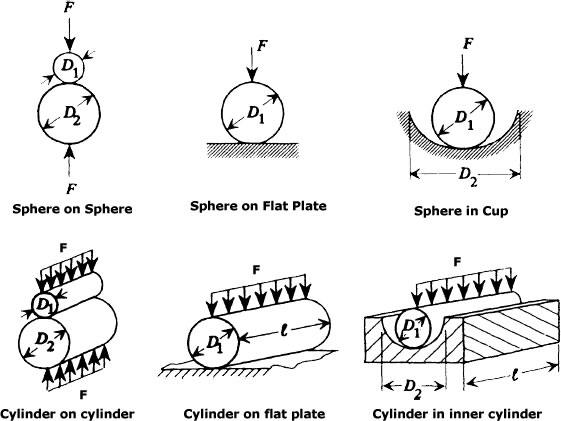
Hertz contact stress refers to the stress and deformation that occurs when two elastic bodies are in contact with each other, typically under a normal load. This phenomenon is named after the German physicist Heinrich Hertz, who first described it in the late 19th century. The Hertz contact stress is a critical factor in the design and analysis of mechanical systems, as it can lead to wear, fatigue, and failure of components.
Causes of Hertz Contact Stress
The Hertz contact stress is caused by the normal load applied to the contact area between two elastic bodies. When the load is applied, the contact area deforms, resulting in a stress distribution that can be described using the Hertz contact theory. The stress and deformation can be affected by various factors, including the material properties, surface roughness, and geometry of the contacting bodies. Some key factors that contribute to Hertz contact stress include:
- Normal load: The magnitude of the load applied to the contact area
- Material properties: The elastic modulus, Poisson's ratio, and other properties of the contacting materials
- Surface roughness: The roughness and texture of the contacting surfaces
Effects of Hertz Contact Stress
The Hertz contact stress can have significant effects on the performance and lifetime of mechanical systems. Some of the potential effects include wear, fatigue, and failure of components, as well as vibration and noise. The stress and deformation caused by Hertz contact can also lead to damage and degradation of the contacting surfaces. Key effects of Hertz contact stress include:
- Wear: The removal of material from the contacting surfaces due to friction and adhesion
- Fatigue: The crack initiation and propagation caused by cyclic loading and stress
- Failure: The catastrophic failure of components due to excessive stress and deformation
Hertz Contact Theory
The Hertz contact theory provides a mathematical framework for analyzing the stress and deformation caused by Hertz contact. The theory assumes that the contacting bodies are elastic and isotropic, and that the contact area is small compared to the size of the bodies. The Hertz contact theory can be used to predict the stress distribution, contact area, and deformation caused by Hertz contact. Key aspects of the Hertz contact theory include:
- Elastic deformation: The deformation of the contacting bodies due to normal load and friction
- Stress distribution: The distribution of stress within the contacting bodies
- Contact area: The size and shape of the contact area between the bodies
Applications of Hertz Contact Stress
The Hertz contact stress is an important factor in the design and analysis of mechanical systems, including gears, bearings, and cam followers. The Hertz contact stress can be used to predict the lifetime and performance of these systems, and to optimize their design for reliability and efficiency. Key applications of Hertz contact stress include:
- Gear design: The design of gears and gearboxes for optimal performance and reliability
- Bearing design: The design of bearings and bearing systems for optimal performance and lifetime
- Cam follower design: The design of cam followers and cam systems for optimal performance and reliability
Measurement and Analysis of Hertz Contact Stress
The measurement and analysis of Hertz contact stress can be challenging due to the small size of the contact area and the high stress levels involved. Various experimental techniques and numerical methods can be used to measure and analyze the Hertz contact stress, including finite element analysis and contact stress measurement. Key aspects of measurement and analysis include:
- Experimental techniques: The use of experimental methods to measure the Hertz contact stress
- Numerical methods: The use of numerical methods to analyze and simulate the Hertz contact stress
- Finite element analysis: The use of finite element analysis to model and simulate the Hertz contact stress
What is the Hertzian stress of a gear?

The Hertzian stress of a gear refers to the maximum contact stress that occurs at the surface of two gears in mesh. This stress is a result of the normal force exerted by one gear tooth on another, causing a contact pressure that can lead to wear and failure of the gear. The Hertzian stress is an important factor in gear design, as excessive stress can lead to premature failure of the gear.
Calculation of Hertzian Stress
The calculation of Hertzian stress involves several parameters, including the radius of curvature of the gear teeth, the normal force applied to the teeth, and the elastic modulus of the gear material. The Hertzian stress can be calculated using the following formula: σ = (2F / πbl) (1 / (ρ1 + ρ2)), where σ is the Hertzian stress, F is the normal force, b is the face width of the gear, l is the length of the gear, ρ1 and ρ2 are the radii of curvature of the two gears. Some key points to consider when calculating Hertzian stress are:
- The normal force applied to the gear teeth must be carefully calculated to ensure accurate results.
- The elastic modulus of the gear material must be known in order to calculate the Hertzian stress.
- The radius of curvature of the gear teeth is critical in determining the Hertzian stress.
Factors Affecting Hertzian Stress
Several factors can affect the Hertzian stress of a gear, including the gear material, surface roughness, and lubrication. The gear material can affect the Hertzian stress by changing the elastic modulus and yield strength of the gear. Surface roughness can also affect the Hertzian stress by creating micro-contacts that can increase the stress. Lubrication can reduce the Hertzian stress by reducing the friction between the gear teeth. Some key factors to consider are:
- The gear material used can significantly affect the Hertzian stress.
- Surface roughness can increase the Hertzian stress by creating micro-contacts.
- Lubrication can reduce the Hertzian stress by reducing friction.
Design Considerations for Hertzian Stress
When designing gears, it is essential to consider the Hertzian stress to ensure that the gear can withstand the loads and stresses applied to it. The gear designer must carefully select the gear material, tooth profile, and surface finish to minimize the Hertzian stress. The designer must also consider the operating conditions, such as temperature and speed, to ensure that the gear can operate safely and efficiently. Some key design considerations are:
- The gear material must be carefully selected to minimize the Hertzian stress.
- The tooth profile must be designed to reduce the Hertzian stress.
- The surface finish must be smooth to reduce the Hertzian stress.
Methods for Reducing Hertzian Stress
There are several methods for reducing the Hertzian stress of a gear, including shot peening, nitriding, and coating. Shot peening can increase the surface hardness of the gear, reducing the Hertzian stress. Nitriding can also increase the surface hardness, while coating can reduce the friction between the gear teeth. Some key methods for reducing Hertzian stress are:
- Shot peening can increase the surface hardness, reducing the Hertzian stress.
- Nitriding can increase the surface hardness, reducing the Hertzian stress.
- Coating can reduce the friction, reducing the Hertzian stress.
Consequences of High Hertzian Stress
High Hertzian stress can lead to premature failure of the gear, resulting in downtime and maintenance costs. The high stress can cause pitting, spalling, and cracking of the gear teeth, leading to tooth breakage and gear failure. The high stress can also lead to noise and vibration, reducing the overall performance and efficiency of the gear. Some key consequences of high Hertzian stress are:
- Pitting and spalling can occur, leading to tooth breakage.
- Cracking can occur, leading to gear failure.
- Noise and vibration can occur, reducing performance and efficiency.
Frequently Asked Questions (FAQs)
What is the Hertz Gear Tooth Contact Stress Equation and how is it used in engineering applications?
The Hertz Gear Tooth Contact Stress Equation is a mathematical model used to calculate the contact stress between two gears in mesh. This equation is crucial in mechanical engineering as it helps designers and engineers to determine the load-carrying capacity of gears and predict the potential for gear failure due to excessive stress. The equation takes into account various parameters such as the module, pitch diameter, face width, and material properties of the gears. By using this equation, engineers can optimize gear design and ensure that the gears can withstand the operating loads and stresses imposed on them. The Hertz Gear Tooth Contact Stress Equation is a fundamental concept in gear design and is widely used in various industries, including automotive, aerospace, and industrial machinery.
What are the key factors that influence the Hertz Gear Tooth Contact Stress Equation and how do they impact the calculation results?
The Hertz Gear Tooth Contact Stress Equation is influenced by several key factors, including the gear geometry, material properties, and operating conditions. The gear geometry parameters, such as the module, pitch diameter, and face width, play a significant role in determining the contact stress. The material properties, including the elastic modulus and Poisson's ratio, also affect the calculation results. Additionally, the operating conditions, such as the torque, speed, and temperature, can impact the contact stress and gear life. The surface roughness and lubrication conditions can also influence the calculation results. By understanding the impact of these factors, engineers can optimize the gear design and operating conditions to minimize the contact stress and ensure reliable gear performance. The accuracy of the calculation results depends on the accuracy of the input parameters, and engineers should ensure that the input values are reliable and consistent with the actual operating conditions.
How is the Hertz Gear Tooth Contact Stress Calculator used in practice, and what are its advantages and limitations?
The Hertz Gear Tooth Contact Stress Calculator is a practical tool used by engineers to calculate the contact stress between two gears in mesh. The calculator is based on the Hertz Gear Tooth Contact Stress Equation and takes into account various parameters such as the gear geometry, material properties, and operating conditions. The calculator provides a quick and accurate way to determine the contact stress and gear life, allowing engineers to optimize gear design and operating conditions. The advantages of the calculator include its ease of use, speed, and accuracy, making it a valuable tool for gear design and analysis. However, the calculator has some limitations, including the assumption of ideal gear geometry and material properties, which may not always reflect the actual operating conditions. Additionally, the calculator may not account for other factors that can affect gear performance, such as misalignment, vibration, and wear. By understanding the advantages and limitations of the calculator, engineers can use it effectively and efficiently in their gear design and analysis work.
What are the implications of the Hertz Gear Tooth Contact Stress Equation and Calculator for gear design and failure analysis, and how can they be used to improve gear reliability and performance?
The Hertz Gear Tooth Contact Stress Equation and Calculator have significant implications for gear design and failure analysis. The equation and calculator can be used to predict the contact stress and gear life, allowing engineers to optimize gear design and operating conditions to minimize the risk of failure. The equation and calculator can also be used to analyze gear failures and identify the root cause of the failure. By understanding the contact stress and gear life, engineers can design gears that are more reliable and efficient, and operate them under optimal conditions. The equation and calculator can also be used to investigate the effects of different materials, surface treatments, and lubrication conditions on gear performance and reliability. By using the Hertz Gear Tooth Contact Stress Equation and Calculator, engineers can improve gear reliability and performance, and reduce the risk of failure and maintenance costs. The equation and calculator are essential tools for gear design and analysis, and are widely used in various industries to optimize gear performance and reliability.
Deja una respuesta
Entradas Relacionadas