
Convert Flat Oval Ducts to Round Sizes Formula and Calculator

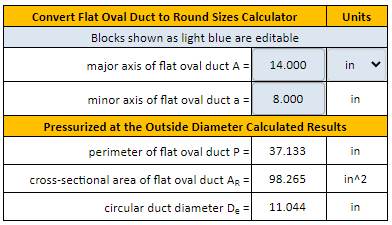
Converting flat oval ducts to round sizes is a crucial process in various engineering applications, particularly in HVAC and ductwork design. The equivalent round size of an oval duct is essential for determining airflow, pressure drop, and system performance. To simplify this process, a formula and calculator can be used to accurately convert flat oval ducts to their corresponding round sizes, ensuring efficient and effective system design. This article provides a comprehensive guide on the formula and calculator for converting flat oval ducts to round sizes. The formula and calculator are essential tools for engineers and designers.
-
Converting Flat Oval Ducts to Round Sizes: Formula and Calculator
- Understanding the Formula for Converting Flat Oval Ducts to Round Sizes
- Using a Calculator to Convert Flat Oval Ducts to Round Sizes
- Factors to Consider When Converting Flat Oval Ducts to Round Sizes
- Benefits of Converting Flat Oval Ducts to Round Sizes
- Common Applications for Converting Flat Oval Ducts to Round Sizes
- What is the formula for round ducts?
- What is the formula for calculating duct size?
- What is the formula for duct equivalent diameter?
-
Frequently Asked Questions (FAQs)
- What is the purpose of converting flat oval ducts to round sizes?
- How does the formula for converting flat oval ducts to round sizes work?
- What are the benefits of using a calculator to convert flat oval ducts to round sizes?
- How can I ensure accurate results when using a calculator to convert flat oval ducts to round sizes?
Converting Flat Oval Ducts to Round Sizes: Formula and Calculator
Converting flat oval ducts to round sizes is a crucial process in the field of HVAC (Heating, Ventilation, and Air Conditioning) and ductwork design. This process involves calculating the equivalent round duct size for a given flat oval duct, taking into account factors such as airflow, pressure drop, and duct material. The formula used to convert flat oval ducts to round sizes is based on the equivalent diameter of the oval duct, which is calculated using the major and minor axes of the oval.
Understanding the Formula for Converting Flat Oval Ducts to Round Sizes
The formula for converting flat oval ducts to round sizes is based on the equivalent diameter of the oval duct, which is calculated using the major and minor axes of the oval. The equivalent diameter is then used to determine the round duct size that would have the same airflow and pressure drop characteristics as the original flat oval duct. The formula is as follows: Equivalent Diameter = (Major Axis x Minor Axis) / (Major Axis + Minor Axis).
Using a Calculator to Convert Flat Oval Ducts to Round Sizes
Using a calculator to convert flat oval ducts to round sizes can simplify the process and reduce errors. These calculators typically require the user to input the major and minor axes of the oval duct, as well as the desired airflow and pressure drop values. The calculator then uses the equivalent diameter formula to determine the round duct size that meets the specified requirements.
Factors to Consider When Converting Flat Oval Ducts to Round Sizes
When converting flat oval ducts to round sizes, there are several factors to consider, including airflow, pressure drop, and duct material. The airflow rate and pressure drop values will affect the round duct size required, while the duct material will affect the friction factor and heat transfer characteristics of the duct. Additionally, the installation and maintenance requirements of the duct should also be considered.
Benefits of Converting Flat Oval Ducts to Round Sizes
Converting flat oval ducts to round sizes can offer several benefits, including increased airflow, reduced pressure drop, and improved duct performance. Round ducts are also generally easier to install and maintain than flat oval ducts, which can reduce labor costs and improve overall system efficiency.
Common Applications for Converting Flat Oval Ducts to Round Sizes
Converting flat oval ducts to round sizes is commonly used in a variety of applications, including HVAC systems, industrial ventilation systems, and commercial ductwork. In these applications, the ability to convert flat oval ducts to round sizes can help to optimize system performance, reduce energy consumption, and improve indoor air quality.
| Parameter | Unit | Description |
|---|---|---|
| Major Axis | in | The longer axis of the oval duct |
| Minor Axis | in | The shorter axis of the oval duct |
| Equivalent Diameter | in | The diameter of the round duct that is equivalent to the oval duct |
| Airflow | cfm | The rate of air flow through the duct |
| Pressure Drop | in.wg | The difference in pressure between the inlet and outlet of the duct |
What is the formula for round ducts?

The formula for round ducts is used to calculate the duct diameter and friction loss in a duct system. The formula is:
D = (4 Q) / (π V)
where D is the duct diameter, Q is the airflow rate, and V is the air velocity.
Understanding Duct Diameter Calculations
To calculate the duct diameter, we need to understand the factors that affect it, such as airflow rate, air velocity, and friction loss.
- The duct diameter should be large enough to handle the airflow rate without excessive friction loss.
- The air velocity should be within the recommended range to avoid noise and vibration.
- The duct material and insulation should be considered when calculating the duct diameter.
Factors Affecting Friction Loss in Round Ducts
Friction loss is a critical factor in round ducts, as it affects the system's performance and energy efficiency.
- The duct surface roughness can significantly impact friction loss.
- The air velocity and airflow rate also play a crucial role in determining friction loss.
- The duct length and number of fittings can also contribute to friction loss.
Importance of Air Velocity in Round Ducts
Air velocity is a critical parameter in round ducts, as it affects the system's performance, noise, and vibration.
- The recommended air velocity range is typically between 500-2000 feet per minute.
- Higher air velocities can result in increased noise and vibration.
- Lower air velocities can lead to reduced system performance and increased energy consumption.
Calculating Friction Loss in Round Ducts
Friction loss can be calculated using the Darcy-Weisbach equation, which takes into account the duct diameter, air velocity, and duct length.
- The Darcy-Weisbach equation is: h = (f L V^2) / (2 g D)
- The friction factor (f) depends on the duct surface roughness and Reynolds number.
- The duct length and number of fittings should be considered when calculating friction loss.
Optimizing Round Duct Systems for Energy Efficiency
To optimize round duct systems for energy efficiency, we need to consider factors such as duct diameter, air velocity, and friction loss.
- Proper sizing of the duct diameter and air velocity can help reduce energy consumption.
- Minimizing friction loss can also lead to increased energy efficiency.
- Regular maintenance and inspections can help identify areas for improvement and optimize the system's performance.
What is the formula for calculating duct size?
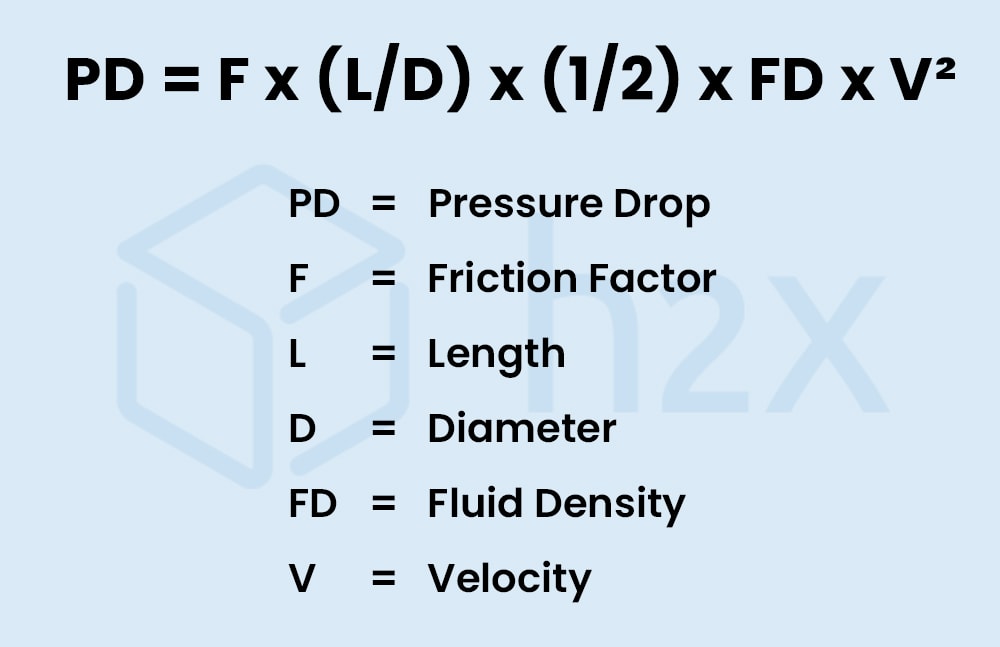
The formula for calculating duct size is based on the friction loss and velocity of the air flowing through the duct. The calculation involves determining the required airflow and pressure drop through the duct, as well as the duct material and layout. The formula is:
D = √(Q / (V x 0.000157 x (1 / (P / L)^0.5))),
where D is the duct diameter, Q is the airflow rate, V is the velocity, P is the pressure drop, and L is the duct length.
Understanding Duct Size Calculation
To calculate the duct size, you need to understand the factors affecting duct size, such as airflow rate, velocity, and pressure drop. The calculation involves determining the required airflow and pressure drop through the duct, as well as the duct material and layout.
- Duct material: The type of material used for the duct, such as galvanized steel, aluminum, or flexible duct.
- Duct layout: The layout of the duct system, including the number of bends and connections.
- Airflow rate: The amount of air flowing through the duct, typically measured in cubic feet per minute (CFM).
Factors Affecting Duct Size
Several factors can affect the duct size calculation, including air density, temperature, and humidity. The duct size must be sufficient to handle the required airflow while minimizing pressure drop and energy losses.
- Air density: The density of the air, which can affect the duct size calculation.
- Temperature: The temperature of the air, which can affect the duct size calculation.
- Humidity: The humidity of the air, which can affect the duct size calculation.
Calculating Duct Size for Different Applications
The duct size calculation can vary depending on the application, such as residential, commercial, or industrial. The duct size must be sufficient to handle the required airflow while minimizing pressure drop and energy losses.
- Residential: The duct size calculation for residential applications typically involves sufficient airflow for heating and cooling.
- Commercial: The duct size calculation for commercial applications typically involves sufficient airflow for heating, cooling, and ventilation.
- Industrial: The duct size calculation for industrial applications typically involves sufficient airflow for processes, ventilation, and exhaust.
Using Duct Size Calculation Tools and Software
There are several tools and software available to help with duct size calculation, such as duct sizing charts and computer simulations. These tools can help streamline the calculation process and ensure accurate results.
- Duct sizing charts: Pre-calculated charts that provide duct sizes based on airflow rate and velocity.
- Computer simulations: Software that uses complex algorithms to calculate duct size based on input parameters.
- Online calculators: Web-based calculators that provide instant results for duct size calculations.
Best Practices for Duct Size Calculation
To ensure accurate and reliable duct size calculations, it's essential to follow best practices, such as using up-to-date calculation methods and considering all relevant factors.
- Use up-to-date calculation methods: Ensure that the calculation method is current and accurate.
- Consider all relevant factors: Take into account all factors that can affect the duct size calculation, such as air density, temperature, and humidity.
- Verify calculations: Double-check calculations to ensure accuracy and reliability.
What is the formula for duct equivalent diameter?
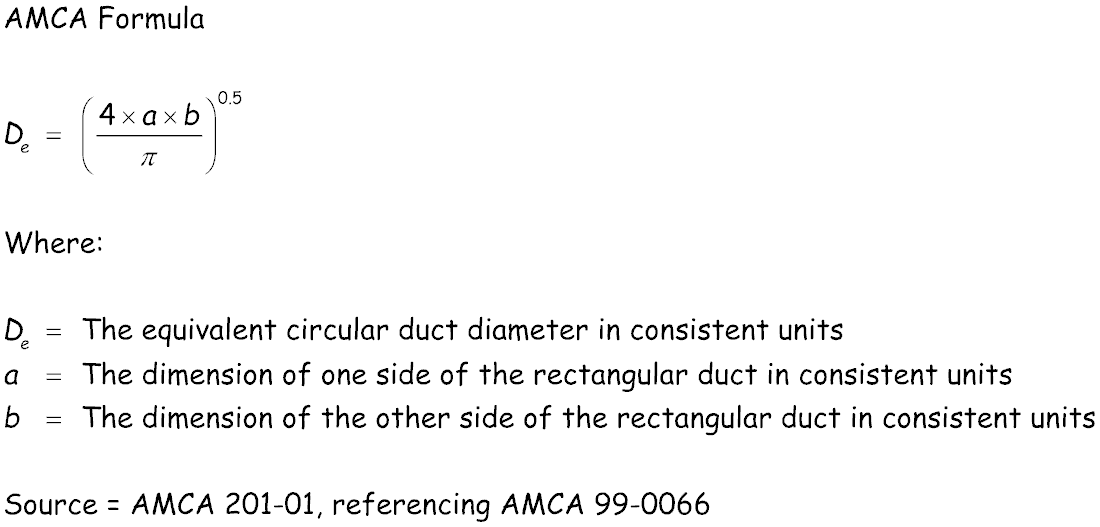
The formula for duct equivalent diameter is a mathematical equation used to calculate the equivalent diameter of a rectangular duct based on its dimensions. The formula is: De = 1.3 (ab)^(0.625) / (a + b)^(0.25), where De is the equivalent diameter, a is the length of one side of the duct, and b is the length of the other side.
Understanding the Concept of Equivalent Diameter
The concept of equivalent diameter is crucial in duct design and airflow calculations. It represents the diameter of a round duct that would have the same flow characteristics as a rectangular duct. To calculate the equivalent diameter, one needs to understand the dimensional relationships between the rectangular duct and its equivalent round duct.
- The aspect ratio of the rectangular duct affects the equivalent diameter, with higher aspect ratios resulting in larger equivalent diameters.
- The cross-sectional area of the rectangular duct is also a critical factor in determining the equivalent diameter.
- The friction factor and pressure drop in the duct are influenced by the equivalent diameter, making it an essential parameter in HVAC system design.
Applications of Duct Equivalent Diameter Formula
The duct equivalent diameter formula has numerous applications in various fields, including heating, ventilation, and air conditioning (HVAC) systems, industrial ventilation, and aerospace engineering. The formula is used to calculate the equivalent diameter of rectangular ducts, which is essential for airflow calculations, pressure drop analysis, and system design.
- In HVAC system design, the equivalent diameter is used to determine the required airflow rates and pressure drops in the system.
- In industrial ventilation, the formula is used to design and optimize ventilation systems for workplaces and industrial facilities.
- In aerospace engineering, the equivalent diameter is used to design and analyze aircraft and spacecraft ventilation systems.
Factors Affecting Duct Equivalent Diameter
Several factors can affect the duct equivalent diameter, including the aspect ratio, cross-sectional area, and flow characteristics of the duct. The surface roughness of the duct and the air density also influence the equivalent diameter.
- The aspect ratio of the duct has a significant impact on the equivalent diameter, with higher aspect ratios resulting in larger equivalent diameters.
- The cross-sectional area of the duct affects the equivalent diameter, with larger areas resulting in larger equivalent diameters.
- The flow characteristics, such as turbulence and laminar flow, also influence the equivalent diameter.
Calculating Duct Equivalent Diameter Using the Formula
To calculate the duct equivalent diameter, one can use the formula: De = 1.3 (ab)^(0.625) / (a + b)^(0.25), where De is the equivalent diameter, a is the length of one side of the duct, and b is the length of the other side. It is essential to ensure that the units of measurement are consistent and that the calculations are performed accurately.
- First, measure the dimensions of the rectangular duct, including the length and width.
- Then, plug the values into the formula and perform the calculations to determine the equivalent diameter.
- Finally, verify the results and ensure that they are reasonable and consistent with the design requirements.
Importance of Accurate Duct Equivalent Diameter Calculations
Accurate duct equivalent diameter calculations are crucial in HVAC system design and industrial ventilation to ensure optimal performance, energy efficiency, and system reliability. Inaccurate calculations can result in reduced system performance, increased energy consumption, and premature system failure.
- Inaccurate calculations can lead to undersized or oversized ducts, resulting in reduced system performance and increased energy consumption.
- Accurate calculations ensure that the ducts are properly sized, resulting in optimal system performance, energy efficiency, and system reliability.
- Regular maintenance and system monitoring are also essential to ensure that the ducts operate at optimal levels and that any issues are identified and addressed promptly.
Frequently Asked Questions (FAQs)
What is the purpose of converting flat oval ducts to round sizes?
Converting flat oval ducts to round sizes is a crucial step in the design and installation of heating, ventilation, and air conditioning (HVAC) systems. The primary purpose of this conversion is to ensure that the ducts are properly sized to handle the required airflow and pressure. Flat oval ducts are commonly used in HVAC systems due to their space-saving design, but they can be challenging to work with when it comes to calculating their equivalent round size. By converting flat oval ducts to round sizes, engineers and technicians can easily determine the diameter and cross-sectional area of the duct, which is essential for sizing fans, blowers, and other system components. This conversion also helps to ensure that the system is energy-efficient and operates at optimal performance levels.
How does the formula for converting flat oval ducts to round sizes work?
The formula for converting flat oval ducts to round sizes involves calculating the equivalent diameter of the oval duct based on its major and minor axes. The formula takes into account the aspect ratio of the oval duct, which is the ratio of the major axis to the minor axis. The equivalent diameter is then used to determine the round size of the duct, which can be used to select the appropriate duct fittings and system components. The formula is typically expressed as: Equivalent Diameter = (Major Axis x Minor Axis) / (π x Aspect Ratio). This formula provides a accurate and reliable way to convert flat oval ducts to round sizes, ensuring that the system is properly designed and installed. By using this formula, engineers and technicians can avoid errors and miscalculations that can lead to system inefficiencies and reduced performance.
What are the benefits of using a calculator to convert flat oval ducts to round sizes?
Using a calculator to convert flat oval ducts to round sizes offers several benefits, including increased accuracy and speed. A calculator can quickly and easily perform the complex calculations required to determine the equivalent round size of an oval duct, reducing the risk of human error. Additionally, a calculator can store and recall frequently used values, such as the aspect ratio and major and minor axes, making it easier to perform repeated calculations. This can be particularly useful in large-scale HVAC system design, where multiple ducts and fittings need to be sized and selected. A calculator can also provide instantaneous results, allowing engineers and technicians to quickly and easily compare different design options and optimize system performance. By using a calculator, users can save time and reduce costs, while also ensuring that their HVAC system is designed and installed to meet or exceed performance and efficiency standards.
How can I ensure accurate results when using a calculator to convert flat oval ducts to round sizes?
To ensure accurate results when using a calculator to convert flat oval ducts to round sizes, it is essential to carefully enter the required input values, such as the major and minor axes, and aspect ratio. Users should also verify that the calculator is set to the correct units of measurement, such as inches or millimeters. Additionally, users should check the calculator's settings and assumptions to ensure that they are consistent with the specific application and system design. It is also important to validate the results by cross-checking them with manual calculations or other independent sources. By taking these precautions, users can ensure that the results provided by the calculator are accurate and reliable, and that their HVAC system is designed and installed to meet or exceed performance and efficiency standards.
Deja una respuesta
Entradas Relacionadas