
Brinkman Number Equation and Calculator

The Brinkman Number is a dimensionless quantity used to characterize heat transfer and fluid flow in porous media. It represents the ratio of viscous heat generation to conductive heat transfer. The Brinkman Number equation is a fundamental concept in engineering and physics, allowing for the calculation of heat transfer rates in various applications. This article provides an overview of the Brinkman Number equation, its derivation, and a calculator tool to simplify calculations, enabling engineers and researchers to efficiently analyze and design systems involving porous media and heat transfer phenomena. The equation has numerous practical applications.
- Understanding the Brinkman Number Equation and Calculator
- What is the Brinkman number ratio?
- What is the significance of the Brinkman number?
-
Frequently Asked Questions (FAQs)
- What is the Brinkman Number and its significance in fluid dynamics and heat transfer?
- How is the Brinkman Number Equation derived and what are its key components?
- What are the limitations and assumptions of the Brinkman Number Equation and Calculator?
- How can the Brinkman Number Equation and Calculator be applied in engineering design and optimization?
Understanding the Brinkman Number Equation and Calculator
The Brinkman number is a dimensionless quantity used in fluid dynamics and heat transfer to characterize the ratio of viscous dissipation to heat conduction. It is an important parameter in the study of fluid flow and heat transfer in various engineering applications, including pipe flow, heat exchangers, and electronic cooling systems. The Brinkman number equation is a mathematical expression that relates the Brinkman number to the physical properties of the fluid and the system geometry.
Definition and Interpretation of the Brinkman Number
The Brinkman number is defined as the ratio of the viscous dissipation term to the heat conduction term in the energy equation. It is a measure of the relative importance of viscous heating to heat conduction in a fluid flow. A high Brinkman number indicates that viscous dissipation is dominant, while a low Brinkman number indicates that heat conduction is dominant. The Brinkman number is an important parameter in the design of heat transfer systems, as it helps to determine the optimal operating conditions and system geometry.
Brinkman Number Equation and Calculator
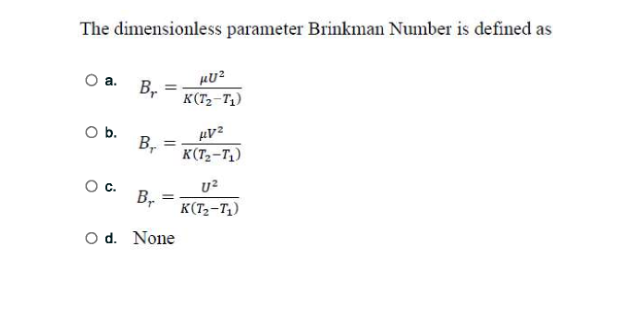
The Brinkman number equation is given by:
Br = μ u^2 / (k ΔT)
where Br is the Brinkman number, μ is the dynamic viscosity, u is the characteristic velocity, k is the thermal conductivity, and ΔT is the temperature difference. The Brinkman number calculator is a tool used to calculate the Brinkman number for a given set of input parameters. It is a useful tool for engineers and researchers to quickly estimate the Brinkman number and determine the relative importance of viscous dissipation and heat conduction in a fluid flow.
Applications of the Brinkman Number
The Brinkman number has a wide range of applications in various fields, including:
| Application | Description |
|---|---|
| Pipe Flow | The Brinkman number is used to determine the friction factor and heat transfer coefficient in pipe flow. |
| Heat Exchangers | The Brinkman number is used to design heat exchangers and determine the optimal operating conditions. |
| Electronic Cooling Systems | The Brinkman number is used to design electronic cooling systems and determine the optimal cooling strategy. |
Limitations and Assumptions of the Brinkman Number
The Brinkman number has several limitations and assumptions that must be considered when using it to analyze fluid flow and heat transfer problems. These include:
Laminar flow: The Brinkman number is only applicable to laminar flow, and not to turbulent flow.
Newtonian fluid: The Brinkman number is only applicable to Newtonian fluids, and not to non-Newtonian fluids.
Constant properties: The Brinkman number assumes constant fluid properties, such as viscosity and thermal conductivity.
Future Developments and Research Directions
Future research directions for the Brinkman number include:
Turbulent flow: Developing a Brinkman number equation for turbulent flow.
Non-Newtonian fluids: Developing a Brinkman number equation for non-Newtonian fluids.
Variable properties: Developing a Brinkman number equation that accounts for variable fluid properties.
These developments will help to expand the applicability of the Brinkman number and improve its accuracy in predicting fluid flow and heat transfer behavior.
What is the Brinkman number ratio?

The Brinkman number ratio is a dimensionless quantity used to characterize the heat transfer and fluid flow in a system. It is defined as the ratio of the viscous dissipation to the conductive heat transfer. In other words, it is a measure of the relative importance of the frictional heating and the conductive cooling in a fluid flow system.
Introduction to Brinkman Number
The Brinkman number is a dimensionless parameter that is used to predict the behavior of fluids in various engineering applications. It is an important design parameter in the design of heat exchangers, chemical reactors, and biomedical devices. The Brinkman number is calculated as the ratio of the viscous dissipation to the conductive heat transfer. This ratio helps to determine the dominant mode of heat transfer in a system. Some key aspects of the Brinkman number are:
- The Brinkman number is a dimensionless quantity, which makes it easy to compare different systems.
- The Brinkman number is dependent on the fluid properties, such as viscosity and thermal conductivity.
- The Brinkman number is used to predict the temperature distribution in a system.
Physical Significance of Brinkman Number
The Brinkman number has a significant impact on the design and operation of various engineering systems. A high Brinkman number indicates that the viscous dissipation is dominant, while a low Brinkman number indicates that the conductive heat transfer is dominant. This information is crucial in the design of heat exchangers, where the goal is to maximize the heat transfer while minimizing the pressure drop. Some key aspects of the physical significance of the Brinkman number are:
! OL
- The Brinkman number is related to the temperature distribution in a system.
- The Brinkman number is used to predict the pressure drop in a system.
- The Brinkman number is dependent on the fluid velocity and thermal conductivity.
Applications of Brinkman Number
The Brinkman number has a wide range of applications in engineering, including the design of heat exchangers, chemical reactors, and biomedical devices. It is also used in the analysis of fluid flow and heat transfer in various industrial processes. Some key aspects of the applications of the Brinkman number are:
- The Brinkman number is used in the design of heat exchangers to predict the heat transfer and pressure drop.
- The Brinkman number is used in the analysis of fluid flow and heat transfer in chemical reactors.
- The Brinkman number is used in the design of biomedical devices, such as implantable devices.
Calculation of Brinkman Number
The Brinkman number is calculated using the following equation: Br = (μ u^2) / (k ΔT), where μ is the viscosity, u is the fluid velocity, k is the thermal conductivity, and ΔT is the temperature difference. This equation shows that the Brinkman number is dependent on the fluid properties and the operating conditions. Some key aspects of the calculation of the Brinkman number are:
- The Brinkman number is calculated using the viscosity and fluid velocity.
- The Brinkman number is dependent on the thermal conductivity and temperature difference.
- The Brinkman number is used to predict the heat transfer and pressure drop in a system.
Limitations of Brinkman Number
The Brinkman number has several limitations, including the assumption of steady-state conditions and the neglect of turbulent flows. Additionally, the Brinkman number is dependent on the fluid properties, which can be difficult to measure. Some key aspects of the limitations of the Brinkman number are:
- The Brinkman number is limited to laminar flows and steady-state conditions.
- The Brinkman number is dependent on the fluid properties, which can be difficult to measure.
- The Brinkman number is not applicable to turbulent flows or unsteady-state conditions.
What is the significance of the Brinkman number?

The Brinkman number is a dimensionless quantity used in fluid dynamics and heat transfer to characterize the ratio of viscous heat generation to conductive heat transfer. It is defined as the ratio of the viscous dissipation term to the conductive heat transfer term in the energy equation. The Brinkman number is significant in understanding the behavior of fluids in various engineering applications, such as heat exchangers, pipeline flows, and chemical reactors.
Introduction to the Brinkman Number
The Brinkman number is a crucial parameter in understanding the thermal behavior of fluids in various engineering applications. It helps to identify the dominant heat transfer mechanism, whether it is conduction, convection, or viscous dissipation. The Brinkman number is defined as Br = μU^2 / (k ΔT), where μ is the dynamic viscosity, U is the characteristic velocity, k is the thermal conductivity, and ΔT is the temperature difference.
- Viscous dissipation is the heat generated by the friction between the fluid and the surrounding surfaces.
- Conductive heat transfer is the heat transfer mechanism that occurs due to the temperature difference between the fluid and the surrounding surfaces.
- The Brinkman number is used to determine the thermal behavior of fluids in laminar and turbulent flows.
Applications of the Brinkman Number
The Brinkman number has numerous applications in various fields of engineering, including chemical engineering, mechanical engineering, and aerospace engineering. It is used to design heat exchangers, pipelines, and chemical reactors. The Brinkman number is also used to understand the thermal behavior of fluids in microchannels and nanochannels.
- Heat exchangers are designed to optimize the heat transfer between two or more fluids.
- Pipelines are designed to minimize the pressure drop and heat loss during the transportation of fluids.
- Chemical reactors are designed to optimize the reaction rate and yield by controlling the temperature and pressure.
Limitations of the Brinkman Number
The Brinkman number has some limitations, as it is a simplistic model that assumes laminar flow and constant properties. In reality, turbulent flows and variable properties can affect the thermal behavior of fluids.
- Turbulent flows can increase the heat transfer coefficient and pressure drop.
- Variable properties, such as temperature-dependent viscosity, can affect the thermal behavior of fluids.
- The Brinkman number is not applicable to multiphase flows, such as gas-liquid or solid-liquid flows.
Relationship with Other Dimensionless Numbers
The Brinkman number is related to other dimensionless numbers, such as the Nusselt number and the Prandtl number. The Nusselt number is a measure of the convective heat transfer, while the Prandtl number is a measure of the ratio of momentum diffusivity to thermal diffusivity.
- The Nusselt number is used to calculate the convective heat transfer coefficient.
- The Prandtl number is used to calculate the thermal boundary layer thickness.
- The Brinkman number is used to determine the thermal behavior of fluids in laminar and turbulent flows.
Experimental and Numerical Methods
Experimental and numerical methods are used to validate the Brinkman number model and to understand the thermal behavior of fluids in various engineering applications. Computational fluid dynamics (CFD) is a powerful tool used to simulate the fluid flow and heat transfer in complex geometries.
- Experimental methods, such as hot-wire anemometry, are used to measure the velocity and temperature profiles.
- Numerical methods, such as finite element method, are used to solve the governing equations of fluid flow and heat transfer.
- Validation of the Brinkman number model is essential to ensure the accuracy of the predictions.
Frequently Asked Questions (FAQs)
What is the Brinkman Number and its significance in fluid dynamics and heat transfer?
The Brinkman Number is a dimensionless quantity used in fluid dynamics and heat transfer to characterize the ratio of viscous heat dissipation to conductive heat transfer. It is an important parameter in understanding the behavior of fluids in porous media, such as in packed beds, porous channels, and other engineering applications. The Brinkman Number is defined as the ratio of the viscous heat generated by the fluid flow to the conductive heat transferred through the solid matrix. A high Brinkman Number indicates that the viscous heat dissipation dominates the conductive heat transfer, while a low Brinkman Number suggests that the conductive heat transfer is more significant. The Brinkman Number is used to predict the temperature distribution and heat transfer rates in porous media, which is crucial in designing and optimizing various engineering systems, such as heat exchangers, chemical reactors, and biomedical devices.
How is the Brinkman Number Equation derived and what are its key components?
The Brinkman Number Equation is derived from the Navier-Stokes equations and the energy equation, which describe the fluid flow and heat transfer in porous media. The equation is obtained by non-dimensionalizing the governing equations and scaling the variables to reveal the characteristic ratios of the problem. The Brinkman Number Equation is typically expressed as a ratio of the viscous heat generation term to the conductive heat transfer term, and it involves several key components, including the fluid velocity, viscosity, thermal conductivity, and temperature gradient. The equation is often simplified and approximated to obtain a more manageable form, which can be used to analyze and predict the behavior of the fluid and heat transfer in porous media. The Brinkman Number Equation is a powerful tool for understanding the complex interactions between the fluid flow, heat transfer, and porous medium, and it has been widely used in various engineering applications, such as chemical engineering, mechanical engineering, and biomedical engineering.
What are the limitations and assumptions of the Brinkman Number Equation and Calculator?
The Brinkman Number Equation and Calculator are based on several assumptions and simplifications, which can limit their applicability and accuracy. One of the main assumptions is that the fluid flow is laminar and incompressible, which may not be valid for all engineering applications. Additionally, the equation assumes that the porous medium is isotropic and homogeneous, which may not be the case in reality. The Brinkman Number Equation also neglects the effects of turbulence, non-Newtonian fluid behavior, and radiative heat transfer, which can be significant in certain applications. Furthermore, the Calculator is typically based on a simplified form of the equation, which may not account for all the complex interactions between the fluid flow, heat transfer, and porous medium. Therefore, the Brinkman Number Equation and Calculator should be used with caution and in conjunction with other theoretical and experimental tools to ensure accurate and reliable results.
How can the Brinkman Number Equation and Calculator be applied in engineering design and optimization?
The Brinkman Number Equation and Calculator can be applied in various engineering design and optimization applications, such as heat exchanger design, chemical reactor optimization, and biomedical device development. By using the Brinkman Number Equation, engineers can predict the temperature distribution and heat transfer rates in porous media, which is critical in designing and optimizing these systems. The Calculator can be used to quickly and easily evaluate the Brinkman Number for different design scenarios, allowing engineers to iterate and optimize their designs more efficiently. Additionally, the Brinkman Number Equation can be used to scale-up or scale-down designs, ensuring that the heat transfer and fluid flow behavior is properly accounted for. The Brinkman Number Equation and Calculator can also be used in conjunction with other computational tools, such as computational fluid dynamics (CFD) and finite element methods (FEM), to provide a more comprehensive understanding of the complex interactions between the fluid flow, heat transfer, and porous medium.
Deja una respuesta
Entradas Relacionadas