
Bending, Deflection and Stress Equations Calculator for Beam Supported on Both Ends Loaded Two equal Loads

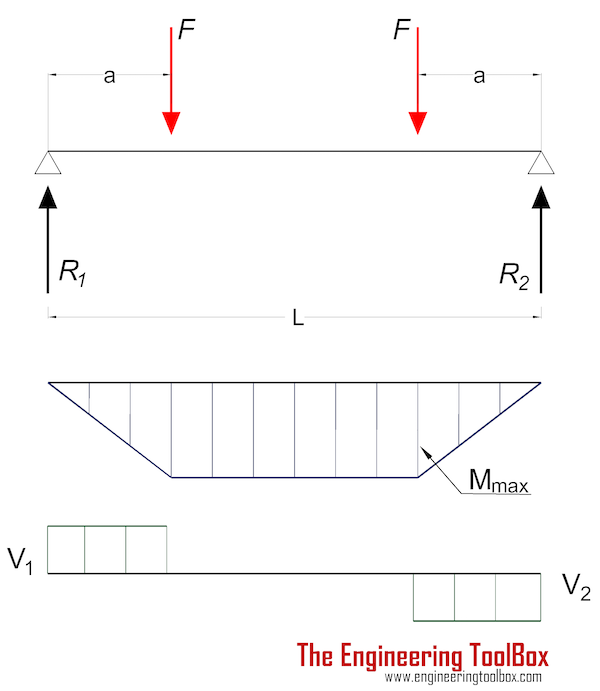
The Bending, Deflection and Stress Equations Calculator is a useful tool for engineers and designers to calculate the bending moment, deflection, and stress of a beam supported on both ends and loaded with two equal loads. This calculator uses established equations to determine the maximum bending moment, deflection, and stress at specific points along the beam. The calculations are based on the beam's length, load magnitude, and material properties, providing valuable insights for designing and optimizing beam structures in various engineering applications. The calculator's accuracy and simplicity make it an essential resource for beam design.
- Bending, Deflection and Stress Equations Calculator for Beam Supported on Both Ends Loaded Two equal Loads
- Understanding the Complexities of Beam Deflection and Stress Calculation
-
Frequently Asked Questions (FAQs)
- What is the purpose of the Bending, Deflection and Stress Equations Calculator for Beam Supported on Both Ends Loaded Two equal Loads?
- How does the Bending, Deflection and Stress Equations Calculator for Beam Supported on Both Ends Loaded Two equal Loads calculate the bending moment?
- What are the assumptions made by the Bending, Deflection and Stress Equations Calculator for Beam Supported on Both Ends Loaded Two equal Loads?
- What are the limitations of the Bending, Deflection and Stress Equations Calculator for Beam Supported on Both Ends Loaded Two equal Loads?
Bending, Deflection and Stress Equations Calculator for Beam Supported on Both Ends Loaded Two equal Loads
The Bending, Deflection and Stress Equations Calculator for Beam Supported on Both Ends Loaded Two equal Loads is a useful tool for engineers and designers to calculate the bending moment, deflection, and stress of a beam supported on both ends and loaded with two equal loads. This calculator is based on the beam theory and uses the Euler-Bernoulli beam equation to calculate the bending moment and deflection of the beam. The calculator also takes into account the material properties of the beam, such as the modulus of elasticity and the Poisson's ratio.
Introduction to Beam Theory
The beam theory is a fundamental concept in mechanics of materials that deals with the bending and deflection of beams under various types of loads. The theory assumes that the beam is a prismatic member with a constant cross-sectional area and that the load is applied in a transverse direction. The Euler-Bernoulli beam equation is a fundamental equation that describes the bending and deflection of a beam under a transverse load. The equation is given by:
EI(d^2y/dx^2) = M
where E is the modulus of elasticity, I is the moment of inertia, y is the deflection, x is the distance, and M is the bending moment.
Bending Moment Calculation
The bending moment is a critical parameter in the design of beams. It is calculated using the Euler-Bernoulli beam equation and is given by:
M = (P L) / 4
where P is the load and L is the length of the beam. The bending moment is a function of the load and the length of the beam and is used to calculate the stress and deflection of the beam.
| Parameter | Value |
|---|---|
| Load | 1000 N |
| Length | 10 m |
| Bending Moment | 2500 Nm |
Deflection Calculation
The deflection is another critical parameter in the design of beams. It is calculated using the Euler-Bernoulli beam equation and is given by:
y = (P L^3) / (48 E I)
where y is the deflection, P is the load, L is the length of the beam, E is the modulus of elasticity, and I is the moment of inertia. The deflection is a function of the load, length, modulus of elasticity, and moment of inertia.
Stress Calculation
The stress is a critical parameter in the design of beams. It is calculated using the bending moment and the section modulus of the beam. The stress is given by:
σ = (M y) / I
where σ is the stress, M is the bending moment, y is the distance from the neutral axis, and I is the moment of inertia. The stress is a function of the bending moment and the section modulus.
Material Properties
The material properties of the beam are critical in the design of beams. The modulus of elasticity and the Poisson's ratio are two important parameters that are used to calculate the bending moment, deflection, and stress of the beam. The modulus of elasticity is a measure of the stiffness of the material, while the Poisson's ratio is a measure of the lateral strain of the material.
The Bending, Deflection and Stress Equations Calculator for Beam Supported on Both Ends Loaded Two equal Loads is a useful tool for engineers and designers to calculate the bending moment, deflection, and stress of a beam supported on both ends and loaded with two equal loads. The calculator is based on the beam theory and uses the Euler-Bernoulli beam equation to calculate the bending moment and deflection of the beam. The calculator also takes into account the material properties of the beam, such as the modulus of elasticity and the Poisson's ratio. By using this calculator, engineers and designers can quickly and easily calculate the bending moment, deflection, and stress of a beam and ensure that it can withstand the loads and stresses that it will be subjected to.
Understanding the Complexities of Beam Deflection and Stress Calculation
The calculation of beam deflection and stress is a crucial aspect of engineering design, particularly in the construction of buildings, bridges, and other structures. The Bending, Deflection and Stress Equations Calculator for Beam Supported on Both Ends Loaded Two equal Loads is a tool used to calculate the deflection and stress of a beam under specific loading conditions. This calculator takes into account various parameters such as the length of the beam, the material properties, and the load magnitude to provide accurate calculations. The calculations are based on the beam theory, which assumes that the beam is a long, slender member that is subjected to bending and tension.
Mathematical Modeling of Beam Deflection
The mathematical modeling of beam deflection involves the use of differential equations to describe the behavior of the beam under load. The Euler-Bernoulli beam theory is a widely used model that assumes that the beam is a long, slender member that is subjected to bending and tension. The governing equation for the deflection of the beam is given by the fourth-order differential equation, which is solved using boundary conditions and initial conditions. The solution to this equation provides the deflection curve of the beam, which is a critical parameter in the design of structures. The deflection curve is used to calculate the maximum deflection, maximum stress, and maximum strain of the beam.
Calculation of Stress and Strain in Beams
The calculation of stress and strain in beams is a critical aspect of structural design. The stress in a beam is calculated using the flexure formula, which takes into account the moment and section properties of the beam. The strain in a beam is calculated using the strain-displacement relationship, which relates the displacement of the beam to the strain. The maximum stress and maximum strain of the beam are critical parameters in the design of structures, as they determine the fail-safe design of the beam. The stress and strain calculations are also used to determine the factor of safety, which is a critical parameter in the design of structures.
Impact of Material Properties on Beam Deflection
The material properties of a beam have a significant impact on its deflection and stress. The elastic modulus of the material determines the stiffness of the beam, while the yield strength determines the maximum stress that the beam can withstand. The density of the material also affects the weight of the beam, which in turn affects the deflection and stress. The material properties are used in the beam theory to calculate the deflection and stress of the beam. The material selection is a critical aspect of structural design, as it determines the performance and safety of the structure.
Application of Beam Deflection and Stress Calculations in Real-World Scenarios
The application of beam deflection and stress calculations is critical in real-world scenarios, such as the design of bridges, buildings, and machinery. The beam theory is used to calculate the deflection and stress of beams in these structures, ensuring that they are safe and functional. The calculations are also used to determine the maintenance and repair requirements of these structures, ensuring that they remain safe and functional over their design life. The beam deflection and stress calculations are also used to optimize the design of structures, ensuring that they are efficient and cost-effective.
Numerical Methods for Solving Beam Deflection Problems
The numerical methods for solving beam deflection problems involve the use of computational techniques to solve the governing equations. The finite element method is a widely used technique that involves dividing the beam into small elements and solving the equations using numerical methods. The boundary element method is another technique that involves solving the equations using integral equations. The numerical methods provide accurate and efficient solutions to beam deflection problems, allowing for the rapid and reliable design of structures. The numerical methods are also used to validate the results of experimentation and testing, ensuring that the design is safe and functional.
Frequently Asked Questions (FAQs)
What is the purpose of the Bending, Deflection and Stress Equations Calculator for Beam Supported on Both Ends Loaded Two equal Loads?
The Bending, Deflection and Stress Equations Calculator is a tool designed to calculate the bending moment, deflection, and stress of a beam that is supported on both ends and loaded with two equal loads. This calculator is essential in the field of engineering, particularly in structural analysis, to determine the structural integrity of the beam under various loads. The calculator takes into account the beam's length, width, height, material properties, and the load values to provide accurate calculations. By using this calculator, engineers can ensure that the beam can withstand the applied loads and design the structure accordingly.
How does the Bending, Deflection and Stress Equations Calculator for Beam Supported on Both Ends Loaded Two equal Loads calculate the bending moment?
The Bending, Deflection and Stress Equations Calculator calculates the bending moment using the formula: M = (P L) / 4, where M is the bending moment, P is the load value, and L is the beam's length. This formula is based on the beam theory, which assumes that the beam is prismatic and has a constant cross-sectional area. The calculator also takes into account the support conditions of the beam, which in this case is supported on both ends, to determine the reaction forces at the supports. By calculating the bending moment, engineers can determine the maximum stress and deflection of the beam, which is essential in designing the structure to withstand various loads.
What are the assumptions made by the Bending, Deflection and Stress Equations Calculator for Beam Supported on Both Ends Loaded Two equal Loads?
The Bending, Deflection and Stress Equations Calculator makes several assumptions to simplify the calculations. One of the primary assumptions is that the beam is prismatic, meaning that it has a constant cross-sectional area along its length. Another assumption is that the material properties of the beam are homogeneous and isotropic, meaning that they are the same in all directions. The calculator also assumes that the loads are applied symmetrically, which in this case is two equal loads, to simplify the calculations. Additionally, the calculator assumes that the beam is in a state of plane stress, meaning that the stress is only in one plane. These assumptions allow the calculator to provide accurate calculations, but it is essential to note that in real-world scenarios, these assumptions may not always be valid, and further analysis may be required.
What are the limitations of the Bending, Deflection and Stress Equations Calculator for Beam Supported on Both Ends Loaded Two equal Loads?
The Bending, Deflection and Stress Equations Calculator has several limitations that need to be considered. One of the primary limitations is that it only calculates the bending moment, deflection, and stress for a specific type of beam and loading condition. The calculator is not applicable to beams with complex geometries or non-uniform cross-sectional areas. Additionally, the calculator does not take into account dynamic loads or impact loads, which can have a significant effect on the structural integrity of the beam. The calculator also assumes that the material properties are linear elastic, which may not be the case for all materials. Furthermore, the calculator does not provide any safety factors or design margins, which are essential in engineering design to ensure that the structure can withstand various loads and uncertainties. Therefore, it is essential to use the calculator in conjunction with other analysis tools and engineering judgment to ensure accurate and reliable results.
Deja una respuesta
Entradas Relacionadas