
Angle Conversion Calculator and Factors


The Angle Conversion Calculator and Factors is a crucial tool in various mathematical and scientific applications. It enables users to convert between different units of angular measurement, such as degrees, radians, and gradians. Understanding the conversion factors between these units is essential for accurate calculations in trigonometry, geometry, and engineering. This article provides an overview of the angle conversion calculator, its importance, and the key factors involved in converting between different angular units, helping users to improve their mathematical skills and problem-solving abilities. The calculator's functionality and applications will be discussed in detail.
- Understanding Angle Conversion Calculator and Factors
- What is the formula for angle conversion?
- How to convert angle measurements to degrees?
-
Frequently Asked Questions (FAQs)
- What is the purpose of an Angle Conversion Calculator and how does it work with factors?
- How do I use the Angle Conversion Calculator to convert between different angle units and factors?
- What are the common angle units and factors used in the Angle Conversion Calculator?
- What are the limitations and potential errors of the Angle Conversion Calculator when working with factors?
Understanding Angle Conversion Calculator and Factors
The angle conversion calculator is a useful tool for converting between different units of angle measurement. It can be used to convert degrees to radians, radians to degrees, and other units such as gradians and minutes of arc. The calculator takes into account various factors that affect the conversion, including the type of angle being measured and the unit of measurement being used.
Introduction to Angle Conversion Calculator
The angle conversion calculator is a simple and accurate tool that can be used to convert between different units of angle measurement. It is commonly used in mathematics, physics, and engineering applications where angle measurements are critical. The calculator can be used to convert degrees, radians, gradians, and other units of angle measurement.
Factors Affecting Angle Conversion
There are several factors that affect the conversion of angles, including the type of angle being measured and the unit of measurement being used. The angle type can be either acute, obtuse, or right, and the unit of measurement can be degrees, radians, or gradians. The calculator takes into account these factors to ensure an accurate conversion.
Angle Conversion Formulas
The angle conversion calculator uses various formulas to convert between different units of angle measurement. The most common formulas are:
| Formula | Description |
|---|---|
| degrees = radians (180/π) | Converts radians to degrees |
| radians = degrees (π/180) | Converts degrees to radians |
| gradians = degrees (9/10) | Converts degrees to gradians |
These formulas are used to ensure an accurate conversion between different units of angle measurement.
Applications of Angle Conversion Calculator
The angle conversion calculator has various applications in mathematics, physics, and engineering. It is commonly used to convert angle measurements in trigonometry, geometry, and calculus. The calculator is also used in surveying, navigation, and architecture to convert angle measurements between different units.
Benefits of Using Angle Conversion Calculator
The angle conversion calculator has several benefits, including speed, accuracy, and convenience. The calculator can quickly and accurately convert between different units of angle measurement, saving time and reducing errors. The calculator is also easy to use and can be accessed online or offline, making it a convenient tool for anyone who needs to convert angle measurements. The calculator also provides step-by-step instructions and examples to help users understand the conversion process, making it a valuable resource for students and professionals alike.
What is the formula for angle conversion?
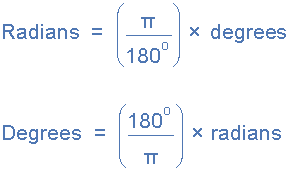
The formula for angle conversion depends on the type of conversion being performed. For example, to convert degrees to radians, the formula is: radians = degrees π / 180. To convert radians to degrees, the formula is: degrees = radians 180 / π. These formulas are used to convert between the two most common units of measurement for angles.
Understanding Angle Conversion Formulas
The formulation of angle conversion formulas is based on the relationship between the unit circle and the coordinate plane. The unit circle is a circle with a radius of 1, and it is used to define the trigonometric functions. The coordinate plane is a two-dimensional plane with x and y axes. The angle conversion formulas are used to convert between the polar coordinates and the cartesian coordinates. For example:
- The polar coordinates are used to describe the position of a point in terms of its distance from the origin and its angle from the positive x-axis.
- The cartesian coordinates are used to describe the position of a point in terms of its x and y coordinates.
- The angle conversion formulas are used to convert between these two systems of coordinates.
Common Angle Conversion Formulas
There are several common angle conversion formulas that are used in mathematics and physics. These formulas include:
- The degree to radian formula: radians = degrees π / 180.
- The radian to degree formula: degrees = radians 180 / π.
- The gradian to degree formula: degrees = gradian 9 / 10.
These formulas are used to convert between the different units of measurement for angles, and they are essential for solving trigonometric problems.
Applications of Angle Conversion Formulas
The angle conversion formulas have several practical applications in science and engineering. For example:
- In navigation, the angle conversion formulas are used to convert between the compass direction and the bearing.
- In physics, the angle conversion formulas are used to solve problems involving rotation and torque.
- In computer graphics, the angle conversion formulas are used to perform rotations and transformations on objects.
These applications require the use of precise angle measurements, and the angle conversion formulas provide a way to convert between the different units of measurement.
Derivation of Angle Conversion Formulas
The derivation of the angle conversion formulas is based on the definition of the unit circle and the coordinate plane. The unit circle is defined! with a radius of 1, and the coordinate plane is defined with x and y axes. The angle conversion formulas are derived by using the relationships between the polar coordinates and the cartesian coordinates. For example:
- The polar coordinates are related to the cartesian coordinates by the equations: x = r cos(θ) and y = r sin(θ).
- The angle conversion formulas are derived by using these equations and the definition of the unit circle.
- The derivation of the angle conversion formulas involves the use of trigonometric functions, such as sine and cosine.
Importance of Angle Conversion Formulas
The angle conversion formulas are essential for solving problems in mathematics and physics. The formulas provide a way to convert between the different units of measurement for angles, and they are used in a wide range of applications. For example:
- The angle conversion formulas are used to solve problems involving rotation and torque.
- The formulas are used to perform rotations and transformations on objects in computer graphics.
- The angle conversion formulas are used to convert between the compass direction and the bearing in navigation.
The importance of the angle conversion formulas lies in their ability to provide precise angle measurements, which are essential for solving problems in science and engineering. Trigonometry and geometry are key areas where these formulas are used, and they are also relevant in calculus and linear algebra.
How to convert angle measurements to degrees?
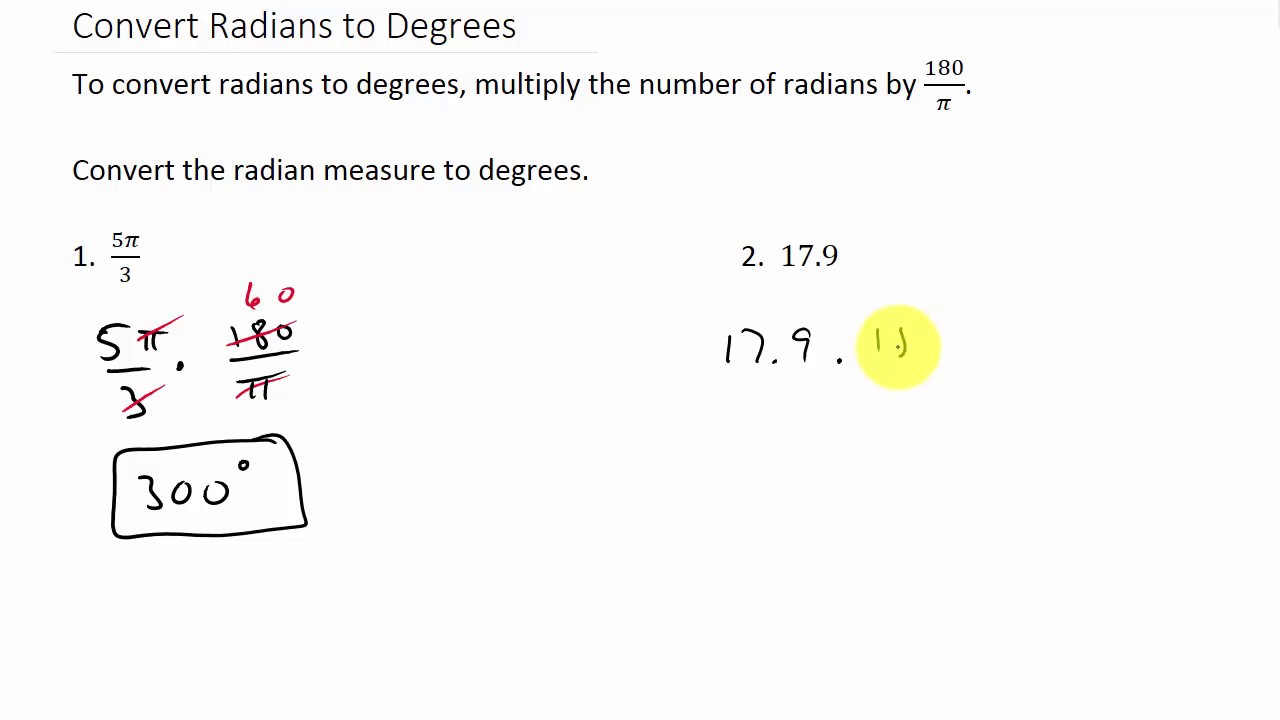
To convert angle measurements to degrees, you need to understand the different units of measurement for angles, such as radians, gradians, and degrees. The conversion process involves using the appropriate conversion factor to transform the angle from one unit to another. For example, to convert radians to degrees, you can use the conversion factor: 1 radian = 180/π degrees. This means that you can multiply the angle in radians by 180/π to get the equivalent angle in degrees.
Understanding Angle Measurement Units
To convert angle measurements to degrees, it's essential to understand the different units of measurement for angles. The most common units are degrees, radians, and gradians. Each unit has its own conversion factor, which is used to transform the angle from one unit to another. The following are the conversion factors for each unit:
- 1 degree = 1/360 of a full circle
- 1 radian = 180/π degrees
- 1 gradian = 9/10 degrees
These conversion factors are used to convert angles from one unit to another, making it possible to express angles in different units.
Converting Radians to Degrees
Converting radians to degrees is a common conversion in mathematics and physics. To convert radians to degrees, you can use the conversion factor: 1 radian = 180/π degrees. This means that you can multiply the angle in radians by 180/π to get the equivalent angle in degrees. For example, to convert 2 radians to degrees, you would multiply 2 by 180/π, resulting in approximately 114.59 degrees. The following are the steps to convert radians to degrees:
- Multiply the angle in radians by 180
- Divide the result by π
- The resulting value is the angle in degrees
This conversion is commonly used in trigonometry and physics.
Converting Gradians to Degrees
Converting gradians to degrees is another common conversion. To convert gradians to degrees, you can use the conversion factor: 1 gradian = 9/10 degrees. This means that you can multiply the angle in gradians by 9/10 to get the equivalent angle in degrees. For example, to convert 100 gradians to degrees, you would multiply 100 by 9/10, resulting in 90 degrees. The following are the steps to convert gradians to degrees:
- Multiply the angle in gradians by 9
- Divide the result by 10
- The resulting value is the angle in degrees
This conversion is commonly used in surveying and mapping.
Using Conversion Factors for Degrees
Using conversion factors is an essential step in converting angle measurements to degrees. A conversion factor is a ratio of two equivalent quantities, which can be used to convert a quantity from one unit to another. For example, to convert radians to degrees, you can use the conversion factor: 1 radian = 180/π degrees. This means that you can multiply the angle in radians by 180/π to get the equivalent angle in degrees. The following are some common conversion factors for angle measurements:
- 1 radian = 180/π degrees
- 1 gradian = 9/10 degrees
- 1 degree = 1/360 of a full circle
These conversion factors are used to convert angles from one unit to another, making it possible to express angles in different units.
Applying Conversions in Real-World Applications
Converting angle measurements to degrees has many real-world applications in physics, engineering, and surveying. For example, in physics, angles are used to describe the motion of objects, and converting angles from radians to degrees can be essential in certain calculations. In engineering, angles are used to design and build structures, and converting angles from gradians to degrees can be necessary for precise calculations. The following are some real-world applications of converting angle measurements to degrees:
- Physics: converting radians to degrees for calculations involving motion and torque
- Engineering: converting gradians to degrees for designing and building structures
- Surveying: converting gradians to degrees for mapping and geographic information systems
These applications require precise conversions of angle measurements to degrees, making it essential to understand the different units of measurement for angles and their conversion factors.
Frequently Asked Questions (FAQs)
What is the purpose of an Angle Conversion Calculator and how does it work with factors?
The Angle Conversion Calculator is a tool designed to convert angles between different units, such as degrees, radians, and gradians. This calculator is essential in various mathematical and scientific applications, including trigonometry, geometry, and physics. The calculator works by taking an input angle in one unit and converting it to the desired output unit. For instance, if you want to convert an angle from degrees to radians, the calculator will use the conversion factor of π/180 to perform the calculation. The calculator can also handle conversions involving factors, such as converting an angle from degrees to minutes or seconds. This is achieved by using the conversion factors between these units, which are based on the relationships between the different angle units.
How do I use the Angle Conversion Calculator to convert between different angle units and factors?
To use the Angle Conversion Calculator, you need to select the input angle unit and the output angle unit. Then, enter the value of the angle you want to convert. The calculator will perform the conversion using the conversion factors and display the result in the desired output unit. For example, if you want to convert an angle of 30 degrees to radians, you would select degrees as the input unit and radians as the output unit, and then enter 30 as the input value. The calculator would then use the conversion factor of π/180 to convert the angle to radians and display the result. The calculator can also be used to convert between different factors, such as converting an angle from degrees to minutes or seconds. This is achieved by using the conversion factors between these units, which are based on the relationships between the different angle units. It is essential to understand the concepts of angle units and conversion factors to use the calculator effectively.
What are the common angle units and factors used in the Angle Conversion Calculator?
The Angle Conversion Calculator supports various angle units, including degrees, radians, gradians, minutes, and seconds. The calculator uses conversion factors to convert between these units. For example, to convert an angle from degrees to radians, the calculator uses the conversion factor of π/180. To convert an angle from degrees to minutes, the calculator uses the conversion factor of 1/60, since there are 60 minutes in a degree. The calculator can also handle conversions involving factors, such as converting an angle from degrees to seconds. This is achieved by using the conversion factors between these units, which are based on the relationships between the different angle units. Understanding the common angle units and conversion factors is crucial to using the calculator effectively and performing accurate angle conversions.
What are the limitations and potential errors of the Angle Conversion Calculator when working with factors?
The Angle Conversion Calculator is a mathematical tool designed to perform angle conversions using conversion factors. While the calculator is generally accurate, there are limitations and potential errors to consider. One limitation is that the calculator assumes the input angle is exact, which may not always be the case in real-world applications. Additionally, the calculator uses approximations of π and other mathematical constants, which can introduce small errors in the calculations. When working with factors, the calculator may also be subject to rounding errors, particularly when converting between large and small angle units. To minimize errors, it is essential to understand the limitations of the calculator and to use it judiciously, taking into account the context and requirements of the specific application. Furthermore, it is crucial to verify the results of the calculator using alternative methods or independent calculations to ensure accuracy and reliability.
Deja una respuesta
Entradas Relacionadas