
Lames equation Thick-walled Cylinders Formula and Calculator

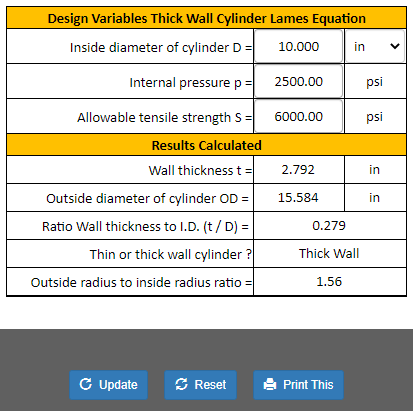
The Lame equation is a fundamental concept in mechanics of materials, particularly in the study of thick-walled cylinders. It describes the radial and tangential stresses in a cylinder subjected to internal and external pressures. The Lame equation is crucial in designing pressure vessels, pipes, and other cylindrical structures. This article provides an overview of the Lame equation for thick-walled cylinders, including the formula and a calculator to simplify the calculation process. Understanding this equation is essential for ensuring the safety and integrity of cylindrical structures under various loading conditions. The formula is widely used in engineering applications.
- Lames Equation Thick-Walled Cylinders Formula and Calculator: Understanding the Basics
- What is the lame's equation for a thick cylinder?
- What is the lame equation?
- How to find the wall thickness of a cylinder?
- Do the Lamé equations predict the stress and strain in thick cylinders?
-
Frequently Asked Questions (FAQs)
- What is Lame's equation for thick-walled cylinders and how is it used in engineering applications?
- How does the Lame's equation thick-walled cylinders formula and calculator work, and what are its limitations?
- What are the key factors that affect the accuracy of Lame's equation for thick-walled cylinders, and how can they be mitigated?
- How can Lame's equation for thick-walled cylinders be applied to real-world engineering problems, and what are some examples of its practical applications?
Lames Equation Thick-Walled Cylinders Formula and Calculator: Understanding the Basics
The Lames equation is a fundamental concept in the field of mechanics of materials, particularly when dealing with thick-walled cylinders. It is used to calculate the stress and strain in a cylinder when it is subjected to internal and external pressures. The equation is named after the French mathematician and engineer Gabriel Lame, who first introduced it in the 19th century. The Lames equation is a set of equations that describe the relationship between the pressure, radius, and thickness of a cylinder.
What is the Lames Equation?
The Lames equation is a mathematical formula that describes the distribution of stress and strain in a thick-walled cylinder. It is based on the assumption that the cylinder is subjected to a uniform internal pressure and a uniform external pressure. The equation takes into account the elasticity and plasticity of the material, as well as the geometry of the cylinder. The Lames equation is commonly used in the design and analysis of pipes, tanks, and other cylindrical structures.
Thick-Walled Cylinders Formula
The thick-walled cylinders formula is a set of equations that can be used to calculate the stress and strain in a cylinder. The formula is based on the Lames equation and takes into account the internal pressure, external pressure, radius, and thickness of the cylinder. The formula is as follows:
| Parameter | Formula |
|---|---|
| Stress | σ = (P_i r_i^2 - P_e r_e^2) / (r_e^2 - r_i^2) |
| Strain | ε = (P_i r_i^2 - P_e r_e^2) / (2 G (r_e^2 - r_i^2)) |
Lames Equation Calculator
A Lames equation calculator is a tool that can be used to calculate the stress and strain in a cylinder using the Lames equation. The calculator takes into account the internal pressure, external pressure, radius, and thickness of the cylinder, as well as the elasticity and plasticity of the material. The calculator can be used to design and analyze pipes, tanks, and other cylindrical structures.
Applications of the Lames Equation
The Lames equation has a wide range of applications in the field of mechanics of materials. It is commonly used in the design and analysis of pipes, tanks, and other cylindrical structures. The equation is also used in the aerospace and nuclear industries, where high-pressure and high-temperature applications are common. Additionally, the Lames equation is used in the petroleum and chemical industries, where pipelines and storage tanks are used to transport and store fluids and gases.
Limitations of the Lames Equation
The Lames equation has several limitations that must be considered when using it to design and analyze cylindrical structures. One of the main limitations is that the equation assumes a uniform internal pressure and a uniform external pressure, which is not always the case in real-world applications. Additionally, the equation does not take into account non-linear effects, such as plasticity and creep, which can occur in materials under high-stress and high-temperature conditions. Furthermore, the equation assumes a circular cross-section, which may not be the case for all cylindrical structures.
What is the lame's equation for a thick cylinder?

The Lame's equation for a thick cylinder is a mathematical equation used to calculate the stress and strain in a thick-walled cylinder subjected to internal and external pressures. The equation is based on the theory of elasticity and is commonly used in mechanical engineering and materials science to design and analyze cylindrical vessels, pipes, and other pressure-containing components.
Derivation of Lame's Equation
The derivation of Lame's equation involves the use of cylindrical coordinates and the application of equilibrium equations to a thick-walled cylinder. The equation is derived by considering the radial, hoop, and axial stresses in the cylinder and applying the principle of superposition to obtain the total stress at any point in the cylinder. The resulting equation is a differential equation that can be solved to obtain the stress and strain distributions in the cylinder. Some of the key steps involved in the derivation of Lame's equation include:
- Define the cylindrical coordinates and the stress components in the cylinder
- Apply the equilibrium equations to the cylinder to obtain the differential equation
- Solve the differential equation to obtain the stress and strain distributions in the cylinder
Application of Lame's Equation
Lame's equation has a wide range of applications in mechanical engineering and materials science, including the design and analysis of pressure vessels, pipes, and other cylindrical components. The equation is used to calculate the stress and strain in these components and to determine the safety factor against failure. The equation is also used to analyze the behavior of thick-walled cylinders under various loading conditions, including internal pressure, external pressure, and thermal loading. Some of the key applications of Lame's equation include:
- Design and analysis of pressure vessels and pipes
- Calculation of stress and strain in thick-walled cylinders
- Determination of the safety factor against failure
Assumptions of Lame's Equation
Lame's equation is based on several assumptions, including the assumption that the cylinder is thick-walled, meaning that the wall thickness is significant compared to the radius of the cylinder. The equation also assumes that the material is isotropic and homogeneous, meaning that it has the same properties in all directions and that it is uniform throughout. Additionally, the equation assumes that the loading is axisymmetric, meaning that it is symmetric about the axis of the cylinder. Some of the key assumptions of Lame's equation include:
- The cylinder is thick-walled
- The material is isotropic and homogeneous
- The loading is axisymmetric
Limits of Lame's Equation
Lame's equation has several limits, including the assumption that the cylinder is thick-walled, which may not be valid for thin-walled cylinders. The equation also assumes that the material is elastic, meaning that it obeys Hooke's law, which may not be valid for plastic or viscoelastic materials. Additionally, the equation assumes that the loading is static, meaning that it is constant over time, which may not be valid for dynamic loading conditions. Some of the key limits of Lame's equation include:
- The cylinder is thick-walled
- The material is elastic
- The loading is static
Extension of Lame's Equation
Lame's equation can be extended to include additional effects, such as thermal loading, dynamic loading, and nonlinear material behavior. The equation can also be modified to account for non-axisymmetric loading conditions, such as bending and torsion. Additionally, the equation can be simplified to obtain approximate solutions for thin-walled cylinders or cylinders with simple geometry. Some of the key extensions of Lame's equation include:
- Inclusion of thermal loading effects
- Inclusion of dynamic loading effects
- Inclusion of nonlinear material behavior
What is the lame equation?
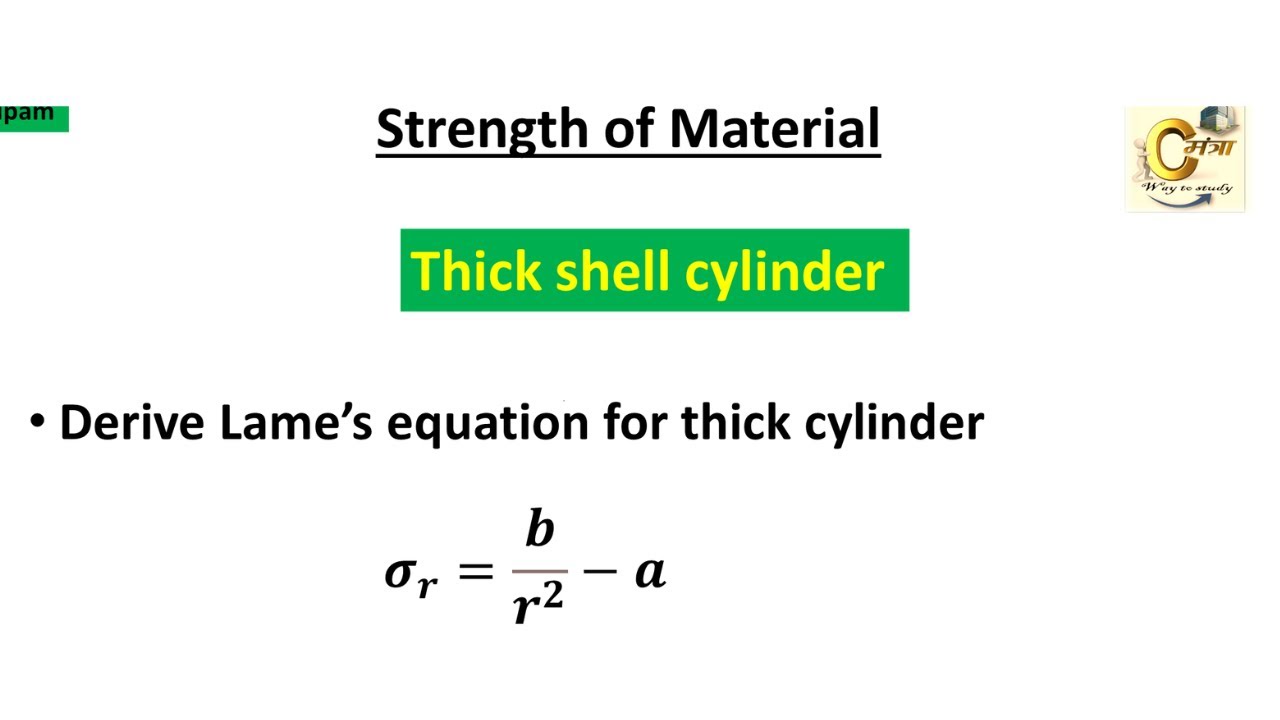
The Lamé equation is a type of differential equation that is used to describe the behavior of elastic and anisotropic materials. It is a second-order partial differential equation that is used to model the deformation of materials under stress and strain. The equation is named after the French mathematician Gabriel Lamé, who first introduced it in the 19th century. The Lamé equation is a fundamental equation in the field of continuum mechanics and is used to study the behavior of a wide range of materials, including metals, polymers, and composites.
History of the Lamé Equation
The Lamé equation has a rich history that dates back to the 19th century. The equation was first introduced by Gabriel Lamé in 1839, and it was initially used to study the behavior of elastic materials. Over the years, the equation has been modified and extended to include the effects of anisotropy and nonlinearity. Today, the Lamé equation is a cornerstone of continuum mechanics and is used to study the behavior of a wide range of materials. Some of the key features of the Lamé equation include:
- It is a second-order partial differential equation that describes the behavior of elastic and anisotropic materials.
- It is used to model the deformation of materials under stress and strain.
- It is a fundamental equation in the field of continuum mechanics.
Mathematical Formulation of the Lamé Equation
The Lamé equation is a mathematical equation that describes the behavior of elastic and anisotropic materials. The equation is typically written in the form of a second-order partial differential equation, and it involves the displacement and stress fields of the material. The equation is often solved using numerical methods, such as the finite element method. Some of the key features of the mathematical formulation of the Lamé equation include:
- It is a linear or nonlinear equation, depending on the material properties.
- It involves the displacement and stress fields of the material.
- It is often solved using numerical methods, such as the finite element method.
Applications of the Lamé Equation
The Lamé equation has a wide range of applications in the field of continuum mechanics. The equation is used to study the behavior of elastic and anisotropic materials, and it is used to model the deformation of materials under stress and strain. Some of the key applications of the Lamé equation include:
- Structural analysis: The Lamé equation is used to study the behavior of structures under load.
- Material science: The equation is used to study the behavior of materials under stress and strain.
- Engineering design: The equation is used to design structures and components that can withstand stress and strain.
Numerical Solution of the Lamé Equation
The Lamé equation is often solved using numerical methods, such as the finite element method. The finite element method involves discretizing the material into a set of finite elements, and then solving the equation using a numerical algorithm. Some of the key features of the numerical solution of the Lamé equation include:
- Discretization: The material is discretized into a set of finite elements.
- Numerical algorithm: The equation is solved using a numerical algorithm, such as the Gaussian elimination method.
- Convergence: The solution is often converged using a convergence criterion, such as the residual norm.
Conclusion of the Lamé Equation in Continuum Mechanics
The Lamé equation is a fundamental equation in the field of continuum mechanics. The equation is used to study the behavior of elastic and anisotropic materials, and it is used to model the deformation of materials under stress and strain. Some of the key features of the Lamé equation in continuum mechanics include:
- Elasticity: The equation is used to study the behavior of elastic materials.
- Anisotropy: The equation is used to study the behavior of anisotropic materials.
- Nonlinearity: The equation is used to study the behavior of nonlinear materials.
How to find the wall thickness of a cylinder?
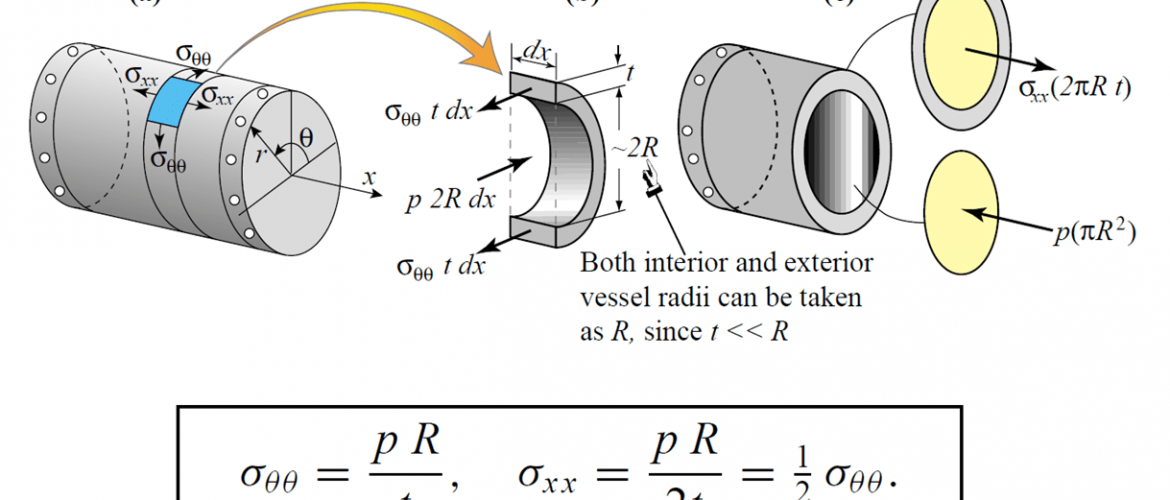
To find the wall thickness of a cylinder, you can use several methods, depending on the information available. The most common method is to use the formula for the volume of a cylinder, which is V = πr^2h, where V is the volume, π is a constant, r is the radius of the cylinder, and h is the height. By rearranging this formula, you can solve for the radius, and then use the inner radius and outer radius to find the wall thickness.
Understanding Cylinder Dimensions
To find the wall thickness, you need to understand the dimensions of the cylinder, including the inner diameter, outer diameter, and height. The wall thickness is the difference between the outer radius and the inner radius. You can use the following steps to find the wall thickness:
- Measure the inner diameter and outer diameter of the cylinder using a caliper or other measuring device.
- Calculate the inner radius and outer radius by dividing the diameters by 2.
- Subtract the inner radius from the outer radius to find the wall thickness.
Using the Formula for Wall Thickness
The formula for wall thickness is t = (D_o - D_i) / 2, where t is the wall thickness, D_o is the outer diameter, and D_i is the inner diameter. You can plug in the values for the outer and inner diameters to find the wall thickness. For example, if the outer diameter is 10 inches and the inner diameter is 8 inches, the wall thickness would be (10 - 8) / 2 = 1 inch. The wall thickness is an important factor in determining the strength and durability of the cylinder.
Measuring Wall Thickness with a Caliper
A caliper is a handy tool for measuring the wall thickness of a cylinder. You can use a caliper to measure the outer diameter and inner diameter of the cylinder, and then calculate the wall thickness using the formula. To use a caliper, place the jaw of the caliper on the outer surface of the cylinder and take a reading. Then, place the jaw on the inner surface of the cylinder and take another reading. The difference between the two readings is the wall thickness.
Calculating Wall Thickness from Volume and Height
If you know the volume and height of the cylinder, you can use the formula V = πr^2h to find the radius, and then calculate the wall thickness. First, rearrange the formula to solve for the radius: r = √(V / πh). Then, use the inner radius and outer radius to find the wall thickness. For example, if the volume is 100 cubic inches and the height is 10 inches, you can calculate the radius and then find the wall thickness.
Factors Affecting Wall Thickness
The wall thickness of a cylinder can be affected by several factors, including the material, pressure, and temperature. The material used to make the cylinder can affect its strength and durability, which in turn can affect the wall thickness. The pressure inside the cylinder can also affect the wall thickness, as higher pressures require thicker walls to maintain structural integrity. Additionally, temperature changes can cause the cylinder to expand or contract, which can affect the wall thickness.
- The material used to make the cylinder can affect its strength and durability.
- The pressure inside the cylinder can affect the wall thickness.
- The temperature changes can cause the cylinder to expand or contract.
Do the Lamé equations predict the stress and strain in thick cylinders?
The Lamé equations are a set of partial differential equations that describe the mechanical behavior of elastic solids under stress and strain. These equations are used to predict the displacement, stress, and strain fields in elastic materials, including thick cylinders. The Lamé equations take into account the geometry and material properties of the cylinder, such as its radius, length, and elastic moduli. By solving these equations, engineers can determine the stress and strain distributions within the cylinder, which is essential for designing and analyzing mechanical systems.
Introduction to Lamé Equations
The Lamé equations are a fundamental tool in solid mechanics and are used to analyze the mechanical behavior of elastic solids. These equations are based on the principles of conservation of momentum and energy, and they provide a mathematical framework for predicting the stress and strain fields in elastic materials. The key aspects of the Lamé equations are:
- The equations of motion, which describe the relationship between stress and strain
- The constitutive equations, which relate the stress and strain to the material properties
- The boundary conditions, which specify the loads and displacements applied to the elastic solid
Assumptions and Limitations
The Lamé equations are based on several assumptions and limitations, including the assumption of small deformations, isotropic material behavior, and linear elasticity. These assumptions are often valid for many engineering applications, but they may not be applicable in certain situations, such as large deformations or non-linear material behavior. The key aspects of the assumptions and limitations are:
- The assumption of small deformations, which limits the applicability of the Lamé equations to small strains
- The isotropic material behavior, which assumes that the material properties are independent of direction
- The linear elasticity, which assumes that the stress-strain relationship is linear
Application to Thick Cylinders
The Lamé equations can be applied to thick cylinders to predict the stress and strain distributions within the cylinder. This is important in engineering applications, such as pipe design and pressure vessel analysis. The key aspects of the application to thick cylinders are:
- The cylinder geometry, which includes the radius, length, and thickness of the cylinder
- The material properties, which include the elastic moduli and Poisson's ratio
- The boundary conditions, which specify the loads and displacements applied to the cylinder
Numerical Solution Methods
The Lamé equations can be solved numerically using various methods, such as the finite element method or the boundary element method. These methods discretize the domain into small elements and solve the equations using numerical techniques. The key aspects of the numerical solution methods are:
- The finite element method, which discretizes the domain into small elements and solves the equations using numerical techniques
- The boundary element method, which discretizes the boundary into small elements and solves the equations using numerical techniques
- The solution algorithms, which include iterative methods and direct methods
Experimental Validation
The predictions of the Lamé equations can be validated using experimental techniques, such as strain gauges or photoelasticity. These techniques measure the strain and stress fields in the elastic solid and compare them to the predictions of the Lamé equations. The key aspects of the experimental validation are:
- The experimental techniques, which include strain gauges, photoelasticity, and X-ray diffraction
- The measurement uncertainty, which includes the errors and limitations of the experimental techniques
- The comparison between the predictions and experimental results, which validates the accuracy of the Lamé equations
Frequently Asked Questions (FAQs)
What is Lame's equation for thick-walled cylinders and how is it used in engineering applications?
Lame's equation is a mathematical formula used to calculate the stress and strain in thick-walled cylinders subjected to internal and external pressures. The equation takes into account the thickness of the cylinder wall, as well as the elastic properties of the material, such as Young's modulus and Poisson's ratio. This equation is widely used in mechanical engineering and civil engineering applications, including the design of pipelines, tanks, and pressure vessels. By using Lame's equation, engineers can determine the safety factor of a cylinder and ensure that it can withstand the operating pressures without failing. The equation is also useful for calculating the deformation of the cylinder under different loading conditions, which is essential for maintaining the structural integrity of the system.
How does the Lame's equation thick-walled cylinders formula and calculator work, and what are its limitations?
The Lame's equation thick-walled cylinders formula and calculator are used to calculate the hoop stress, radial stress, and axial stress in a thick-walled cylinder. The formula takes into account the internal pressure, external pressure, inner radius, outer radius, and elastic properties of the material. The calculator is typically used to simplify the calculation process and provide a quick and accurate estimate of the stresses and strains in the cylinder. However, the equation has some limitations, such as assuming a linear elastic behavior of the material, which may not be valid for all types of materials. Additionally, the equation does not account for non-uniform loading conditions, thermal stresses, or residual stresses, which can affect the accuracy of the results. Therefore, it is essential to validate the results obtained from the calculator with experimental data or finite element analysis to ensure the reliability of the design.
What are the key factors that affect the accuracy of Lame's equation for thick-walled cylinders, and how can they be mitigated?
The accuracy of Lame's equation for thick-walled cylinders depends on several key factors, including the material properties, geometric parameters, and loading conditions. The material properties, such as Young's modulus and Poisson's ratio, can significantly affect the accuracy of the equation, and small errors in these values can lead to large errors in the calculated stresses and strains. The geometric parameters, such as the inner radius and outer radius, must also be accurately known to ensure the reliability of the results. Additionally, the loading conditions, including the internal pressure and external pressure, can affect the accuracy of the equation, and non-uniform loading conditions can lead to complex stress distributions that are not accounted for by the equation. To mitigate these factors, it is essential to use high-quality material data, ensure precise geometric measurements, and validate the results with experimental data or finite element analysis.
How can Lame's equation for thick-walled cylinders be applied to real-world engineering problems, and what are some examples of its practical applications?
Lame's equation for thick-walled cylinders has numerous practical applications in various fields of engineering, including mechanical engineering, civil engineering, and aerospace engineering. One of the most common applications is in the design of pipelines, where the equation is used to calculate the maximum allowable pressure and ensure the structural integrity of the pipeline. Another example is in the design of pressure vessels, such as tanks and cylinders, where the equation is used to calculate the stress and strain in the vessel walls and ensure that they can withstand the operating pressures. The equation is also used in the design of turbines, pumps, and compressors, where it is used to calculate the stress and strain in the rotating components. Additionally, the equation has been used in the design of nuclear reactors, rocket motors, and spacecraft, where the high pressures and temperatures require a detailed analysis of the stress and strain distributions. Overall, Lame's equation is a powerful tool for engineers to analyze and design complex systems that involve thick-walled cylinders.
Deja una respuesta
Entradas Relacionadas