
Volume of Square Prism Equation and Calculator


The volume of a square prism is a fundamental concept in geometry, and it can be calculated using a simple formula. A square prism, also known as a rectangular prism, is a three-dimensional solid object with six faces, where the top and bottom faces are squares. The volume of a square prism is given by the product of its length, width, and height. This article provides an overview of the volume of a square prism equation and offers a calculator to help users compute the volume easily and accurately. The formula is V = l w h.
Understanding the Volume of Square Prism Equation and Calculator
The volume of a square prism is a fundamental concept in geometry, and it can be calculated using a simple equation. The volume of a square prism is given by the formula V = lwh, where l is the length, w is the width, and h is the height of the prism. This equation can be used to calculate the volume of any square prism, regardless of its size or dimensions. A calculator can also be used to find the volume of a square prism, and it is often more convenient and accurate than manual calculations.
What is the Volume of a Square Prism?
The volume of a square prism is the amount of space that it occupies, and it is measured in cubic units such as cubic centimeters or cubic meters. The volume of a square prism can be calculated using the formula V = lwh, where l is the length, w is the width, and h is the height of the prism. This equation is derived from the fact that the volume of a prism is equal to the area of its base times its height.
How to Calculate the Volume of a Square Prism
To calculate the volume of a square prism, you need to know the length, width, and height of the prism. Once you have these values, you can plug them into the formula V = lwh to get the volume. For example, if the length of the prism is 5 cm, the width is 3 cm, and the height is 2 cm, the volume would be V = 5 x 3 x 2 = 30 cubic centimeters. A calculator can also be used to find the volume of a square prism, and it can be more convenient and accurate than manual calculations.
Volume of Square Prism Equation
The volume of a square prism equation is V = lwh, where l is the length, w is the width, and h is the height of the prism. This equation is used to calculate the volume of any square prism, and it is a fundamental concept in geometry. The equation can be derived from the fact that the volume of a prism is equal to the area of its base times its height. The area of the base is lw, and the height is h, so the volume is V = lwh.
Using a Calculator to Find the Volume of a Square Prism
A calculator can be used to find the volume of a square prism, and it is often more convenient and accurate than manual calculations. To use a calculator to find the volume of a square prism, you simply need to enter the length, width, and height of the prism into the calculator and press the calculate button. The calculator will then display the volume of the prism. This can be a time-saving method, especially for large or complex calculations.
Applications of the Volume of a Square Prism
The volume of a square prism has many practical applications in real life. For example, it can be used to calculate the volume of a room or a container, or to determine the amount of material needed to build a structure. It is also used in many scientific and engineering applications, such as calculating the volume of a fluid or the capacity of a tank. The following table shows some examples of the volume of a square prism:
| Length (l) | Width (w) | Height (h) | Volume (V) |
|---|---|---|---|
| 5 cm | 3 cm | 2 cm | 30 cubic centimeters |
| 10 cm | 5 cm | 3 cm | 150 cubic centimeters |
| 20 cm | 10 cm | 5 cm | 1000 cubic centimeters |
The volume of a square prism is an important concept in geometry, and it has many practical applications in real life.
What is the formula for the volume of a square prism?
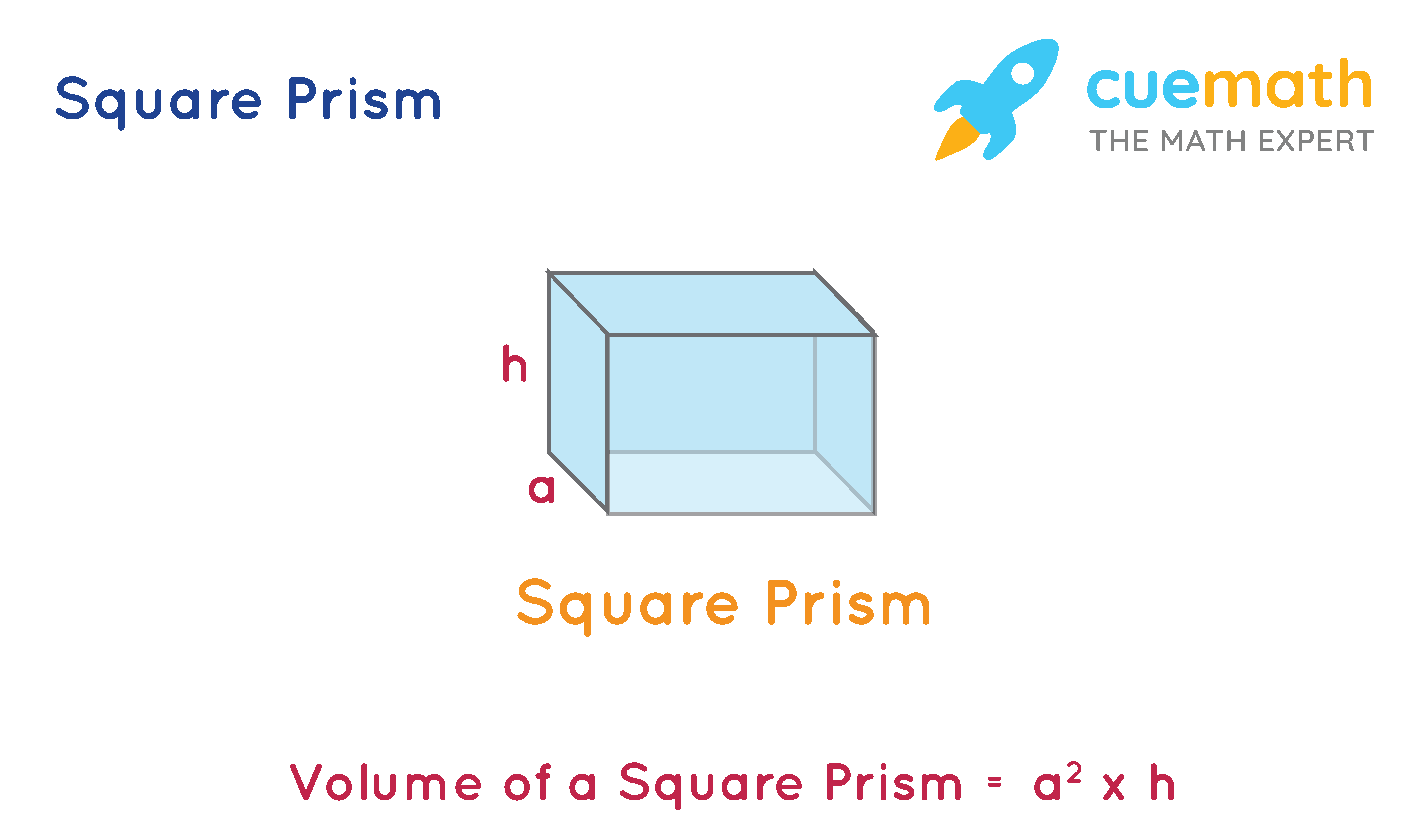
The formula for the volume of a square prism is given by V = lwh, where l is the length, w is the width, and h is the height of the prism. This formula is used to calculate the volume of a three-dimensional shape with a square base and four rectangular sides.
Understanding the Formula
The formula for the volume of a square prism is based on the concept of multiplication of the length, width, and height of the prism. To calculate the volume, you need to multiply the length, width, and height of the prism, which gives you the total volume of the shape. The formula can be broken down into the following steps:
- Identify the length, width, and height of the prism
- Multiply the length, width, and height together
- Write the result as the volume of the prism
Key Components of the Formula
The formula for the volume of a square prism consists of three key components: length, width, and height. The length and width are the dimensions of the square base, while the height is the distance from the base to the top of the prism. These components are essential to calculating the volume of the prism. The formula can be applied to different types of square prisms, including:
- Rectangular prisms with a square base
- Cube-shaped prisms with equal length, width, and height
- Tilted prisms with a square base and a height that is not perpendicular to the base
Real-World Applications of the Formula
The formula for the volume of a square prism has numerous real-world applications, including architecture, engineering, and design. Architects use the formula to calculate the volume of buildings and structures, while engineers use it to design and optimize systems. The formula is also used in everyday life, such as calculating the volume of a room or a container. Some examples of real-world applications include:
- Building design: calculating the volume of a building or a room
- Containerization: calculating the volume of a container or a package
- Engineering: designing and optimizing systems, such as pipes and ducts
Calculating the Volume of a Square Prism
To calculate the volume of a square prism, you need to plug in the values of the length, width, and height into the formula. For example, if the length is 5 cm, the width is 3 cm, and the height is 2 cm, the volume would be V = 5 x 3 x 2 = 30 cubic cm. The formula can be applied to different units of measurement, such as inches, feet, or meters. Some examples of calculations include:
- Cubic centimeters: calculating the volume of a small object or a container
- Cubic meters: calculating the volume of a large object or a building
- Cubic feet: calculating the volume of a room or a container in imperial units
Common Mistakes to Avoid
When calculating the volume of a square prism, there are several common mistakes to avoid. One of the most common mistakes is forgetting to multiply the length, width, and height together. Another mistake is using the wrong units of measurement, such as using inches instead of feet or meters. To avoid these mistakes, it's essential to double-check your calculations and use the correct units of measurement. Some examples of mistakes to avoid include:
- Forgetting to multiply: not multiplying the length, width, and height together
- Using the wrong units: using the wrong units of measurement, such as inches instead of feet or meters
- Rounding errors: rounding the values of the length, width, and height incorrectly
What is the formula for the volume of a prism?
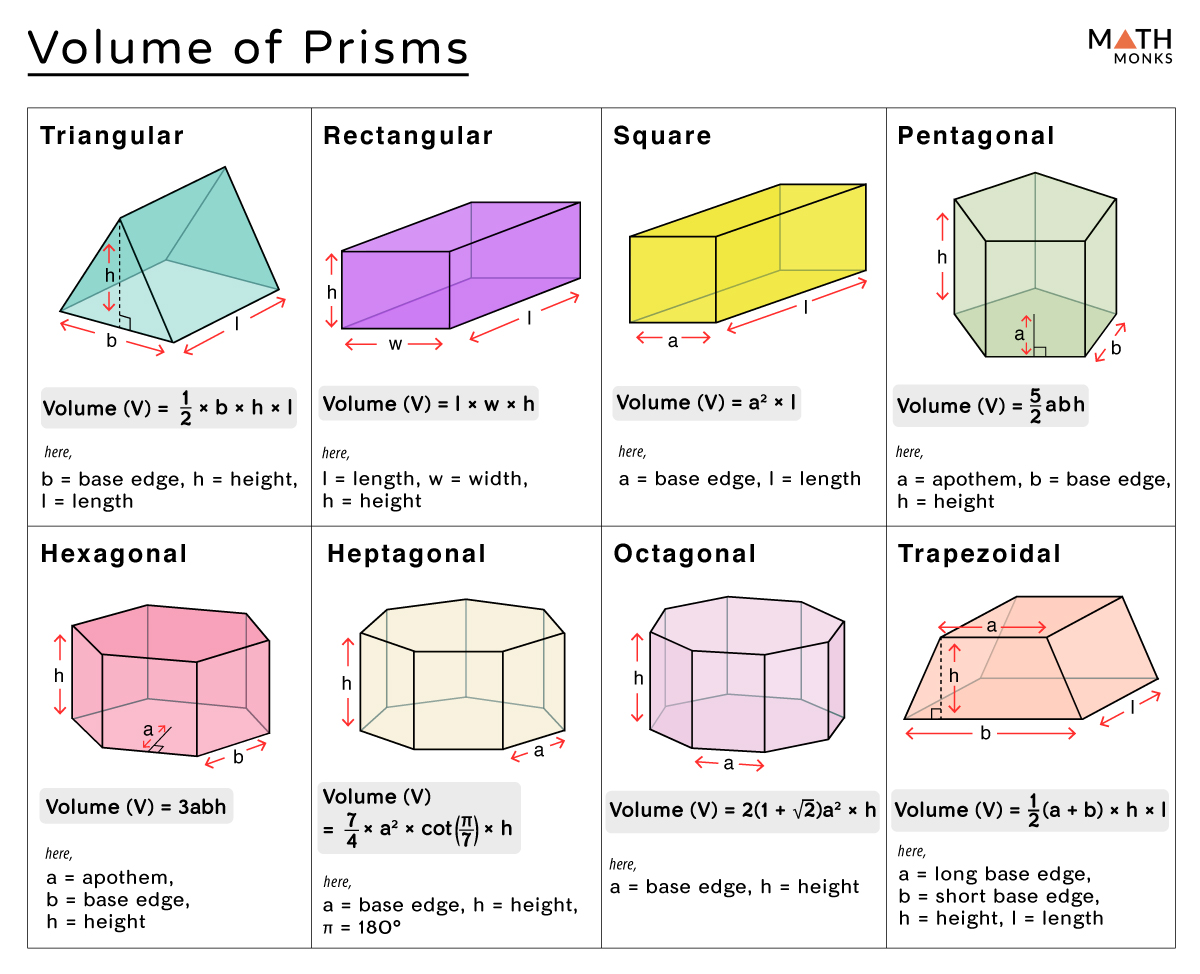
The formula for the volume of a prism is V = Bh, where V is the volume, B is the area of the base, and h is the height of the prism. This formula applies to all types of prisms, including rectangular prisms, triangular prisms, and polygonal prisms.
Understanding the Formula Components
The formula V = Bh consists of three main components: volume, base area, and height. To calculate the volume of a prism, you need to know the area of the base and the height of the prism. The base area can be calculated using different formulas depending on the shape of the base, such as length times width for a rectangular base or (base times height) / 2 for a triangular base. The height of the prism is the perpendicular distance from the base to the opposite face.
- The base area is calculated using the formula for the area of the specific shape, such as length times width for a rectangle or (base times height) / 2 for a triangle.
- The height of the prism is measured perpendicular to the base.
- The volume is calculated by multiplying the base area by the height.
Types of Prisms and Their Volume Formulas
There are different types of prisms, including rectangular prisms, triangular prisms, and polygonal prisms. Each type of prism has its own specific formula for calculating the volume.
- A rectangular prism has a volume formula of V = lwh, where l is the length, w is the width, and h is the height.
- A triangular prism has a volume formula of V = (1/2)bh, where b is the base length and h is the height of the triangle and the prism.
- A polygonal prism has a volume formula of V = Ah, where A is the area of the polygonal base and h is the height of the prism.
Calculating the Volume of a Prism with a Complex Base
When the base of the prism is a complex shape, such as a hexagon or an octagon, the volume formula V = Bh still applies, but the base area B must be calculated using the specific formula for the area of that shape.
- The area of a hexagon can be calculated using the formula A = (3 sqrt(3) / 2) s^2, where s is the side length of the hexagon.
- The area of an octagon can be calculated using the formula A = (2 + 4 / sqrt(2)) s^2, where s is the side length of the octagon.
- Once the base area is calculated, the volume of the prism can be found using the formula V = Bh.
Real-World Applications of Prism Volume Calculations
Calculating the volume of a prism has many real-world applications, including architecture, engineering, and design. Architects and engineers use volume calculations to determine the amount of materials needed for a project, while designers use volume calculations to create efficient and functional spaces.
- Architects use volume calculations to determine the amount of concrete needed for a foundation or the amount of steel needed for a building frame.
- Engineers use volume calculations to design efficient systems, such as plumbing and HVAC systems.
- Designers use volume calculations to create functional and aesthetically pleasing spaces, such as kitchens and bathrooms.
Common Mistakes to Avoid When Calculating Prism Volume
When calculating the volume of a prism, there are several common mistakes to avoid, including incorrectly measuring the base area or height, using the wrong formula, and not considering the units of measurement.
- Make sure to measure the base area and height accurately to avoid calculation errors.
- Use the correct formula for the specific type of prism you are working with.
- Always consider the units of measurement when calculating the volume to ensure accurate results.
Frequently Asked Questions (FAQs)
What is the Volume of a Square Prism Equation and How is it Used?
The volume of a square prism can be calculated using the formula V = lwh, where V is the volume, l is the length, w is the width, and h is the height. This equation is used to find the volume of a square prism by multiplying the length, width, and height of the prism. The volume of a square prism is an important concept in geometry and is used in a variety of real-world applications, such as architecture, engineering, and design. To use the equation, simply plug in the values for the length, width, and height of the square prism and multiply them together to find the volume. For example, if the length of the prism is 5 units, the width is 3 units, and the height is 2 units, the volume would be V = 5 x 3 x 2 = 30 cubic units.
How Do I Use a Volume of a Square Prism Calculator?
Using a volume of a square prism calculator is a straightforward process that can help you quickly and easily find the volume of a square prism. To use a calculator, simply enter the values for the length, width, and height of the prism into the corresponding fields, and the calculator will do the rest. The calculator will multiply the values together and display the volume of the prism. Some calculators may also allow you to enter the values in different units, such as inches or feet, and may provide additional features, such as the ability to calculate the surface area of the prism. When using a calculator, make sure to double-check your values to ensure that you are entering the correct information. Additionally, be sure to understand the units of measurement that the calculator is using, as this can affect the accuracy of the calculation.
What are the Key Components of the Volume of a Square Prism Equation?
The volume of a square prism equation consists of three key components: length, width, and height. The length of the prism is the distance from one end of the prism to the other, while the width is the distance from one side of the prism to the other. The height of the prism is the distance from the base of the prism to the top. These three components are multiplied together to find the volume of the prism. It is essential to understand the relationship between these components and how they affect the volume of the prism. For example, if the length of the prism is increased, the volume will also increase, while if the width is decreased, the volume will decrease. Understanding these relationships can help you to better understand the properties of square prisms and how to calculate their volume.
What are the Real-World Applications of the Volume of a Square Prism Equation?
The volume of a square prism equation has a variety of real-world applications in fields such as architecture, engineering, and design. For example, architects use the equation to calculate the volume of buildings and other structures, while engineers use it to calculate the volume of materials needed for construction projects. Designers use the equation to calculate the volume of objects and spaces, such as furniture and rooms. The equation is also used in science and research to calculate the volume of objects and materials. Additionally, the equation is used in everyday life to calculate the volume of containers and packaging, such as boxes and crates. Understanding the real-world applications of the volume of a square prism equation can help you to appreciate the importance of this mathematical concept and how it is used to solve real-world problems.
Deja una respuesta
Entradas Relacionadas