
Truncated Cone Friction Equation and Calculator

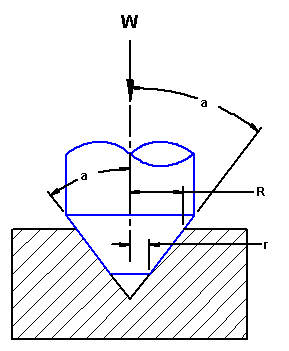
The Truncated Cone Friction Equation and Calculator is a valuable tool for engineers and designers. It calculates the frictional force between two surfaces in contact, specifically for a truncated cone shape. This equation takes into account the cone's dimensions, the coefficient of friction, and the normal force applied. By using the calculator, users can easily determine the frictional force and torque for various scenarios, making it an essential resource for mechanical design and analysis applications, particularly in industries involving rotational motion and power transmission systems. The equation's accuracy is crucial for safe and efficient system operation.
-
Understanding the Truncated Cone Friction Equation and Calculator
- Introduction to the Truncated Cone Friction Equation
- Derivation of the Truncated Cone Friction Equation
- Applications of the Truncated Cone Friction Equation
- Limitations and Assumptions of the Truncated Cone Friction Equation
- Comparison of the Truncated Cone Friction Equation with Other Friction Models
- What is the formula for the curved surface area of a truncated cone?
- What is the volume of a flat top cone?
-
Frequently Asked Questions (FAQs)
- What is the Truncated Cone Friction Equation and how is it used in engineering applications?
- How does the Truncated Cone Friction Equation differ from other friction equations, such as the Coulomb Friction Equation?
- What are the key parameters that need to be input into the Truncated Cone Friction Equation and Calculator?
- How can the Truncated Cone Friction Equation and Calculator be used to optimize the design of mechanical systems and reduce frictional losses?
Understanding the Truncated Cone Friction Equation and Calculator
The Truncated Cone Friction Equation is a mathematical formula used to calculate the frictional force that occurs when a truncated cone is in contact with a surface. This equation is essential in various fields, including physics, engineering, and materials science. The calculator associated with this equation allows users to input specific values and obtain the calculated frictional force.
Introduction to the Truncated Cone Friction Equation
The Truncated Cone Friction Equation is based on the principle of friction, which states that the frictional force between two surfaces is proportional to the normal force and the coefficient of friction. The equation takes into account the geometry of the truncated cone, including its height, radius, and angle of inclination. By using this equation, researchers and engineers can predict and analyze the frictional behavior of truncated cones in various applications.
Derivation of the Truncated Cone Friction Equation
The derivation of the Truncated Cone Friction Equation involves the use of calculus and vector analysis. The equation is derived by considering the forces acting on the truncated cone, including the normal force, frictional force, and weight. The derivation also takes into account the boundary conditions of the problem, such as the contact area and surface roughness. The resulting equation is a nonlinear equation that relates the frictional force to the input parameters.
Applications of the Truncated Cone Friction Equation
The Truncated Cone Friction Equation has numerous applications in various fields, including mechanical engineering, civil engineering, and materials science. Some examples of applications include the design of mechanical systems, Prediction of wear and tear on surfaces, and analysis of frictional behavior in complex systems. The equation is also used in the study of tribology, which is the science of friction, lubrication, and wear.
Limitations and Assumptions of the Truncated Cone Friction Equation
The Truncated Cone Friction Equation is based on several assumptions and limitations, including the assumption of a static system, negligible surface roughness, and constant coefficient of friction. The equation also assumes that the truncated cone is rigid and non-deformable. These assumptions and limitations can affect the accuracy and validity of the equation in certain situations.
Comparison of the Truncated Cone Friction Equation with Other Friction Models
The Truncated Cone Friction Equation can be compared with other friction models, such as the Coulomb friction model and the viscoelastic friction model. Each model has its own strengths and weaknesses, and the choice of model depends on the specific application and requirements. The Truncated Cone Friction Equation is a simplified model that is easy to apply and interpret, but it may not be accurate in all situations.
| Parameter | Unit | Description |
|---|---|---|
| Frictional Force | N | The force that opposes motion between two surfaces |
| Normal Force | N | The force that acts perpendicular to the surface |
| Coefficient of Friction | - | A dimensionless value that represents the frictional properties of a surface |
What is the formula for the curved surface area of a truncated cone?

The formula for the curved surface area of a truncated cone is given by the equation: A = π (R + r) sqrt((R - r)^2 + h^2), where R is the radius of the larger base, r is the radius of the smaller base, and h is the height of the truncated cone.
Understanding the Variables
To calculate the curved surface area of a truncated cone, it's essential to understand the variables involved in the formula. The variables are:
- The radius of the larger base (R), which is the distance from the center of the base to the edge.
- The radius of the smaller base (r), which is the distance from the center of the base to the edge.
- The height of the truncated cone (h), which is the distance between the two bases.
These variables are crucial in determining the curved surface area of the truncated cone, and their values must be accurately measured or calculated to obtain the correct result.
Derivation of the Formula
The formula for the curved surface area of a truncated cone is derived from the Pythagorean theorem and the formula for the lateral surface area of a cone. The derivation involves calculating the slant height of the truncated cone, which is the hypotenuse of a right triangle formed by the height and the difference in radii of the two bases. The slant height is then used to calculate the curved surface area.
Applications of the Formula
The formula for the curved surface area of a truncated cone has various applications in engineering, architecture, and design. It's used to calculate the surface area of structures such as conical roofs, chimneys, and tanks. The formula is also used in mathematical modeling to simulate the behavior of fluids and gases in conical containers.
Comparison with Other Shapes
The curved surface area of a truncated cone is different from that of other shapes, such as cylinders and spheres. The formula for the curved surface area of a truncated cone takes into account the tapered shape of the cone, which makes it more complex than the formulas for other shapes. The curved surface area of a truncated cone is also affected by the ratio of the radii of the two bases, which makes it unique compared to other shapes.
Calculating the Curved Surface Area
To calculate the curved surface area of a truncated cone, it's essential to follow a step-by-step approach. The steps involve:
- Measuring or calculating the radii of the two bases (R and r) and the height (h) of the truncated cone.
- Calculating the slant height using the Pythagorean theorem.
- Substituting the values into the formula to obtain the curved surface area.
By following these steps and using the correct values, the curved surface area of a truncated cone can be accurately calculated, which is essential in various engineering and architectural applications.
What is the volume of a flat top cone?
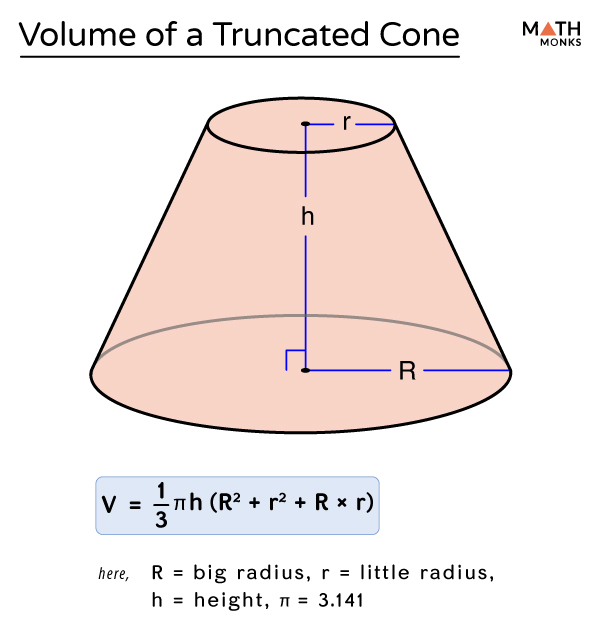
The volume of a flat top cone can be calculated using the formula: V = (1/3)πr^2h, where V is the volume, π is a mathematical constant approximately equal to 3.14, r is the radius of the base, and h is the height of the cone. This formula is used to calculate the volume of a right circular cone, which is a three-dimensional shape with a circular base and a vertex that is directly above the center of the base.
Calculating the Volume of a Flat Top Cone
To calculate the volume of a flat top cone, we need to know the radius of the base and the height of the cone. We can use the formula: V = (1/3)πr^2h, where V is the volume, π is a mathematical constant approximately equal to 3.14, r is the radius of the base, and h is the height of the cone. The steps to calculate the volume are:
- Measure the radius of the base of the cone.
- Measure the height of the cone.
- Plug the values into the formula: V = (1/3)πr^2h.
Understanding the Formula for the Volume of a Flat Top Cone
The formula for the volume of a flat top cone is based on the principle of similar triangles. The volume of a cone is equal to one-third the area of the base times the height. The area of the base is given by the formula: A = πr^2, where A is the area and r is the radius. The formula for the volume of a cone is then: V = (1/3)πr^2h. The key concepts to understand when using this formula are:
- The radius of the base must be measured accurately.
- The height of the cone must be measured accurately.
- The mathematical constant π must be used in the calculation.
Properties of a Flat Top Cone
A flat top cone is a three-dimensional shape with a circular base and a flat top. The properties of a flat top cone include:
- The base is a circle with a radius.
- The top is a flat surface that is parallel to the base.
- The height is the distance between the base and the top.
These properties are important to understand when calculating the volume of a flat top cone.
Applications of Flat Top Cones
Flat top cones have many practical applications in engineering, architecture, and design. Some examples of applications include:
- Roofing: Flat top cones can be used as roofs for buildings, providing a weather-tight seal and a unique aesthetic.
- Lighting: Flat top cones can be used as lighting fixtures, providing a focused beam of light and a stylized appearance.
- Furniture: Flat top cones can be used as table bases or chair legs, providing a stable and stylish support.
Real-World Examples of Flat Top Cones
There are many real-world examples of flat top cones, including:
- The Guggenheim Museum: The famous museum in New York City has a flat top cone-shaped roof that provides a unique and iconic silhouette.
- The Chrysler Building: The skyscraper in New York City has a flat top cone-shaped skyscraper that provides a distinctive and recognizable profile.
- The Sydney Opera House: The famous performing arts center in Australia has a flat top cone-shaped roof that provides a dramatic and breathtaking appearance.
Frequently Asked Questions (FAQs)
What is the Truncated Cone Friction Equation and how is it used in engineering applications?
The Truncated Cone Friction Equation is a mathematical model used to calculate the frictional force that arises when a truncated cone is in contact with a surface. This equation is particularly useful in engineering applications where the interaction between two surfaces is critical, such as in the design of mechanical systems, gears, and bearings. The equation takes into account the geometric parameters of the truncated cone, including its height, radius, and angle of inclination, as well as the coefficient of friction between the two surfaces. By using the Truncated Cone Friction Equation, engineers can predict and optimize the performance of their designs, ensuring that they can withstand the stresses and loads imposed upon them.
How does the Truncated Cone Friction Equation differ from other friction equations, such as the Coulomb Friction Equation?
The Truncated Cone Friction Equation differs from other friction equations, such as the Coulomb Friction Equation, in that it is specifically designed to handle the unique geometric characteristics of a truncated cone. While the Coulomb Friction Equation is a more general model that can be applied to a wide range of surfaces, the Truncated Cone Friction Equation takes into account the curved shape of the cone and the way it interacts with the surface. This allows for a more accurate and precise calculation of the frictional force, which is essential in engineering applications where safety and reliability are paramount. Additionally, the Truncated Cone Friction Equation can be used to model more complex frictional behaviors, such as static friction and kinetic friction, which are critical in understanding the dynamics of mechanical systems.
What are the key parameters that need to be input into the Truncated Cone Friction Equation and Calculator?
To use the Truncated Cone Friction Equation and Calculator, several key parameters need to be input, including the height and radius of the truncated cone, the angle of inclination, and the coefficient of friction between the two surfaces. The coefficient of friction is a critical parameter, as it determines the amount of frictional force that arises between the two surfaces. The geometric parameters of the truncated cone, such as its height and radius, are also essential, as they determine the surface area and curvature of the cone. Additionally, the angle of inclination is important, as it affects the direction and magnitude of the frictional force. By inputting these parameters into the equation and calculator, users can calculate the frictional force and evaluate the performance of their designs.
How can the Truncated Cone Friction Equation and Calculator be used to optimize the design of mechanical systems and reduce frictional losses?
The Truncated Cone Friction Equation and Calculator can be used to optimize the design of mechanical systems and reduce frictional losses by allowing engineers to simulate and analyze the behavior of their designs under various loading conditions. By using the equation and calculator, engineers can identify the key parameters that affect the frictional force and modify their designs to minimize frictional losses. For example, they can adjust the geometric parameters of the truncated cone, such as its height and radius, to reduce the surface area and curvature of the cone, which can help to reduce the frictional force. Additionally, they can select materials with a low coefficient of friction to minimize the frictional force. By using the Truncated Cone Friction Equation and Calculator, engineers can create more efficient and reliable mechanical systems that minimize frictional losses and maximize performance.
Deja una respuesta
Entradas Relacionadas