
Trapezoidal Weirs Flow Formula and Calculator


The trapezoidal weir flow formula is a widely used method for calculating the flow rate of water over a trapezoidal weir. This type of weir is commonly used in water management systems, such as dams and reservoirs, to measure and control the flow of water. The formula takes into account the dimensions of the weir, including the length, width, and height, as well as the water level and velocity. By using the trapezoidal weir flow formula and calculator, engineers and hydrologists can accurately determine the flow rate of water and make informed decisions about water management.
- Trapezoidal Weirs Flow Formula and Calculator
- How do you calculate weir flow?
- What is the side ratio of trapezoidal weir?
- What is the function of the trapezoidal weir?
- What is the discharge coefficient of a trapezoidal weir?
-
Frequently Asked Questions (FAQs)
- What is the Trapezoidal Weirs Flow Formula and how does it work?
- How do I use the Trapezoidal Weirs Flow Calculator to determine the flow rate?
- What are the advantages and limitations of using the Trapezoidal Weirs Flow Formula and Calculator?
- How can I apply the Trapezoidal Weirs Flow Formula and Calculator in real-world applications?
Trapezoidal Weirs Flow Formula and Calculator
The Trapezoidal Weirs Flow Formula and Calculator is a tool used to calculate the flow rate of water over a trapezoidal weir. A trapezoidal weir is a type of weir that has a trapezoidal shape, with a flat bottom and sloping sides. The flow rate of water over a trapezoidal weir can be calculated using the formula: Q = (2/3) sqrt(2 g) b h^(3/2), where Q is the flow rate, b is the width of the weir, h is the height of the water above the weir, and g is the acceleration due to gravity.
Introduction to Trapezoidal Weirs
Trapezoidal weirs are commonly used in water resources engineering to measure the flow rate of water in open channels. They are particularly useful in situations where the flow rate is variable and needs to be measured accurately. The trapezoidal shape of the weir allows for a more accurate measurement of the flow rate, as it takes into account the velocity of the water as it flows over the weir. The Trapezoidal Weirs Flow Formula is used to calculate the flow rate of water over a trapezoidal weir, and it is an essential tool for water resources engineers.
How the Trapezoidal Weirs Flow Formula Works
The Trapezoidal Weirs Flow Formula works by using the principles of fluid mechanics to calculate the flow rate of water over a trapezoidal weir. The formula takes into account the width of the weir, the height of the water above the weir, and the acceleration due to gravity. The flow rate is calculated using the formula: Q = (2/3) sqrt(2 g) b h^(3/2), where Q is the flow rate, b is the width of the weir, h is the height of the water above the weir, and g is the acceleration due to gravity. This formula is based on the Bernoulli's equation, which describes the relationship between the pressure and velocity of a fluid.
Advantages and Disadvantages of Trapezoidal Weirs
Trapezoidal weirs have several advantages, including their ability to accurately measure the flow rate of water in open channels. They are also relatively easy to install and maintain, and they can be used in a variety of applications. However, trapezoidal weirs also have some disadvantages, including their high cost and the fact that they can be affected by debris and sedimentation. Additionally, trapezoidal weirs require regular maintenance to ensure that they are functioning accurately.
Applications of Trapezoidal Weirs
Trapezoidal weirs have a variety of applications in water resources engineering, including water supply systems, flood control systems, and irrigation systems. They are particularly useful in situations where the flow rate of water needs to be measured accurately, such as in hydroelectric power plants. Trapezoidal weirs can also be used to measure the flow rate of water in rivers and streams, and they can be used to monitor the water quality of these water bodies.
Calculator for Trapezoidal Weirs Flow Formula
A calculator for the Trapezoidal Weirs Flow Formula can be used to calculate the flow rate of water over a trapezoidal weir. The calculator takes into account the width of the weir, the height of the water above the weir, and the acceleration due to gravity. The calculator can be used to calculate the flow rate in cubic meters per second, and it can also be used to calculate the velocity of the water as it flows over the weir.
| Parameter | Unit | Description |
|---|---|---|
| Q | m^3/s | Flow rate |
| b | m | Width of the weir |
| h | m | Height of the water above the weir |
| g | m/s^2 | Acceleration due to gravity |
How do you calculate weir flow?
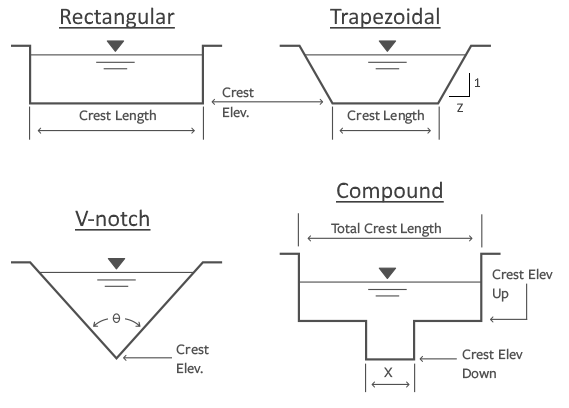
To calculate Weir Flow, you need to understand the concept of a weir, which is a barrier across a river or stream that alters the flow of water. The flow rate over a weir can be calculated using the weir equation, which takes into account the height of the water above the weir, the length of the weir, and the discharge coefficient. The weir equation is given by Q = (2/3) C_d L sqrt(2 g H^1.5), where Q is the flow rate, C_d is the discharge coefficient, L is the length of the weir, g is the acceleration due to gravity, and H is the height of the water above the weir.
Weir Flow Calculation Methods
Weir flow calculation methods involve using the weir equation to determine the flow rate over a weir. The methods include:
- Using a weir plate with a known discharge coefficient to calculate the flow rate
- Measuring the water level above the weir and using the weir equation to calculate the flow rate
- Using a calibrated weir to directly measure the flow rate
The choice of method depends on the accuracy required and the availability of data.
Factors Affecting Weir Flow Calculation
Several factors can affect the calculation of weir flow, including the shape and size of the weir, the roughness of the weir surface, and the velocity of the water approaching the weir. These factors can affect the discharge coefficient, which is a critical parameter in the weir equation. The discharge coefficient can be affected by:
- The geometry of the weir, including the shape and size of the weir
- The surface roughness of the weir, which can affect the flow of water over the weir
- The approach velocity of! the water, which can affect the flow rate over the weir
A thorough understanding of these factors is necessary to accurately calculate the weir flow.
Weir Flow Measurement Techniques
Weir flow measurement techniques involve using sensors and instruments to measure the flow rate over a weir. The techniques include:
- Using ultrasonic sensors to measure the water level above the weir
- Using pressure sensors to measure the pressure of the water above the weir
- Using acoustic sensors to measure the velocity of the water over the weir
These techniques can provide accurate and reliable measurements of the flow rate over a weir.
Applications of Weir Flow Calculation
Weir flow calculation has several practical applications, including:
- Water treatment plants, where weir flow calculation is used to determine the flow rate of water into the plant
- Hydroelectric power plants, where weir flow calculation is used to determine the flow rate of water over the turbine
- Irrigation systems, where weir flow calculation is used to determine the flow rate of water to crops
The accuracy of the weir flow calculation is critical in these! applications, as it can affect the efficiency and effectiveness of the system.
Limitations of Weir Flow Calculation
Weir flow calculation has several limitations, including:
- The assumption of a steady-state flow, which may not always be the case
- The sensitivity of the discharge coefficient to small changes in the weir geometry or surface roughness
- The difficulty of measuring the water level above the weir, particularly in turbulent flows
These limitations can affect the accuracy of the weir flow calculation, and alternative methods may be necessary in some cases. The selection of the correct method depends on the specific application and the availability of data and resources.
What is the side ratio of trapezoidal weir?
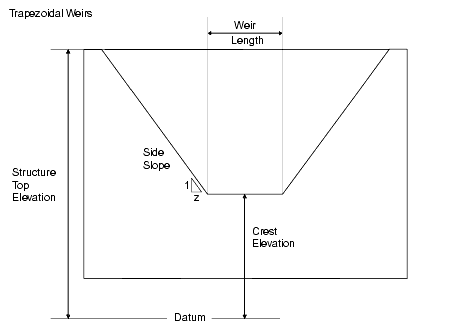
The side ratio of a trapezoidal weir is a critical parameter in determining its hydraulic performance. A trapezoidal weir is a type of irregular weir that has a trapezoidal shape, with a flat bottom and sloping sides. The side ratio of a trapezoidal weir is defined as the ratio of the length of the top side to the length of the bottom side.
Design Considerations
The design of a trapezoidal weir involves careful consideration of the side ratio, as it affects the hydraulic efficiency and flow rate of the weir. A higher side ratio can result in a more efficient flow, but it also increases the structural complexity of the weir. The design considerations for a trapezoidal weir include:
- Calculating the optimal side ratio based on the desired flow rate and hydraulic efficiency
- Selecting the appropriate materials for the weir, taking into account factors such as durability and cost
- Ensuring that the weir is structurally sound and can withstand the expected flow rates and water pressures
Hydraulic Performance
The hydraulic performance of a trapezoidal weir is closely related to its side ratio. A well-designed weir with an optimal side ratio can achieve high hydraulic efficiency, resulting in a more sustainable and environmentally friendly operation. The hydraulic performance of a trapezoidal weir can be influenced by factors such as:
- The shape and size of the weir, including the side ratio and the crest height
- The flow rate and water level upstream and downstream of the weir
- The roughness and friction of the weir surface, which can affect the energy losses and flow characteristics
Flow Characteristics
The flow characteristics of a trapezoidal weir are affected by its side ratio, as well as other factors such as the inflow rate and water depth. The flow characteristics of a trapezoidal weir can be described by:
- The flow velocity and flow rate through the weir, which can be influenced by the side ratio and crest shape
- The water surface tension and viscosity, which can affect the flow behavior and energy losses
- The turbulence and vortex formation downstream of the weir, which can be influenced by the side ratio and weir shape
Structural Integrity
The structural integrity of a trapezoidal weir is critical to its safe and efficient operation. The structural design of the weir must take into account the expected loads and stresses, including:
- The weight and pressure of the water, which can cause bending and torsion stresses in the weir structure
- The flow-induced forces, such as drag and lift, which can affect the stability and anchorage of the weir
- The soil and foundation conditions, which can influence the settlement and stability of the weir
Applications and Limitations
Trapezoidal weirs have a range of applications in water resources engineering, including:
- Flow measurement and control, where the weir is used to regulate the flow rate and water level
- Irrigation and drainage, where the weir is used to distribute water to crops or drain excess water from the land
- Hydroelectric power generation, where the weir is used to create a head of water to drive a turbine
What is the function of the trapezoidal weir?
The function of the trapezoidal weir is to measure the flow rate of a liquid, typically water, in an open channel or stream. It operates by creating a narrowing of the channel, which increases the velocity of the liquid and creates a head of water behind the weir. This head of water is then measured to calculate the flow rate.
Principle of Operation
The trapezoidal weir operates on the principle of conservation of energy, where the energy of the liquid is converted from potential energy to kinetic energy as it flows over the weir. This conversion of energy results in a specific head-discharge relationship, which allows for the calculation of the flow rate. The key factors that affect the operation of the trapezoidal weir include:
- The crest length and width of the weir, which determines the amount of water that can flow over it.
- The height of the weir, which affects the head of water behind the weir.
- The angle of the weir, which influences the velocity of the water as it flows over the weir.
Design Considerations
The design of a trapezoidal weir involves careful consideration of several factors, including the channel geometry, flow rates, and water levels. The weir must be designed to withstand the forces exerted by the water, including hydrostatic pressure and dynamic forces. The design should also take into account the accuracy and reliability of the flow measurements, as well as the maintenance and operation of the weir. Some key design considerations include:
- The material used to construct the weir, which must be durable and resistant to corrosion.
- The shape and size of the weir, which affects the flow rate and head-discharge relationship.
- The location of the weir, which must be accessible and safe for operation and maintenance.
Applications
Trapezoidal weirs are commonly used in a variety of applications, including water supply systems, irrigation systems, and hydroelectric power plants. They are particularly useful in situations where accurate flow measurements are required, such as in water treatment plants and wastewater treatment plants. The trapezoidal weir is also used in research and development applications, such as hydraulic modeling and water resources management. Some key applications include:
- Flow measurement, where the trapezoidal weir is used to measure the flow rate of a liquid.
- Water level control, where the weir is used to regulate the water level in a channel or reservoir.
- Sediment transport, where the weir is used to measure the transport of sediments in a channel.
Advantages and Limitations
The trapezoidal weir has several advantages, including its simplicity, low cost, and accuracy. However, it also has some limitations, including its sensitivity to debris and sedimentation, as well as its limited range of operation. The weir is also affected by air entrainment and surface tension, which can impact its accuracy. Some key advantages and limitations include:
- The accuracy of the trapezoidal weir, which can be affected by factors such as instrumentation and calibration.
- The range of operation, which is limited by the height and width of the weir.
- The maintenance requirements, which include regular cleaning and inspection.
Calibration and Maintenance
The trapezoidal weir requires regular calibration and maintenance to ensure its accuracy and reliability. This includes checking the instrumentation and data acquisition systems, as well as cleaning and inspecting the weir. The weir should also be calibrated regularly to ensure that it is operating within its design specifications. Some key calibration and maintenance tasks include:
- Checking the water level and flow rate measurements to ensure that they are accurate and reliable.
- Cleaning the weir to remove debris and sedimentation.
- Inspecting the weir for damage or wear, and replacing any damaged or worn components.
What is the discharge coefficient of a trapezoidal weir?

The discharge coefficient of a trapezoidal weir is a dimensionless value that represents the ratio of the actual flow rate to the theoretical flow rate over the weir. It is an important parameter in hydraulic engineering and is used to calculate the flow rate of water over the weir. The discharge coefficient of a trapezoidal weir is affected by several factors, including the weir geometry, water depth, and flow velocity.
Introduction to Trapezoidal Weirs
Trapezoidal weirs are a type of flow measurement device used to measure the flow rate of water in open channels. They consist of a trapezoidal-shaped weir plate with a crested top and a sloping bottom. The discharge coefficient of a trapezoidal weir is used to calculate the flow rate of water over the weir, and it is typically determined experimentally or using empirical equations. Some of the key factors that affect the discharge coefficient of a trapezoidal weir include:
- The weir geometry, including the length and shape of the weir plate
- The water depth upstream of the weir, which affects the flow velocity and turbulence
- The flow velocity and turbulence of the water as it flows over the weir
Factors Affecting the Discharge Coefficient
The discharge coefficient of a trapezoidal weir is affected by several factors, including the weir geometry, water depth, and flow velocity. The weir geometry affects the discharge coefficient by changing the flow pattern and turbulence of the water as it flows over the weir. The water depth upstream of the weir also affects the discharge coefficient by changing the flow velocity and turbulence. Some of the key factors that affect the discharge coefficient of a trapezoidal weir include:
- The weir crest shape and length, which affects the flow pattern and turbulence
- The water surface profile upstream of the weir, which affects the flow velocity and turbulence
- The flow regime, including the laminar or turbulent flow, which affects the discharge coefficient
Empirical Equations for Discharge Coefficient
Several empirical equations have been developed to predict the discharge coefficient of a trapezoidal weir. These equations are typically based on experimental data and dimensional analysis. Some of the most commonly used equations include the Bazin equation and the Rehbock equation. These equations take into account the weir geometry, water depth, and flow velocity to predict the discharge coefficient. Some of the key factors that are included in these equations include:
- The weir length and crest shape, which affects the flow pattern and turbulence
- The water depth upstream of the weir, which affects the flow velocity and turbulence
- The flow velocity and turbulence, which affects the discharge coefficient
Experimental Determination of Discharge Coefficient
The discharge coefficient of a trapezoidal weir can be determined experimentally using a hydraulic flume or open channel. The experimental setup typically consists of a trapezoidal weir installed in a hydraulic flume or open channel, with flow measurement devices used to measure the flow rate and water depth. The discharge coefficient is then calculated using the measured flow rate and water depth. Some of the key factors that are considered during the experimental determination of the discharge coefficient include:
- The weir geometry, including the length and crest shape
- The water depth upstream of the weir, which affects the flow velocity and turbulence
- The flow measurement devices, including the accuracy and precision of the devices
Applications of Trapezoidal Weirs
Trapezoidal weirs are widely used in hydraulic engineering and water resources management to measure the flow rate of water in open channels and rivers. The discharge coefficient of a trapezoidal weir is an important parameter in these applications, as it is used to calculate the flow rate and water depth. Some of the key applications of trapezoidal weirs include:
- Flow measurement in open channels and rivers
- Water supply and irrigation systems
- Flood control and water management systems
Frequently Asked Questions (FAQs)
What is the Trapezoidal Weirs Flow Formula and how does it work?
The Trapezoidal Weirs Flow Formula is a mathematical equation used to calculate the flow rate of water over a trapezoidal weir. A trapezoidal weir is a type of weir that has a trapezoidal shape, with a flat bottom and sloping sides. The formula takes into account the dimensions of the weir, including the length, width, and height, as well as the water level upstream and downstream of the weir. The flow rate is calculated using the formula: Q = (2/3) C_d b sqrt(2 g) H^1.5, where Q is the flow rate, C_d is the discharge coefficient, b is the length of the weir, g is the acceleration due to gravity, and H is the height of the water above the crest of the weir. The discharge coefficient is a dimensionless value that depends on the shape and size of the weir, as well as the water level and flow rate.
How do I use the Trapezoidal Weirs Flow Calculator to determine the flow rate?
To use the Trapezoidal Weirs Flow Calculator, you need to input the dimensions of the weir and the water level upstream and downstream of the weir. The calculator will then use the Trapezoidal Weirs Flow Formula to calculate the flow rate. First, you need to enter the length and width of the weir, as well as the height of the water above the crest of the weir. You also need to enter the discharge coefficient, which can be found in tables or calculated using other formulas. Once you have entered all the necessary values, the calculator will calculate the flow rate and display the result. The calculator can also be used to determine the dimensions of the weir required to achieve a certain flow rate, by rearranging the formula and solving for the unknown variable. This can be useful in the design of irrigation systems, drainage systems, and other applications where the flow rate needs to be controlled.
What are the advantages and limitations of using the Trapezoidal Weirs Flow Formula and Calculator?
The Trapezoidal Weirs Flow Formula and Calculator have several advantages, including the ability to accurately calculate the flow rate over a trapezoidal weir, and the simplicity of use. The formula is based on the principles of fluid dynamics and has been extensively tested and validated. However, there are also some limitations to using the formula and calculator. For example, the formula assumes that the water level upstream and downstream of the weir is constant, and that the flow is subcritical. In reality, the water level and flow rate can vary over time, and the flow can be supercritical or transcritical. Additionally, the formula does not take into account other factors that can affect the flow rate, such as the roughness of the weir and the surrounding channel, and the presence of obstacles or debris. Therefore, the results of the calculator should be used with caution and in conjunction with other methods and data.
How can I apply the Trapezoidal Weirs Flow Formula and Calculator in real-world applications?
The Trapezoidal Weirs Flow Formula and Calculator can be applied in a variety of real-world applications, including the design of irrigation systems, drainage systems, and water supply systems. The formula and calculator can be used to determine the flow rate over a trapezoidal weir, and to design the weir to achieve a certain flow rate. This can be useful in applications where the flow rate needs to be controlled, such as in agriculture, urban planning, and environmental engineering. Additionally, the formula and calculator can be used to monitor and manage water resources, and to predict the effects of climate change and other factors on water flow and availability. The formula and calculator can also be used in research and education, to study the principles of fluid dynamics and to teach students about the behavior of water in different channels and systems.
Deja una respuesta
Entradas Relacionadas