
Time to Drain a Conical Tank Equation and Calculator


The time it takes to drain a conical tank is a crucial aspect of various industrial and engineering applications. Calculating this time accurately is essential for efficient system design and operation. The equation to determine the time to drain a conical tank involves several factors, including the tank's dimensions, the fluid's properties, and the drainage rate. This article provides a comprehensive overview of the time to drain a conical tank equation and offers a calculator to simplify the calculation process, making it easier to apply in real-world scenarios. Accurate calculations are vital for optimal performance.
-
Understanding the Time to Drain a Conical Tank Equation and Calculator
- What is the Time to Drain a Conical Tank Equation?
- How to Use the Time to Drain a Conical Tank Calculator
- Applications of the Time to Drain a Conical Tank Equation and Calculator
- Factors Affecting the Time to Drain a Conical Tank
- Limits and Assumptions of the Time to Drain a Conical Tank Equation and Calculator
- What is the formula for the time to empty a conical tank?
- How do you calculate time to empty a tank?
- What is the formula for draining a tank?
- What is the formula for a conical water tank?
- Frequently Asked Questions (FAQs)
Understanding the Time to Drain a Conical Tank Equation and Calculator
The time to drain a conical tank equation and calculator is a mathematical model used to determine the time it takes to empty a conical tank. This equation takes into account the volume of the tank, the flow rate of the fluid, and the angle of the cone. The equation is typically used in industrial and engineering applications, such as in the design of storage tanks and drainage systems.
What is the Time to Drain a Conical Tank Equation?
The time to drain a conical tank equation is a mathematical formula that calculates the time it takes to empty a conical tank. The equation is based on the principle of conservation of mass and the equation of continuity. The equation is as follows: t = V / (π r^2 sqrt(2 g h)), where t is the time to drain, V is the volume of the tank, r is the radius of the tank, g is the acceleration due to gravity, and h is the height of the fluid.
How to Use the Time to Drain a Conical Tank Calculator
The time to drain a conical tank calculator is a tool used to calculate the time it takes to empty a conical tank. To use the calculator, simply enter the volume of the tank, the flow rate of the fluid, and the angle of the cone. The calculator will then calculate the time it takes to empty the tank.
Applications of the Time to Drain a Conical Tank Equation and Calculator
The time to drain a conical tank equation and calculator has a wide range of applications in industry and engineering. Some of the key applications include:
| Application | Description |
|---|---|
| Storage Tanks | Design and optimization of storage tanks |
| Drainage Systems | Design and optimization of drainage systems |
| Water Treatment | Design and optimization of water treatment systems |
| Chemical Processing | Design and optimization of chemical processing systems |
| Food Processing | Design and optimization of food processing systems |
Factors Affecting the Time to Drain a Conical Tank
There are several factors that can affect the time it takes to drain a conical tank. Some of the key factors include:
the flow rate of the fluid, the angle of the cone, and the viscosity of the fluid. These factors can affect the time to drain and must be taken into account when designing and optimizing drainage systems.
Limits and Assumptions of the Time to Drain a Conical Tank Equation and Calculator
The time to drain a conical tank equation and calculator is based on several limits and assumptions. Some of the key limits and assumptions include:
the equation of continuity, the principle of conservation of mass, and the assumption of a constant flow rate. These limits and assumptions must be taken into account when using the equation and calculator to ensure accurate results. The equation and calculator are also limited by the complexity of the system and the availability of data.
What is the formula for the time to empty a conical tank?

The formula for the time to empty a conical tank is given by the equation: t = (2 V) / (A sqrt(2 g h)), where t is the time to empty the tank, V is the volume of the tank, A is the area of the outlet, g is the acceleration due to gravity, and h is the height of the tank. This equation is derived from the principle of conservation of mass and the equation of continuity, which states that the mass flow rate into the tank is equal to the mass flow rate out of the tank.
Derivation of the Formula
The derivation of the formula for the time to empty a conical tank involves the use of calculus and the equation of continuity. The equation of continuity states that the mass flow rate into the tank is equal to the mass flow rate out of the tank. By applying this equation to the conical tank, we can derive the formula for the time to empty the tank. The key steps in the derivation are:
- Define the problem and the given parameters, such as the volume of the tank, the area of the outlet, and the height of the tank.
- Apply the equation of continuity to the conical tank, and use integration to find the mass flow rate out of the tank.
- Use the chain rule and separation of variables to solve the resulting differential equation and obtain the formula for the time to empty the tank.
Assumptions and Limitations
The formula for the time to empty a conical tank is based on several assumptions and limitations. These include the assumption that the tank is perfectly conical, that the outlet is small compared to the size of the tank, and that the fluid is incompressible. Additionally, the formula assumes that the viscosity of the fluid is negligible, and that the flow is laminar. The limitations of the formula include the fact that it does not account for turbulence or non-Newtonian fluids, and that it is only applicable to conical tanks with a small outlet.
Applications and Examples
The formula for the time to empty a conical tank has several practical applications and examples. For instance, it can be used to design and optimize storage tanks and process vessels in the chemical and petroleum industries. It can also be used to predict the draining time of a tank, and to determine the required outlet size for a given tank and fluid. Some examples of applications include:
- Designing a storage tank for a chemical plant, and predicting the time it will take to empty the tank.
- Optimizing the outlet size of a process vessel to achieve a desired draining time.
- Modeling the draining behavior of a conical tank using computational fluid dynamics (CFD) and experimentation.
Conclusion of the Formula
In conclusion to the explanation of the formula, the time to empty a conical tank is a complex phenomenon that depends on several factors, including the volume of the tank, the area of the outlet, and the height of the tank. By understanding the underlying physics and mathematics of the problem, we can derive a formula that accurately predicts the time to empty the tank. The formula is based on the principle of conservation of mass and the equation of continuity, and it has several practical applications and examples.
Further Developments and Research
There are several further developments and research opportunities related to the formula for the time to empty a conical tank. For instance, researchers could investigate the effect of turbulence on the draining behavior of the tank, or develop new models that account for non-Newtonian fluids. Some potential areas of research include:
- Developing new formulas that account for viscosity and turbulence.
- Investigating the effect of outlet size and shape on the draining behavior of the tank.
- Using computational fluid dynamics (CFD) and experimentation to validate and refine the formula.
How do you calculate time to empty a tank?

To calculate the time to empty a tank, you need to know the volume of the tank, the flow rate of the liquid being drained, and the pressure of the system. The time to empty the tank can be calculated using the formula: time = volume / flow rate. This formula assumes that the flow rate is constant and that the tank is being drained at a steady state. However, in reality, the flow rate may vary due to factors such as viscosity and friction, which can affect the accuracy of the calculation.
Understanding the Formula
The formula to calculate the time to empty a tank is based on the following principles:
- The volume of the tank is the amount of liquid it can hold, typically measured in cubic meters or gallons.
- The flow rate is the rate at which the liquid is being drained from the tank, typically measured in liters per minute or gallons per hour.
- The pressure of the system can affect the flow rate, and therefore the time to empty the tank, with higher pressures resulting in faster flow rates and shorter emptying times.
The formula is a simple and effective way to estimate the time to empty a tank, but it may not be accurate in all situations, particularly where the flow rate is not constant.
Factors Affecting Flow Rate
There are several factors that can affect the flow rate of a tank, including:
- The viscosity of the liquid, with thicker liquids flowing more slowly than thinner ones.
- The friction between the liquid and the walls of the tank or pipe, which can slow down the flow rate.
- The pressure of the system, with higher pressures resulting in faster flow rates.
These factors can make it difficult to accurately calculate the time to empty a tank using a simple formula, and may require more complex calculations or modeling techniques.
Calculating Volume
To calculate the volume of a tank, you need to know its dimensions, including its length, width, and height. The volume of a rectangular tank can be! calculated using the formula: volume = length x width x height. For more complex tank shapes, such as cylindrical or spherical tanks, the volume can be calculated using specialized formulas or software.
- The length and width of the tank are typically measured in meters or feet.
- The height of the tank is also measured in meters or feet.
- The shape of the tank can affect the volume calculation, with different formulas required for different shapes.
Measuring Flow Rate
The flow rate of a tank can be measured using a variety of techniques, including:
- Flow meters, which measure the flow rate directly.
- Pressure sensors, which measure the pressure of the system and can be used to estimate the flow rate.
- timers and volumetric measurements, which can be used to estimate the flow rate indirectly.
The choice of measurement technique will depend on the specific application and the accuracy required.
Applications and Considerations
The calculation of the time to empty a tank has many practical applications, including:
- Process control, where the time to empty a tank is used to control the flow rate and optimize the process.
- Safety calculations, where the time to empty a tank is used to estimate the risk of overflow or other hazards.
- Design and optimization, where the time to empty a tank is used to size and configure the tank and piping system.
In each of these applications, the accuracy of the calculation is critical, and careful consideration must be given to the assumptions and limitations of the formula.
What is the formula for draining a tank?
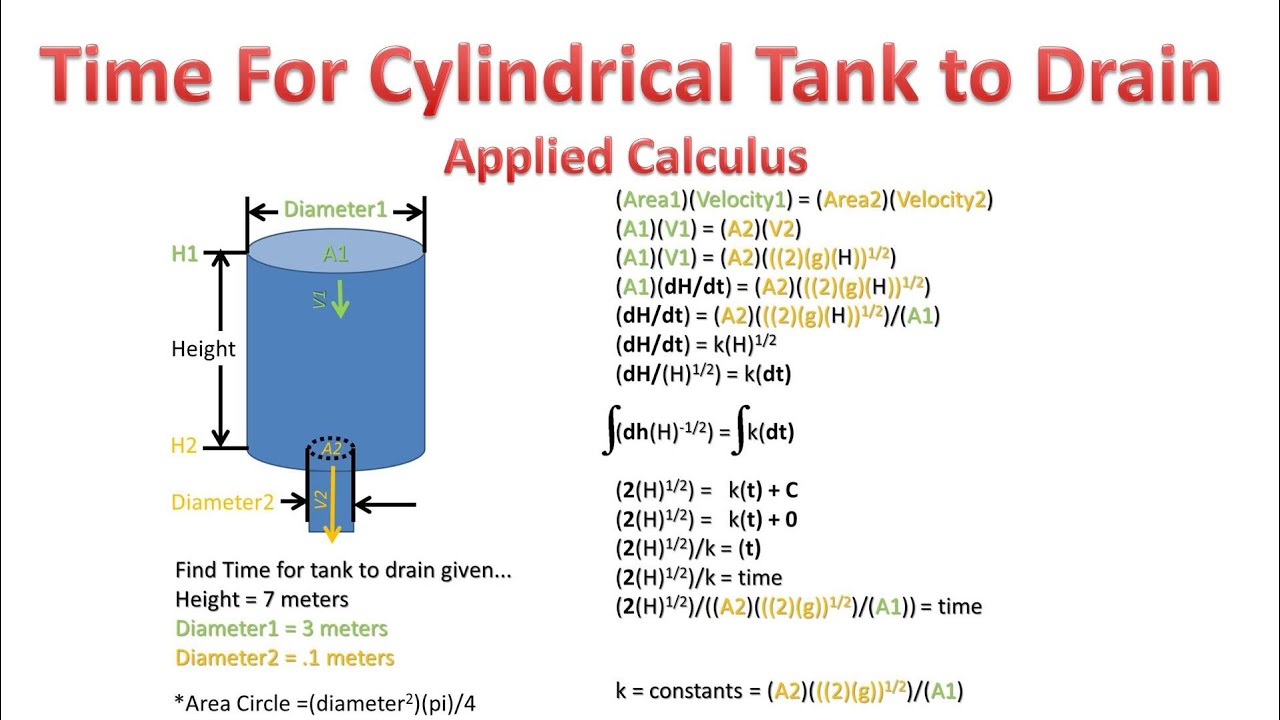
The formula for draining a tank can be determined by the torricelli's theorem, which states that the velocity of the fluid flowing out of the tank is proportional to the square root of the height of the fluid in the tank. This theorem can be expressed mathematically as: v = √(2gh), where v is the velocity of the fluid, g is the acceleration due to gravity, and h is the height of the fluid in the tank.
Understanding the Basics of Torricelli's Theorem
To understand the formula for draining a tank, it's essential to grasp the concept of torricelli's theorem. This theorem is based on the principle of conservation of energy, which states that the sum of kinetic energy and potential energy of a fluid remains constant. By applying this theorem, we can calculate the velocity of the fluid flowing out of the tank. The key points to consider are:
- The height of the fluid in the tank is a crucial factor in determining the velocity of the fluid flowing out.
- The acceleration due to gravity plays a significant role in the theorem, as it affects the potential energy of the fluid.
- The cross-sectional area of the tank and the orifice through which the fluid flows out also impact the velocity of the fluid.
Factors Affecting the Draining of a Tank
Several factors can influence the rate at which a tank drains, including the viscosity of the fluid, the surface tension of the fluid, and the shape and size of the tank. These factors can affect the flow rate of the fluid and, subsequently, the time it takes to drain the tank. The key points to consider are:
- The viscosity of the fluid can slow down or speed up the flow rate, depending on its magnitude.
- The surface tension of the fluid can also impact the flow rate, particularly when the fluid is flowing through a narrow orifice.
- The shape and size of the tank can affect the flow rate and the time it takes to drain the tank, due to the variation in height and pressure.
Calculating the Time to Drain a Tank
To calculate the time it takes to drain a tank, we need to use the formula: t = V / Q, where t is the time, V is the volume of the tank, and Q is the flow rate. The flow rate can be calculated using the formula: Q = A v, where A is the cross-sectional area of the orifice and v is the velocity of the fluid. The key points to consider are:
- The volume of the tank is a critical factor in determining the time it takes to drain the tank.
- The flow rate is also essential, as it affects the time it takes to drain the tank.
- The cross-sectional area of the orifice and the velocity of the fluid are necessary to calculate the flow rate.
Applications of Torricelli's Theorem
Torricelli's theorem has numerous applications in engineering and physics, particularly in the design and operation of fluid systems. The theorem can be used to calculate the flow rate and velocity of fluids in pipes, tanks, and orifices. The key points to consider are:
- The design of fluid systems relies heavily on the application of torricelli's theorem.
- The operation of fluid systems also requires an understanding of the theorem, to ensure efficient and safe operation.
- The calculation of flow rate and velocity is crucial in many engineering applications, such as water supply systems and irrigation systems.
Limitations and Assumptions of Torricelli's Theorem
While torricelli's theorem is a powerful tool for calculating the velocity and flow rate of fluids, it has several limitations and assumptions. The theorem assumes that the fluid is inviscid and irrotational, and that the flow is steady and one-dimensional. The key points to consider are:
- The assumption of inviscid flow can lead to inaccurate results, particularly in viscous fluids.
- The assumption of irrotational flow can also lead to inaccurate results, particularly in rotating fluids.
- The assumption of steady and one-dimensional flow can limit the application of the theorem, particularly in unsteady and two-dimensional flows.
What is the formula for a conical water tank?
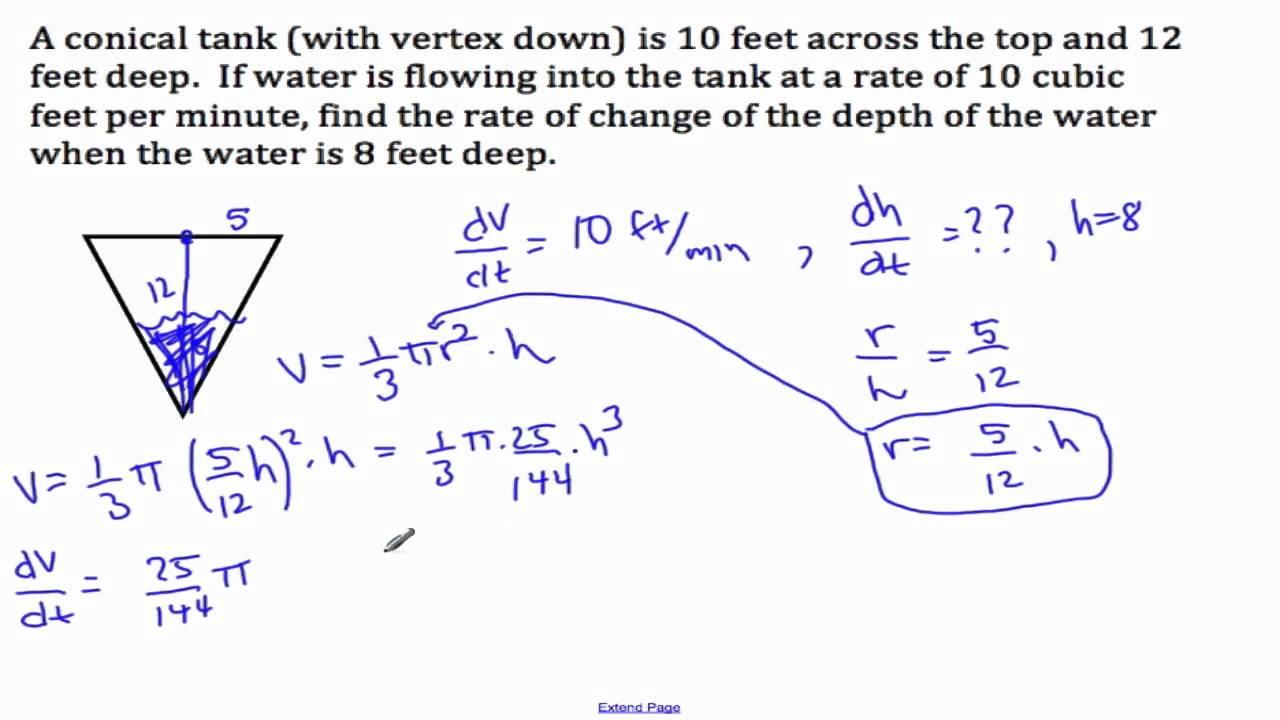
The formula for a conical water tank is V = (1/3)πr^2h, where V is the volume of the tank, π is a mathematical constant approximately equal to 3.14, r is the radius of the base of the cone, and h is the height of the cone. This formula is used to calculate the volume of a conical shape, which is a common design for water tanks due to its stability and efficiency.
Understanding the Formula
To understand the formula for a conical water tank, it's essential to know the key components involved. The formula consists of the volume (V), the mathematical constant (π), the radius of the base (r), and the height (h) of the cone. These components are crucial in determining the volume of the tank. Here are some key points to consider:
- The formula V = (1/3)πr^2h is used to calculate the volume of a cone.
- The radius of the base is a critical component in determining the volume of the tank.
- The height of the cone also plays a significant role in calculating the volume of the tank.
Calculating the Volume
Calculating the volume of a conical water tank involves using the formula V = (1/3)πr^2h. To do this, you need to know the radius and height of the cone. Once you have these values, you can plug them into the formula to get the volume. Here are the steps to follow:
- Measure the radius of the base of the cone.
- Measure the height of the cone.
- Plug the values into the formula V = (1/3)πr^2h to calculate the volume.
Design Considerations
When designing a conical water tank, there are several factors to consider. The shape and size of the tank will depend on the amount of water it needs to hold. The material used to build the tank will also impact its durability and maintenance. Here are some key considerations:
- The material used to build the tank should be durable and resistant to corrosion.
- The size and shape of the tank will depend on the amount of water it needs to hold.
- The design should also take into account safety and accessibility features.
Applications of Conical Water Tanks
Conical water tanks have a range of applications in various industries. They are commonly used in water treatment and distribution systems. They are also used in agriculture and irrigation systems. Here are some examples:
- Water treatment plants use conical tanks to store and process water.
- Agriculture and irrigation systems use conical tanks to store and distribute water to crops.
- Industrial processes also use conical tanks to store and handle chemicals and other substances.
Advantages of Conical Water Tanks
Conical water tanks have several advantages over other types of tanks. They are stable and efficient, making them a popular choice for water storage. They are also space-efficient and can be easily maintained. Here are some benefits:
- Stability: Conical tanks are more stable than other types of tanks, making them less prone to tip-over.
- Efficiency: Conical tanks are more efficient than other types of tanks, making them ideal for water storage.
- Space-efficiency: Conical tanks are space-efficient, making them ideal for small spaces.
Frequently Asked Questions (FAQs)
What is the Time to Drain a Conical Tank Equation and Calculator?
The Time to Drain a Conical Tank Equation is a mathematical formula used to calculate the time it takes to drain a conical tank. This equation takes into account the volume of the tank, the height of the tank, the radius of the tank, and the flow rate of the liquid being drained. The equation is typically represented as a differential equation, which can be solved to find the time it takes to drain the tank. The calculator is a tool used to simplify the process of solving the equation, allowing users to input the necessary values and calculate the time to drain the tank. The calculator can be used in a variety of industrial applications, such as in the petroleum industry, chemical industry, and food processing industry.
How does the Time to Drain a Conical Tank Equation work?
The Time to Drain a Conical Tank Equation works by using the principle of conservation of mass to relate the volume of liquid in the tank to the flow rate of the liquid being drained. The equation takes into account the geometry of the tank, including the height and radius of the tank, as well as the density of the liquid being drained. The equation is typically represented as a nonlinear differential equation, which can be solved using numerical methods or approximation techniques. The calculator uses a numerical algorithm to solve the equation, allowing users to input the necessary values and calculate the time to drain the tank. The equation is highly accurate, but it does require precise input values to produce accurate results.
What are the key factors that affect the Time to Drain a Conical Tank Equation?
There are several key factors that affect the Time to Drain a Conical Tank Equation, including the volume of the tank, the height of the tank, the radius of the tank, and the flow rate of the liquid being drained. The density of the liquid being drained is also an important factor, as it affects the viscosity and surface tension of the liquid. The geometry of the tank, including the shape and size of the tank, also plays a critical role in determining the time to drain the tank. Additionally, the friction and resistance to flow, such as pipe friction and valve resistance, can also affect the time to drain the tank. The calculator takes all of these factors into account, allowing users to input the necessary values and calculate the time to drain the tank.
How can I use the Time to Drain a Conical Tank Equation and Calculator in my work?
The Time to Drain a Conical Tank Equation and calculator can be used in a variety of industrial applications, such as in the petroleum industry, chemical industry, and food processing industry. The equation and calculator can be used to design and optimize tanks and drainage systems, predict and prevent tank overflows, and improve and optimize drainage operations. The calculator can also be used to train and educate personnel on the principles of fluid dynamics and tank drainage. Additionally, the equation and calculator can be used to research and develop new technologies and products, such as more efficient and cost-effective drainage systems. The calculator is a valuable tool that can help users to save time and reduce costs, while also improving and optimizing their drainage operations.
Deja una respuesta
Entradas Relacionadas