
Tank with Spherical Ends Dimensional and Volume Data Calculator


The Tank with Spherical Ends Dimensional and Volume Data Calculator is a valuable tool for engineers, architects, and designers working with cylindrical tanks. This calculator provides accurate calculations for the dimensions and volume of tanks with spherical ends, also known as Horton spheres or spherical tanks. By inputting the tank's diameter, length, and wall thickness, users can obtain vital data, including the tank's volume, surface area, and weight. This information is crucial for designing, building, and maintaining tanks used in various industries, such as oil and gas, chemical processing, and water storage. Calculations are precise and reliable.
- Tank with Spherical Ends Dimensional and Volume Data Calculator
- How to calculate volume of a spherical tank?
- How do you calculate tank capacity with dimensions?
- How to calculate round tank volume?
- How to calculate diesel tank capacity in liters?
-
Frequently Asked Questions (FAQs)
- What is the purpose of the Tank with Spherical Ends Dimensional and Volume Data Calculator?
- What are the key inputs and outputs of the Tank with Spherical Ends Dimensional and Volume Data Calculator?
- How does the Tank with Spherical Ends Dimensional and Volume Data Calculator handle different units and measurement systems?
- What are the limitations and assumptions of the Tank with Spherical Ends Dimensional and Volume Data Calculator?
Tank with Spherical Ends Dimensional and Volume Data Calculator
The Tank with Spherical Ends Dimensional and Volume Data Calculator is a mathematical tool used to calculate the dimensions and volume of a tank with spherical ends. This type of tank is commonly used in industrial applications, such as storage of liquids and gases. The calculator takes into account the diameter, length, and wall thickness of the tank, as well as the radius of the spherical ends.
Introduction to Tank with Spherical Ends
A tank with spherical ends is a type of storage tank that has a cylindrical body and spherical ends. This design provides a strong and efficient way to store liquids and gases. The spherical ends are welded to the cylindrical body, creating a leak-tight seal.
Calculating the Volume of a Tank with Spherical Ends
To calculate the volume of a tank with spherical ends, you need to use the formula: V = π/4 (D^2 L + 4/3 R^3), where V is the volume, D is the diameter, L is the length, and R is the radius of the spherical ends.
| Variable | Description |
|---|---|
| D | Diameter of the tank |
| L | Length of the tank |
| R | Radius of the spherical ends |
Dimensions and Tolerances of a Tank with Spherical Ends
When designing a tank with spherical ends, it is important to consider the dimensions and tolerances of the tank. The diameter and length of the tank must be precise, as well as the radius of the spherical ends. The wall thickness of the tank must also be considered to ensure safety and efficiency.
Materials and Manufacturing of a Tank with Spherical Ends
The materials used to manufacture a tank with spherical ends are crucial to its performance and safety. The most common materials used are steel and aluminum, which provide strength and durability. The manufacturing process involves welding and forming the spherical ends and cylindrical body.
Applications of a Tank with Spherical Ends
A tank with spherical ends has various applications in industry, including storage of liquids and gases, chemical processing, and power generation. The unique design of the tank provides a safe and efficient way to store and process hazardous materials. The tank is also used in aerospace and defense applications, where high-strength and lightweight materials are required.
How to calculate volume of a spherical tank?
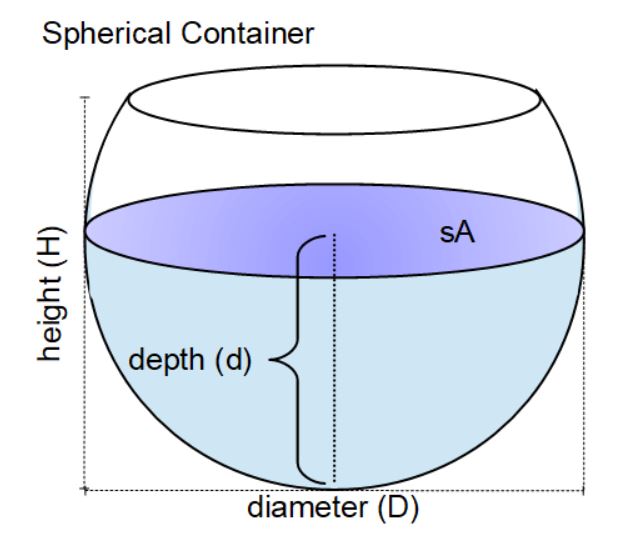
To calculate the volume of a spherical tank, you can use the formula for the volume of a sphere, which is given by (4/3)πr³, where r is the radius of the sphere. This formula is derived from the integration of the area of the sphere with respect to its radius.
Understanding the Formula
The formula for the volume of a sphere is (4/3)πr³, where r is the radius of the sphere. To calculate the volume, you need to know the radius of the sphere, which can be measured or calculated from other dimensions. Here are the steps to calculate the volume:
- Measure or calculate the radius of the sphere.
- Plug the radius into the formula (4/3)πr³.
- Calculate the volume using the formula.
Applying the Formula to a Spherical Tank
When applying the formula to a spherical tank, you need to consider the actual volume of the tank, which may be less than the theoretical volume due to the thickness of the tank's walls and other factors. The actual volume can be calculated by subtracting the volume of the walls and other obstructions from the theoretical volume. Here are the steps:
- Calculate the theoretical volume using the formula (4/3)πr³.
- Measure or calculate the thickness of the tank's walls and other obstructions.
- Subtract the volume of the walls and other obstructions from the theoretical volume.
Considerations for Partially Filled Tanks
When the spherical tank is only partially filled, the volume of the liquid can be calculated using the formula for the volume of a spherical cap, which is given by (1/3)πh(3a² + h²), where h is the height of the liquid and a is the radius of the base of the spherical cap. Here are the steps:
- Measure or calculate the height of the liquid and the radius of the base of the spherical cap.
- Plug the values into the formula (1/3)πh(3a² + h²).
- Calculate the volume of the liquid using the formula.
Accounting for Tank Shape Irregularities
In some cases, the spherical tank may not be a perfect sphere, but rather an ellipsoid or other irregular shape. To calculate the volume of such a tank, you need to use a more complex formula that takes into account the shape of the tank. Here are the steps:
- Measure or calculate the dimensions of the tank, including its length, width, and height.
- Use a 3D modeling software or other tool to create a model of the tank.
- Use the model to calculate the volume of the tank.
Using Online Calculators and Software
There are many online calculators and software programs available that can help you calculate the volume of a spherical tank, including spreadsheet programs like Microsoft Excel and mathematical modeling software like MATLAB. Here are the steps:
- Choose a suitable calculator or software program.
- Enter the dimensions of the tank into the calculator or software program.
- Use the calculator or software program to calculate the volume of the tank.
How do you calculate tank capacity with dimensions?

To calculate tank capacity with dimensions, you need to know the length, width, and height of the tank. The formula to calculate the capacity of a tank is volume = length x width x height. This formula is used for rectangular tanks. For cylindrical tanks, the formula is volume = π x radius^2 x height.
Understanding Tank Dimensions
To calculate tank capacity, it's essential to understand the dimensions of the tank. The dimensions of a tank include its length, width, and height. These dimensions can be measured in various units such as meters, feet, or inches. The accuracy of these measurements is crucial to calculate the correct capacity of the tank.
- The length of the tank is measured from one end to the other.
- The width of the tank is measured from one side to the other.
- The height of the tank is measured from the bottom to the top.
Calculating Rectangular Tank Capacity
Calculating the capacity of a rectangular tank is straightforward. You multiply the length, width, and height of the tank to get the volume. This formula is volume = length x width x height. For example, if a tank has a length of 10 feet, a width of 5 feet, and a height of 8 feet, the volume would be 10 x 5 x 8 = 400 cubic feet.
- Measure the length, width, and height of the tank.
- Multiply these dimensions together to get the volume.
- Convert the volume to the desired unit, such as gallons or liters.
Calculating Cylindrical Tank Capacity
Calculating the capacity of a cylindrical tank is slightly more complex. The formula to calculate the volume of a cylindrical tank is volume = π x radius^2 x height. The radius is half the diameter of the tank. For example, if a tank has a diameter of 10 feet and a height of 20 feet, the radius would be 5 feet, and the volume would be π x 5^2 x 20 = approximately 1570 cubic feet.
- Measure the diameter and height of the tank.
- Calculate the radius by dividing the diameter by 2.
- Use the formula volume = π x radius^2 x height to calculate the volume.
Converting Volume to Other Units
Once you have calculated the volume of the tank in cubic units, you may need to convert it to other units such as gallons or liters. This can be done using conversion factors. For example, 1 cubic foot is equal to approximately 7.48 gallons.
- Choose the desired unit of measurement.
- Look up the conversion factor for the unit.
- Multiply the volume by the conversion factor to get the desired unit.
Accounting for Tank Shape
The shape of the tank can affect its capacity. Rectangular tanks have a straightforward calculation, while cylindrical tanks require a more complex formula. Other shapes, such as spherical or elliptical tanks, may require specialized formulas or calculations.
- Determine the shape of the tank.
- Choose the correct formula for the shape.
- Measure the necessary dimensions to calculate the volume.
How to calculate round tank volume?
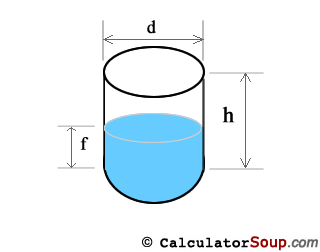
To calculate the volume of a round tank, you need to know the radius and height of the tank. The formula for calculating the volume of a round tank is V = πr²h, where V is the volume, π is a mathematical constant approximately equal to 3.14, r is the radius of the tank, and h is the height of the tank.
Understanding the Formula
The formula V = πr²h is used to calculate the volume of a cylindrical tank. This formula is derived from the geometry of a cylinder, where the volume is equal to the area of the base times the height. The area of the base is a circle, which is calculated as πr². By multiplying this area by the height, you get the volume of the tank.
- The radius of the tank is the distance from the center of the tank to the edge.
- The height of the tank is the distance from the bottom to the top of the tank.
- The pi value is a mathematical constant approximately equal to 3.14.
Measuring the Tank Dimensions
To calculate the volume of a round tank, you need to measure the radius and height of the tank. The radius can be measured by finding the distance from the center of the tank to the edge, while the height is measured from the bottom to the top of the tank. It's essential to take accurate measurements to ensure the calculated volume is correct.
- Use a tape measure or a ruler to measure the diameter of the tank.
- Divide the diameter by 2 to get the radius.
- Measure the height of the tank from the bottom to the top.
Calculating the Volume
Once you have the radius and height of the tank, you can calculate the volume using the formula V = πr²h. Plug in the values you've measured, and calculate the result. Make sure to use the correct units, such as gallons or liters, depending on the desired output.
- Plug in the values of radius and height into the formula.
- Calculate the area of the base using πr².
- Multiply the area by the height to get the volume.
Units and Conversions
When calculating the volume of a round tank, it's essential to consider the units of measurement. The formula will give you the volume in cubic units, such as cubic feet or cubic meters. You may need to convert these units to more practical units, such as gallons or liters.
- Understand the units of measurement for the radius and height.
- Calculate the volume in cubic units.
- Convert the volume to the desired units, such as gallons or liters.
Real-World Applications
Calculating the volume of a round tank is crucial in various industries, such as water treatment, chemical processing, and petroleum. Accurate volume calculations are necessary for safety, efficiency, and cost-effectiveness. By understanding how to calculate the volume of a round tank, you can ensure optimal performance and compliance with regulations.
- Water treatment plants use round tanks to store and process water.
- Chemical processing plants use round tanks to store and mix chemicals.
- Petroleum companies use round tanks to store and transport fuels.
How to calculate diesel tank capacity in liters?
To calculate diesel tank capacity in liters, you need to know the dimensions of the tank and the density of diesel fuel. The volume of the tank can be calculated by multiplying the length, width, and height of the tank. Then, you need to convert the volume from cubic units to liters. The density of diesel fuel is approximately 0.85 grams per milliliter, which is equivalent to 850 kilograms per cubic meter.
Understanding Diesel Tank Dimensions
To calculate the capacity of a diesel tank, you need to know the length, width, and height of the tank. These dimensions are usually provided by the manufacturer or can be measured directly. You can use the following steps to calculate the volume of the tank:
- Measure the length, width, and height of the tank in meters or feet.
- Convert the dimensions to a consistent unit, such as meters.
- Multiply the length, width, and height to get the volume of the tank in cubic meters or cubic feet.
Converting Volume to Liters
Once you have the volume of the tank in cubic meters or cubic feet, you need to convert it to liters. There are 1000 liters in a cubic meter, so you can multiply the volume in cubic meters by 1000 to get the volume in liters. For cubic feet, you need to know that there are approximately 28.3168 liters in a cubic foot.
- Convert the volume from cubic meters to liters by multiplying by 1000.
- Convert the volume from cubic feet to liters by multiplying by 28.3168.
- Round the result to the nearest whole number or to one decimal place, depending on the desired level of precision.
Calculating Diesel Tank Capacity with Density
The density of diesel fuel is important when calculating the capacity of a diesel tank. The density of diesel fuel is approximately 0.85 grams per milliliter, which is equivalent to 850 kilograms per cubic meter. You can use the density to calculate the mass of diesel fuel that the tank can hold.
- Calculate the volume of the tank in cubic meters.
- Multiply the volume by the density of diesel fuel to get the mass in kilograms.
- Convert the mass to a more convenient unit, such as tons or pounds, if necessary.
Factors Affecting Diesel Tank Capacity
There are several factors that can affect the capacity of a diesel tank, including the shape and size of the tank, the material it is made of, and the operating conditions. For example, a tank that is not fully filled may have a lower effective capacity due to the vapor space at the top.
- Consider the shape and size of the tank when calculating its capacity.
- Take into account the material the tank is made of and its corrosion resistance.
- Consider the operating conditions, such as temperature and pressure, when calculating the capacity.
Importance of Accurate Diesel Tank Capacity Calculation
Accurate calculation of diesel tank capacity is crucial for various applications, including fuel storage and transportation. It can help prevent overfilling or underfilling of the tank, which can lead to safety hazards and environmental damage.
- Use accurate measurements and calculations to determine the capacity of the tank.
- Consider the safety factors and regulations when calculating the capacity.
- Use specialized software or consult with experts if necessary to ensure accurate calculations.
Frequently Asked Questions (FAQs)
What is the purpose of the Tank with Spherical Ends Dimensional and Volume Data Calculator?
The Tank with Spherical Ends Dimensional and Volume Data Calculator is a tool designed to help users calculate the volume and other dimensional parameters of a tank with spherical ends. This calculator is particularly useful for engineers, architects, and other professionals who need to design or work with tanks, containers, or other vessels that have spherical ends. The calculator takes into account the diameter and length of the tank, as well as the radius of the spherical ends, to provide accurate calculations of the tank's volume, surface area, and other important parameters. By using this calculator, users can save time and effort in their design and calculation work, and ensure that their tanks or containers are properly sized and configured for their intended use.
What are the key inputs and outputs of the Tank with Spherical Ends Dimensional and Volume Data Calculator?
The key inputs of the Tank with Spherical Ends Dimensional and Volume Data Calculator include the diameter and length of the tank, as well as the radius of the spherical ends. These inputs are used to calculate a range of outputs, including the volume of the tank, the surface area of the tank, and the weight of the tank when filled with a given material. The calculator also provides dimensional data, such as the height and width of the tank, and the curvature of the spherical ends. By providing these key inputs and outputs, the calculator helps users to fully understand the characteristics and behavior of their tanks or containers, and to make informed decisions about their design and use. The calculator's outputs can be used for a variety of purposes, including design optimization, cost estimation, and safety analysis.
How does the Tank with Spherical Ends Dimensional and Volume Data Calculator handle different units and measurement systems?
The Tank with Spherical Ends Dimensional and Volume Data Calculator is designed to handle different units and measurement systems, making it a versatile tool for users around the world. The calculator allows users to select from a range of units, including metric units such as meters and liters, and imperial units such as feet and gallons. The calculator also supports different measurement systems, including SI and US customary systems. By handling different units and measurement systems, the calculator helps to ensure that users can work with the units and systems that are most familiar to them, and that they can easily convert between different units and systems if needed. This flexibility makes the calculator a valuable tool for international collaborations and global projects, where different units and measurement systems may be in use.
What are the limitations and assumptions of the Tank with Spherical Ends Dimensional and Volume Data Calculator?
The Tank with Spherical Ends Dimensional and Volume Data Calculator is a powerful tool, but it is not without limitations and assumptions. One key limitation is that the calculator assumes a simplified model of the tank, with symmetrical spherical ends and a cylindrical body. The calculator also assumes that the tank is made of a homogeneous material, and that the density of the material is uniform throughout the tank. Additionally, the calculator does not take into account real-world factors such as corrosion, wear, and tear, which can affect the performance and lifetime of the tank. By understanding these limitations and assumptions, users can ensure that they use the calculator in a way that is consistent with their specific needs and requirements, and that they do not rely solely on the calculator for critical design or safety decisions. Instead, users should use the calculator as a tool to inform and support their decision-making, and should always verify their results through other means, such as experimental testing or expert consultation.
Deja una respuesta
Entradas Relacionadas