
Stress in Cone or Conical Section Seam Equations and Calculator

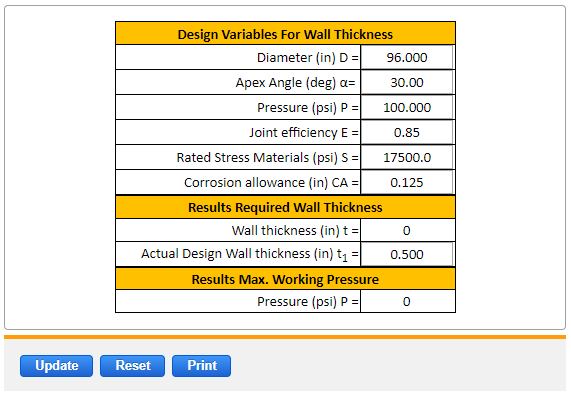
The stress in a cone or conical section seam is a critical aspect of mechanical engineering, particularly in the design of pressure vessels, storage tanks, and piping systems. Conical sections are commonly used to transition between different diameters or to provide a smooth flow path. However, the seam where the cone meets the cylinder or another cone can be a weak point, prone to stress concentrations and potential failure. This article will explore the equations and calculator used to determine the stress in a conical section seam, providing a valuable resource for engineers and designers. Proper calculation is essential.
- Stress in Cone or Conical Section Seam Equations and Calculator
- Understanding Stress in Cone or Conical Section Seam Equations and Calculator
-
Frequently Asked Questions (FAQs)
- What is stress in cone or conical section seam equations and calculator?
- How do you calculate stress in cone or conical section seam equations and calculator?
- What are the applications of stress in cone or conical section seam equations and calculator?
- What are the limitations and challenges of stress in cone or conical section seam equations and calculator?
Stress in Cone or Conical Section Seam Equations and Calculator
The stress in a cone or conical section seam is a critical aspect of engineering design, particularly in the construction of pressure vessels, tanks, and piping systems. The conical section seam is a common feature in these structures, and its integrity is essential to ensure safe and reliable operation. The stress in the seam is calculated using various equations and calculators, which take into account factors such as the cone angle, seam length, pressure, and material properties.
Introduction to Conical Section Seam Stress
The conical section seam is a type of joint used to connect two conical sections of a pressure vessel or tank. The seam is typically welded or brazed, and its integrity is crucial to prevent leaks or ruptures. The stress in the seam is caused by the pressure inside the vessel or tank, as well as any external loads or forces. The stress is calculated using equations that take into account the geometry of the seam, including the cone angle and seam length.
Equations for Calculating Stress in Conical Section Seam
The equations for calculating stress in a conical section seam are based on the theory of elasticity and the principles of mechanics. The equations take into account the material properties, such as the modulus of elasticity and Poisson's ratio, as well as the geometry of the seam. The equations are typically solved using numerical methods, such as the finite element method.
Calculator for Stress in Conical Section Seam
A calculator for stress in a conical section seam is a software tool that uses the equations to calculate the stress in the seam. The calculator typically requires input of the geometry of the seam, including the cone angle and seam length, as well as the material properties and pressure. The calculator then outputs the stress in the seam, which can be used to design and optimize the structure.
Factors Affecting Stress in Conical Section Seam
Several factors can affect the stress in a conical section seam, including the cone angle, seam length, pressure, and material properties. The cone angle can affect the stress in the seam by changing the geometry of the joint. The seam length can also affect the stress by changing the length of the joint. The pressure inside the vessel or tank can also affect the stress in the seam.
Applications of Stress in Conical Section Seam Equations and Calculator
The equations and calculator for stress in a conical section seam have various applications in engineering design, including the construction of pressure vessels, tanks, and piping systems. The equations and calculator can be used to design and optimize these structures, ensuring safe and reliable operation.
| Factor | Description |
|---|---|
| Cone Angle | The angle of the cone, which affects the geometry of the joint |
| Seam Length | The length of the seam, which affects the length of the joint |
| Pressure | The pressure inside the vessel or tank, which affects the stress in the seam |
| Material Properties | The properties of the material, such as the modulus of elasticity and Poisson's ratio |
| Stress | The stress in the seam, which is calculated using the equations and calculator |
Understanding Stress in Cone or Conical Section Seam Equations and Calculator
The calculation of stress in cone or conical section seams is a complex process that involves the use of various equations and formulas. The stress in these seams can be caused by a variety of factors, including pressure, gravity, and external forces. To accurately calculate the stress in these seams, engineers and designers use a variety of calculators and software programs. These programs take into account the geometry of the cone or conical section, as well as the materials used in its construction.
Introduction to Conical Section Seam Equations
The conical section seam equations are a set of mathematical formulas that are used to calculate the stress and strain in cone or conical section seams. These equations take into account the geometry of the cone or conical section, as well as the materials used in its construction. The equations are based on the principles of mechanics and are used to determine the stress and strain in the seam under various loading conditions. The conical section seam equations are an essential tool for engineers and designers who work with cone or conical section seams, as they allow them to predict and analyze the behavior of the seam under different conditions.
Types of Stress in Cone or Conical Section Seams
There are several types of stress that can occur in cone or conical section seams, including tensile stress, compressive stress, and shear stress. Tensile stress occurs when the seam is stretched or pulled, while compressive stress occurs when the seam is compressed or pushed. Shear stress occurs when the seam is subjected to a force that causes it to deform or fail. The type of stress that occurs in the seam depends on the loading conditions and the geometry of the cone or conical section. Engineers and designers must be able to analyze and predict the type of stress that will occur in the seam in order to design and construct a safe and reliable structure.
Factors Affecting Stress in Cone or Conical Section Seams
There are several factors that can affect the stress in cone or conical section seams, including the geometry of the cone or conical section, the materials used in its construction, and the loading conditions. The geometry of the cone or conical section can affect the stress in the seam by concentrating or distributing the forces that act on the seam. The materials used in the construction of the cone or conical section can also affect the stress in the seam, as different materials may have different strengths and properties. The loading conditions can also affect the stress in the seam, as different loads and forces can cause different types of stress to occur.
Calculation of Stress in Cone or Conical Section Seams
The calculation of stress in cone or conical section seams is a complex process that involves the use of various equations and formulas. The calculation typically involves the use of computer programs and software that can analyze and simulate the behavior of the seam under different loading conditions. The calculation takes into account the geometry of the cone or conical section, as well as the materials used in its construction. The calculation also involves the use of boundary conditions, which are used to define the behavior of the seam at its edges and surfaces. The calculation of stress is an essential step in the design and construction of cone or conical section seams, as it allows engineers and designers to predict and analyze the behavior of the seam under different conditions.
Applications of Stress in Cone or Conical Section Seam Equations and Calculator
The stress in cone or conical section seam equations and calculator has a wide range of applications in various fields, including engineering, architecture, and construction. The equations and calculator can be used to design and construct a variety of structures, including buildings, bridges, and tanks. The equations and calculator can also be used to analyze and predict the behavior of existing structures under different loading conditions. The applications of the stress in cone or conical section seam equations and calculator are limited only by the imagination and creativity of the engineers and designers who use them. The equations and calculator are an essential tool for anyone who works with cone or conical section seams, as they allow for the safe and reliable design and construction of structures that are subject to stress and strain.
Frequently Asked Questions (FAQs)
What is stress in cone or conical section seam equations and calculator?
The stress in cone or conical section seam equations and calculator is a mathematical tool used to determine the stress values in a conical section, which is a type of geometric shape commonly found in engineering and design applications. The conical section is a shape that tapers from a larger diameter to a smaller diameter, and the seam refers to the joint or connection between two or more conical sections. The stress in the conical section seam is an important consideration in design and engineering, as it can affect the structural integrity and stability of the overall system. The equations used to calculate the stress in cone or conical section seam are based on the principles of mechanics and mathematics, and take into account various factors such as the geometry of the conical section, the materials used, and the loads applied to the system.
How do you calculate stress in cone or conical section seam equations and calculator?
To calculate the stress in cone or conical section seam equations and calculator, you need to use a combination of mathematical formulas and engineering principles. The calculation involves determining the forces and moments acting on the conical section, as well as the geometric properties of the shape, such as the radius, height, and thickness. The stress calculation also takes into account the material properties, such as the elastic modulus and Poisson's ratio, which are used to determine the stress-strain relationship. The calculator is a tool that can be used to simplify the calculation process, by providing a user-friendly interface for inputting the relevant parameters and variables, and then using algorithms and numerical methods to calculate the stress values. The equations used in the calculation are based on the theory of elasticity and plasticity, and are typically non-linear and complex, requiring the use of numerical methods to solve.
What are the applications of stress in cone or conical section seam equations and calculator?
The applications of stress in cone or conical section seam equations and calculator are diverse and widespread, and can be found in various fields of engineering and design, including mechanical engineering, aerospace engineering, civil engineering, and architectural engineering. The conical section is a common shape used in the design of tanks, vessels, pipes, and tunnels, and the stress calculation is critical in ensuring the safety and reliability of these systems. The calculator can be used to optimize the design of conical sections, by minimizing the stress values and maximizing the structural integrity. The stress calculation can also be used to predict the failure of conical sections, by identifying the weak points and critical regions where the stress values are highest. Additionally, the stress calculation can be used to validate the design of conical sections, by comparing the theoretical stress values with experimental results.
What are the limitations and challenges of stress in cone or conical section seam equations and calculator?
The limitations and challenges of stress in cone or conical section seam equations and calculator are related to the complexity of the mathematical models and the numerical methods used to solve them. The equations used to calculate the stress values are non-linear and coupled, requiring the use of advanced numerical methods and high-performance computing. The calculator is also limited by the accuracy and reliability of the input data, which can be affected by various factors such as measurement errors and uncertainties. Additionally, the stress calculation can be sensitive to the choice of material properties and boundary conditions, which can affect the accuracy of the results. The challenges also include the validation of the calculator and the stress calculation, which requires experimental verification and physical testing to ensure the reliability and accuracy of the results. Furthermore, the calculator may not be able to account for all the complexities and non-linearities of the real-world systems, requiring the use of simplifications and assumptions to make the calculation tractable.
Deja una respuesta
Entradas Relacionadas