
Spring Shear Stress Calculator

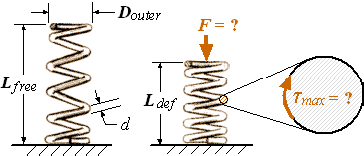
The Spring Shear Stress Calculator is a valuable tool for engineers and designers working with springs in various applications. It helps calculate the shear stress in springs, which is crucial for determining their reliability and lifespan. By inputting parameters such as wire diameter, spring diameter, and number of coils, users can quickly determine the maximum allowable shear stress. This calculator is essential for ensuring the structural integrity and performance of springs in different industries, including aerospace, automotive, and manufacturing. Accurate calculations can prevent spring failure and optimize design. The calculator is easy to use and provides fast results.
- Understanding Spring Shear Stress Calculator
- Understanding the Importance of Spring Shear Stress Calculator in Engineering
-
Frequently Asked Questions (FAQs)
- What is the Spring Shear Stress Calculator and how does it work?
- What are the key inputs required for the Spring Shear Stress Calculator?
- How is the Spring Shear Stress Calculator used in engineering design?
- What are the limitations and potential sources of error for the Spring Shear Stress Calculator?
Understanding Spring Shear Stress Calculator
The Spring Shear Stress Calculator is a tool used to calculate the shear stress that occurs in a spring due to an applied load. This calculator is essential in the design and analysis of springs, as it helps engineers to determine the maximum stress that a spring can withstand without failing. The calculator takes into account the spring's material properties, such as its modulus of elasticity and Poisson's ratio, as well as the spring's geometry, including its wire diameter, coil diameter, and number of coils.
What is Shear Stress in a Spring?
Shear stress in a spring occurs when a torsional load is applied to the spring, causing the spring's wires to twist and deform. This deformation results in a shear stress that acts on the spring's material, which can lead to fatigue failure if the stress is too high. The Spring Shear Stress Calculator helps engineers to calculate this shear stress and ensure that the spring is designed to withstand the expected loads.
How to Use the Spring Shear Stress Calculator
To use the Spring Shear Stress Calculator, engineers need to input the spring's material properties and geometry, as well as the applied load. The calculator then uses formulas and algorithms to calculate the shear stress that occurs in the spring. The results are typically presented in a table or graph, showing the maximum shear stress that the spring can withstand.
| Spring Property | Value |
|---|---|
| Wire Diameter | 0.5 mm |
| Coil Diameter | 10 mm |
| Number of Coils | 10 |
| Applied Load | 100 N |
| Maximum Shear Stress | 500 MPa |
Benefits of Using the Spring Shear Stress Calculator
The Spring Shear Stress Calculator offers several benefits to engineers, including the ability to accurately predict the shear stress that occurs in a spring, reduce the risk of fatigue failure, and optimize the spring's design for maximum performance. By using the calculator, engineers can also save time and reduce costs associated with prototyping and testing.
Common Applications of the Spring Shear Stress Calculator
The Spring Shear Stress Calculator is commonly used in a variety of industries, including aerospace, automotive, and medical devices. It is particularly useful in the design and analysis of complex systems, such as engine components, gearboxes, and suspension systems. By using the calculator, engineers can ensure that the springs used in these systems are designed to withstand the expected loads and operating conditions.
Limitations and Assumptions of the Spring Shear Stress Calculator
The Spring Shear Stress Calculator is based on simplifying assumptions and mathematical models that may not fully capture the complex behavior of a spring under real-world conditions. Therefore, the results obtained from the calculator should be interpreted with caution and validated through experimental testing and finite element analysis. Additionally, the calculator may not account for non-linear effects, such as plastic deformation and friction, which can affect the accuracy of the results.
Understanding the Importance of Spring Shear Stress Calculator in Engineering
The Spring Shear Stress Calculator is a crucial tool in the field of engineering, particularly in the design and development of springs and other mechanical components. The calculator helps engineers to determine the shear stress that occurs in a spring when it is subjected to various types of loading, such as tensile, compressive, or torsional forces. By using the calculator, engineers can ensure that their designs are safe, reliable, and efficient, and that they meet the required performance and safety standards.
What is Spring Shear Stress and How is it Calculated?
Spring shear stress refers to the deformation that occurs in a spring when it is subjected to external forces. The shear stress is calculated using a formula that takes into account the spring's geometry, material properties, and the applied load. The formula for calculating shear stress is: τ = (8 * F * D) / (π * d^3), where τ is the shear stress, F is the applied force, D is the spring's diameter, and d is the wire diameter. The calculator uses this formula to determine the shear stress that occurs in a spring, and it also takes into account other factors such as the spring's pitch, wire diameter, and number of coils.
The Benefits of Using a Spring Shear Stress Calculator
Using a Spring Shear Stress Calculator offers several benefits to engineers and designers. One of the main benefits is that it helps to reduce the risk of failure by ensuring that the spring is designed to withstand the expected loads and stresses. The calculator also helps to optimize the design of the spring, by determining the optimal geometry and material properties that are required to achieve the desired performance and safety standards. Additionally, the calculator can help to save time and cost by reducing the need for physical prototyping and experimental testing.
How to Select the Right Spring Shear Stress Calculator
Selecting the right Spring Shear Stress Calculator depends on several factors, including the type of spring, material properties, and loading conditions. Engineers should look for a calculator that is user-friendly, accurate, and reliable, and that can handle complex calculations and multiple variables. The calculator should also be able to account for various types of loading, such as static, dynamic, and cyclic loading, and it should be able to provide detailed reports and graphs to help engineers visualize and understand the results.
Common Applications of Spring Shear Stress Calculator
The Spring Shear Stress Calculator has a wide range of applications in various fields of engineering, including mechanical engineering, aerospace engineering, and automotive engineering. It is commonly used in the design and development of springs, shafts, gears, and other mechanical components that are subject to shear stress and other types of loading. The calculator is also used in research and development to study the behavior of springs and other mechanical components under various loading conditions, and to optimize their design and performance.
Best Practices for Using a Spring Shear Stress Calculator
To get the most out of a Spring Shear Stress Calculator, engineers should follow best practices for using the tool. This includes entering accurate input data, selecting the right calculation method, and interpreting the results correctly. Engineers should also validate the results of the calculator by comparing them with experimental data or other calculation methods, and they should document their findings and results in a clear and concise manner. By following these best practices, engineers can ensure that they are using the calculator effectively and efficiently, and that they are getting the most out of the tool.
Frequently Asked Questions (FAQs)
What is the Spring Shear Stress Calculator and how does it work?
The Spring Shear Stress Calculator is a tool designed to calculate the shear stress that occurs in a spring when it is subjected to a specific load or force. This calculator takes into account the material properties of the spring, such as its elastic modulus and Poisson's ratio, as well as the geometric parameters of the spring, including its wire diameter, coil diameter, and number of coils. By inputting these values, the calculator can determine the shear stress that occurs in the spring, which is essential for predicting its fatigue life and reliability. The calculator uses complex mathematical formulas to calculate the shear stress, taking into account the torsional moment and bending moment that occur in the spring.
What are the key inputs required for the Spring Shear Stress Calculator?
To use the Spring Shear Stress Calculator, several key inputs are required, including the spring's material properties, such as its elastic modulus and Poisson's ratio. These values can be found in material property tables or by consulting with a materials engineer. Additionally, the calculator requires the geometric parameters of the spring, including its wire diameter, coil diameter, and number of coils. These values can be measured directly from the spring or obtained from the spring's design specifications. The calculator also requires the load or force that will be applied to the spring, which can be determined through finite element analysis or experimental testing. By inputting these values, the calculator can provide an accurate calculation of the shear stress that occurs in the spring.
How is the Spring Shear Stress Calculator used in engineering design?
The Spring Shear Stress Calculator is a valuable tool for engineers and designers who need to design and optimize springs for various applications, including mechanical systems, aerospace engineering, and automotive engineering. By using the calculator, engineers can quickly and easily determine the shear stress that occurs in a spring, which is essential for predicting its fatigue life and reliability. This information can be used to optimize the spring's design, including its material selection, geometric parameters, and load capacity. The calculator can also be used to compare different spring designs, allowing engineers to select the most suitable spring for their application. Additionally, the calculator can be used to validate the results of finite element analysis and experimental testing, providing a high degree of confidence in the spring's design.
What are the limitations and potential sources of error for the Spring Shear Stress Calculator?
While the Spring Shear Stress Calculator is a powerful tool for calculating the shear stress that occurs in a spring, it is not without its limitations and potential sources of error. One potential source of error is the accuracy of the input values, which can affect the accuracy of the calculation. Additionally, the calculator assumes a simple linear elastic material behavior, which may not be accurate for all materials. The calculator also assumes a specific spring geometry, which may not be representative of all spring designs. Furthermore, the calculator does not account for other factors that can affect the spring's behavior, such as friction, corrosion, and temperature effects. To minimize these limitations, it is essential to validate the results of the calculator through experimental testing and finite element analysis, and to consult with a qualified engineer or materials scientist if necessary.
Deja una respuesta
Entradas Relacionadas