
Prism Refraction Index from Minimum Angle of Deviation Equations and Calculator

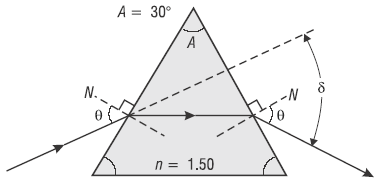
The prism refraction index is a fundamental concept in optics, describing how light behaves as it passes through a prism. The minimum angle of deviation equations provide a crucial tool for calculating this index. By understanding the relationship between the angle of incidence, the angle of refraction, and the prism's properties, scientists and engineers can design and optimize optical systems. This article explores the mathematical equations and offers a calculator to determine the prism refraction index from the minimum angle of deviation, facilitating precise calculations and applications in various fields. Accurate calculations are essential for optimal performance.
- Understanding Prism Refraction Index from Minimum Angle of Deviation Equations and Calculator
- How to find refractive index using angle of minimum deviation?
- How do you calculate refractive index of prism?
- What is the formula for the minimum angle of deviation in a prism?
- What is the refractive index of the prism if the angle of minimum deviation for an equilateral glass prism is 30?
-
Frequently Asked Questions (FAQs)
- What is the Prism Refraction Index and how is it calculated?
- How do I use the Prism Refraction Index equations and calculator to determine the Refraction Index of a prism?
- What are the applications of the Prism Refraction Index in optics and photonics?
- How does the Prism Refraction Index relate to other optical constants, such as the refractive index and the absorption coefficient?
Understanding Prism Refraction Index from Minimum Angle of Deviation Equations and Calculator
The prism refraction index is a fundamental concept in optics that describes how light behaves when passing through a prism. The minimum angle of deviation is a critical parameter in determining the refractive index of a prism. The equations used to calculate the refractive index from the minimum angle of deviation are based on Snell's law and the geometry of the prism. A calculator can be used to simplify the calculations and provide a more accurate result.
Introduction to Prism Refraction Index
The prism refraction index is defined as the ratio of the speed of light in a vacuum to the speed of light in the prism material. It is a measure of how much the light is bent, or refracted, as it passes through the prism. The refractive index is a dimensionless quantity that is typically denoted by the symbol n. The minimum angle of deviation is the smallest angle at which the light is refracted as it passes through the prism.
Minimum Angle of Deviation Equations
The equations used to calculate the refractive index from the minimum angle of deviation are based on Snell's law, which states that the ratio of the sines of the angles of incidence and refraction is equal to the ratio of the speeds of light in the two media. The minimum angle of deviation is related to the refractive index by the following equation: n = sin((A + δm) / 2) / sin(A / 2), where A is the angle of the prism and δm is the minimum angle of deviation.
Prism Refraction Index Calculator
A calculator can be used to simplify the calculations and provide a more accurate result. The calculator takes into account the angle of the prism, the minimum angle of deviation, and the wavelength of light to calculate the refractive index. The calculator can also be used to calculate the dispersion of the prism, which is the variation of the refractive index with wavelength.
Applications of Prism Refraction Index
The prism refraction index has many applications in optics and photonics. It is used in the design of optical instruments, such as spectrometers and telescopes. It is also used in the manufacture of optical fibers and 光学 lenses. The prism refraction index is an important parameter in the characterization of optical materials.
Table of Prism Refraction Index Values
The following table lists the refractive index values for some common prism materials:
| Material | Refractive Index (n) |
|---|---|
| Glass | 1.5 |
| Quartz | 1.54 |
| Flint glass | 1.62 |
| Crown glass | 1.52 |
| Plastic | 1.49 |
The refractive index values are strongly dependent on the wavelength of light and the temperature of the material. The values listed in the table are for a specific wavelength and temperature. The refractive index can be calculated using the equations and calculator mentioned earlier.
How to find refractive index using angle of minimum deviation?

To find the refractive index using the angle of minimum deviation, we need to understand the concept of total internal reflection and refraction. When a light beam passes from one medium to another, it is refracted, and the angle of refraction depends on the refractive indices of the two media. The angle of minimum deviation is the smallest angle at which the light beam can pass through a prism or a lens without being totally internally reflected.
Understanding the Concept of Refractive Index
The refractive index is a measure of how much a light beam is bent as it passes from one medium to another. It is defined as the ratio of the speed of light in a vacuum to the speed of light in the medium. To find the refractive index using the angle of minimum deviation, we can use the following formula: n = sin((A + δ)/2) / sin(A/2), where n is the refractive index, A is the angle of the prism, and δ is the angle of minimum deviation. The steps to calculate the refractive index are:
- Measure the angle of the prism and the angle of minimum deviation using a spectrometer or a prism table.
- Plug in the values of A and δ into the formula to calculate the refractive index.
- Use a calculator to simplify the expression and obtain the value of n.
Factors Affecting the Angle of Minimum Deviation
The angle of minimum deviation is affected by several factors, including the wavelength of light, the temperature of the medium, and the orientation of the prism. To minimize errors, it is essential to control these factors and ensure that the measurements are taken under identical conditions. The factors that affect the angle of minimum deviation are:
- The wavelength of light: different wavelengths of light have different refractive indices, so it is essential to use a monochromatic light source.
- The temperature of the medium: changes in temperature can affect the refractive index of the medium, so it is essential to control the temperature.
- The orientation of the prism: the orientation of the prism can affect the angle of minimum deviation, so it is essential to ensure that the prism is properly aligned.
Calculating the Refractive Index Using the Angle of Minimum Deviation
To calculate the refractive index using the angle of minimum deviation, we need to use the formula: n = sin((A + δ)/2) / sin(A/2). This formula can be derived from the law of sines and the law of refraction. The steps to calculate the refractive index are:
- Measure the angle of the prism and the angle of minimum deviation using a spectrometer or a prism table.
- Plug in the values of A and δ into the formula to calculate the refractive index.
- Use a calculator to simplify the expression and obtain the value of n.
Applications of the Refractive Index
The refractive index has several applications in optics and physics, including the design of optical instruments, such as microscopes and telescopes, and the measurement of temperatures and pressures. The refractive index is also used in medical imaging and spectroscopy. The applications of the refractive index are:
- Design of optical instruments: the refractive index is used to design optical instruments, such as microscopes and telescopes.
- Measurement of temperatures and pressures: the refractive index is used to measure temperatures and pressures in industrial processes.
- Medical imaging: the refractive index is used in medical imaging techniques, such as optical coherence tomography.
Limitations of the Method
The method of finding the refractive index using the angle of minimum deviation has several limitations, including the accuracy of the measurements and the assumptions made. The limitations of the method are:
- The accuracy of the measurements: the accuracy of the measurements of the angle of the prism and the angle of minimum deviation can affect the accuracy of the calculated refractive index.
- The assumptions made: the method assumes that the prism is a perfect prism and that the light beam is monochromatic, which may not always be the case.
- The range of wavelengths: the method is limited to a specific range of wavelengths, and the refractive index may vary at different wavelengths.
How do you calculate refractive index of prism?

To calculate the refractive index of a prism, you need to understand the relationship between the angle of incidence, the angle of refraction, and the angle of deviation. The refractive index of a prism is a measure of how much it bends light as it passes through it. The calculation involves using Snell's law, which states that the ratio of the sines of the angles of incidence and refraction is equal to the ratio of the velocities of the two media.
Understanding the Prism's Geometry
The geometry of the prism plays a crucial role in calculating its refractive index. To do this, you need to know the angle of the prism, which is the angle between the two faces of the prism. The angle of incidence and the angle of refraction are also important, as they determine the path of the light as it passes through the prism.
- The angle of incidence is the angle at which the light hits the prism.
- The angle of refraction is the angle at which the light is bent as it passes through the prism.
- The angle of deviation is the angle between the incident and emergent rays.
Using Snell's Law to Calculate Refractive Index
Snell's law is a fundamental principle in optics that describes how light behaves when it passes from one medium to another. To calculate the refractive index of a prism using Snell's law, you need to know the angles of incidence and refraction. The refractive index is then calculated using the formula: n = sin(θ1) / sin(θ2), where n is the refractive index, θ1 is the angle of incidence, and θ2 is the angle of refraction.
- Measure the angle of incidence and the angle of refraction.
- Use Snell's law to calculate the refractive index.
- Repeat the measurement for different angles of incidence to ensure accuracy.
Accounting for Dispersion in the Prism
Dispersion occurs when different wavelengths of light are bent at slightly different angles as they pass through the prism. This can affect the calculation of the refractive index, especially if you are working with a polychromatic light source. To account for dispersion, you need to use a monochromatic light source or measure the refractive index at different wavelengths.
- Use a monochromatic light source to minimize dispersion.
- Measure the refractive index at different wavelengths to account for dispersion.
- Use the average refractive index if the dispersion is minimal.
Measuring the Angle of Deviation
The angle of deviation is an important parameter in calculating the refractive index of a prism. It is defined as the angle between the incident and emergent rays. To measure the angle of deviation, you need to use a spectrometer or a goniometer.
- Measure the angle of incidence and the angle of emergence.
- Calculate the angle of deviation using the formula: δ = θ1 - θ2.
- Use the angle of deviation to calculate the refractive index.
Calculating the Refractive Index using the Prism Formula
The prism formula is a simple and convenient way to calculate the refractive index of a prism. It is given by the formula: n = sin((δ + α) / 2) / sin(α / 2), where n is the refractive index, δ is the angle of deviation, and α is the angle of the prism.
- Measure the angle of deviation and the angle of the prism.
- Use the prism formula to calculate the refractive index.
- Repeat the measurement for different angles of incidence to ensure accuracy.
What is the formula for the minimum angle of deviation in a prism?
The formula for the minimum angle of deviation in a prism is given by the equation:
δ_min = (n - 1) α
where δ_min is the minimum angle of deviation, n is the refractive index of the prism material, and α is the angle of the prism. This equation is derived from Snell's law and is used to calculate the minimum angle of deviation for a given prism.
Understanding the Refractive Index
The refractive index is a measure of how much a light beam is bent as it passes from one medium to another. In the context of a prism, the refractive index is critical in determining the minimum angle of deviation. The refractive index is typically denoted by the symbol n and is defined as the ratio of the speed of light in a vacuum to the speed of light in the medium. Some key points to note about refractive index are:
- The refractive index is a dimensionless quantity
- The refractive index is always greater than or equal to 1
- The refractive index depends on the wavelength of light
Angle of the Prism
The angle of the prism is the angle between the two faces of the prism that are involved in the refraction of light. This angle is typically denoted by the symbol α and is measured in degrees. The angle of the prism plays a crucial role in determining the minimum angle of deviation, as it affects the amount of bending that occurs as light passes through the prism. Some key points to note about the angle of the prism are:
- The angle of the prism can be adjusted to achieve different angles of deviation
- The angle of the prism is typically fixed in a given prism
- The angle of the prism can affect the dispersion of light as it passes through the prism
Dispersion and the Prism
Dispersion occurs when different wavelengths of light are refracted at slightly different angles as they pass through a prism. This results in the separation of white light into its component colors, a phenomenon known as spectral dispersion. The dispersion of light through a prism is influenced by the refractive index and the angle of the prism. Some key points to note about dispersion and the prism are:
- Dispersion is a result of the different refractive indices for different wavelengths of light
- Dispersion can be used to separate white light into its component colors
- Dispersion can be affected by the angle of the prism and the material of the prism
Calculating the Minimum Angle of Deviation
To calculate the minimum angle of deviation, we need to use the formula δ_min = (n - 1) α. This requires knowledge of the refractive index of the prism material and the angle of the prism. The refractive index can be looked up for a given material, and the angle of the prism can be measured directly. Some key points to note about calculating the minimum angle of deviation are:
- The refractive index must be known for the prism material
- The angle of the prism must be measured accurately
- The minimum angle of deviation can be calculated using the formula δ_min = (n - 1) α
Applications of the Minimum Angle of Deviation
The minimum angle of deviation has several applications in optics, including the design of spectrometers and prism telescopes. By understanding how to calculate the minimum angle of deviation, we can design optical systems that Take advantage of the dispersion of light through a prism. Some key points to note about the applications of the minimum angle of deviation are:
- The minimum angle of deviation is used in the design of spectrometers
- The minimum angle of deviation is used in the design of prism telescopes
- The minimum angle of deviation can be used to separate white light into its component colors
What is the refractive index of the prism if the angle of minimum deviation for an equilateral glass prism is 30?

The refractive index of the prism can be determined using the formula for the angle of minimum deviation, which is given by δ = i + e - A, where δ is the angle of minimum deviation, i is the angle of incidence, e is the angle of emergence, and A is the angle of the prism. For an equilateral glass prism, the angle of the prism is 60 degrees. Since the angle of minimum deviation is given as 30 degrees, we can use the formula to find the refractive index of the prism.
Understanding the Prism's Properties
The refractive index of a prism is a measure of how much it bends light. The angle of minimum deviation is the smallest angle at which light passes through the prism. To calculate the refractive index, we need to know the angles of incidence and emergence. The formula for the refractive index is n = sin((i + e) / 2) / sin(A / 2).
- The angle of incidence is the angle at which light enters the prism.
- The angle of emergence is the angle at which light exits the prism.
- The angle of the prism is the angle between the two faces of the prism.
Calculating the Refractive Index
To calculate the refractive index of the prism, we can use the formula n = sin((i + e) / 2) / sin(A / 2). Since the angle of minimum deviation is 30 degrees, we can use the fact that i = e = (δ + A) / 2 to find the angles of incidence and emergence.
- The angle of incidence is equal to the angle of emergence.
- The angle of the prism is 60 degrees for an equilateral glass prism.
- The refractive index can be calculated using the formula n = sin((i + e) / 2) / sin(A / 2).
Applying the Formula
Using the formula n = sin((i + e) / 2) / sin(A / 2), we can calculate the refractive index of the prism. Since the angle of minimum deviation is 30 degrees, we have i = e = (30 + 60) / 2 = 45 degrees. The angle of the prism is 60 degrees.
- The refractive index is n = sin(45) / sin(30).
- The value of sin(45) is approximately 0.7071.
- The value of sin(30) is 0.5.
Determining the Refractive Index
The refractive index of the prism can be calculated by dividing the value of sin(45) by the value of sin(30). This gives us n = 0.7071 / 0.5 = 1.4142.
- The refractive index is approximately 1.4142.
- The refractive index is a measure of how much the prism bends light.
- The refractive index is an important property of the prism.
Interpreting the Results
The calculated refractive index of the prism is approximately 1.4142. This means that the prism will bend light by a factor of 1.4142. The refractive index is an important property of the prism, as it determines how much the prism will bend light.
- The refractive index is a measure of the prism's ability to bend light.
- The refractive index is an important property of the prism.
- The refractive index can be used to calculate the angle of minimum deviation.
Frequently Asked Questions (FAQs)
What is the Prism Refraction Index and how is it calculated?
The Prism Refraction Index is a measure of the extent to which a prism bends light as it passes through it. It is calculated using the Minimum Angle of Deviation equations, which take into account the angle of incidence, the angle of refraction, and the angle of deviation. The Prism Refraction Index is an important concept in optics and is used in a variety of applications, including optical instruments and photonic devices. To calculate the Prism Refraction Index, one must first determine the values of the Minimum Angle of Deviation and the refractive indices of the prism and the surrounding medium. These values can then be used in the Prism Refraction Index equation to obtain the desired result. The Prism Refraction Index is a critical parameter in the design and development of optical systems, as it determines the amount of bending and dispersion that occurs as light passes through the prism.
How do I use the Prism Refraction Index equations and calculator to determine the Refraction Index of a prism?
To use the Prism Refraction Index equations and calculator, one must first gather the necessary input values, including the Minimum Angle of Deviation, the angle of incidence, and the refractive indices of the prism and the surrounding medium. These values can then be entered into the calculator, which will use the Prism Refraction Index equations to calculate the Refraction Index of the prism. The calculator will take into account the dispersion and bending of light as it passes through the prism, and will provide an accurate calculation of the Refraction Index. The Prism Refraction Index equations and calculator can be used to determine the Refraction Index of a wide range of prisms, including glass prisms, plastic prisms, and crystal prisms. By using the Prism Refraction Index equations and calculator, one can quickly and easily determine the Refraction Index of a prism, which is essential for the design and development of optical systems.
What are the applications of the Prism Refraction Index in optics and photonics?
The Prism Refraction Index has a wide range of applications in optics and photonics, including the design and development of optical instruments, such as telescopes, microscopes, and spectrometers. The Prism Refraction Index is also used in the development of photonic devices, such as optical fibers, laser systems, and optical switches. In addition, the Prism Refraction Index is used in the study of light propagation and optical phenomena, such as total internal reflection, diffraction, and interference. The Prism Refraction Index is an essential parameter in the design and development of optical systems, as it determines the amount of bending and dispersion that occurs as light passes through the prism. By understanding the Prism Refraction Index and its applications, one can design and develop optical systems that are more efficient, accurate, and reliable.
How does the Prism Refraction Index relate to other optical constants, such as the refractive index and the absorption coefficient?
The Prism Refraction Index is related to other optical constants, such as the refractive index and the absorption coefficient, through the equations of optics. The refractive index is a measure of the extent to which a medium bends light, while the absorption coefficient is a measure of the extent to which a medium absorbs light. The Prism Refraction Index takes into account both the refractive index and the absorption coefficient of the prism and the surrounding medium, and provides a comprehensive description of the optical properties of the prism. The Prism Refraction Index is also related to other optical constants, such as the dispersion and the birefringence of the prism, which are important in the design and development of optical systems. By understanding the relationships between the Prism Refraction Index and other optical constants, one can design and develop optical systems that are more efficient, accurate, and reliable. The Prism Refraction Index is a critical parameter in the optics and photonics community, and is widely used in the design and development of optical instruments and photonic devices.
Deja una respuesta
Entradas Relacionadas