
Pressure Vessel, Thin Wall Hoop Stress Calculator

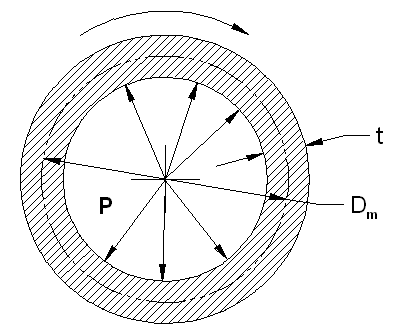
The Pressure Vessel, Thin Wall Hoop Stress Calculator is a valuable tool for engineers and designers working with cylindrical vessels. This calculator determines the hoop stress in a thin-walled vessel, which is crucial for ensuring the structural integrity and safety of the vessel. Hoop stress occurs due to internal pressure and is a significant factor in the design of pressure vessels, such as pipes, tanks, and boilers. The calculator uses the formula for hoop stress, which is based on the internal pressure, vessel radius, and wall thickness, to provide accurate calculations and help prevent vessel failure.
- Understanding Pressure Vessel and Thin Wall Hoop Stress Calculator
- How do you calculate hoop stress on a thin wall?
- What is the hoop stress of a thin pressure vessel?
- Is there shear stress in a thin-walled pressure vessel?
-
Frequently Asked Questions (FAQs)
- What is the purpose of the Pressure Vessel, Thin Wall Hoop Stress Calculator?
- How does the Pressure Vessel, Thin Wall Hoop Stress Calculator work?
- What are the limitations of the Pressure Vessel, Thin Wall Hoop Stress Calculator?
- How can the results of the Pressure Vessel, Thin Wall Hoop Stress Calculator be used in practice?
Understanding Pressure Vessel and Thin Wall Hoop Stress Calculator
The Pressure Vessel and Thin Wall Hoop Stress Calculator is a tool used to calculate the stress and pressure on a pressure vessel, which is a container designed to hold gases or liquids at a pressure significantly different from the ambient pressure. The calculator uses the formula for thin wall hoop stress, which is a critical factor in determining the safety and durability of pressure vessels.
What is Thin Wall Hoop Stress?
Thin wall hoop stress refers to the tensile stress that occurs in the hoop direction of a pressure vessel, which is the direction perpendicular to the longitudinal axis. This stress is caused by the internal pressure of the vessel and is a critical factor in determining the strength and safety of the vessel. The formula for calculating thin wall hoop stress is: σ = (P r) / t, where σ is the stress, P is the internal pressure, r is the radius of the vessel, and t is the thickness of the vessel wall.
How to Use the Pressure Vessel and Thin Wall Hoop Stress Calculator
To use the Pressure Vessel and Thin Wall Hoop Stress Calculator, you need to input the dimensions of the pressure vessel, including the radius, length, and thickness of the vessel wall. You also need to input the internal pressure of the vessel. The calculator will then use the formula for thin wall hoop stress to calculate the stress on the vessel.
Factors Affecting Thin Wall Hoop Stress
There are several factors that can affect the thin wall hoop stress of a pressure vessel, including the material of the vessel, the temperature of the contents, and the corrosion of the vessel wall. The material of the vessel can affect the strength and ductility of the vessel, while the temperature of the contents can affect the thermal stress on the vessel. Corrosion can also weaken the vessel wall and increase the risk of failure.
Applications of Pressure Vessel and Thin Wall Hoop Stress Calculator
The Pressure Vessel and Thin Wall Hoop Stress Calculator has several applications in engineering and industry, including the design and analysis of pipes, tanks, and boilers. It can also be used to calculate the stress on cylindrical and spherical vessels, as well as conical and elliptical vessels.
Importance of Accurate Calculation of Thin Wall Hoop Stress
Accurate calculation of thin wall hoop stress is critical to ensuring the safety and durability of pressure vessels. Inaccurate calculations can lead to overdesign or underdesign of the vessel, which can result in failure or accidents. The Pressure Vessel and Thin Wall Hoop Stress Calculator can help engineers and designers to make accurate calculations and ensure the reliability of pressure vessels.
| Parameter | Unit | Description |
|---|---|---|
| Internal Pressure | Psi | The pressure inside the vessel |
| Radius | Inches | The radius of the vessel |
| Thickness | Inches | The thickness of the vessel wall |
| Stress | Psi | The stress on the vessel wall |
| Material | Grade | The material of the vessel |
How do you calculate hoop stress on a thin wall?

To calculate hoop stress on a thin wall, you need to consider the pressure and diameter of the pipe or vessel, as well as the thickness of the wall. The formula for calculating hoop stress is: σh = (P D) / (2 t), where σh is the hoop stress, P is the internal pressure, D is the diameter of the pipe or vessel, and t is the thickness of the wall.
Understanding Hoop Stress
The calculation of hoop stress is crucial in ensuring the integrity of thin-walled vessels and pipes. To calculate hoop stress, you need to consider the following factors:
- Internal pressure: The pressure inside the pipe or vessel, which can be due to fluid or gas.
- Diameter: The diameter of the pipe or vessel, which affects the hoop stress.
- Thickness: The thickness of the wall, which also affects the hoop stress.
The hoop stress calculation is essential in engineering and design applications, where the strength and stability of thin-walled structures are critical.
Factors Affecting Hoop Stress
Several factors can affect the hoop stress on a thin wall, including:
- Material properties: The strength and elasticity of the material used for the pipe or vessel.
- Temperature: Changes in temperature can affect the material properties and hoop stress.
- Corrosion: Corrosion can reduce the thickness of the wall and increase the hoop stress.
These factors must be considered when calculating hoop stress to ensure accurate results.
Calculating Hoop Stress in Different Scenarios
The calculation of hoop stress can vary depending on the scenario. For example:
- Cylindrical vessels: The hoop stress calculation for cylindrical vessels is different from that of spherical vessels.
- Pipes with fittings: The hoop stress calculation for pipes with fittings must consider the stress concentrations caused by the fittings.
- Vessels under external pressure: The hoop stress calculation for vessels under external pressure must consider the external pressure and thickness of the wall.
Each scenario requires a specific approach to calculate hoop stress.
Importance of Accurate Hoop Stress Calculation
Accurate hoop stress calculation is crucial in ensuring the safety and reliability of thin-walled vessels and pipes. Inaccurate calculations can lead to:
- Structural failure: Inaccurate calculations can result in structural failure, which can have catastrophic consequences.
- Maintenance costs: Inaccurate calculations can lead to increased maintenance costs due to premature failure.
- Environmental damage: Inaccurate calculations can result in environmental damage due to leaks or spills.
Therefore, it is essential to perform accurate hoop stress calculations to ensure the integrity of thin-walled vessels and pipes.
Tools and Techniques for Hoop Stress Calculation
Several tools and techniques are available for calculating hoop stress, including:
- Finite element analysis: A numerical method used to analyze stress and strain in complex structures.
- Analytical solutions: Mathematical equations used to calculate hoop stress in simple structures.
- Commercial software: Specialized software used to calculate hoop stress in thin-walled vessels and pipes.
These tools and techniques can help engineers and designers calculate hoop stress accurately and efficiently.
What is the hoop stress of a thin pressure vessel?

The hoop stress of a thin pressure vessel is a type of stress that occurs due to the internal pressure of the vessel. This stress is caused by the force of the pressure pushing outward on the vessel walls, resulting in a tensile stress in the circumferential direction. The hoop stress is an important consideration in the design of pressure vessels, as it can lead to failure if not properly managed.
Definition of Hoop Stress
The hoop stress is defined as the stress that acts on a circumferential plane of a cylinder or sphere. It is calculated using the formula: σh = (p r) / t, where σh is the hoop stress, p is the internal pressure, r is the radius of the vessel, and t is the thickness of the vessel wall. The hoop stress is a critical factor in determining the strength and stability of a pressure vessel, as it can lead to yielding or rupture if not properly managed.
- The hoop stress is a type of tensile stress that occurs due to the internal pressure of the vessel.
- The hoop stress is calculated using the formula: σh = (p r) / t.
- The hoop stress is a critical factor in determining the strength and stability of a pressure vessel.
Hoop Stress in Thin-Walled Cylinders
In thin-walled cylinders, the hoop stress is the dominant type of stress. This is because the internal pressure of the cylinder causes the walls to expand outward, resulting in a tensile stress in the circumferential direction. The hoop stress in thin-walled cylinders is calculated using the formula: σh = (p r) / t, where σh is the hoop stress, p is the internal pressure, r is the radius of the cylinder, and t is the thickness of the cylinder wall.
- The hoop stress is the dominant type of stress in thin-walled cylinders.
- The hoop stress in thin-walled cylinders is calculated using the formula: σh = (p r) / t.
- The hoop stress in thin-walled cylinders can lead to yielding or rupture if not properly managed.
Hoop Stress in Thin-Walled Spheres
In thin-walled spheres, the hoop stress is also a critical factor. The internal pressure of the sphere causes the walls to expand outward, resulting in a tensile stress in the circumferential direction. The hoop stress in thin-walled spheres is calculated using the formula: σh = (p r) / (2 t), where σh is the hoop stress, p is the internal pressure, r is the radius of the sphere, and t is the thickness of the sphere wall.
- The hoop stress is a critical factor in thin-walled spheres.
- The hoop stress in thin-walled spheres is calculated using the formula: σh = (p r) / (2 t).
- The hoop stress in thin-walled spheres can lead to failure if not properly managed.
Factors Affecting Hoop Stress
There are several factors that can affect the hoop stress of a thin pressure vessel. These include the internal pressure, the! radius of the vessel, and the thickness of the vessel wall. Additionally, the material properties of the vessel, such as its yield strength and ultimate strength, can also impact the hoop stress.
- The internal pressure is a critical factor in determining the hoop stress.
- The radius of the vessel is also an important factor in determining the hoop stress.
- The thickness of the vessel wall is a key factor in determining the hoop stress.
Design Considerations for Hoop Stress
When designing a thin pressure vessel, it is essential to consider the hoop stress. This includes selecting a material with sufficient strength and stability, as well as ensuring that the vessel is designed to withstand the internal pressure. Additionally, the thickness of the vessel wall should be sufficient to resist the hoop stress, and the radius of the vessel should be carefully selected to minimize the hoop stress.
- Selecting a material with sufficient strength and stability is critical.
- Ensuring that the vessel is designed to withstand the internal pressure is essential.
- The thickness of the vessel wall should be sufficient to resist the hoop stress.
Is there shear stress in a thin-walled pressure vessel?

Yes, there is shear stress in a thin-walled pressure vessel. The pressure inside the vessel creates a tensile stress in the wall of the vessel, which can lead to shear stress due to the deformation of the material. The shear stress is caused by the uneven distribution of the pressure and the material's properties. The thin-walled nature of the vessel means that the wall thickness is small compared to the radius of the vessel, which can lead to high shear stresses.
Types of Shear Stress in Thin-Walled Pressure Vessels
There are several types of shear stress that can occur in thin-walled pressure vessels, including circumferential shear stress, longitudinal shear stress, and tangential shear stress. These types of shear stress can be caused by various factors, such as:
- Pressure differences between the inside and outside of the vessel
- Material properties, such as the yield strength and ultimate tensile strength
- Geometry of the vessel, including the radius and wall thickness
Causes of Shear Stress in Thin-Walled Pressure Vessels
The shear stress in thin-walled pressure vessels can be caused by various factors, including internal pressure, external loads, and material defects. The internal pressure can cause hoop stress and longltudinal stress, which can lead to shear stress. The external loads can cause bending and torsion, which can also lead to shear stress. The material defects, such as cracks and voids, can weaken the material and increase the shear stress. Some of the key factors that contribute to shear stress are:
- Pressure and temperature fluctuations
- Material properties, such as density and elastic modulus
- Geometry and size of the vessel
Effects of Shear Stress on Thin-Walled Pressure Vessels
The shear stress in thin-walled pressure vessels can have significant effects on the integrity and performance of the vessel. The shear stress can cause deformation, cracking, and failure of the vessel. The deformation can lead to leakage and loss of pressure, while the cracking and failure can lead to catastrophic failure. The key effects of shear stress are:
- Reduction in the strength and stiffness of the vessel
- Increase in the likelihood of failure and leakage
- Decrease in the service life of the vessel
Analysis of Shear Stress in Thin-Walled Pressure Vessels
The analysis of shear stress in thin-walled pressure vessels involves the use of mathematical models and numerical methods. The mathematical models can be used to predict the shear stress and deformation of the vessel under various loading conditions. The numerical methods, such as the finite element method, can be used to simulate the behavior of the vessel and predict the shear stress and deformation. Some of the key steps in the analysis are:
- Definition of the problem and boundary conditions
- Selection of the mathematical model and numerical method
- Validation of the results and comparison with experimental data
Design Considerations for Thin-Walled Pressure Vessels
The design of thin-walled pressure vessels requires careful consideration of the shear stress and deformation. The designer must ensure that the vessel is strong and stiff enough to withstand the internal pressure and external loads. The designer must also consider the material properties, geometry, and size of the vessel. Some of the key considerations are:
- Selection of the material and fabrication method
- Determination of the wall thickness and radius of the vessel
- Evaluation of the shear stress and deformation using mathematical models and numerical methods
Frequently Asked Questions (FAQs)
What is the purpose of the Pressure Vessel, Thin Wall Hoop Stress Calculator?
The Pressure Vessel, Thin Wall Hoop Stress Calculator is a tool designed to calculate the hoop stress in a thin-walled pressure vessel. This type of vessel is commonly used in various industries, such as chemical processing, power generation, and petroleum refining. The calculator takes into account the internal pressure, vessel diameter, and wall thickness to determine the hoop stress, which is a critical factor in ensuring the structural integrity of the vessel. By using this calculator, engineers and designers can quickly and accurately determine the hoop stress and make informed decisions about the design and construction of pressure vessels. The calculator is particularly useful for thin-walled vessels, where the wall thickness is relatively small compared to the vessel diameter. In these cases, the hoop stress can be significant, and accurate calculations are essential to prevent vessel failure.
How does the Pressure Vessel, Thin Wall Hoop Stress Calculator work?
The Pressure Vessel, Thin Wall Hoop Stress Calculator uses a formula-based approach to calculate the hoop stress in a thin-walled pressure vessel. The calculator requires input values for the internal pressure, vessel diameter, and wall thickness, which are then used to calculate the hoop stress using the Lame equation. This equation is a mathematical model that describes the stress distribution in a cylindrical vessel under internal pressure. The calculator also takes into account the units of measurement for each input value, ensuring that the calculations are performed correctly and the results are accurate. The calculator is designed to be user-friendly, with a simple and intuitive interface that allows users to input values and obtain results quickly and easily. By using this calculator, users can avoid the complexities of manual calculations and focus on the design and analysis of pressure vessels.
What are the limitations of the Pressure Vessel, Thin Wall Hoop Stress Calculator?
The Pressure Vessel, Thin Wall Hoop Stress Calculator is a specialized tool designed for thin-walled pressure vessels, and it has several limitations. One of the main limitations is that it only calculates the hoop stress, and does not take into account other stress components, such as longitudinal stress or radial stress. Additionally, the calculator assumes a cylindrical vessel with a constant wall thickness, and does not account for vessel geometries with variable wall thickness or non-cylindrical shapes. The calculator also assumes that the material properties of the vessel are isotropic, meaning that they are the same in all directions. In cases where the material properties are anisotropic, the calculator may not provide accurate results. Furthermore, the calculator is only applicable to thin-walled vessels, and is not suitable for thick-walled vessels or vessels with complex geometries. Users should be aware of these limitations and use the calculator only within its intended scope.
How can the results of the Pressure Vessel, Thin Wall Hoop Stress Calculator be used in practice?
The results of the Pressure Vessel, Thin Wall Hoop Stress Calculator can be used in practice to design and analyze pressure vessels. The calculated hoop stress can be used to determine the required strength of the vessel material, and to select the appropriate material and wall thickness for the vessel. The results can also be used to evaluate the structural integrity of an existing vessel, and to identify potential weak points or areas of high stress. Additionally, the calculator can be used to optimize the design of a vessel, by minimizing the wall thickness while still maintaining the required strength and safety factors. The results can also be used to compare different design options, and to select the most cost-effective and efficient solution. By! using the Pressure Vessel, Thin Wall Hoop Stress Calculator, engineers and designers can make informed decisions about the design and construction of pressure vessels, and ensure that they are safe, reliable, and efficient.
Deja una respuesta
Entradas Relacionadas