
Poiseuille's Law Formula and Calculator

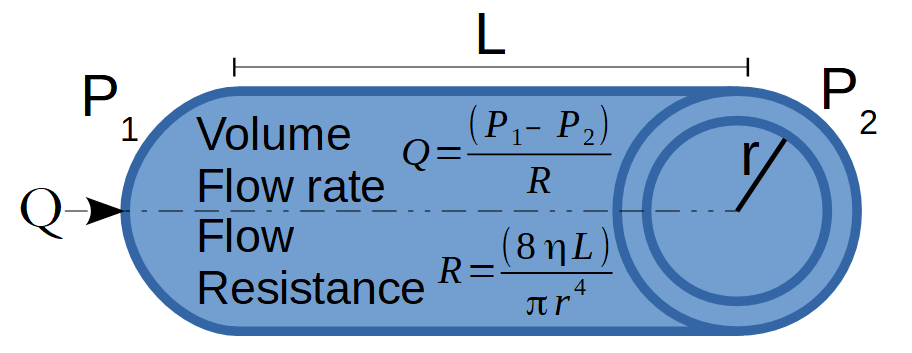
Poiseuille's Law is a fundamental principle in fluid dynamics that describes the laminar flow of fluids through cylindrical tubes. The law, formulated by Jean Léonard Marie Poiseuille, relates the flow rate of a fluid to its viscosity, the radius of the tube, and the pressure difference between the two ends. The Poiseuille's Law formula is a crucial tool for calculating the flow rate and pressure drop in various engineering applications, including pipeline design and medical devices. This article provides an in-depth explanation of the formula and offers a calculator to simplify calculations.
Poiseuille's Law Formula and Calculator: Understanding Fluid Dynamics
Poiseuille's Law is a fundamental concept in fluid dynamics that describes the laminar flow of fluids through cylindrical pipes. The law states that the volume flow rate of a fluid is directly proportional to the pressure difference between the two ends of the pipe, and inversely proportional to the viscosity of the fluid and the length of the pipe. The formula for Poiseuille's Law is given by: Q = (π r^4) / (8 η L) ΔP, where Q is the volume flow rate, r is the radius of the pipe, η is the viscosity of the fluid, L is the length of the pipe, and ΔP is the pressure difference.
What is Poiseuille's Law Formula?
Poiseuille's Law formula is a mathematical equation that describes the relationship between the volume flow rate of a fluid and the pressure difference between the two ends of a pipe. The formula is: Q = (π r^4) / (8 η L) ΔP. This formula is used to calculate the volume flow rate of a fluid through a pipe, given the radius of the pipe, the viscosity of the fluid, the length of the pipe, and the pressure difference.
How to Use Poiseuille's Law Calculator
A Poiseuille's Law calculator is a tool that can be used to calculate the volume flow rate of a fluid through a pipe, using the formula: Q = (π r^4) / (8 η L) ΔP. To use the calculator, simply enter the values of the radius of the pipe, the viscosity of the fluid, the length of the pipe, and the pressure difference, and the calculator will output the volume flow rate.
Applications of Poiseuille's Law
Poiseuille's Law has many practical applications in fields such as engineering, physics, and chemistry. Some examples of applications include: designing pipelines for the transportation of fluids, calculating the flow rate of fluids through tubes and pipes, and understanding the behavior of fluids in biological systems.
Limitations of Poiseuille's Law
While Poiseuille's Law is a useful tool for understanding fluid dynamics, it has some limitations. For example, the law assumes that the flow is laminar, which means that the fluid flows in parallel layers, with no turbulence. In reality, fluid flow can be turbulent, which means that the fluid flows in a chaotic, unpredictable manner. Additionally, the law assumes that the pipe is cylindrical, which may not always be the case.
Derivation of Poiseuille's Law
The derivation of Poiseuille's Law involves using the Navier-Stokes equations, which are a set of equations that describe the behavior of fluids. The derivation assumes that the flow is laminar, and that the pipe is cylindrical. The resulting equation is: Q = (π r^4) / (8 η L) ΔP, where Q is the volume flow rate, r is the radius of the pipe, η is the viscosity of the fluid, L is the length of the pipe, and ΔP is the pressure difference.
| Variable | Description | Unit |
|---|---|---|
| Q | Volume flow rate | m^3/s |
| r | Radius of the pipe | m |
| η | Viscosity of the fluid | Pas |
| L | Length of the pipe | m |
| ΔP | Pressure difference | Pa |
How do you calculate Poiseuille's law?

To calculate Poiseuille's law, we need to understand the concept of laminar flow and the factors that affect it. Poiseuille's law states that the flow rate of a fluid is directly proportional to the pressure difference and the fourth power of the radius of the tube, and inversely proportional to the length of the tube and the viscosity of the fluid.
Understanding the Formula
The formula for Poiseuille's law is given by: Q = (π (r)^4 (ΔP)) / (8 η L), where Q is the flow rate, r is the radius of the tube, ΔP is the pressure difference, η is the viscosity of the fluid, and L is the length of the tube. To calculate the flow rate, we need to know the values of these parameters. Some key points to consider are:
- The flow rate is directly proportional to the pressure difference, so increasing the pressure difference will increase the flow rate.
- The radius of the tube has a fourth power relationship with the flow rate, so small changes in radius can result in large changes in flow rate.
- The viscosity of the fluid has an inverse relationship with the flow rate, so increasing the viscosity will decrease the flow rate.
Factors Affecting Flow Rate
Several factors can affect the flow rate of a fluid, including the pressure difference, radius of the tube, length of the tube, and viscosity of the fluid. These factors can be manipulated to control the flow rate. Some key points to consider are:
- Increasing the pressure difference will increase the flow rate, but may also increase the risk of turbulence.
- Increasing the radius of the tube will increase the flow rate, but may also increase the cost and complexity of the system.
- Decreasing the length of the tube will increase the flow rate, but may also decrease the efficiency of the system.
Viscosity and Its Effects
The viscosity of a fluid is a measure of its resistance to flow. A higher viscosity means that the fluid is more resistant to flow, and will result in a lower flow rate. The viscosity of a fluid can be affected by several factors, including temperature and pressure. Some key points to consider are:
- Increasing the temperature will decrease the viscosity of most fluids, resulting in an increase in flow rate.
- Increasing the pressure will increase the viscosity of most fluids, resulting in a decrease in flow rate.
- Some fluids, such as non-Newtonian fluids, can exhibit complex viscosity behavior, which can affect the flow rate.
Applications of Poiseuille's Law
Poiseuille's law has many practical applications in fields such as engineering, medicine, and biology. Some examples include:
- Pipe flow: Poiseuille's law is used to design and optimize pipe systems for fluid transportation.
- Blood flow: Poiseuille's law is used to understand and model blood flow in the human body.
- Microfluidics: Poiseuille's law is used to design and optimize microfluidic systems for lab-on-a-chip applications.
Limitations and Assumptions
Poiseuille's law is based on several assumptions and has some limitations. Some key points to consider are:
- The law assumes laminar flow, which may not always be the case in real-world systems.
- The law assumes a circular cross-sectional area, which may not always be the case in real-world systems.
- The law assumes a constant viscosity, which may not always be the case in real-world systems.
What is Poiseuille's formula?
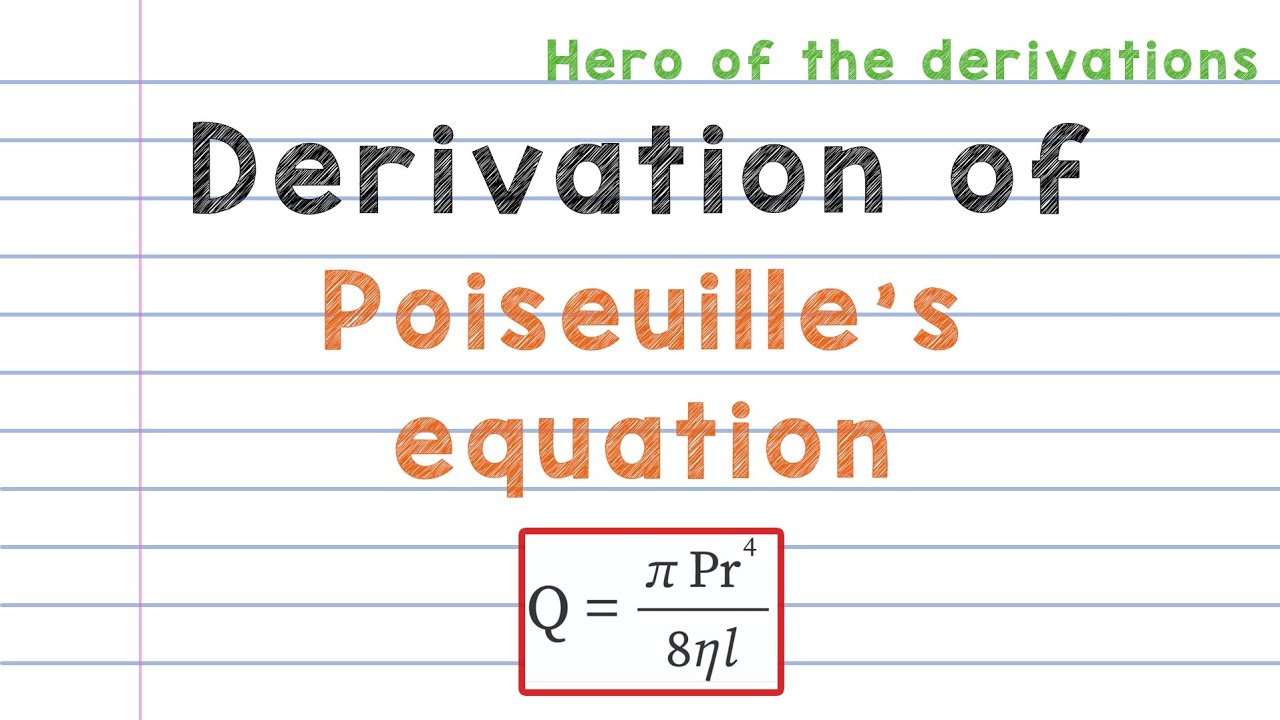
Poiseuille's formula is a mathematical equation that describes the laminar flow of a Newtonian fluid through a long, cylindrical pipe. The formula is named after Jean Léonard Marie Poiseuille, who first derived it in the 19th century. The formula states that the volume flow rate (Q) of a fluid is proportional to the pressure difference (ΔP) between the two ends of the pipe, and inversely proportional to the viscosity (η) of the fluid and the length (L) of the pipe.
Derivation of Poiseuille's Formula
The derivation of Poiseuille's formula involves the use of conservation of mass and conservation of momentum principles. The formula is derived by assuming that the flow is laminar, incompressible, and steady-state. The resulting equation is: Q = (π r^4 ΔP) / (8 η L), where r is the radius of the pipe. Some key points about the derivation of Poiseuille's formula include:
- The formula is based on the assumption of laminar flow, which means that the fluid flows in parallel layers or streams, with no turbulence or mixing between the layers.
- The formula is also based on the assumption of incompressible flow, which means that the density of the fluid remains constant throughout the flow.
- The formula is steady-state, meaning that the flow rate and pressure difference remain constant over time.
Applications of Poiseuille's Formula
Poiseuille's formula has many practical applications in engineering and physics. It is used to design and optimize pipelines, tubes, and channels for the transport of fluids. The formula is also used to calculate the pressure drop and flow rate of fluids in various systems. Some examples of applications of Poiseuille's formula include:
- Pipeline design: Poiseuille's formula is used to calculate the required diameter and length of pipelines to transport fluids at a given flow rate and pressure difference.
- Blood flow: Poiseuille's formula is used to model the flow of blood through blood vessels and to understand the pressure drop and flow rate of blood in the circulatory system.
- Chemical engineering: Poiseuille's formula is used to design and optimize reactors, mixers, and separators in chemical processing plants.
Limitations of Poiseuille's Formula
Poiseuille's formula has several limitations and assumptions that must be considered when using it. The formula assumes laminar flow, which may not always be the case in real-world systems. The formula also assumes that the fluid is incompressible, which may not be true for gases or supercritical fluids. Some key limitations of Poiseuille's formula include:
- Turbulent flow: Poiseuille's formula does not account for turbulent flow, which can occur at high Reynolds numbers or in systems with complex geometries.
- Compressible flow: Poiseuille's formula does not account for compressible flow, which can occur in systems with high pressure differences or temperature gradients.
- Non-Newtonian fluids: Poiseuille's formula does not account for non-Newtonian fluids, which can exhibit shear-thinning or shear-thickening behavior.
Comparison with Other Flow Formulas
Poiseuille's formula is one of several formulas used to describe fluid flow in different systems. Other formulas, such as the Darcy-Weisbach equation and the Hagen-Poiseuille equation, are also used to model fluid flow in pipes and channels. Some key differences between these formulas include:
- Darcy-Weisbach equation: This formula is used to model turbulent flow in pipes and channels, and takes into account the friction factor and Reynolds number of the flow.
- Hagen-Poiseuille equation: This formula is used to model laminar flow in pipes and channels, and is similar to Poiseuille's formula but includes an additional term to account for the entrance length of the pipe.
- Navier-Stokes equations: These equations are a set of nonlinear partial differential equations that describe the motion of fluids in general, and can be used to model a wide range of fluid flow phenomena.
Experimental Verification of Poiseuille's Formula
Poiseuille's formula has been experimentally verified in numerous studies, which have shown that the formula accurately predicts the flow rate and pressure drop of fluids in pipes and channels. Some key aspects of experimental verification of Poiseuille's formula include:
- Flow rate measurements: Experimental studies have shown that the flow rate of fluids in pipes and channels can be accurately predicted using Poiseuille's formula, with errors typically less than 5-10%.
- Pressure drop measurements: Experimental studies have also shown that the pressure drop of fluids in pipes and channels can be accurately predicted using Poiseuille's formula, with errors typically less than 5-10%.
- Flow visualization: Experimental studies have used flow visualization techniques, such as particle image velocimetry (PIV), to visualize the flow of fluids in pipes and channels and verify the predictions of Poiseuille's formula.
How do you calculate flow resistance?
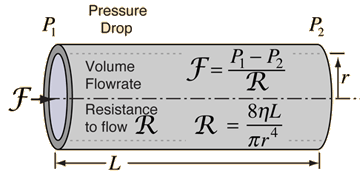
To calculate flow resistance, you need to consider several factors, including the velocity of the fluid, the density of the fluid, and the viscosity of the fluid. The calculation of flow resistance is crucial in various fields, such as engineering and physics. The most common method to calculate flow resistance is by using the Darcy-Weisbach equation, which takes into account the friction factor, velocity, and pipe diameter.
Understanding the Darcy-Weisbach Equation
The Darcy-Weisbach equation is a widely used formula to calculate flow resistance. The equation is given by: h = (f L v^2) / (2 g D), where h is the head loss, f is the friction factor, L is the length of the pipe, v is the velocity of the fluid, g is the acceleration due to gravity, and D is the pipe diameter. To apply this equation, you need to know the values of the following parameters:
- Friction factor: which depends on the Reynolds number and the pipe roughness
- Velocity: which can be calculated using the continuity equation
- Pipe diameter: which is a given parameter in the problem
Calculating the Friction Factor
The friction factor is a critical parameter in the Darcy-Weisbach equation. The friction factor depends on the Reynolds number and the pipe roughness. To calculate the friction factor, you can use the Colebrook-White equation, which is given by: 1 / sqrt(f) = -2 log10((ε / 3.7 D) + (2.51 / (Re sqrt(f)))), where ε is the pipe roughness, D is the pipe diameter, and Re is the Reynolds number. The calculation of the friction factor involves the following steps:
- Determine the Reynolds number: which depends on the velocity, density, and viscosity of the fluid
- Determine the pipe roughness: which is a given parameter in the problem
- Solve the Colebrook-White equation: using iterative methods or charts
Considering the Effects of Pipe Roughness
The pipe roughness has a significant impact on the flow resistance. The pipe roughness can be classified into three categories: smooth pipes, transitionally rough pipes, and fully rough pipes. The pipe roughness is usually represented by the equivalent sand grain roughness, which is a measure of the pipe surface roughness. To consider the effects of pipe roughness, you need to:
- Determine the pipe roughness category: based on the Reynolds number and the pipe roughness
- Use the correct friction factor equation: depending on the pipe roughness category
- Calculate the head loss: using the Darcy-Weisbach equation
Accounting for Flow Velocity and Density
The flow velocity and density are essential parameters in calculating the flow resistance. The flow velocity can be calculated using the continuity equation, which states that the mass flow rate is constant throughout the pipe. The density of the fluid can be calculated using the equation of state, which relates the pressure, temperature, and density of the fluid. To account for flow velocity and density, you need to:
- Calculate the mass flow rate: using the continuity equation
- Calculate the density: using the equation of state
- Calculate the velocity: using the continuity equation and the density
Applying the Calculation to Real-World Problems
The calculation of flow resistance has numerous applications in engineering and physics. To apply the calculation to real-world problems, you need to:
- Define the problem: and identify the given parameters
- Choose the correct equation: depending on the problem, such as the Darcy-Weisbach equation or the Hazen-Williams equation
- Calculate the flow resistance: using the chosen equation and the given parameters
Frequently Asked Questions (FAQs)
What is Poiseuille's Law and how does it relate to fluid dynamics?
Poiseuille's Law is a fundamental principle in fluid dynamics that describes the laminar flow of a Newtonian fluid through a long, narrow cylindrical pipe. The law states that the volumetric flow rate of a fluid is directly proportional to the fourth power of the pipe's radius, the pressure difference between the two ends of the pipe, and inversely proportional to the length of the pipe and the dynamic viscosity of the fluid. This law is widely used in various fields, including engineering, physics, and biomedicine, to calculate the flow rate of fluids through pipes and tubes. The Poiseuille's Law formula is often used in conjunction with a calculator to simplify the calculations and provide accurate results.
How does the Poiseuille's Law formula work and what are its limitations?
The Poiseuille's Law formula is a mathematical equation that calculates the volumetric flow rate of a fluid through a pipe. The formula is given by Q = (π r^4 ΔP) / (8 η L), where Q is the volumetric flow rate, π is a mathematical constant, r is the radius of the pipe, ΔP is the pressure difference, η is the dynamic viscosity of the fluid, and L is the length of the pipe. The formula assumes that the flow is laminar, the fluid is Newtonian, and the pipe is cylindrical and long. However, the formula has some limitations, such as not accounting for turbulent flow, non-Newtonian fluids, or pipe roughness. Additionally, the formula requires accurate values of the pipe's radius, pressure difference, viscosity, and length, which can be difficult to measure in some cases. A calculator can be used to simplify the calculations and reduce errors.
What are the applications of Poiseuille's Law in real-world situations?
Poiseuille's Law has numerous applications in various fields, including engineering, physics, and biomedicine. In engineering, the law is used to design and optimize pipelines, tubing systems, and fluid distribution networks. In physics, the law is used to study the behavior of fluids and gases in various flow regimes. In biomedicine, the law is used to understand the blood flow through blood vessels and arteries. Additionally, the law is used in chemical engineering to design and optimize process equipment, such as reactors and separators. The Poiseuille's Law formula and calculator can be used to calculate the flow rate and pressure drop in these systems, allowing for more efficient and effective design and operation. The law is also used in research and development to study the behavior of complex fluids and nano-fluids.
How can I use a Poiseuille's Law calculator to simplify my calculations?
A Poiseuille's Law calculator is a tool that can be used to simplify the calculations involved in applying Poiseuille's Law. The calculator typically requires input values for the pipe's radius, pressure difference, viscosity, and length, and then calculates the volumetric flow rate using the Poiseuille's Law formula. The calculator can be used to reduce errors and save time in calculations, especially when dealing with complex systems or large datasets. Additionally, the calculator can be used to explore the effects of different parameters on the flow rate and pressure drop, allowing for more in-depth analysis and optimization of systems. The calculator can be found online or in software packages that specialize in fluid dynamics and engineering. By using a Poiseuille's Law calculator, you can streamline your calculations and gain a deeper understanding of the behavior of fluids in various systems.
Deja una respuesta
Entradas Relacionadas