
Long Cylinder Surface Drag & Drag Coefficient Equation and Calculator


The drag force exerted on a long cylinder surface is a crucial aspect of aerodynamics and hydrodynamics. It is essential to understand the factors that influence this force, including the shape, size, and velocity of the object. The drag coefficient equation is a mathematical formula that helps calculate the drag force experienced by an object. This article delves into the concept of long cylinder surface drag, the drag coefficient equation, and provides a calculator to simplify the calculation process, making it easier to understand and apply in various engineering applications. The equation is fundamental to designing efficient systems.
- Understanding Long Cylinder Surface Drag and Drag Coefficient Equation and Calculator
- What is the formula for the drag coefficient of a cylinder?
- How do you calculate surface drag?
- What is the formula for drag force with drag coefficient?
- What is the drag coefficient in flow past a cylinder?
-
Frequently Asked Questions (FAQs)
- What is the significance of the drag coefficient in the context of a long cylinder surface drag and drag coefficient equation and calculator?
- How does the equation for the drag coefficient of a long cylinder surface relate to the overall drag force experienced by the cylinder?
- What is the role of the Reynolds number in the calculation of the drag coefficient for a long cylinder surface?
- How can the drag coefficient equation and calculator for a long cylinder surface be applied in real-world engineering problems?
Understanding Long Cylinder Surface Drag and Drag Coefficient Equation and Calculator
The drag coefficient is a dimensionless quantity that is used to quantify the amount of drag experienced by an object as it moves through a fluid, such as air or water. The drag equation is a mathematical formula that is used to calculate the drag force experienced by an object, and it is given by the equation: Fd = ½ ρ v^2 Cd A, where Fd is the drag force, ρ is the density of the fluid, v is the velocity of the object, Cd is the drag coefficient, and A is the cross-sectional area of the object. In the case of a long cylinder, the drag coefficient is typically higher than for a sphere or other shapes, due to the fact that the cylinder has a larger surface area that is exposed to the fluid.
Introduction to Long Cylinder Surface Drag
Long cylinders are commonly used in many engineering applications, such as pipelines, tubing, and shafts. The surface drag experienced by these cylinders can have a significant impact on their performance and efficiency. The drag coefficient for a long cylinder is typically in the range of 0.5 to 1.5, depending on the Reynolds number and the surface roughness of the cylinder. Understanding the drag coefficient and drag equation is crucial for designing and optimizing systems that involve long cylinders.
Drag Coefficient Equation and Calculator
The drag coefficient equation for a long cylinder is given by the equation: Cd = (1.02 + (0.305 / (Re^0.5))), where Re is the Reynolds number. This equation is valid for Reynolds numbers up to 100,000. For higher Reynolds numbers, the drag coefficient becomes more complex and is influenced by factors such as turbulence and surface roughness. A calculator can be used to calculate the drag coefficient and drag force for a given set of conditions, including the velocity, density, and cross-sectional area of the cylinder.
Factors Affecting Drag Coefficient
Several factors can affect the drag coefficient of a long cylinder, including the Reynolds number, surface roughness, and end effects. The Reynolds number is a dimensionless quantity that characterizes the nature of fluid flow, and it is given by the equation: Re = ρ v L / μ, where ρ is the density of the fluid, v is the velocity of the object, L is the length of the cylinder, and μ is the dynamic viscosity of the fluid. Increasing the Reynolds number can lead to a decrease in the drag coefficient, while increasing the surface roughness can lead to an increase in the drag coefficient.
Applications of Long Cylinder Surface Drag
The study of long cylinder surface drag has many practical applications in fields such as aerospace engineering, chemical engineering, and mechanical engineering. For example, understanding the drag coefficient and drag equation is crucial for designing pipelines and tubing systems, as well as wind turbine blades and aircraft wings. Additionally, the study of long cylinder surface drag can help to optimize the performance of systems such as heat exchangers and mass transfer equipment.
Limitations and Future Research Directions
While the study of long cylinder surface drag has made significant progress in recent years, there are still many limitations and uncertainties that need to be addressed. For example, the drag coefficient equation is only valid for certain ranges of Reynolds numbers and surface roughness, and the effects of turbulence and end effects are not yet fully understood. Future research directions may include the development of more advanced calculators and simulation tools, as well as experimental studies to validate the drag coefficient equation and drag equation.
| Variable | Description | Units |
|---|---|---|
| Drag Force (Fd) | Force exerted on an object by a fluid | N (Newtons) |
| Density (ρ) | Mass per unit volume of a fluid | kg/m^3 (kilograms per cubic meter) |
| Velocity (v) | Speed of an object through a fluid | m/s (meters per second) |
| Drag Coefficient (Cd) | Dimensionless quantity characterizing drag | - (no units) |
| Cross-Sectional Area (A) | Area of an object perpendicular to the flow direction | m^2 (square meters) |
What is the formula for the drag coefficient of a cylinder?
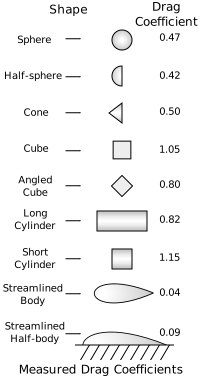
The formula for the drag coefficient of a cylinder is quite complex and depends on several factors, including the Reynolds number, which is a dimensionless quantity used to predict flow patterns in different fluid flow situations. The drag coefficient is a measure of the resistance an object encounters as it moves through a fluid, such as air or water. The formula is typically given as: Cd = f(Re, shape, size), where Cd is the drag coefficient, Re is the Reynolds number, and the function f depends on the shape and size of the cylinder.
Introduction to Drag Coefficient of a Cylinder
The drag coefficient of a cylinder is a crucial parameter in fluid dynamics, as it helps engineers and researchers understand the resistance encountered by an object moving through a fluid. To calculate the drag coefficient, one needs to consider the Reynolds number, which is defined as the ratio of inertial forces to viscous forces. The formula for the Reynolds number is: Re = ρUL/μ, where ρ is the density of the fluid, U is the velocity of the object, L is the characteristic length of the object, and μ is the dynamic viscosity of the fluid.
- The Reynolds number is a key factor in determining the flow regime around the cylinder.
- The shape and size of the cylinder also play a significant role in determining the drag coefficient.
- The drag coefficient can be used to estimate the force exerted on the cylinder by the fluid.
Factors Affecting Drag Coefficient of a Cylinder
Several factors can affect the drag coefficient of a cylinder, including the Reynolds number, surface roughness, and aspect ratio. The Reynolds number is the most critical factor, as it determines the flow regime around the cylinder. At low Reynolds numbers, the flow is laminar, while at high Reynolds numbers, the flow is turbulent. The surface roughness of the cylinder can also affect the drag coefficient, as it can increase the turbulence around the cylinder.
- The aspect ratio of the cylinder can also impact the drag coefficient.
- The orientation of the cylinder with respect to the flow can also affect the drag coefficient.
- The density of the fluid can also influence the drag coefficient.
Calculation of Drag Coefficient of a Cylinder
The calculation of the drag coefficient of a cylinder involves using the Reynolds number and other factors, such as the shape and size of the cylinder. One common method is to use the drag equation, which is: Cd = Fd / (0.5 ρ U^2 A), where Fd is the drag force, ρ is the density of the fluid, U is the velocity of the object, and A is the cross-sectional area of the cylinder.
- The drag equation can be used to estimate the drag coefficient of a cylinder.
- The drag coefficient can be used to calculate the force exerted on the cylinder by the fluid.
- The drag coefficient can also be used to optimize the shape and size of the cylinder to reduce drag.
Applications of Drag Coefficient of a Cylinder
The drag coefficient of a cylinder has numerous applications in engineering and research, including the design of aircraft, vehicles, and buildings. By understanding the drag coefficient of a cylinder, engineers can optimize the shape and size of an object to reduce drag and improve its performance. The drag coefficient can also be used to study the flow around complex geometries, such as bridges and buildings.
- The drag coefficient can be used to optimize the shape of an aircraft to reduce drag.
- The drag coefficient can be used to design more efficient vehicles.
- The drag coefficient can also be used to study the flow around complex geometries.
Experimental Measurement of Drag Coefficient of a Cylinder
The drag coefficient of a cylinder can be measured experimentally using a wind tunnel or a water tunnel. The experimental setup typically involves placing the cylinder in the tunnel and measuring the force exerted on it by the fluid. The drag coefficient can then be calculated using the drag equation. The experimental measurement of the drag coefficient can provide valuable insights into the flow around the cylinder and help validate theoretical models.
- The experimental setup typically involves a wind tunnel or a water tunnel.
- The force exerted on the cylinder is measured using a load cell or a (force sensor).
- The drag coefficient can be calculated using the drag equation and the experimental data.
How do you calculate surface drag?
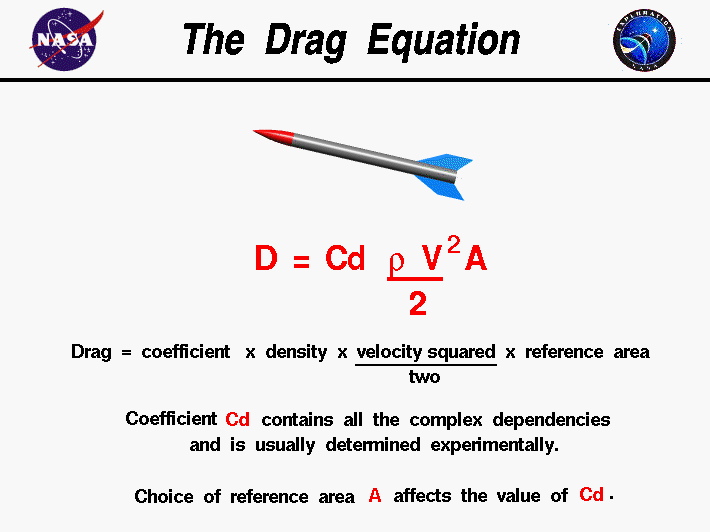
To calculate surface drag, you need to consider several factors, including the velocity of the object, the density of the fluid it is moving through, and the shape and size of the object. The formula for surface drag is typically represented as D = ½ ρ v^2 C_d A, where D is the drag force, ρ is the fluid density, v is the velocity, C_d is the drag coefficient, and A is the cross-sectional area of the object.
Understanding the Drag Equation
The drag equation is a fundamental concept in calculating surface drag. To apply this equation, you need to understand the parameters involved and how they affect the overall drag force. The key factors to consider are:
- The velocity of the object, as it has a significant impact on the drag force.
- The density of the fluid, which can vary depending on the environment and conditions.
- The drag coefficient, which is a dimensionless quantity that depends on the shape and size of the object.
Factors Affecting Drag Coefficient
The drag coefficient is a critical component in calculating surface drag. It is influenced by several factors, including the shape and size of the object, as well as the surface roughness. To determine the drag coefficient, you need to consider:
- The geometry of the object, including its length, width, and height.
- The surface roughness, which can increase or decrease the drag coefficient.
- The flow regime, which can be either laminar or turbulent, affecting the drag coefficient.
Calculating Cross-Sectional Area
The cross-sectional area of the object is another essential factor in calculating surface drag. To calculate this area, you need to consider the shape and size of the object. For example:
- A circular object has a cross-sectional area of πr^2, where r is the radius.
- A rectangular object has a cross-sectional area of length × width.
- An irregularly shaped object may require more complex calculations to determine its cross-sectional area.
Assessing Fluid Density
The fluid density is a critical factor in calculating surface drag. To assess fluid density, you need to consider the type of fluid and its properties, such as temperature and pressure. For example:
- Air has a density of approximately 1.2 kg/m^3 at standard conditions.
- Water has a density of approximately 1000 kg/m^3 at standard conditions.
- Other fluids, such as gases or liquids, may have different densities depending on their composition and properties.
Applying the Drag Equation in Real-World Scenarios
The drag equation can be applied in various real-world scenarios, including aerospace, automotive, and marine applications. To apply the drag equation, you need to consider the specific conditions and parameters involved, such as:
- Velocity and altitude can affect the drag force on an aircraft.
- Speed and road conditions can affect the drag force on a vehicle.
- Flow rate and pipe diameter can affect the drag force on a fluid in a pipe.
What is the formula for drag force with drag coefficient?
The formula for drag force with drag coefficient is given by the equation: Fd = ½ ρ v^2 Cd A, where Fd is the drag force, ρ is the density of the fluid, v is the velocity of the object, Cd is the drag coefficient, and A is the cross-sectional area of the object.
Understanding the Drag Coefficient
The drag coefficient (Cd) is a dimensionless quantity that depends on the shape and size of the object. It is a measure of the object's ability to resist drag force. The value of Cd can range from 0 to 1, with lower values indicating a more aerodynamic or hydrodynamic shape. For example, a sphere has a Cd of approximately 0.47, while a flat plate has a Cd of approximately 1.28. The factors that affect the drag coefficient include:
- Shape: The shape of the object can significantly affect its drag coefficient.
- Size: The size of the object can also affect its drag coefficient.
- Surface roughness: The surface roughness of the object can increase its drag coefficient.
Calculating Drag Force
To calculate the drag force on an object, you need to know its velocity, density of the fluid, drag coefficient, and cross-sectional area. The formula can be rearranged to solve for any of these variables. For example, if you know the drag force, density of the fluid, drag coefficient, and cross-sectional area, you can solve for the velocity. The steps to calculate drag force are:
- Determine the density of the fluid.
- Determine the velocity of the object.
- Determine the drag coefficient of the object.
Factors Affecting Drag Force
The drag force on an object is affected by several factors, including its velocity, density of the fluid, drag coefficient, and cross-sectional area. The velocity of the object is a key factor, as it has a squared relationship with the drag force. The density of the fluid also affects the drag force, with higher densities resulting in greater drag force. The factors that affect drag force include:
- Velocity: The velocity of the object has a significant effect on the drag force.
- Density: The density of the fluid affects the drag force.
- Drag coefficient: The drag coefficient of the object affects the drag force.
Applications of Drag Force Formula
The drag force formula has several practical applications, including the design of aerodynamic and hydrodynamic systems, such as aircraft, cars, and boats. It is also used in the study of fluid dynamics and aerodynamics. The formula can be used to:
- Optimize the shape of an object to reduce drag force.
- Calculate the power required to overcome drag force.
- Determine the maximum speed of an object in a fluid.
Limitations of the Drag Force Formula
The drag force formula has several limitations, including its assumption of a constant density and velocity. It also assumes that the object is symmetric and that the fluid is incompressible. The limitations of the formula include:
- Assumes constant density and velocity.
- Assumes symmetry of the object.
- Assumes incompressibility of the fluid.
What is the drag coefficient in flow past a cylinder?

The drag coefficient in flow past a cylinder is a dimensionless quantity that characterizes the resistance to flow created by the cylinder. It is defined as the ratio of the drag force to the dynamic pressure times the cross-sectional area of the cylinder. The drag coefficient depends on the Reynolds number, which is a dimensionless quantity that characterizes the nature of the flow.
Introduction to Drag Coefficient
The drag coefficient is an important parameter in fluid dynamics as it helps to predict the resistance to flow created by an object. In the case of a cylinder, the drag coefficient is affected by the Reynolds number, which is defined as the ratio of the inertia force to the viscous force. The drag coefficient can be calculated using the following formula:
- The drag force is proportional to the dynamic pressure and the cross-sectional area of the cylinder.
- The drag coefficient is a function of the Reynolds number, which is a dimensionless quantity that characterizes the nature of the flow.
- The drag coefficient can be used to predict the resistance to flow created by a cylinder in a variety of fluid flows.
Factors Affecting Drag Coefficient
The drag coefficient in flow past a cylinder is affected by several factors, including the Reynolds number, the surface roughness of the cylinder, and the flow regime. The Reynolds number is the most important factor, as it determines the nature of the flow. At low Reynolds numbers, the flow is laminar, while at high Reynolds numbers, the flow is turbulent. The surface roughness of the cylinder can also affect the drag coefficient, as it can create turbulence and increase the resistance to flow.
- The Reynolds number is the most important factor affecting the drag coefficient.
- The surface roughness of the cylinder can affect the drag coefficient by creating turbulence and increasing the resistance to flow.
- The flow regime can also affect the drag coefficient, as it determines the nature of the flow.
Calculation of Drag Coefficient
The drag coefficient in flow past a cylinder can be calculated using the following formula: Cd = Fd / (0.5 ρ v^2 A), where Cd is the drag coefficient, Fd is the drag force, ρ is the density of the fluid, v is the velocity of the fluid, and A is the cross-sectional area of the cylinder. The drag force can be measured using a force sensor, while the velocity of the fluid can be measured using a velocity sensor.
- The drag coefficient can be calculated using a formula that involves the drag force, the density of the fluid, the velocity of the fluid, and the cross-sectional area of the cylinder.
- The drag force can be measured using a force sensor.
- The velocity of the fluid can be measured using a velocity sensor.
Applications of Drag Coefficient
The drag coefficient in flow past a cylinder has several applications in engineering and physics. It is used to predict the resistance to flow created by a cylinder in a variety of fluid flows, such as aerodynamics and hydrodynamics. The drag coefficient is also used to design aerodynamic and hydrodynamic systems, such as aircraft and ships.
- The drag coefficient is used to predict the resistance to flow created by a cylinder in a variety of fluid flows.
- The drag coefficient is used to design aerodynamic and hydrodynamic systems.
- The drag coefficient has several applications in engineering and physics.
Experimental Measurement of Drag Coefficient
The drag coefficient in flow past a cylinder can be measured experimentally using a wind tunnel or a water tunnel. The drag force is measured using a force sensor, while the velocity of the fluid is measured using a velocity sensor. The drag coefficient is then calculated using the formula: Cd = Fd / (0.5 ρ v^2 A).
- The drag coefficient can be measured experimentally using a wind tunnel or a water tunnel.
- The drag force is measured using a force sensor.
- The drag coefficient is calculated using a formula that involves the drag force, the density of the fluid, the velocity of the fluid, and the cross-sectional area of the cylinder.
Frequently Asked Questions (FAQs)
What is the significance of the drag coefficient in the context of a long cylinder surface drag and drag coefficient equation and calculator?
The drag coefficient is a crucial parameter in the calculation of drag force exerted on a long cylinder. It is a dimensionless quantity that characterizes the aerodynamic or hydrodynamic properties of an object. In the context of a long cylinder surface drag and drag coefficient equation and calculator, the drag coefficient is used to calculate the drag force exerted on the cylinder due to the flow of a fluid, such as air or water, around it. The drag coefficient is influenced by several factors, including the shape and size of the cylinder, the velocity of the fluid, and the density and viscosity of the fluid. A higher drag coefficient indicates a greater drag force, which can lead to increased energy losses and reduced efficiency in systems involving fluid flow.
How does the equation for the drag coefficient of a long cylinder surface relate to the overall drag force experienced by the cylinder?
The equation for the drag coefficient of a long cylinder surface is a fundamental component in calculating the overall drag force experienced by the cylinder. The equation typically involves the density and velocity of the fluid, as well as the diameter and length of the cylinder. By using the drag coefficient equation, one can calculate the drag force exerted on the cylinder, which is essential in designing and optimizing systems involving fluid flow, such as pipelines, wind turbines, and aircraft. The drag coefficient equation takes into account the boundary layer effects, turbulence, and other factors that influence the flow regime around the cylinder. By understanding the relationship between the drag coefficient and the overall drag force, engineers and researchers can develop more efficient and effective designs for systems involving fluid flow.
What is the role of the Reynolds number in the calculation of the drag coefficient for a long cylinder surface?
The Reynolds number plays a significant role in the calculation of the drag coefficient for a long cylinder surface. The Reynolds number is a dimensionless quantity that characterizes the nature of fluid flow, including laminar and turbulent regimes. It is defined as the ratio of inertial forces to viscous forces within the fluid. In the context of a long cylinder surface, the Reynolds number is used to determine the flow regime around the cylinder, which in turn affects the drag coefficient. At low Reynolds numbers, the flow is typically laminar, resulting in a lower drag coefficient. As the Reynolds number increases, the flow becomes turbulent, leading to a higher drag coefficient. By considering the Reynolds number, engineers and researchers can accurately calculate the drag coefficient and predict the drag force exerted on the cylinder.
How can the drag coefficient equation and calculator for a long cylinder surface be applied in real-world engineering problems?
The drag coefficient equation and calculator for a long cylinder surface have numerous applications in real-world engineering problems. For instance, in aerospace engineering, the drag coefficient is crucial in designing aircraft and spacecraft to minimize drag and maximize efficiency. In chemical engineering, the drag coefficient is used to design pipelines and pumps to optimize fluid flow and reduce energy losses. Additionally, in civil engineering, the drag coefficient is applied in designing bridges and buildings to withstand wind loads and fluid forces. By using the drag coefficient equation and calculator, engineers can predict the drag force exerted on a long cylinder surface and develop more efficient and effective designs for various engineering applications. The calculator can also be used to perform sensitivity analyses and optimization studies to identify the most critical parameters affecting the drag coefficient and drag force.
Deja una respuesta
Entradas Relacionadas