
Inclined Wedge Force and Friction 3 Equation and Calculator

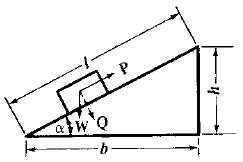
The inclined wedge force and friction 3 equation is a fundamental concept in physics and engineering, describing the relationship between the forces acting on an object on an inclined plane. This equation takes into account the weight of the object, the angle of inclination, and the coefficient of friction. By understanding and applying this equation, engineers and physicists can calculate the forces required to move or hold an object in place on an inclined surface, which is crucial in various applications, including design and construction of machines and mechanisms. The calculator helps simplify the calculation process.
-
Inclined Wedge Force and Friction 3 Equation and Calculator
- Understanding the Inclined Wedge Force and Friction 3 Equation
- Key Components of the Inclined Wedge Force and Friction 3 Equation
- Using the Inclined Wedge Force and Friction 3 Calculator
- Applications of the Inclined Wedge Force and Friction 3 Equation
- Limitations of the Inclined Wedge Force and Friction 3 Equation
-
Understanding the Complexities of Inclined Wedge Force and Friction 3 Equation and Calculator
- Introduction to Inclined Plane Forces
- Understanding the Role of Friction in Inclined Plane Motion
- Derivation of the Inclined Wedge Force and Friction 3 Equation
- Applications of the Inclined Wedge Force and Friction 3 Equation and Calculator
- Limitations and Assumptions of the Inclined Wedge Force and Friction 3 Equation and Calculator
-
Frequently Asked Questions (FAQs)
- What is the concept of Inclined Wedge Force and Friction 3 Equation and Calculator?
- How does the Inclined Wedge Force and Friction 3 Equation and Calculator work?
- What are the applications of the Inclined Wedge Force and Friction 3 Equation and Calculator?
- What are the limitations of the Inclined Wedge Force and Friction 3 Equation and Calculator?
Inclined Wedge Force and Friction 3 Equation and Calculator
The Inclined Wedge Force and Friction 3 Equation is a mathematical model used to calculate the forces acting on an object on an inclined plane. This equation takes into account the normal force, frictional force, and gravitational force acting on the object. The calculator is a tool used to simplify the calculation process, allowing users to input values and obtain the resulting forces.
Understanding the Inclined Wedge Force and Friction 3 Equation
The Inclined Wedge Force and Friction 3 Equation is based on the concept of equilibrium, where the net force acting on an object is zero. The equation is given by: F = μN + mg sin(θ), where F is the frictional force, μ is the coefficient of friction, N is the normal force, m is the mass of the object, g is the acceleration due to gravity, and θ is the angle of inclination. This equation is used to calculate the force required to move an object on an inclined plane.
Key Components of the Inclined Wedge Force and Friction 3 Equation
The Inclined Wedge Force and Friction 3 Equation consists of several key components, including the normal force, frictional force, and gravitational force. The normal force is the force exerted by the inclined plane on the object, while the frictional force is the force opposing the motion of the object. The gravitational force is the force acting on the object due to its mass and the acceleration due to gravity.
Using the Inclined Wedge Force and Friction 3 Calculator
The Inclined Wedge Force and Friction 3 Calculator is a tool used to simplify the calculation process. To use the calculator, users input values for the mass of the object, angle of inclination, coefficient of friction, and acceleration due to gravity. The calculator then uses the Inclined Wedge Force and Friction 3 Equation to calculate the resulting forces, including the normal force, frictional force, and net force.
Applications of the Inclined Wedge Force and Friction 3 Equation
The Inclined Wedge Force and Friction 3 Equation has several practical applications, including the design of incline conveyors, ramps, and elevators. It is also used in the calculation of forces in mechanical systems, such as gear trains and pulleys. Additionally, the equation is used in the analysis of motion of objects on inclined planes, including the calculation of acceleration and velocity.
Limitations of the Inclined Wedge Force and Friction 3 Equation
The Inclined Wedge Force and Friction 3 Equation has several limitations, including the assumption of a constant coefficient of friction and a rigid inclined plane. In reality, the coefficient of friction can vary depending on the surface roughness and material properties. Additionally, the inclined plane may not be rigid, resulting in deformations and changes in the angle of inclination.
| Variable | Definition | Unit |
|---|---|---|
| F | Frictional force | N (Newtons) |
| μ | Coefficient of friction | unitless |
| N | Normal force | N (Newtons) |
| m | Mass | kg (kilograms) |
| g | Acceleration due to gravity | m/s^2 (meters per second squared) |
| θ | Angle of inclination | degrees or radians |
Understanding the Complexities of Inclined Wedge Force and Friction 3 Equation and Calculator
The study of physics and mechanics often involves the calculation of forces and friction in various scenarios, including the movement of objects up inclined planes. The Inclined Wedge Force and Friction 3 Equation and Calculator is a tool used to determine the forces acting on an object as it moves up an inclined plane, taking into account the angle of the plane, the mass of the object, and the coefficient of friction. This equation is crucial in understanding how objects move in different environments and how friction affects their motion.
Introduction to Inclined Plane Forces
When an object is placed on an inclined plane, it is subjected to several forces, including the normal force, the frictional force, and the gravitational force. The normal force is perpendicular to the surface of the plane, while the frictional force acts opposite to the direction of motion. The gravitational force, or weight, acts downward and can be resolved into two components: one parallel to the plane and one perpendicular to it. Understanding these forces is essential in calculating the net force acting on the object and determining its motion.
Understanding the Role of Friction in Inclined Plane Motion
Friction plays a significant role in the motion of an object up an inclined plane. The coefficient of friction is a measure of the amount of friction between two surfaces and is used to calculate the frictional force. There are two types of friction: static friction and kinetic friction. Static friction occurs when an object is at rest, while kinetic friction occurs when an object is in motion. The coefficient of static friction is typically greater than the coefficient of kinetic friction, which means that it is more difficult to get an object moving than to keep it moving.
Derivation of the Inclined Wedge Force and Friction 3 Equation
The Inclined Wedge Force and Friction 3 Equation is derived by summing the forces acting on an object as it moves up an inclined plane. The equation takes into account the normal force, the frictional force, and the gravitational force, as well as the angle of the plane and the coefficient of friction. The equation is often expressed as F = μN + mg sin(θ), where F is the net force, μ is the coefficient of friction, N is the normal force, m is the mass of the object, g is the acceleration due to gravity, and θ is the angle of the plane. This equation can be used to calculate the net force acting on an object and determine its motion.
Applications of the Inclined Wedge Force and Friction 3 Equation and Calculator
The Inclined Wedge Force and Friction 3 Equation and Calculator has several practical applications in physics and engineering. It can be used to design machines and mechanisms that involve the movement of objects up inclined planes, such as conveyors and elevators. The equation can also be used to calculate! the efficiency of these machines and determine the energy required to move an object up an inclined plane. Additionally, the equation can be used to understand the stability of objects on inclined planes and determine the conditions under which they will slide or roll.
Limitations and Assumptions of the Inclined Wedge Force and Friction 3 Equation and Calculator
The Inclined Wedge Force and Friction 3 Equation and Calculator is based on several assumptions and simplifications, including the assumption that the coefficient of friction is constant and that the surface of the inclined plane is smooth. In reality, the coefficient of friction can vary depending on the surface roughness and the velocity of the object, and the surface of the inclined plane may be rough or irregular. Additionally, the equation does not take into account other forces that may be acting on the object, such as air resistance or viscous forces. Therefore, the equation should be used with caution and in conjunction with experimental data and real-world observations to ensure accurate results.
Frequently Asked Questions (FAQs)
What is the concept of Inclined Wedge Force and Friction 3 Equation and Calculator?
The concept of Inclined Wedge Force and Friction 3 Equation and Calculator is a fundamental principle in physics and engineering that deals with the calculation of forces and friction on an inclined plane. This concept is crucial in understanding how objects move or remain at rest on inclined surfaces, and it has numerous applications in various fields such as mechanics, engineering, and architecture. The Inclined Wedge Force and Friction 3 Equation and Calculator is a mathematical tool used to calculate the forces acting on an object on an inclined plane, taking into account the angle of inclination, the mass of the object, and the coefficient of friction. By using this equation and calculator, one can determine the normal force, the frictional force, and the net force acting on an object, which is essential in designing and analyzing systems that involve inclined planes.
How does the Inclined Wedge Force and Friction 3 Equation and Calculator work?
The Inclined Wedge Force and Friction 3 Equation and Calculator works by using the fundamental principles of physics and mathematics to calculate the forces acting on an object on an inclined plane. The equation takes into account the angle of inclination of the plane, the mass of the object, and the coefficient of friction between the object and the plane. The calculator then uses these values to calculate the normal force, which is the force exerted by the plane on the object, and the frictional force, which is the force that opposes the motion of the object. The calculator then calculates the net force acting on the object, which is the sum of the normal force and the frictional force. By using this equation and calculator, one can determine the acceleration of the object, the velocity of the object, and the distance traveled by the object, which is essential in understanding the motion of objects on inclined planes.
What are the applications of the Inclined Wedge Force and Friction 3 Equation and Calculator?
The Inclined Wedge Force and Friction 3 Equation and Calculator has numerous applications in various fields such as mechanics, engineering, and architecture. One of the primary applications of this equation and calculator is in the design and analysis of incline planes and ramps in buildings, roads, and other infrastructure. The equation and calculator can be used to determine the slope of the incline plane, the length of the incline plane, and the materials required to build the incline plane. Additionally, the equation and calculator can be used to analyze the motion of objects on inclined planes, which is essential in understanding the behavior of objects in various situations. The equation and calculator can also be used in the design and analysis of machines and mechanisms that involve inclined planes, such as gearboxes and transmissions.
What are the limitations of the Inclined Wedge Force and Friction 3 Equation and Calculator?
The Inclined Wedge Force and Friction 3 Equation and Calculator has several limitations that need to be considered when using it to calculate forces and friction on inclined planes. One of the primary limitations of this equation and calculator is that it assumes a constant coefficient of friction between the object and the plane, which may not always be the case in real-world situations. Additionally, the equation and calculator assume that the angle of inclination is constant, which may not always be the case in situations where the incline plane is curved or irregular. Furthermore, the equation and calculator do not take into account other factors that can affect the motion of objects on inclined planes, such as air resistance and viscosity. Therefore, the results obtained from the equation and calculator should be used with caution and in conjunction with other analytical tools to ensure accurate and reliable results.
Deja una respuesta
Entradas Relacionadas