
Hydraulic Accumulator Sizing Equations and Calculator

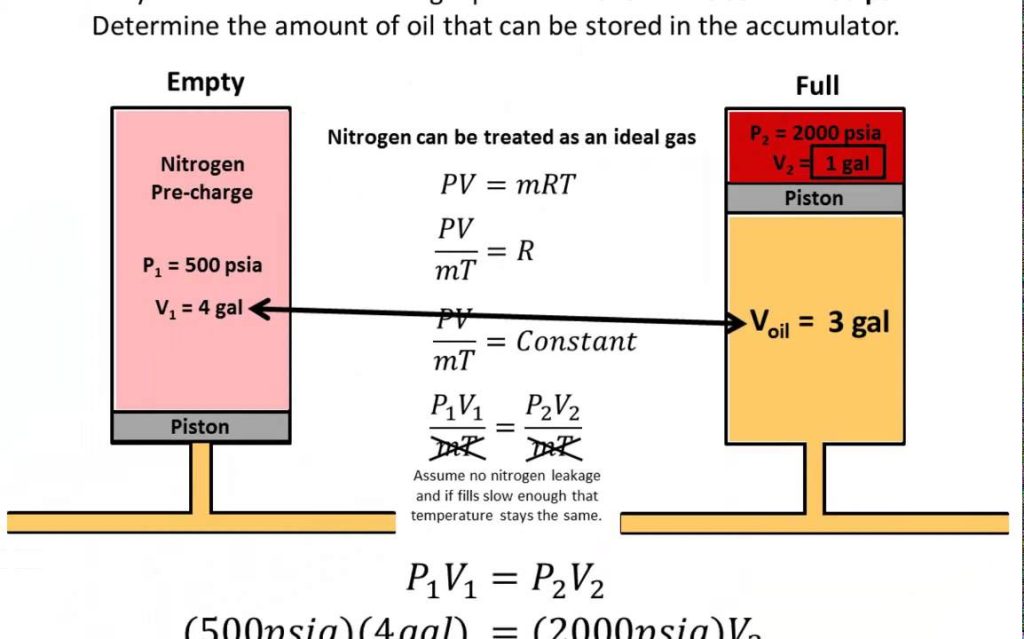
Hydraulic accumulators are crucial components in hydraulic systems, storing energy and regulating pressure fluctuations. Proper sizing is essential to ensure optimal performance, reliability, and safety. Incorrect sizing can lead to reduced system efficiency, increased maintenance costs, and potential safety hazards. This article provides a comprehensive overview of hydraulic accumulator sizing equations and offers a calculator tool to facilitate accurate calculations, enabling engineers and technicians to design and optimize hydraulic systems with confidence and precision, meeting specific application requirements and industry standards. The equations and calculator will be explained in detail, along with their application and limitations.
Hydraulic Accumulator Sizing Equations and Calculator: A Comprehensive Guide
The hydraulic accumulator is a critical component in hydraulic systems, responsible for storing energy in the form of compressed fluid. Proper sizing of the accumulator is essential to ensure the system operates efficiently and effectively. The hydraulic accumulator sizing equations and calculator are used to determine the required size of the accumulator based on the system's requirements.
Introduction to Hydraulic Accumulator Sizing
Hydraulic accumulator sizing involves calculating the required volume of the accumulator to store the necessary amount of energy. This is typically done using equations that take into account the system's pressure, flow rate, and volumetric efficiency. The calculator is used to simplify the calculation process and provide accurate results. The sizing equations are based on the principles of fluid dynamics and thermodynamics.
Types of Hydraulic Accumulators
There are several types of hydraulic accumulators, including bladder accumulators, piston accumulators, and diaphragm accumulators. Each type has its own unique characteristics and sizing requirements. The bladder accumulator is the most common type, which uses a flexible bladder to separate the fluid from the gas. The piston accumulator uses a piston to separate the fluid from the gas, while the diaphragm accumulator uses a flexible diaphragm.
Hydraulic Accumulator Sizing Equations
The hydraulic accumulator sizing equations are based on the following parameters:
| Parameter | Description |
|---|---|
| Pressure | The maximum pressure of the system |
| Flow Rate | The maximum flow rate of the system |
| Volumetric Efficiency | The efficiency of the accumulator |
The equations used to calculate the required volume of the accumulator are:
- V = (Q x t) / (η x (P2 - P1)), where V is the volume of the accumulator, Q is the flow rate, t is the time, η is the volumetric efficiency, P2 is the maximum pressure, and P1 is the minimum pressure.
Hydraulic Accumulator Calculator
The hydraulic accumulator calculator is a tool used to simplify the calculation process. It takes into account the system's parameters and provides the required volume of the accumulator. The calculator can be used to calculate the required volume of the accumulator for different types of accumulators, including bladder accumulators, piston accumulators, and diaphragm accumulators.
Importance of Proper Sizing
Proper sizing of the hydraulic accumulator is essential to ensure the system operates efficiently and effectively. A undersized accumulator can lead to insufficient energy storage, while an oversized accumulator can lead to increased costs and reduced system performance. Proper sizing can help to optimize system performance, reduce energy consumption, and increase system reliability. The sizing equations and calculator can help to ensure proper sizing of the accumulator.
What is the formula for hydraulic accumulator sizing?

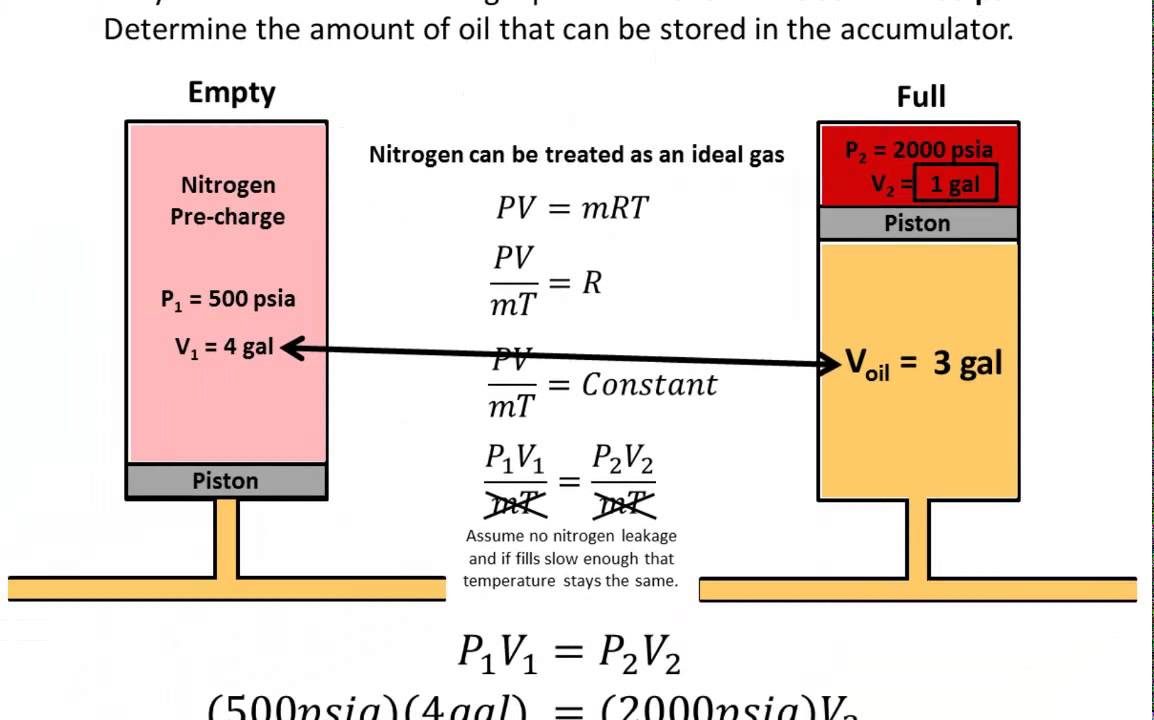
The formula for hydraulic accumulator sizing is a critical aspect of ensuring that a hydraulic system operates efficiently and effectively. The formula typically involves calculating the required volume of the accumulator based on the system's pressure, flow rate, and cylinder size. The calculation also takes into account the pre-charge pressure and the maximum operating pressure of the system. The formula is: V = (Q x ΔP) / (P1 - P2), where V is the volume of the accumulator, Q is the flow rate, ΔP is the pressure differential, P1 is the pre-charge pressure, and P2 is the maximum operating pressure.
Understanding the Parameters
To apply the formula for hydraulic accumulator sizing, it is essential to understand the parameters involved. The system's pressure and flow rate are critical factors that determine the required volume of the accumulator. The cylinder size also plays a significant role in determining the accumulator size. Other factors such as pre-charge pressure and maximum operating pressure are also crucial in the calculation. The following are key parameters to consider:
- System pressure: The maximum pressure that the system will operate at.
- Flow rate: The rate at which fluid flows through the system.
- Cylinder size: The size of the cylinder that the accumulator is connected to.
Importance of Pre-Charge Pressure
The pre-charge pressure is a critical factor in hydraulic accumulator sizing. It is the pressure at which the accumulator is charged when it is not in operation. The pre-charge pressure affects the volume of the accumulator and the maximum operating pressure of the system. A higher pre-charge pressure results in a smaller accumulator size, while a lower pre-charge pressure results in a larger accumulator size. The following are key considerations for pre-charge pressure:
- Nitrogen pre-charge pressure: The pressure at which the accumulator is charged with nitrogen gas.
- System operating pressure: The pressure at which the system operates.
- Accum!ulator size: The size of the accumulator required to meet the system's pressure and flow rate requirements.
Calculating the Volume of the Accumulator
Calculating the volume of the accumulator is a critical step in hydraulic accumulator sizing. The formula V = (Q x ΔP) / (P1 - P2) is used to calculate the required volume of the accumulator. The flow rate, pressure differential, pre-charge pressure, and maximum operating pressure are all critical factors in this calculation. The following are key considerations for calculating the volume of the accumulator:
- Flow rate calculation: Calculating the flow rate of the system to determine the required volume of the accumulator.
- Pressure differential calculation: Calculating the pressure differential to determine the required volume of the accumulator.
- Pre-charge pressure calculation: Calculating the pre-charge pressure to determine the required volume of the accumulator.
Selecting the Right Accumulator Size
Selecting the right accumulator size is critical to ensuring that the hydraulic system operates efficiently and effectively. The accumulator size must be sufficient to meet the system's pressure and flow rate requirements. A larger accumulator size may be required for systems with high pressure and flow rate requirements. The following are key considerations for selecting the right accumulator size:
- System requirements: Understanding the system's pressure and flow rate requirements to select the right accumulator size.
- Accumulator types: Selecting the right type of accumulator, such as a bladder or piston accumulator, based on the system's requirements.
- Accumulator materials: Selecting the right materials for the accumulator, such as steel or fiberglass, based on the system's requirements.
Design Considerations for Hydraulic Accumulators
There are several design considerations that must be taken into account when sizing a hydraulic accumulator. The accumulator's volume, pre-charge pressure, and maximum operating pressure are all critical factors that must be considered. The accumulator's size and type must also be selected based on the system's pressure and flow rate requirements. The following are key design considerations for hydraulic accumulators:
- System integration: Integrating the accumulator into the hydraulic system to ensure efficient and effective operation.
- Accumulator maintenance: Ensuring that the accumulator is properly maintained to prevent corrosion and leaks.
- Accumulator testing: Testing the accumulator to ensure that it meets the system's pressure and flow rate requirements.
What is the formula for the accumulator equation?
The formula for the accumulator equation is a mathematical expression that represents the accumulation of a sequence of values over time. It is a fundamental concept in mathematics and is used in various fields, including finance, economics, and engineering. The formula is typically represented as:
A(t) = ∑[x(i) (1 + r)^(-i)]
Where A(t) is the accumulated value at time t, x(i) is the value at time i, r is the interest rate, and i is the time period.
Understanding the Accumulator Equation
The accumulator equation is a powerful tool for calculating the future value of a sequence of investments or payments. To understand the equation, it is essential to break down its components and analyze how they interact with each other. The key components of the equation are:
- The initial value of the investment or payment
- The interest rate at which the investment or payment grows
- The time period over which the investment or payment is made
Applications of the Accumulator Equation
The accumulator equation has various applications in finance, economics, and engineering. It is used to calculate the future value of investments, loans, and other financial instruments. The equation is also used to model real-world systems, such as population growth and chemical reactions. Some of the key applications of the accumulator equation include:
- Financial modeling: calculating the future value of investments and loans
- Economic forecasting: predicting economic trends and growth
- Engineering design: modeling and optimizing complex systems
Key Components of the Accumulator Equation
The accumulator equation consists of several key components, including the initial value, interest rate, and time period. Each of these components plays a critical role in determining the accumulated value. The initial value represents the starting point of the investment or payment, while the interest rate determines the rate at which the investment or payment grows. The time period, on the other hand, determines the length of time over which the investment or payment is made. Some of the key components of the accumulator equation include:
- Interest rate: the rate at which the investment or payment grows
- Time period: the length of time over which the investment or payment is made
- Initial value: the starting point of the investment or payment
Calculating the Accumulator Equation
Calculating the accumulator equation involves summing up the discounted values of each payment or investment. The discounted value is calculated by multiplying the payment or investment by the discount factor, which is typically represented as (1 + r)^(-i). The discount factor takes into account the time value of money, which is the idea that a dollar today is worth more than a dollar in the future. Some of the key steps involved in calculating the accumulator equation include:
- Calculating the discount factor: (1 + r)^(-i)
- Discounting each payment or investment: x(i) (1 + r)^(-i)
- Summing up the discounted values: ∑[x(i) (1 + r)^(-i)]
Limitations of the Accumulator Equation
While the accumulator equation is a powerful tool for calculating the future value of a sequence of investments or payments, it has several limitations. One of the main limitations is that it assumes a constant interest rate, which may not always be the case in reality. Additionally, the equation assumes that the payments or investments are made at regular intervals, which may not always be the case. Some of the key limitations of the accumulator equation include:
- Constant interest rate: the equation assumes a constant interest rate
- Regular payments or investments: the equation assumes regular payments or investments
- No compounding: the equation does not take into account compounding interest
How do you calculate accumulator capacity?
To calculate accumulator capacity, you need to consider several factors, including the system's requirements, the fluid properties, and the accumulator's design characteristics. The capacity of an accumulator is typically measured in terms of its volume and pressure rating. The calculation involves determining the amount of fluid that can be stored in the accumulator and the pressure at which it can be stored. This is crucial in ensuring that the accumulator can provide the required flow rate and pressure to the system.
Understanding Accumulator Types
There are different types of accumulators, including piston, bladder, and diaphragm accumulators. Each type has its own unique characteristics and requirements for calculating capacity. For example, piston accumulators require consideration of the piston area and piston stroke, while bladder accumulators require consideration of the bladder material and bladder size. The calculation of accumulator capacity involves:
- Identifying the accumulator type and its characteristics
- Determining the system's requirements, including flow rate and pressure
- Calculating the volume of fluid that can be stored in the accumulator
Calculating Accumulator Volume
The volume of an accumulator is calculated based on its geometric dimensions, including the diameter, length, and height. The calculation also involves considering the fluid properties, such as density and viscosity. The volume calculation is critical in determining the accumulator's capacity to store fluid and provide the required flow rate. The calculation involves:
- Measuring the geometric dimensions of the accumulator
- Determining the fluid properties, including density and viscosity
- Calculating the volume of the accumulator using the geometric dimensions and fluid properties
Determining Accumulator Pressure Rating
The pressure rating of an accumulator is critical in determining its capacity to store fluid at a given pressure. The calculation involves considering the accumulator's design characteristics, including the material and thickness of the accumulator's shell. The pressure rating is also affected by the fluid properties, such as density and viscosity. The calculation involves:
- Determining the accumulator's design characteristics, including material and thickness
- Determining the fluid properties, including density and viscosity
- Calculating the pressure rating of the accumulator using the design characteristics and fluid properties
Considering System Requirements
The system's requirements, including flow rate and pressure, must be considered when calculating accumulator capacity. The calculation involves determining the peak demand of the system and ensuring that the accumulator can provide the required flow rate and pressure. The calculation also involves considering the system's operating conditions, including temperature and humidity. The calculation involves:
- Determining the system's requirements, including flow rate and pressure
- Determining the peak demand of the system
- Calculating the accumulator capacity based on the system's requirements and peak demand
Accounting for Fluid Properties
The fluid properties, including density, viscosity, and compressibility, must be considered when calculating accumulator capacity. The calculation involves determining the fluid's behavior under different pressure and temperature conditions. The fluid properties can significantly affect the accumulator's capacity to store fluid and provide the required flow rate. The calculation involves:
- Determining the fluid properties, including density, viscosity, and compressibility
- Calculating the fluid's behavior under different pressure and temperature conditions
- Adjusting the accumulator capacity calculation based on the fluid properties and behavior
How do I choose a hydraulic accumulator?

To choose a hydraulic accumulator, you need to consider several factors that affect its performance and functionality. The primary purpose of a hydraulic accumulator is to store energy in the form of compressed fluid, which can be released as needed to supplement the hydraulic system. This helps to smooth out pressure fluctuations, provide a backup power source, and reduce the load on the pump.
Understanding Accumulator Types
When selecting a hydraulic accumulator, it's essential to understand the different types available, including bladder, piston, and diaphragm accumulators. Each type has its unique characteristics, advantages, and applications. For instance, bladder accumulators are suitable for high-pressure systems, while piston accumulators are better suited for low-pressure applications. The choice of accumulator type depends on the specific requirements of the hydraulic system, including pressure, flow rate, and temperature.
- Bladder accumulators are ideal for high-pressure systems and offer a high volume of stored fluid.
- Piston accumulators are suitable for low-pressure applications and provide a high degree of precision.
- Diaphragm accumulators offer a good balance between pressure and volume, making them suitable for a wide range of applications.
Calculating Accumulator Size
Calculating the correct size of the hydraulic accumulator is crucial to ensure it can store sufficient energy to meet the demands of the hydraulic system. The size of the accumulator depends on factors such as pressure, flow rate, and cycle time. A larger accumulator can store more energy, but it also increases the cost and space requirements. It's essential to strike a balance between accumulator size and system requirements to ensure optimal performance.
- Determine the maximum pressure required by the hydraulic system to ensure the accumulator can handle the pressure.
- Calculate the required flow rate to determine the minimum volume of fluid needed to meet the system demands.
- Consider the cycle time to determine the amount of energy required to be stored in the accumulator.
Material Selection
The material used to construct the hydraulic accumulator is critical, as it affects the corrosion resistance, strength, and durability of the accumulator. Common materials used include steel, stainless steel, and fiberglass. The choice of material depends on the operating conditions, including temperature, pressure, and exposure to corrosive substances.
- Steel accumulators are suitable for high-pressure applications and offer a high degree of strength.
- Stainless steel accumulators provide excellent corrosion resistance and are ideal for applications where hygiene is critical.
- Fiberglass accumulators are lightweight and offer good corrosion resistance, making them suitable for applications where weight is a concern.
Mounting and Installation
The mounting and installation of the hydraulic accumulator are critical to ensure safe and reliable operation. The accumulator should be mounted in a secure location, protected from vibrations and extreme temperatures. It's also essential to follow the manufacturer's instructions for installation and maintenance to ensure the accumulator functions correctly.
- Choose a secure location for the accumulator, away from vibrations and extreme temperatures.
- Follow the manufacturer's instructions for installation and maintenance to ensure the accumulator functions correctly.
- Consider the piping and valving requirements to ensure smooth fluid flow and pressure regulation.
Maintenance and Testing
Regular maintenance and testing are essential to ensure the hydraulic accumulator operates safely and efficiently. This includes checking the pressure, fluid level, and leakage, as well as performing routine inspections to identify any potential issues. It's also crucial to follow the manufacturer's recommendations for maintenance and testing to ensure the accumulator meets the required safety standards.
- Check the pressure and fluid level regularly to ensure the accumulator is functioning correctly.
- Inspect the accumulator for any signs of leakage or damage.
- Perform routine tests to ensure the accumulator meets the required safety standards and performance specifications.
Frequently Asked Questions (FAQs)
What is the purpose of Hydraulic Accumulator Sizing Equations and Calculator?
The purpose of Hydraulic Accumulator Sizing Equations and Calculator is to provide a reliable and efficient method for determining the optimal size of a hydraulic accumulator for a specific application. A hydraulic accumulator is a device that stores energy in the form of compressed fluid, which can be used to supplement the power output of a hydraulic system. The sizing equations and calculator take into account various factors such as the system pressure, flow rate, and energy requirements to determine the optimal accumulator size. This is crucial in ensuring that the hydraulic system operates efficiently and effectively, while also minimizing the risk of over-pressure and under-pressure conditions. By using the Hydraulic Accumulator Sizing Equations and Calculator, engineers and designers can quickly and accurately determine the optimal accumulator size for their specific application, saving time and reducing the risk of errors.
What are the key factors that affect Hydraulic Accumulator Sizing?
The key factors that affect Hydraulic Accumulator Sizing include system pressure, flow rate, energy requirements, and accumulator type. The system pressure refers to the maximum pressure that the hydraulic system is designed to operate at, while the flow rate refers to the volume of fluid that flows through the system per unit time. The energy requirements of the system also play a critical role in determining the optimal accumulator size, as the accumulator must be able to store sufficient energy to meet the demands of the system. Additionally, the type of accumulator used, such as a bladder accumulator or a piston accumulator, can also impact the sizing calculations. Other factors such as temperature, viscosity, and fluid properties can also be important considerations in Hydraulic Accumulator Sizing. By taking into account these key factors, engineers and designers can use the Hydraulic Accumulator Sizing Equations and Calculator to determine the optimal accumulator size for their specific application.
How do Hydraulic Accumulator Sizing Equations and Calculator work?
The Hydraulic Accumulator Sizing Equations and Calculator work by using a combination of mathematical equations and algorithms to determine the optimal accumulator size based on the input parameters. The equations take into account the system pressure, flow rate, energy requirements, and other factors to calculate the optimal accumulator size. The calculator then uses these equations to provide a quick and accurate estimate of the optimal accumulator size. The calculator typically requires the user to input values for the system pressure, flow rate, and energy requirements, as well as other relevant parameters. The calculator then uses these input values to calculate the optimal accumulator size, taking into account factors such as accumulator type, temperature, and fluid properties. The result is a recommended accumulator size that meets the specific needs of the hydraulic system. By using the Hydraulic Accumulator Sizing Equations and Calculator, engineers and designers can quickly and easily determine the optimal accumulator size for their application, without the need for extensive calculations or trial-and-error testing.
What are the benefits of using Hydraulic Accumulator Sizing Equations and Calculator?
The benefits of using Hydraulic Accumulator Sizing Equations and Calculator include improved system performance, increased efficiency, and reduced risk of errors. By determining the optimal accumulator size for a specific application, engineers and designers can ensure that the hydraulic system operates at peak performance, with minimal energy losses and maximum efficiency. The calculator also helps to reduce the risk of over-pressure and under-pressure conditions, which can cause damage to the system or lead to system failure. Additionally, the Hydraulic Accumulator Sizing Equations and Calculator can help to reduce design time and minimize costs, by providing a quick and accurate estimate of the optimal accumulator size. This can be especially beneficial in applications where time-to-market is critical, or where system downtime must be minimized. Overall, the Hydraulic Accumulator Sizing Equations and Calculator is a valuable tool for anyone involved in the design or operation of hydraulic systems, providing a reliable and efficient method for determining the optimal accumulator size.
Deja una respuesta
Entradas Relacionadas