
Heat Loss Insulated Pipe Equation and Calculator

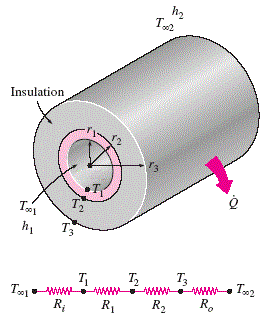
Heat loss from pipelines is a significant concern in various industries, including oil and gas, chemical processing, and power generation. Insulated pipes are used to minimize heat loss and reduce energy consumption. The heat loss insulated pipe equation is a mathematical formula used to calculate the heat transfer rate from a pipe to its surroundings. This article provides an overview of the equation and offers an online calculator to simplify the calculation process, allowing users to determine the optimal insulation thickness and material for their specific application. The calculator is based on the standard heat transfer equations.
- Understanding Heat Loss in Insulated Pipes: Equation and Calculator
- Understanding the Basics of Heat Loss Insulated Pipe Equation and Calculator
-
Frequently Asked Questions (FAQs)
- What is the Heat Loss Insulated Pipe Equation and Calculator?
- How does the Heat Loss Insulated Pipe Equation and Calculator work?
- What are the benefits of using the Heat Loss Insulated Pipe Equation and Calculator?
- How can I apply the Heat Loss Insulated Pipe Equation and Calculator in real-world scenarios?
Understanding Heat Loss in Insulated Pipes: Equation and Calculator
The heat loss in insulated pipes is a critical factor in various industries, including construction, HVAC, and process engineering. It is essential to understand the heat loss phenomenon to design and install efficient piping systems. The heat loss in insulated pipes can be calculated using the heat transfer equation, which takes into account the pipe's diameter, length, insulation thickness, and temperature difference between the pipe and the surrounding environment.
Introduction to Heat Loss in Insulated Pipes
Heat loss in insulated pipes occurs due to the temperature difference between the pipe and the surrounding environment. The insulation plays a crucial role in reducing the heat loss, but it is not entirely effective. The heat loss can be calculated using the Fourier's law of heat conduction, which states that the heat flux is proportional to the temperature gradient and the thermal conductivity of the material. The equation for heat loss in insulated pipes is given by: Q = (2 π k (T1 - T2)) / (ln(r2/r1)), where Q is the heat loss, k is the thermal conductivity, T1 and T2 are the temperatures, and r1 and r2 are the inner and outer radii of the pipe.
Heat Loss Insulated Pipe Equation
The heat loss insulated pipe equation is a complex formula that takes into account various factors, including the pipe's geometry, insulation properties, and temperature difference. The equation can be broken down into several components, including the conductive heat transfer, convective heat transfer, and radiative heat transfer. The conductive heat transfer occurs through the pipe and insulation, while the convective heat transfer occurs through the surrounding fluid. The radiative heat transfer occurs through electromagnetic waves.
Calculator for Heat Loss in Insulated Pipes
A calculator for heat loss in insulated pipes can be a useful tool for designers and engineers. The calculator can take into account various factors, including the pipe's diameter, length, insulation thickness, and temperature difference. The calculator can also account for the thermal conductivity of the pipe and insulation materials, as well as the convective heat transfer coefficient. The calculator can provide the total heat loss and the heat loss per unit length of the pipe.
Factors Affecting Heat Loss in Insulated Pipes
Several factors can affect the heat loss in insulated pipes, including the pipe's diameter, length, insulation thickness, and temperature difference. The thermal conductivity of the pipe and insulation materials also plays a significant role. Additionally, the convective heat transfer coefficient and the radiative heat transfer can affect the heat loss. The pipe's surface roughness and the insulation's density can also impact the heat loss.
Applications of Heat Loss Insulated Pipe Equation and Calculator
The heat loss insulated pipe equation and calculator have various applications in industries, including construction, HVAC, and process engineering. The equation and calculator can be used to design and install efficient piping systems, reducing the energy losses and operating costs. The equation and calculator can also be used to optimize the insulation thickness and pipe diameter, ensuring that the piping system operates within the desired temperature range. The following table summarizes the key factors affecting heat loss in insulated pipes:
| Factor | Description |
|---|---|
| Pipe's diameter | Affects the heat loss due to the increased surface area |
| Length | Affects the heat loss due to the increased surface area |
| Insulation thickness | Affects the heat loss by reducing the convective heat transfer |
| Temperature difference | Affects the heat loss due to the increased temperature gradient |
| Thermal conductivity | Affects the heat loss due to the increased conductive heat transfer |
Understanding the Basics of Heat Loss Insulated Pipe Equation and Calculator
The Heat Loss Insulated Pipe Equation and Calculator are essential tools for engineers and technicians working with pipelines and fluid transfer systems. The equation helps calculate the heat loss from a pipeline to the surrounding environment, which is critical in maintaining the temperature and pressure of the fluid being transferred. The calculator simplifies the process by providing a straightforward way to input variables and obtain the desired results. In this context, understanding the fundamentals of heat transfer, insulation, and pipework is crucial for designing and operating efficient systems.
Introduction to Heat Transfer and Insulation
Heat transfer is the process by which thermal energy is exchanged between systems or objects. In the context of pipelines, heat transfer can occur through conduction, convection, or radiation. Insulation plays a vital role in reducing heat loss by minimizing the flow of thermal energy from the pipeline to the surrounding environment. The insulation material and its thickness are critical factors in determining the effectiveness of the insulation. Engineers must carefully select the insulation material and design the insulation system to achieve the desired level of heat retention or heat dissipation.
Understanding the Heat Loss Insulated Pipe Equation
The Heat Loss Insulated Pipe Equation is a mathematical model that calculates the heat loss from a pipeline to the surrounding environment. The equation takes into account various parameters, including the pipeline diameter, insulation thickness, fluid temperature, and ambient temperature. The equation is based on the principles of heat transfer and is used to determine the heat flux and heat loss from the pipeline. Engineers can use the equation to optimize the insulation and pipeline design to minimize heat loss and reduce energy losses.
Using the Heat Loss Insulated Pipe Calculator
The Heat Loss Insulated Pipe Calculator is a tool that simplifies the process of calculating heat loss from a pipeline. The calculator allows users to input the required parameters, such as pipeline diameter, insulation thickness, fluid temperature, and ambient temperature, and provides the calculated heat loss and heat flux values. The calculator is user-friendly and eliminates the need for complex mathematical calculations. Engineers and technicians can use the calculator to quickly and accurately determine the heat loss from a pipeline and optimize the insulation and pipeline design.
Factors Affecting Heat Loss in Insulated Pipes
Several factors can affect heat loss in insulated pipes, including the insulation material, insulation thickness, pipeline diameter, fluid temperature, and ambient temperature. The insulation material and its thickness are critical in determining the effectiveness of the insulation. The pipeline diameter and fluid temperature also play a significant role in determining the heat loss. Additionally, the ambient temperature and environmental conditions can impact the heat loss from the pipeline. Engineers must carefully consider these factors when designing and operating pipelines to minimize heat loss and optimize energy efficiency.
Applications of Heat Loss Insulated Pipe Equation and Calculator
The Heat Loss Insulated Pipe Equation and Calculator have various applications in industrial, commercial, and residential settings. The equation and calculator can be used to design and optimize pipelines for heating, cooling, and fluid transfer systems. Engineers and technicians can use the equation and calculator to determine the heat loss from pipelines and optimize the insulation and pipeline design to reduce energy losses and improve system efficiency. The equation and calculator can also be used in research and development to study heat transfer and insulation in pipelines and develop new insulation materials and pipeline designs.
Frequently Asked Questions (FAQs)
What is the Heat Loss Insulated Pipe Equation and Calculator?
The Heat Loss Insulated Pipe Equation and Calculator is a tool used to calculate the heat loss from a pipework system, taking into account the insulation properties and the temperature difference between the fluid inside the pipe and the surrounding environment. This equation is based on the Fourier's Law of Heat Conduction, which states that the heat flux is proportional to the temperature gradient. The calculator uses this equation to determine the heat loss rate from the pipe, which is essential for designing and optimizing pipework systems in various industries, such as chemical processing, power generation, and HVAC systems. By using the Heat Loss Insulated Pipe Equation and Calculator, engineers and designers can optimize the insulation of pipework systems, reducing energy losses and increasing efficiency.
How does the Heat Loss Insulated Pipe Equation and Calculator work?
The Heat Loss Insulated Pipe Equation and Calculator works by using a combination of thermal conductivity, pipe diameter, insulation thickness, and temperature difference to calculate the heat loss rate from the pipe. The equation takes into account the conductive, convective, and radiative heat transfer mechanisms, which are all important factors in determining the overall heat loss. The calculator uses a step-by-step approach to calculate the heat loss rate, first calculating the thermal resistance of the insulation, then the heat flux, and finally the heat loss rate. This approach allows for accurate calculations and precise results, which are essential for designing and optimizing pipework systems. By using the Heat Loss Insulated Pipe Equation and Calculator, users can quickly and easily calculate the heat loss rate from a pipework system, without the need for complex calculations or extensive knowledge of heat transfer theory.
What are the benefits of using the Heat Loss Insulated Pipe Equation and Calculator?
The benefits of using the Heat Loss Insulated Pipe Equation and Calculator are numerous, and include increased accuracy, improved efficiency, and reduced energy losses. By using this tool, engineers and designers can optimize the insulation of pipework systems, reducing heat loss and increasing the overall efficiency of the system. This can lead to cost savings, as well as reduced environmental impact, as less energy is required to maintain the desired temperature. Additionally, the Heat Loss Insulated Pipe Equation and Calculator can be used to compare different insulation materials and designs, allowing users to make informed decisions about which insulation solution is best for their specific application. The calculator can also be used to identify areas of improvement in existing pipework systems, allowing users to target their efforts and maximize their returns.
How can I apply the Heat Loss Insulated Pipe Equation and Calculator in real-world scenarios?
The Heat Loss Insulated Pipe Equation and Calculator can be applied in a variety of real-world scenarios, including the design and optimization of pipework systems in chemical processing, power generation, and HVAC systems. For example, in a chemical processing plant, the calculator can be used to design and optimize the pipework system for a specific process, taking into account the temperature requirements and insulation properties. In a power generation plant, the calculator can be used to optimize the insulation of steam pipes, reducing heat loss and increasing efficiency. In an HVAC system, the calculator can be used to design and optimize the pipework system for space heating or cooling, taking into account the temperature requirements and insulation properties. By using the Heat Loss Insulated Pipe Equation and Calculator, users can make informed decisions about the design and optimization of pipework systems, reducing energy losses and increasing efficiency.
Deja una respuesta
Entradas Relacionadas