
Extension Spring Force Formula and Calculator


The extension spring force formula is a fundamental concept in physics and engineering, used to calculate the force exerted by an extension spring when it is stretched or compressed. This formula is crucial in designing and analyzing mechanical systems, ensuring safety and efficiency. The formula takes into account the spring's initial length, stretched length, and spring constant, providing a straightforward way to determine the force applied. An extension spring force calculator can simplify this process, allowing users to input values and obtain accurate results, making it an essential tool for engineers and physicists alike. The formula is F = kx.
- Understanding the Extension Spring Force Formula and Calculator
- How to calculate extension spring force?
- What is the formula for the extension spring?
- What is the equation for the force and extension of a spring?
- How to calculate extension force?
-
Frequently Asked Questions (FAQs)
- What is the Extension Spring Force Formula and how is it used in calculations?
- How does the Extension Spring Force Calculator work and what are its limitations?
- What are the key factors that affect the Extension Spring Force Formula and Calculator results?
- How can I use the Extension Spring Force Formula and Calculator in real-world applications?
Understanding the Extension Spring Force Formula and Calculator
The extension spring force formula and calculator are essential tools in the field of physics and engineering, particularly when dealing with springs and their applications. The extension spring force formula is used to calculate the force exerted by a spring when it is stretched or extended beyond its initial length. This formula is based on Hooke's Law, which states that the force exerted by a spring is directly proportional to its extension. The calculator, on the other hand, is a tool that simplifies the calculation process by providing a straightforward way to input values and obtain results.
What is the Extension Spring Force Formula?
The extension spring force formula is given by the equation F = kx, where F is the force exerted by the spring, k is the spring constant, and x is the extension or displacement of the spring from its initial length. The spring constant is a measure of the spring's stiffness and is typically expressed in units of Newtons per meter (N/m). The formula can be rearranged to solve for the spring constant, which is useful when designing springs for specific applications.
How to Use the Extension Spring Force Calculator
The extension spring force calculator is a simple tool that requires input values for the spring constant and the extension of the spring. The calculator then uses the extension spring force formula to calculate the force exerted by the spring. The calculator can be used to design springs for various applications, such as mechanical systems, electrical circuits, and even medical devices. The calculator can also be used to analyze the behavior of springs under different loading conditions, including tension, compression, and torsion.
Factors Affecting the Extension Spring Force
Several factors can affect the extension spring force, including the spring material, spring diameter, and number of coils. The spring material can affect the spring constant, with materials like stainless steel and titanium exhibiting higher spring constants than materials like copper and aluminum. The spring diameter and number of coils can also impact the spring constant, with larger diameters and more coils resulting in higher spring constants.
Applications of the Extension Spring Force Formula and Calculator
The extension spring force formula and calculator have numerous applications in various fields, including mechanical engineering, electrical engineering, and biomedical engineering. In mechanical engineering, the formula and calculator can be used to design springs for mechanical systems, such as suspension systems and transmission systems. In electrical engineering, the formula and calculator can be used to design springs for electrical circuits, such as relays and switches.
Limitations of the Extension Spring Force Formula and Calculator
While the extension spring force formula and calculator are useful tools, they have limitations. The formula assumes that the spring is linear, meaning that the force exerted by the spring is directly proportional to its extension. However, in reality, springs can exhibit nonlinear behavior, particularly at large extensions. The calculator can also be limited by the accuracy of the input values, particularly the spring constant, which can be difficult to measure accurately.
| Spring Constant | Extension | Force |
|---|---|---|
| 100 N/m | 0.1 m | 10 N |
| 200 N/m | 0.2 m | 40 N |
| 500 N/m | 0.5 m | 250 N |
How to calculate extension spring force?
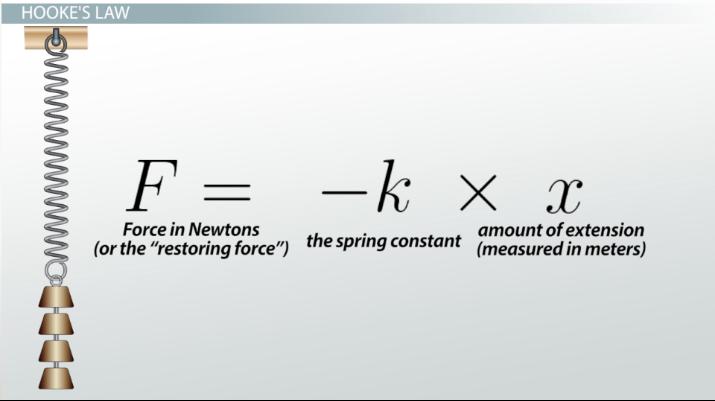
To calculate the extension spring force, you need to understand the basic principles of spring mechanics. The force exerted by an extension spring is directly proportional to its deflection and spring constant. The spring constant is a measure of the spring's stiffness, and it can be calculated using the spring's physical properties, such as its wire diameter, coil diameter, and number of coils.
Understanding Spring Constants
The spring constant is a critical factor in calculating the extension spring force. To calculate the spring constant, you need to know the spring's physical properties, such as its wire diameter, coil diameter, and number of coils. The spring constant can be calculated using the following formula: k = (G d^4) / (8 n D^3), where k is the spring constant, G is the shear modulus of the spring material, d is the wire diameter, n is the number of coils, and D is the coil diameter. The key factors to consider when calculating the spring constant are:
- The wire diameter and coil diameter of the spring
- The number of coils in the spring
- The shear modulus of the spring material
Calculating Deflection
The deflection of an extension spring is the distance it moves from its free length to its loaded length. To calculate the deflection, you need to know the spring's free length, loaded length, and spring constant. The deflection can be calculated using the following formula: δ = (F D^3 n) / (G d^4), where δ is the deflection, F is the force applied to the spring, D is the coil diameter, n is the number of coils, G is the shear modulus, and d is the wire diameter. The key factors to consider when calculating the deflection are:
- The force applied to the spring
- The spring constant of the spring
- The free length and loaded length of the spring
Applying Hooke's Law
Hooke's Law states that the force exerted by a spring is directly proportional to its deflection. The law can be expressed mathematically as F = k δ, where F is the force, k is the spring constant, and δ is the deflection. To calculate the extension spring force, you can use Hooke's Law, provided you know the spring constant and deflection. The key factors to consider when applying Hooke's Law are:
- The spring constant of the spring
- The deflection of the spring
- The force applied to the spring
Considering Spring Materials
The spring material can affect the extension spring force due to its elastic properties. Different materials have different shear moduli, which can impact the spring constant and deflection. Common spring materials include stainless steel, carbon steel, and copper alloys. The key factors to consider when selecting a spring material are:
- The shear modulus of the material
- The elastic limit of the material
- The corrosion resistance of the material
Designing Extension Springs
To design an extension spring, you need to consider the required force, deflection, and spring constant. You can use the formulas and principles mentioned earlier to calculate the spring's physical properties, such as its wire diameter, coil diameter, and number of coils. The key factors to consider when designing an extension spring are:
- The required force and deflection of the spring
- The spring constant and shear modulus of the material
- The wire diameter and coil diameter of the spring
What is the formula for the extension spring?
The formula for the extension spring is a mathematical expression that describes the relationship between the force applied to the spring, its deflection, and the spring's characteristics. The most common formula used to describe the behavior of an extension spring is Hooke's Law, which states that the force (F) required to deflect the spring by a certain distance (x) is proportional to the spring's stiffness (k). The formula is F = kx, where F is the force applied to the spring, k is the spring's stiffness, and x is the distance of deflection.
Understanding the Formula
The formula for the extension spring is based on the principles of elasticity and the mechanical properties of the spring. To understand the formula, it is essential to consider the following points:
- The force applied to the spring is measured in Newtons (N) or pounds-force (lbf)
- The deflection of the spring is measured in meters (m) or inches (in)
- The stiffness of the spring is measured in Newtons per meter (N/m) or pounds-force per inch (lbf/in)
These units are critical in ensuring that the formula is applied correctly and that the results are accurate.
Key Components of the Formula
The formula for the extension spring has several key components that must be understood to apply it correctly. These components include the spring constant (k), which is a measure of the spring's stiffness, and the deflection (x), which is the distance that the spring is compressed or stretched. The following points are essential to consider:
- The spring constant is a measure of the spring's ability to resist deflection
- The deflection is the distance that the spring is compressed or stretched from its equilibrium position
- The force applied to the spring is proportional to the deflection and the spring constant
These components are critical in understanding how the formula works and how to apply it to real-world engineering problems.
Applying the Formula
The formula for the extension spring can be applied to a wide range of engineering problems, from designing mechanical systems to analyzing the behavior of complex systems. To apply the formula, it is essential to consider the following points:
- Identify the force applied to the spring and the deflection of the spring
- Calculate the spring constant using the formula k = F/x
- Use the formula to predict the behavior of the spring under different loading conditions
By applying the formula correctly, engineers can design and analyze mechanical systems that incorporate extension springs.
Limitations of the Formula
The formula for the extension spring has several limitations that must be considered when applying it to real-world engineering problems. These limitations include the assumption of linear elasticity, which may not always be valid, and the neglect of damping and friction, which can affect the behavior of the spring. The following points are essential to consider:
- The formula assumes that the spring behaves linearly, which may not always be the case
- The formula neglects the effects of damping and friction, which can affect the behavior of the spring
- The formula is only applicable to extension springs and not to other types of springs
These limitations are critical in understanding the restrictions of the formula and how to apply it correctly.
Real-World Applications
The formula for the extension spring has numerous real-world applications in engineering and design. These applications include the design of mechanical systems, such as engines and gearboxes, and the analysis of complex systems, such as vibration isolation systems. The following points are essential to consider:
- The formula can be used to design and optimize mechanical systems that incorporate extension springs
- The formula can be used to analyze and predict the behavior of complex systems that incorporate extension springs
- The formula is essential in ensuring the safety and reliability of mechanical systems that incorporate extension springs
These applications are critical in understanding the importance of the formula in real-world engineering problems.
What is the equation for the force and extension of a spring?
The equation for the force and extension of a spring is given by Hooke's Law, which states that the force required to stretch or compress a spring by a certain distance is proportional to that distance. The equation is F = kx, where F is the force applied to the spring, k is the spring constant, and x is the extension or compression of the spring.
Understanding Hooke's Law
Hooke's Law is a fundamental principle in physics that describes the relationship between the force applied to a spring and its resulting extension or compression. The spring constant (k) is a measure of the spring's stiffness, with higher values indicating a stiffer spring. To apply Hooke's Law, you need to know the spring constant and the extension or compression of the spring. Here are some key points to consider:
- The spring constant (k) is a measure of the spring's stiffness.
- The extension or compression of the spring (x) is the distance the spring is stretched or compressed from its equilibrium position.
- The force applied to the spring (F) is the force required to stretch or compress the spring by a certain distance.
Calculating Spring Constant
The spring constant (k) can be calculated by measuring the force required to stretch or compress a spring by a known distance. This can be done using a force sensor and a ruler or meter stick to measure the extension or compression of the spring. To calculate the spring constant, you can use the equation k = F / x, where F is the force applied to the spring and x is the extension or compression of the spring. Here are some steps to follow:
- Measure the force required to stretch or compress the spring by a known distance.
- Measure the extension or compression of the spring using a ruler or meter stick.
- Calculate the spring constant using the equation k = F / x.
Applications of Hooke's Law
Hooke's Law has many practical applications in engineering and physics, including the design of springs and elastic systems. It is used to calculate the force required to stretch or compress a spring by a certain distance, and to determine the spring constant of a spring. Hooke's Law is also used in the design of suspension systems and vibration isolators. Here are some examples of applications:
- Design of springs and elastic systems.
- Calculation of the force required to stretch or compress a spring.
- Determination of the spring constant of a spring.
Limit!ations of Hooke's Law
Hooke's Law is a simplified model that assumes the spring is ideal and that the force applied to the spring is proportional to the extension or compression of the spring. However, in real-world applications, springs can be subject to non-linear effects, such as hysteresis and plastic deformation. Additionally, Hooke's Law does not account for damping or friction effects that can occur in real-world systems. Here are some limitations to consider:
- Non-linear effects, such as hysteresis and plastic deformation.
- Damping or friction effects that can occur in real-world systems.
- Limitations of the simplified model assumed by Hooke's Law.
Real-World Examples of Hooke's Law
Hooke's Law can be observed in many real-world examples, including the stretching of a rubber band, the compression of a spring in a car suspension, and the vibration of a guitar string. In each of these examples, the force applied to the spring or elastic system is proportional to the extension or compression of the spring. Here are some examples:
- Stretching of a rubber band.
- Compression of a spring in a car suspension.
- Vibration of a guitar string.
How to calculate extension force?
To calculate extension force, you need to understand the concept of tension and displacement. The extension force is the force required to stretch or elongate an object, and it is typically measured in Newtons. The calculation of extension force involves the use of Hooke's Law, which states that the force required to stretch an object is proportional to its displacement from its original length. The formula to calculate extension force is F = kx, where F is the force, k is the spring constant, and x is the displacement.
Understanding Hooke's Law
Hooke's Law is a fundamental concept in physics that describes the relationship between the force applied to an object and its resulting displacement. To calculate the extension force using Hooke's Law, you need to know the spring constant of the object, which is a measure of its stiffness. The spring constant can be determined experimentally or by using the object's material properties. Here are some key points to consider:
- The spring constant is a measure of the object's resistance to deformation.
- The displacement is the distance the object is stretched or compressed from its original length.
- The force required to stretch or compress the object is proportional to its displacement.
Calculating Spring Constant
The spring constant is a critical parameter in calculating the extension force. To calculate the spring constant, you need to know the material properties of the object, such as its Young's modulus and cross-sectional area. The formula to calculate the spring constant is k = (E A) / L, where E is the Young's modulus, A is the cross-sectional area, and L is the original length. Here are some key points to consider:
- The Young's modulus is a measure of the object's stiffness.
- The cross-sectional area is the area of the object's cross-section.
- The original length is the length of the object before it is stretched or compressed.
Measuring Displacement
The displacement is the distance the object is stretched or compressed from its original length. To measure the displacement, you can use a ruler or a displacement sensor. The displacement sensor can be an optical sensor or a capacitive sensor, depending on the application. Here are some key points to consider:
- The displacement sensor can be used to measure the displacement accurately.
- The ruler can be used to measure the displacement manually.
- The displacement should be measured in a consistent unit, such as meters or millimeters.
Applying Hooke's Law
To calculate the extension force, you need to apply Hooke's Law, which states that the force required to stretch an object is proportional to its displacement. The formula to calculate the extension force is F = kx, where F is the force, k is the spring constant, and x is the displacement. Here are some key points to consider:
- The force required to stretch the object is proportional to its displacement.
- The spring constant is a measure of the object's stiffness.
- The displacement should be measured in a consistent unit, such as meters or millimeters.
Real-World Applications
The calculation of extension force has many real-world applications, such as in the design of springs and elastic systems. The extension force is used to calculate the stress and strain on an object, which is critical in ensuring its structural integrity. Here are some key points to consider:
- The extension force is used to calculate the stress and strain on an object.
- The stress and strain are critical parameters in ensuring the object's structural integrity.
- The extension force has many real-world applications, such as in the design of springs and elastic systems.
Frequently Asked Questions (FAQs)
What is the Extension Spring Force Formula and how is it used in calculations?
The Extension Spring Force Formula is a mathematical equation used to calculate the force exerted by an extension spring when it is stretched or extended. This formula is essential in the design and application of extension springs in various mechanical systems, as it allows engineers to determine the force required to extend the spring by a certain distance. The formula is given by F = kx, where F is the force exerted by the spring, k is the spring constant, and x is the distance of extension. The spring constant is a measure of the spring's stiffness, and it is typically determined through experimentation or calculation based on the spring's dimensions and material properties. By using this formula, engineers can calculate the force required to extend the spring by a certain distance, which is crucial in designing mechanical systems that rely on extension springs.
How does the Extension Spring Force Calculator work and what are its limitations?
The Extension Spring Force Calculator is a tool used to calculate the force exerted by an extension spring based on the spring's dimensions, material properties, and the distance of extension. This calculator uses the Extension Spring Force Formula as its basis and takes into account various factors such as the spring's wire diameter, coil diameter, and number of coils. The calculator also considers the material properties of the spring, such as its modulus of elasticity and Poisson's ratio. However, the calculator has some limitations, as it assumes that the spring is linearly elastic and that the force is applied axially. Additionally, the calculator does not account for factors such as friction and damping, which can affect the actual force exerted by the spring. Therefore, the results obtained from the calculator should be used as a guideline rather than a definitive answer, and engineers should always verify the calculations through experimentation or more advanced simulations.
What are the key factors that affect the Extension Spring Force Formula and Calculator results?
The key factors that affect the Extension Spring Force Formula and Calculator results are the spring constant, distance of extension, wire diameter, coil diameter, number of coils, and material properties. The spring constant is the most critical factor, as it determines the stiffness of the spring and therefore the force exerted. The distance of extension is also crucial, as it determines the amount of deformation of the spring and therefore the force exerted. The wire diameter and coil diameter affect the spring constant and therefore the force exerted, while the number of coils affects the overall stiffness of the spring. The material properties, such as the modulus of elasticity and Poisson's ratio, also play a significant role in determining the force exerted by the spring. Additionally, factors such as friction and damping can also affect the actual force exerted by the spring, although these are not accounted for in the calculator.
How can I use the Extension Spring Force Formula and Calculator in real-world applications?
The Extension Spring Force Formula and Calculator can be used in a wide range of real-world applications, including mechanical engineering, automotive engineering, and aerospace engineering. For example, engineers can use the formula and calculator to design suspension systems for vehicles, landing gear for aircraft, and mechanical linkages for robots. The formula and calculator can also be used to determine the force required to extend or compress a spring in a mechanical system, which is essential in designing systems that rely on springs for their operation. Additionally, the formula and calculator can be used to optimize the design of springs and mechanical systems, by determining the optimal spring constant and dimensions required to achieve a specific force or motion. By using the Extension Spring Force Formula and Calculator, engineers can create more efficient, reliable, and cost-effective mechanical systems that rely on extension springs.
Deja una respuesta
Entradas Relacionadas