
Composite Sandwich Stiffness Equation and Calculator

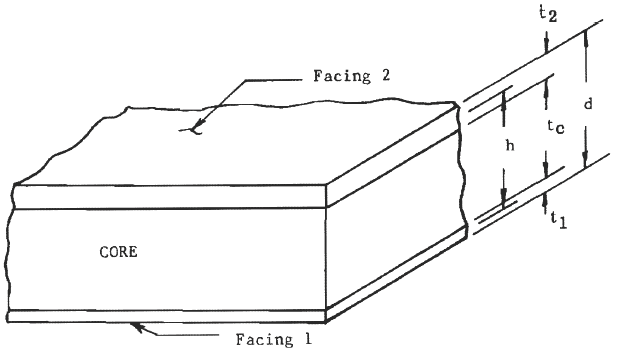
The composite sandwich stiffness equation is a crucial tool for engineers designing complex structures. It calculates the stiffness of a sandwich beam, which consists of two thin face sheets separated by a thick core. This equation takes into account the material properties and geometry of the face sheets and core, providing a precise estimate of the beam's flexural stiffness. The calculator accompanying this equation enables quick and accurate computations, simplifying the design process for engineers working with composite sandwich structures in various industries, including aerospace, automotive, and construction. Accurate stiffness calculations are essential for optimal design.
- Understanding Composite Sandwich Stiffness Equation and Calculator
- Understanding the Composite Sandwich Stiffness Equation and Calculator
-
Frequently Asked Questions (FAQs)
- What is the Composite Sandwich Stiffness Equation and Calculator?
- How does the Composite Sandwich Stiffness Equation and Calculator work?
- What are the benefits of using the Composite Sandwich Stiffness Equation and Calculator?
- What are the limitations and assumptions of the Composite Sandwich Stiffness Equation and Calculator?
Understanding Composite Sandwich Stiffness Equation and Calculator
The Composite Sandwich Stiffness Equation is a mathematical formula used to calculate the stiffness of a composite sandwich structure, which consists of two thin facings separated by a thick core. This equation is crucial in understanding the mechanical behavior of composite sandwich structures, which are widely used in various engineering applications, including aerospace, automotive, and construction.
Definition of Composite Sandwich Structure
A composite sandwich structure is a type of structural component that consists of two thin facings, typically made of a high-strength material, separated by a thick core, typically made of a low-density material. The facings provide the primary load-carrying capacity, while the core provides additional stiffness and stability. The composite sandwich stiffness equation is used to calculate the stiffness of this structure, taking into account the properties of the facings, core, and the interface between them.
Importance of Stiffness in Composite Sandwich Structures
Stiffness is a critical property of composite sandwich structures, as it determines their ability to resist deformation under load. A higher stiffness indicates a greater resistance to deformation, which is essential in many engineering applications. The composite sandwich stiffness equation provides a tool for designing and analyzing composite sandwich structures with optimal stiffness.
Composite Sandwich Stiffness Equation Derivation
The composite sandwich stiffness equation is derived based on the principles of mechanics of materials and the theory of composite materials. The equation takes into account the properties of the facings, core, and the interface between them, including the elastic modulus, Poisson's ratio, and thickness of each component. The equation is typically expressed in terms of the bending stiffness and torsional stiffness of the composite sandwich structure.
Calculator for Composite Sandwich Stiffness
A calculator for composite sandwich stiffness is a software tool that implements the composite sandwich stiffness equation to calculate the stiffness of a given composite sandwich structure. The calculator typically requires input of the material properties and geometric parameters of the structure, and outputs the calculated stiffness values. The calculator can be used to design and optimize composite sandwich structures for specific applications.
Applications of Composite Sandwich Stiffness Equation and Calculator
The composite sandwich stiffness equation and calculator have numerous applications in various engineering fields, including:
| Application | Description |
|---|---|
| Aerospace Engineering | Design of aircraft and spacecraft structures |
| Automotive Engineering | Design of vehicle bodies and chassis |
| Construction Engineering | Design of building structures and bridges |
| Wind Energy | Design of wind turbine blades |
| Marine Engineering | Design of ship hulls and offshore structures |
The composite sandwich stiffness equation and calculator are essential tools for engineers and researchers working in these fields, as they enable the design and optimization of composite sandwich structures with optimal stiffness and performance.
Understanding the Composite Sandwich Stiffness Equation and Calculator
The Composite Sandwich Stiffness Equation and Calculator are essential tools for engineers and researchers working with composite materials. The stiffness of a composite sandwich structure is a critical parameter that determines its overall performance and behavior under various loading conditions. The equation and calculator provide a means to calculate the stiffness of these structures, taking into account the properties of the composite materials, such as the fiber orientation, matrix properties, and layer thickness. The accuracy of these calculations is crucial for designing and optimizing composite sandwich structures for various applications, including aerospace, automotive, and construction industries.
Introduction to Composite Sandwich Structures
Composite sandwich structures are made up of thin face sheets and a thick core material, which provide excellent mechanical properties, such as high stiffness-to-weight ratios and good thermal insulation. The face sheets are typically made of high-strength, high-stiffness materials, such as carbon fiber reinforced polymers (CFRP) or glass fiber reinforced polymers (GFRP), while the core material can be a polymer foam, honeycomb, or balsa wood. The combination of these materials provides a unique set of properties that make composite sandwich structures ideal for various applications. The stiffness equation and calculator are used to predict the behavior of these structures under different loading conditions, such as tension, compression, bending, and torsion.
Derivation of the Composite Sandwich Stiffness Equation
The composite sandwich stiffness equation is derived from the classical lamination theory (CLT), which assumes that the layers in the composite sandwich structure are thin and perfectly bonded. The equation takes into account the elastic properties of the individual layers, such as the Young's modulus, Poisson's ratio, and shear modulus, as well as the geometric parameters, such as the layer thickness and fiber orientation. The equation is typically expressed in terms of the stiffness matrix, which relates the stresses and strains in the composite sandwich structure. The stiffness matrix is used to calculate the overall stiffness of the structure, which is a critical parameter in designing and optimizing composite sandwich structures.
Applications of the Composite Sandwich Stiffness Equation and Calculator
The composite sandwich stiffness equation and calculator have a wide range of applications in various industries, including aerospace, automotive, and construction. For example, in the aerospace industry, composite sandwich structures are used in aircraft wings, fuselage, and control surfaces, where high stiffness-to-weight ratios and good thermal insulation are critical. In the automotive industry, composite sandwich structures are used in body panels, chassis, and engine components, where high strength-to-weight ratios and good crashworthiness are essential. The stiffness equation and calculator are used to design and optimize these structures for specific applications, taking into account the mechanical properties of the composite materials and the geometric parameters of the structure.
Limitations and Assumptions of the Composite Sandwich Stiffness Equation
The composite sandwich stiffness equation is based on several assumptions and limitation, which can affect its accuracy and reliability. For example, the equation assumes that the layers in the composite sandwich structure are thin and perfectly bonded, which may not always be the case in practice. Additionally, the equation does not account for non-linear effects, such as large deformations and material non-linearity, which can occur in composite sandwich structures under certain loading conditions. Furthermore, the equation assumes that the composite materials are homogeneous and isotropic, which may not be true for all types of composite materials. These assumptions and limitation must be carefully considered when using the stiffness equation and calculator to design and optimize composite sandwich structures.
Future Developments and Research Directions
There are several future developments and research directions related to the composite sandwich stiffness equation and calculator. For example, computational models and simulation tools are being developed to predict the behavior of composite sandwich structures under various loading conditions, including non-linear effects and large deformations. Additionally, new composite materials and manufacturing techniques are being developed to improve the mechanical properties and reduce the cost of composite sandwich structures. Furthermore, experimental methods and testing techniques are being developed to validate the stiffness equation and calculator and to characterize the behavior of composite sandwich structures under various loading conditions. These future developments and research directions will help to improve the accuracy and reliability of the composite sandwich stiffness equation and calculator and to expand their applications in various industries.
Frequently Asked Questions (FAQs)
What is the Composite Sandwich Stiffness Equation and Calculator?
The Composite Sandwich Stiffness Equation and Calculator is a mathematical model and computational tool used to determine the stiffness and strength of composite sandwich structures. These structures are made of multiple layers of different materials, such as fibers, polymers, and foams, which are combined to achieve specific mechanical properties. The equation and calculator take into account various parameters, including the thickness and material properties of each layer, as well as the boundary conditions and loading applied to the structure. By using this equation and calculator, engineers and researchers can predict and optimize the behavior of composite sandwich structures under various loads and conditions.
How does the Composite Sandwich Stiffness Equation and Calculator work?
The Composite Sandwich Stiffness Equation and Calculator works by combining the classical lamination theory and the finite element method to analyze the behavior of composite sandwich structures. The equation takes into account the elastic properties of each layer, including the Young's modulus, Poisson's ratio, and shear modulus, as well as the geometric parameters of the structure, such as the length, width, and thickness. The calculator then uses this equation to compute the stiffness matrix and stress-strain behavior of the structure under various loads, including tension, compression, bending, and torsion. This allows users to evaluate and compare the performance of different composite sandwich structures and optimize their design for specific applications.
What are the benefits of using the Composite Sandwich Stiffness Equation and Calculator?
The benefits of using the Composite Sandwich Stiffness Equation and Calculator include the ability to accurately predict the behavior of composite sandwich structures under various loads and conditions. This allows engineers and researchers to optimize the design of these structures for specific applications, such as aerospace, automotive, and marine engineering. The equation and calculator can also be used to reduce the need for experimental testing and prototyping, which can be time-consuming and costly. Additionally, the Composite Sandwich Stiffness Equation and Calculator can be used to investigate the effects of different material properties and geometric parameters on the behavior of composite sandwich structures, which can lead to the development of new materials and design concepts.
What are the limitations and assumptions of the Composite Sandwich Stiffness Equation and Calculator?
The limitations and assumptions of the Composite Sandwich Stiffness Equation and Calculator include the simplifications and approximations made in the model, such as the neglect of non-linear effects and the assumption of linear elastic behavior. The equation and calculator also assume that the composite sandwich structure is homogeneous and isotropic, which may not be the case in reality. Additionally, the model does not account for defects and imperfections in the structure, such as delaminations and voids, which can significantly affect the behavior of the structure. Therefore, users must be aware of these limitations and assumptions when using the Composite Sandwich Stiffness Equation and Calculator, and validate the results with experimental testing and other analytical models whenever possible.
Deja una respuesta
Entradas Relacionadas