
Bend Line Distance To Mold Line Equations and Calculator

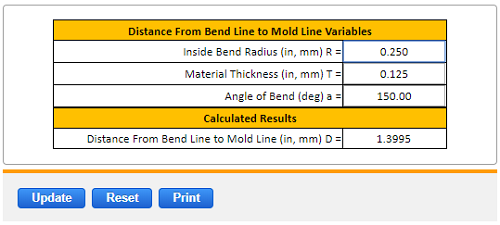
The bend line distance to mold line is a critical calculation in various engineering and manufacturing processes. It determines the distance between the bend line of a part and the mold line, which is essential for ensuring accurate and efficient production. This calculation is particularly important in industries such as automotive, aerospace, and construction, where precision and quality are paramount. The use of equations and calculators can simplify this process, providing accurate results and reducing errors. By understanding these equations, manufacturers can optimize their production processes and improve overall quality. Calculators can also aid in complex calculations.
-
Bend Line Distance To Mold Line Equations and Calculator
- Introduction to Bend Line Distance To Mold Line Equations
- Calculating Bend Line Distance To Mold Line Using Equations
- Using the Bend Line Distance To Mold Line Calculator
- Applications of Bend Line Distance To Mold Line Equations and Calculator
- Advantages of Using Bend Line Distance To Mold Line Equations and Calculator
-
What is the distance from the mold point to the bend tangent line?
- Understanding the Mold Point and Bend Tangent Line
- Calculating the Distance from the Mold Point to the Bend Tangent Line
- Factors Affecting the Distance from the Mold Point to the Bend Tangent Line
- Importance of Accurate Calculation of the Distance from the Mold Point to the Bend Tangent Line
- Applications of the Distance from the Mold Point to the Bend Tangent Line
-
How to calculate bend setback?
- Understanding Bend Radius
- Calculating Bend Allowance
- Determining Tangential Bend Allowance
- Calculating Flat Pattern
- The bend setback is an important factor in sheet metal design. It is used to determine the flat pattern of a sheet metal part, which is critical in ensuring that the part is manufactured correctly. To apply the bend setback in sheet metal design, you need to follow these steps: Determine the bend radius and bend angle Calculate the bend allowance and tangential bend allowance Use the formulas to calculate the bend setback Apply the bend setback to the flat pattern How to calculate length before bending?
- Understanding the Bending Process
- Calculating the Bend Allowance
- Determining the K-Factor
- Calculating the Unbent Length
- Using Software to Calculate Length Before Bending
-
Frequently Asked Questions (FAQs)
- What is the concept of Bend Line Distance To Mold Line Equations and Calculator?
- How do Bend Line Distance To Mold Line Equations and Calculator work?
- What are the benefits of using Bend Line Distance To Mold Line Equations and Calculator?
- What are the common applications of Bend Line Distance To Mold Line Equations and Calculator?
Bend Line Distance To Mold Line Equations and Calculator
The Bend Line Distance To Mold Line Equations and Calculator is a tool used to calculate the distance between the bend line and the mold line in various manufacturing processes, particularly in the production of plastic and metal parts. This calculator is essential in ensuring the accuracy and precision of the manufactured parts, as it helps to determine the correct dimensions and tolerances. The equations used in this calculator are based on the mathematical models of the bending process, which take into account the material properties, bend radius, and mold design.
Introduction to Bend Line Distance To Mold Line Equations
The Bend Line Distance To Mold Line Equations are a set of mathematical equations that describe the relationship between the bend line and the mold line. These equations are used to calculate the distance between the two lines, which is critical in determining the accuracy and precision of the manufactured parts. The equations take into account various parameters, including the bend radius, mold design, and material properties. By using these equations, manufacturers can ensure that their parts meet the required specifications and tolerances.
Calculating Bend Line Distance To Mold Line Using Equations
To calculate the bend line distance to mold line using equations, manufacturers need to follow a series of steps. First, they need to determine the bend radius and mold design, which are critical parameters in the calculation. Next, they need to select the appropriate material properties, such as the young's modulus and poisson's ratio. Once these parameters are determined, manufacturers can use the Bend Line Distance To Mold Line Equations to calculate the distance between the bend line and the mold line.
Using the Bend Line Distance To Mold Line Calculator
The Bend Line Distance To Mold Line Calculator is a software tool that simplifies the calculation process. This calculator uses the same mathematical equations as the manual calculation method, but it automates the process, reducing the error and uncertainty associated with manual calculations. To use the calculator, manufacturers need to input the required parameters, such as the bend radius, mold design, and material properties. The calculator then uses these parameters to calculate the distance between the bend line and the mold line, providing a quick and accurate result.
Applications of Bend Line Distance To Mold Line Equations and Calculator
The Bend Line Distance To Mold Line Equations and Calculator have a wide range of applications in various manufacturing processes, including plastic injection molding, metal stamping, and tube bending. These equations and calculator are essential in ensuring the accuracy and precision of the manufactured parts, which is critical in meeting the required specifications and tolerances. By using these equations and calculator, manufacturers can reduce errors and defects, improve product quality, and increase efficiency.
Advantages of Using Bend Line Distance To Mold Line Equations and Calculator
The use of Bend Line Distance To Mold Line Equations and Calculator offers several advantages, including improved accuracy, increased precision, and reduced errors. These equations and calculator also enable manufacturers to optimize their manufacturing processes, reduce waste, and improve product quality. Additionally, the calculator simplifies the calculation process, reducing the time and effort required to perform the calculations. The following table summarizes the key benefits of using the Bend Line Distance To Mold Line Equations and Calculator:
| Benefit | Description |
|---|---|
| Improved Accuracy | Ensures that the manufactured parts meet the required specifications and tolerances |
| Increased Precision | Reduces errors and defects in the manufacturing process |
| Reduced Errors | Minimizes the risk of manufacturing defects and errors |
| Optimized Manufacturing Process | Enables manufacturers to optimize their manufacturing processes and improve product quality |
| Simplified Calculation Process | Reduces the time and effort required to perform the calculations |
What is the distance from the mold point to the bend tangent line?
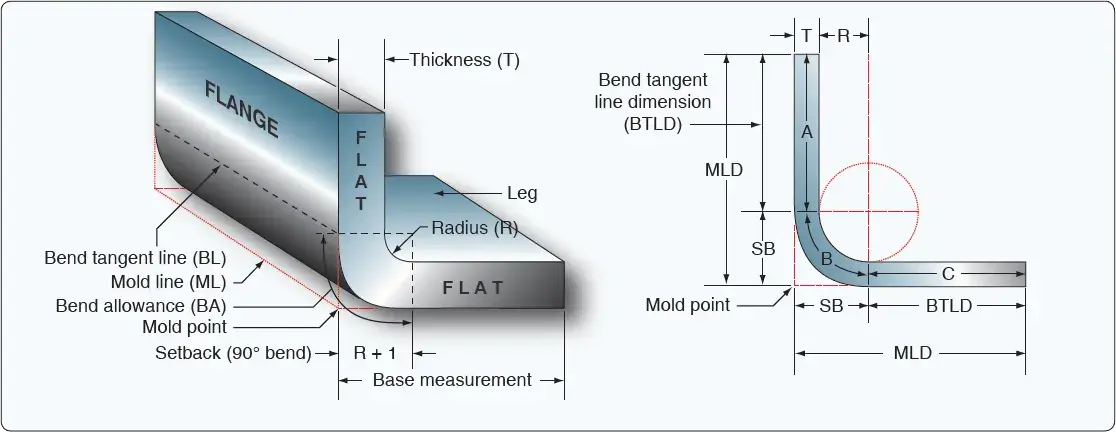
The distance from the mold point to the bend tangent line is a critical dimension in various manufacturing processes, particularly in sheet metal forming and bending operations. This distance is essential in determining the accuracy and precision of the final product. In metal forming, the mold point refers to the point where the metal sheet is formed into the desired shape, and the bend tangent line is an imaginary line that is tangent to the bend radius at the point of bending.
Understanding the Mold Point and Bend Tangent Line
The mold point and bend tangent line are two fundamental concepts in metal forming. The mold point is the point where the metal sheet is formed into the desired shape, and the bend tangent line is an imaginary line that is tangent to the bend radius at the point of bending. To calculate the distance from the mold point to the bend tangent line, one must understand the geometry of the metal forming process. Here are some key points to consider:
- The bend radius is the radius of the curved section of the metal sheet.
- The bend angle is the angle between the two straight sections of the metal sheet.
- The mold point is the point where the metal sheet is formed into the desired shape.
Calculating the Distance from the Mold Point to the Bend Tangent Line
To calculate the distance from the mold point to the bend tangent line, one must use mathematical formulas and geometric principles. The distance can be calculated using the Pythagorean theorem, which states that the square of the hypotenuse of a right triangle is equal to the sum of the squares of the other two sides. Here are some key points to consider:
- The distance from the mold point to the bend tangent line is the hypotenuse of a right triangle.
- The bend radius and bend angle are used to calculate the length of the two sides of the right triangle.
- The mathematical formulas used to calculate the distance are based on the geometry of the metal forming process.
Factors Affecting the Distance from the Mold Point to the Bend Tangent Line
There are several factors that can affect the distance from the mold point to the bend tangent line, including the material properties of the metal sheet, the bend radius, and the bend angle. The thickness and strength of the metal sheet can also affect the distance, as well as the type of metal forming process being used. Here are some key points to consider:
- The material properties of the metal sheet, such as its strength and ductility, can affect the distance.
- The bend radius and bend angle can also affect the distance, as well as the type of metal forming process being used.
- The thickness of the metal sheet can also affect the distance, as well as the surface finish of the metal sheet.
Importance of Accurate Calculation of the Distance from the Mold Point to the Bend Tangent Line
The accurate calculation of the distance from the mold point to the bend tangent line is critical in metal forming operations, as it can affect the quality and accuracy of the final product. Inaccurate calculations can result in defects and errors in the final product, which can lead to rework and waste. Here are some key points to consider:
- The accuracy of the calculation can affect the quality of the final product.
- Inaccurate calculations can result in defects and errors in the final product.
- The distance from the mold point to the bend tangent line is a critical dimension in metal forming operations.
Applications of the Distance from the Mold Point to the Bend Tangent Line
The distance from the mold point to the bend tangent line has several applications in metal forming operations, including sheet metal forming, tube bending, and metal spinning. The distance is also used in the design and development of metal forming tools and dies. Here are some key points to consider:
- The distance from the mold point to the bend tangent line is used in sheet metal forming operations.
- The distance is also used in tube bending and metal spinning operations.
- The distance is used in the design and development of metal forming tools and dies.
How to calculate bend setback?

To calculate bend setback, you need to understand the concept of bend radius and bend allowance. The bend setback is the distance from the edge of the sheet metal to the point where the bend starts. It is an important factor in determining the flat pattern of a sheet metal part. The bend setback can be calculated using the following formula: bend setback = (bend radius x tangential bend allowance) / (2 x bend radius). This formula takes into account the bend radius and the tangential bend allowance, which are both critical factors in determining the bend setback.
Understanding Bend Radius
The bend radius is the radius of the bend in a sheet metal part. It is an important factor in determining the bend setback. To calculate the bend radius, you need to know the thickness of the sheet metal and the bend angle. The bend radius can be calculated using the following formula: bend radius = (thickness x tan(bend angle/2)) / (2 x sin(bend angle/2)). Here are the steps to calculate the bend radius:
- Determine the thickness of the sheet metal
- Determine the bend angle
- Use the formula to calculate the bend radius
Calculating Bend Allowance
The bend allowance is the amount of material that is required to make a bend in the sheet metal. It is an important factor in determining the bend setback. The bend allowance can be calculated using the following formula: bend allowance = (bend radius x (1 - cos(bend angle))) / sin(bend angle). Here are the steps to calculate the bend allowance:
- Determine the bend radius
- Determine the bend angle
- Use the formula to calculate the bend allowance
Determining Tangential Bend Allowance
The tangential bend allowance is the amount of material that is required to make a bend in the sheet metal, measured along the tangent to the bend. It is an important factor in determining the bend setback. The tangential bend allowance can be calculated using the following formula: tangential bend allowance = (bend radius x tan(bend angle/2)) / (2 x sin(bend angle/2)). Here are the steps to calculate the tangential bend allowance:
- Determine the bend radius
- Determine the bend angle
- Use the formula to calculate the tangential bend allowance
Calculating Flat Pattern
The flat pattern is the two-dimensional representation of a sheet metal part, including the bend setback. To calculate the flat pattern, you need to know the bend radius, bend allowance, and tangential bend allowance. The flat pattern can be calculated using the following steps:
- Determine the bend radius
- Determine the bend allowance
- Determine the tangential bend allowance
- Use the formulas to calculate the flat pattern
The bend setback is an important factor in sheet metal design. It is used to determine the flat pattern of a sheet metal part, which is critical in ensuring that the part is manufactured correctly. To apply the bend setback in sheet metal design, you need to follow these steps:
- Determine the bend radius and bend angle
- Calculate the bend allowance and tangential bend allowance
- Use the formulas to calculate the bend setback
- Apply the bend setback to the flat pattern
How to calculate length before bending?

To calculate the length before bending, it's essential to understand the properties of the material and the bending process. The length of a material before bending can be calculated using the bend radius, bend angle, and thickness of the material. The bend radius is the radius of the bend, and the bend angle is the angle of the bend. The thickness of the material also plays a crucial role in determining the length before bending.
Understanding the Bending Process
The bending process involves deforming the material to a specific angle. To calculate the length before bending, it's essential to understand how the material will behave when bent. The bend radius and bend angle can be used to calculate the arc length, which is the length of the material that will be bent. The arc length can be calculated using the formula: arc length = (bend angle / 360) x 2 x π x bend radius. The steps to calculate the length before bending are:
- Determine the bend radius and bend angle.
- Calculate the arc length using the formula.
- Apply the K-factor, which is a factor that takes into account the thickness of the material.
Calculating the Bend Allowance
The bend allowance is the amount of material that is required to create the bend. To calculate the bend allowance, it's essential to understand the properties of the material, such as its thickness and yield strength. The bend allowance can be calculated using the formula: bend allowance = (bend radius x bend angle) / (2 x π). The factors that affect the bend allowance are:
- Material properties, such as thickness and yield strength.
- Bend radius and bend angle.
- K-factor, which takes into account the thickness of the material.
Determining the K-Factor
The K-factor is a factor that takes into account the thickness of the material. The K-factor can be determined using a chart or table that lists the K-factor values for different thicknesses of material. The K-factor can also be calculated using the formula: K-factor = (bend radius / thickness). The steps to determine the K-factor are:
- Determine the thickness of the material.
- Use a chart or table to find the K-factor value.
- Apply the K-factor value to the bend allowance calculation.
Calculating the Unbent Length
The unbent length is the length of the material before it is bent. To calculate the unbent length, it's essential to understand the bend radius, bend angle, and thickness of the material. The unbent length can be calculated using the formula: unbent length = bend allowance + (2 x bend radius x tan(bend angle / 2)). The factors that affect the unbent length are:
- Bend radius and bend angle.
- Thickness of the material.
- K-factor, which takes into account the thickness of the material.
Using Software to Calculate Length Before Bending
There are various software programs available that can calculate the length before bending. These programs can take into account the properties of the material, such as its thickness and yield strength, as well as the bend radius and bend angle. The software can also apply the K-factor value to the bend allowance calculation. The steps to use software to calculate the length before bending are:
- Enter the material properties, such as thickness and yield strength.
- Enter the bend radius and bend angle.
- Apply the K-factor value to the bend allowance calculation.
Frequently Asked Questions (FAQs)
What is the concept of Bend Line Distance To Mold Line Equations and Calculator?
The concept of Bend Line Distance To Mold Line Equations and Calculator is a mathematical approach used to calculate the distance between the bend line and the mold line in various engineering applications. The bend line refers to the line where the material is bent, while the mold line is the line that represents the shape of the mold or die used to form the material. The calculation of this distance is crucial in determining the dimensions and tolerances of the final product. The equations used to calculate this distance take into account various factors such as the material properties, bend angle, and mold geometry. The calculator is a tool that simplifies the calculation process by providing a user-friendly interface to input the necessary parameters and obtain the desired results.
How do Bend Line Distance To Mold Line Equations and Calculator work?
The Bend Line Distance To Mold Line Equations and Calculator work by using a set of mathematical formulas that relate the bend line and mold line to the material properties and bend parameters. The equations are based on the principles of geometry and mechanics of materials, and they take into account the stretching and compressing of the material during the bending process. The calculator uses these equations to calculate the distance between the bend line and the mold line, and it also provides options to calculate other parameters such as the bend radius, bend angle, and springback. The calculator can be used for various types of bending operations, including V-bending, U-bending, and curling.
What are the benefits of using Bend Line Distance To Mold Line Equations and Calculator?
The benefits of using Bend Line Distance To Mold Line Equations and Calculator are numerous. One of the main benefits is the ability to accurately calculate the distance between the bend line and the mold line, which is essential for ensuring the dimensional accuracy of the final product. The calculator also helps to reduce errors and improve productivity by providing a quick and easy way to perform complex calculations. Additionally, the equations and calculator can be used to optimize the bending process by identifying the optimal bend parameters and material properties. The use of Bend Line Distance To Mold Line Equations and Calculator can also help to reduce costs by minimizing the need for prototyping and trial-and-error approaches.
What are the common applications of Bend Line Distance To Mold Line Equations and Calculator?
The Bend Line Distance To Mold Line Equations and Calculator have a wide range of applications in various engineering fields, including mechanical engineering, manufacturing engineering, and materials science. The equations and calculator are commonly used in the design and manufacturing of sheet metal products, such as automotive parts, aircraft components, and consumer appliances. They are also used in the production of tubes and pipes, as well as in the forming of plastics and composites. The calculator is also useful for research and development applications, where it can be used to simulate and analyze the bending behavior of various materials and structures. Overall, the Bend Line Distance To Mold Line Equations and Calculator are essential tools for anyone involved in the design, manufacturing, and testing of bent or formed products.
Deja una respuesta
Entradas Relacionadas