
Bearing Capacity of Soil Equation and Calculator

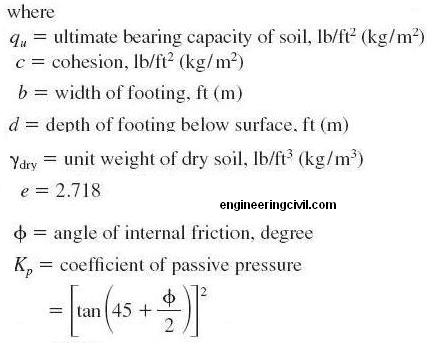
The bearing capacity of soil is a critical factor in geotechnical engineering, as it determines the maximum weight that a soil can support without failing. The bearing capacity equation is a mathematical formula used to calculate this value, taking into account the soil's properties, such as its strength and density. This article will provide an overview of the bearing capacity of soil equation and offer a calculator to help engineers and designers quickly and accurately determine the bearing capacity of different soils. The equation and calculator will be explained in detail, along with examples and applications.
- Bearing Capacity of Soil Equation and Calculator
- What is the formula for soil bearing capacity?
- How to calculate bearing capacity of soil pdf?
- What is the formula for ground bearing pressure?
-
Frequently Asked Questions (FAQs)
- What is the Bearing Capacity of Soil and its Importance in Construction?
- How is the Bearing Capacity of Soil Calculated using the Bearing Capacity Equation?
- What are the Different Types of Bearing Capacity of Soil and their Applications?
- How can the Bearing Capacity of Soil Calculator be Used in Practice?
Bearing Capacity of Soil Equation and Calculator
The bearing capacity of soil is a critical parameter in geotechnical engineering, as it determines the maximum load that a soil can support without failing. The bearing capacity of soil is influenced by several factors, including the soil's strength, density, and moisture content. The equation for calculating the bearing capacity of soil is based on the Terzaghi equation, which takes into account the soil's cohesion, friction angle, and surcharge.
Terzaghi Equation for Bearing Capacity
The Terzaghi equation for bearing capacity is given by: q = (2/π) c Nc + σ' Nq + (1/2) γ B Nγ, where q is the bearing capacity, c is the cohesion, σ' is the effective stress, γ is the unit weight of the soil, B is the width of the foundation, and Nc, Nq, and Nγ are dimensionless factors that depend on the friction angle. This equation is widely used in geotechnical engineering to calculate the bearing capacity of soil.
Factors Affecting Bearing Capacity
Several factors affect the bearing capacity of soil, including the soil type, moisture content, density, and surcharge. The soil type is a critical factor, as different soils have different strength and deformation characteristics. The moisture content also affects the bearing capacity, as high moisture content can reduce the soil's strength. The density of the soil is also important, as higher density soils tend to have higher bearing capacity.
Bearing Capacity Calculator
A bearing capacity calculator is a tool used to calculate the bearing capacity of soil using the Terzaghi equation. The calculator takes into account the soil properties, such as cohesion, friction angle, and unit weight, as well as the foundation width and surcharge. The calculator then outputs the bearing capacity of the soil, which can be used to design foundations and other geotechnical structures.
Importance of Bearing Capacity in Geotechnical Engineering
The bearing capacity of soil is a critical parameter in geotechnical engineering, as it determines the maximum load that a soil can support without failing. Foundation design is one of the most important applications of bearing capacity, as it ensures that the foundation can support the weight of the structure without settling or failing. Other applications of bearing capacity include slope stability and retaining wall design.
Limitations of the Terzaghi Equation
The Terzaghi equation has several limitations, including the assumption of a homogeneous and isotropic soil. In reality, soils are often heterogeneous and anisotropic, which can affect the bearing capacity. Additionally, the equation does not account for dynamic loads or cyclic loading, which can also affect the bearing capacity. Therefore, the Terzaghi equation should be used with caution and in conjunction with other geotechnical analysis techniques.
| Soil Property | Unit | Description |
|---|---|---|
| Cohesion | kPa | The shear strength of the soil when the normal stress is zero |
| Friction Angle | degrees | The angle between the normal stress and the shear stress at failure |
| Unit Weight | kN/m³ | The weight of the soil per unit volume |
What is the formula for soil bearing capacity?
The formula for soil bearing capacity is a complex equation that takes into account several factors, including the strength of the soil, the depth of the foundation, and the load applied to the soil. The most commonly used formula for soil bearing capacity is the Terzaghi equation, which is given by:
q = (2/3) c Nc + σ'v Nq + (1/2) γ B Nγ
Where:
q is the ultimate bearing capacity of the soil
c is the cohesion of the soil
Nc, Nq, and Nγ are bearing capacity factors that depend on the friction angle of the soil
σ'v is the effective overburden pressure at the base of the foundation
γ is the unit weight of the soil
B is the width of the foundation
Factors Affecting Soil Bearing Capacity
The soil bearing capacity is affected by several factors, including the soil type, moisture content, and density. The following are some of the key factors that affect soil bearing capacity:
- The strength of the soil, which is measured by its cohesion and friction angle
- The depth of the foundation, which affects the effective overburden pressure and the soil settlement
- The load applied to the soil, which affects the stress distribution and the soil deformation
Types of Soil Bearing Capacity
There are several types of soil bearing capacity, including ultimate bearing capacity, allowable bearing capacity, and net bearing capacity. The ultimate bearing capacity is the maximum load that the soil can withstand without failure, while the allowable bearing capacity is the maximum load that the soil can withstand without excessive settlement. The following are some of the key types of soil bearing capacity:
- Ultimate bearing capacity, which is the maximum load that the soil can withstand without failure
- Allowable bearing capacity, which is the maximum load that the soil can withstand without excessive settlement
- Net bearing capacity, which is the ultimate bearing capacity minus the overburden pressure
Methods for Determining Soil Bearing Capacity
There are several methods for determining soil bearing capacity, including field tests, laboratory tests, and theoretical calculations. The field tests include standard penetration tests and cone penetration tests, while the laboratory tests include triaxial tests and unconfined compression tests. The following are some of the key methods for determining soil bearing capacity:
- Standard penetration tests, which measure the resistance of the soil to penetration
- Cone penetration tests, which measure the resistance of the soil to cone penetration
- Theoretical calculations, which use empirical formulas to estimate the soil bearing capacity
Importance of Soil Bearing Capacity in Foundation Design
The soil bearing capacity is a critical factor in foundation design, as it affects the stability and safety of the structure. The foundation must be designed to withstand the loads applied to it, while also ensuring that the soil can support the weight of the structure. The following are some of the key reasons why soil bearing capacity is important in foundation design:
- Stability, as the foundation must be able to withstand the loads applied to it without failure
- Safety, as the foundation must be able to support the weight of the structure without collapse
- Cost, as the foundation must be designed to be economically feasible while also ensuring stability and safety
Limitations of Soil Bearing Capacity Formulas
The soil bearing capacity formulas have several limitations, including the assumption of homogeneous soil and the neglect of soil anisotropy. The formulas also assume that the load is applied uniformly and that the soil is isotropic. The following are some of the key limitations of soil bearing capacity formulas:
- Assumption of homogeneous soil, which may not be accurate in practice
- Neglect of soil anisotropy, which can affect the soil behavior
- Assumption of uniform loading, which may not be accurate in practice
How to calculate bearing capacity of soil pdf?

To calculate the bearing capacity of soil, you need to consider several factors, including the soil type, density, moisture content, and depth. The bearing capacity of soil is the maximum load that the soil can support without failure. The calculation of bearing capacity involves the use of formulas and equations that take into account the soil properties and load conditions.
Introduction to Bearing Capacity Calculation
The calculation of bearing capacity of soil is an important aspect of geotechnical engineering. It involves the use of theories and models to predict the behavior of soil under different load conditions. The bearing capacity of soil is affected by several factors, including the soil type, density, moisture content, and depth. To calculate the bearing capacity, you need to follow a step-by-step approach that involves:
- Determining the soil type and its properties
- Evaluating the load conditions and load types
- Using formulas and equations to calculate the bearing capacity
Soil Properties and Bearing Capacity
The soil properties play a crucial role in determining the bearing capacity of soil. The soil type, density, moisture content, and depth are some of the key factors that affect the bearing capacity. For example, clay soils have a lower bearing capacity compared to sandy soils due to their higher moisture content and lower density. To calculate the bearing capacity, you need to consider the following soil properties:
- Soil density: The density of the soil affects its bearing capacity
- Moisture content: The moisture content of the soil affects its strength and stability
- Soil type: The soil type affects its behavior under different load conditions
Load Conditions and Bearing Capacity
The load conditions and load types also affect the bearing capacity of soil. The load can be static or dynamic, and it can be axial or lateral. The load conditions and load types must be carefully evaluated to determine the bearing capacity of soil. For example, a static load may have a different effect on the soil compared to a dynamic load. To calculate the bearing capacity, you need to consider the following load conditions:
- Load type: The type of load affects the soil behavior
- Load magnitude: The magnitude of the load affects the soil strength
- Load duration: The duration of the load affects the soil stability
Calculating Bearing Capacity using Formulas
The bearing capacity of soil can be calculated using formulas and equations. These formulas take into account the soil properties and load conditions to predict the bearing capacity. For example, the Terzaghi equation is a widely used formula to calculate the bearing capacity of soil. To calculate the bearing capacity, you need to use the following formulas:
- Terzaghi equation: A widely used formula to calculate the bearing capacity
- Meyerhof equation: Another formula used to calculate the bearing capacity
- Vesic equation: A formula used to calculate the bearing capacity for deep foundations
Applications of Bearing Capacity Calculation
The calculation of bearing capacity has several applications in civil engineering and geotechnical engineering. It is used to design foundations, retaining walls, and slope stability. The bearing capacity calculation is also used to evaluate the stability of soil and rock masses. To apply the bearing capacity calculation, you need to consider the following applications:
- Foundation design: The bearing capacity calculation is used to design foundations
- Retaining wall design: The bearing capacity calculation is used to design retaining walls
- Slope stability analysis: The bearing capacity calculation is used to evaluate the stability of slopes
What is the formula for ground bearing pressure?
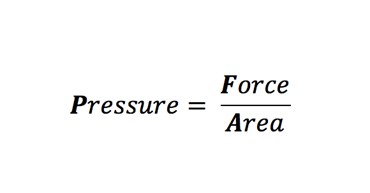
The formula for ground bearing pressure is calculated as the weight of the object or structure divided by the contact area with the ground. Mathematically, this can be expressed as:
P = W / A,
where P is the pressure, W is the weight of the object, and A is the contact area.
Understanding Ground Bearing Pressure
Ground bearing pressure is a critical factor in geotechnical engineering and construction. It is essential to calculate the pressure exerted by a structure on the ground to ensure that it does not exceed the bearing capacity of the soil. This can be achieved by considering the weight of the structure, the contact area, and the soil properties.
- Identify the weight of the structure, including the dead load and live load.
- Determine the contact area between the structure and the ground.
- Analyze the soil properties, including the soil type, density, and moisture content.
Factors Affecting Ground Bearing Pressure
Several factors can affect the ground bearing pressure, including the weight of the structure, the contact area, and the soil properties. The soil type and density can significantly impact the bearing capacity of the soil. Additionally, the moisture content of the soil can also affect its strength and stability.
- Soil type: Different soils have varying bearing capacities, with some soils being more prone to settlement or failure.
- Soil density: The density of the soil can affect its strength and stability.
- Moisture content: The moisture content of the soil can impact its strength and stability.
Calculating Ground Bearing Pressure
To calculate the ground bearing pressure, it is essential to determine the weight of the structure and the contact area with the ground. The weight of the structure can be calculated by adding the dead load and live load. The contact area can be determined by measuring the footprint of the structure.
- Determine the dead load of the structure, including the weight of the materials and the self-weight of the structure.
- Calculate the live load of the structure, including the weight of occupants, furniture, and other variable loads.
- Measure the contact area between the structure and the ground, including the footprint of the foundation.
Importance of Ground Bearing Pressure in Construction
The ground bearing pressure is a critical factor in construction and geotechnical engineering. It is essential to calculate the pressure exerted by a structure on the ground to ensure that it does not exceed the bearing capacity of the soil. This can help prevent settlement, failure, and other geotechnical hazards.
- Settlement: Excessive settlement can occur when the ground bearing pressure exceeds the bearing capacity of the soil.
- Failure: The ground bearing pressure can cause failure of the soil, leading to collapse or instability of the structure.
- Geotechnical hazards: The ground bearing pressure can also contribute to other geotechnical hazards, including landslides and erosion.
Applications of Ground Bearing Pressure in Engineering
The ground bearing pressure has various applications in engineering, including geotechnical engineering, civil engineering, and structural engineering. It is used to design foundations, retaining walls, and other geotechnical structures.
- Foundation design: The ground bearing pressure is used to design foundations that can support the weight of the structure.
- Retaining wall design: The ground bearing pressure is used to design retaining walls that can resist the lateral earth pressure.
- Geotechnical structure design: The ground bearing pressure is used to design other geotechnical structures, including tunnels and excavations.
Frequently Asked Questions (FAQs)
What is the Bearing Capacity of Soil and its Importance in Construction?
The bearing capacity of soil is a critical parameter in geotechnical engineering that refers to the maximum pressure that a soil can withstand without failing. It is an essential consideration in the design of foundations, retaining walls, and other structural elements that interact with the soil. The bearing capacity of soil depends on various factors, including the soil type, density, moisture content, and effective stress. A thorough understanding of the bearing capacity of soil is crucial in ensuring the stability and safety of structures, as well as preventing settlement and failure. The Bearing Capacity of Soil Equation is a mathematical formula used to calculate the bearing capacity of soil, taking into account the various factors that affect it.
How is the Bearing Capacity of Soil Calculated using the Bearing Capacity Equation?
The Bearing Capacity of Soil Equation is a complex formula that involves several parameters, including the soil's cohesion, friction angle, density, and effective stress. The equation is typically expressed as a function of the ultimate bearing capacity, which is the maximum pressure that the soil can withstand without failing. The calculator for the Bearing Capacity of Soil Equation is a tool that simplifies the calculation process by allowing users to input the relevant parameters and obtain the ultimate bearing capacity. The calculation involves several steps, including the determination of the soil's properties, the calculation of the effective stress, and the application of the Bearing Capacity of Soil Equation. The result is a value that represents the maximum allowable pressure that can be applied to the soil without causing failure.
What are the Different Types of Bearing Capacity of Soil and their Applications?
There are several types of bearing capacity of soil, each with its own applications and considerations. The ultimate bearing capacity is the most common type, which represents the maximum pressure that the soil can withstand without failing. The allowable bearing capacity is another type, which is a reduced value of the ultimate bearing capacity that takes into account the factor of safety and other design considerations. The net bearing capacity is a type that considers the weight of the soil above the foundation and is used in the design of deep foundations. The gross bearing capacity is a type that ignores! the weight of the soil and is used in the design of shallow foundations. Each type of bearing capacity has its own equation and calculator, and the choice of which one to use depends on the specific application and design requirements.
How can the Bearing Capacity of Soil Calculator be Used in Practice?
The Bearing Capacity of Soil Calculator is a valuable tool that can be used in practice to determine the bearing capacity of soil for various engineering applications. The calculator can be used to design foundations, retaining walls, and other structural elements that interact with the soil. It can also be used to evaluate the stability of existing structures and to identify potential problems. The calculator is particularly useful for geotechnical engineers, civil engineers, and construction professionals who need to ensure that their designs are safe and functional. The calculator can be used in conjunction with other geotechnical software and tools to provide a more comprehensive and accurate analysis of the soil's behavior. By using the Bearing Capacity of Soil Calculator, engineers and construction professionals can save time, reduce costs, and improve the overall quality of their designs and constructions.
Deja una respuesta
Entradas Relacionadas