
Area Moment of Inertia Section Properties of Inertia Section Properties Square Rotated 90 Deg @ Center Calculator

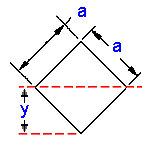
The Area Moment of Inertia is a crucial property in engineering, describing an object's resistance to changes in its rotation. For a square section rotated 90 degrees at its center, calculating this property is essential for understanding its behavior under various loads. This calculator is designed to provide the section properties of inertia for such a rotated square, allowing users to input the necessary dimensions and obtain the moment of inertia, polar moment of inertia, and other relevant properties with ease and precision, facilitating accurate engineering designs and analyses. Calculations are based on established mathematical formulas.
- Understanding the Area Moment of Inertia Section Properties of a Square Rotated 90 Degrees at the Center Calculator
-
Understanding the Fundamentals of Area Moment of Inertia and Section Properties
- Introduction to Area Moment of Inertia and Its Significance
- Understanding Section Properties and Their Importance
- The Role of Material Properties in Section Properties and Area Moment of Inertia
- Applications of Area Moment of Inertia and Section Properties in Engineering
- Limitations and Assumptions of the Square Rotated 90 Deg @ Center Calculator
-
Frequently Asked Questions (FAQs)
- What is the Area Moment of Inertia and how does it relate to Section Properties of Inertia in a Square Rotated 90 Deg @ Center Calculator?
- How does the Square Rotated 90 Deg @ Center Calculator calculate the Section Properties of Inertia, including the Moment of Inertia and Radius of Gyration?
- What are the advantages of using a Square Rotated 90 Deg @ Center Calculator to calculate the Section Properties of Inertia, and how can it be applied in real-world engineering problems?
- Can the Square Rotated 90 Deg @ Center Calculator be used to calculate the Section Properties of Inertia for other shapes, such as rectangles and triangles, and what are the limitations of the calculator?
Understanding the Area Moment of Inertia Section Properties of a Square Rotated 90 Degrees at the Center Calculator
The Area Moment of Inertia Section Properties of a Square Rotated 90 Degrees at the Center Calculator is a tool used to calculate the moment of inertia of a square cross-section that has been rotated 90 degrees at its center. This calculator is essential in engineering and physics, particularly in the design and analysis of structural elements such as beams and columns. The moment of inertia is a measure of an object's resistance to changes in its rotation, and it is a critical factor in determining the stresses and strains that a structural element can withstand.
Introduction to Moment of Inertia
The moment of inertia is a fundamental concept in physics and engineering that describes the distribution of mass in an object. It is a measure of an object's resistance to changes in its rotation, and it is defined as the sum of the products of the mass elements of the object and their distances from the axis of rotation. The moment of inertia is an important factor in the design of structural elements, as it determines the stresses and strains that the element can withstand.
Section Properties of a Square Cross-Section
The section properties of a square cross-section include the area, perimeter, and moment of inertia. The area of a square is given by the formula A = s^2, where s is the side length of the square. The perimeter of a square is given by the formula P = 4s. The moment of inertia of a square cross-section is given by the formula I = (1/12)s^4, where s is the side length of the square.
Effect of Rotation on Moment of Inertia
When a square cross-section is rotated 90 degrees at its center, its moment of inertia changes. The new moment of inertia is given by the formula I = (1/12)s^4, where s is the side length of the square. The rotation of the square cross-section does not change its area or perimeter, but it does change its moment of inertia.
Calculator Functionality
The Area Moment of Inertia Section Properties of a Square Rotated 90 Degrees at the Center Calculator is a tool that calculates the moment of inertia of a square cross-section that has been rotated 90 degrees at its center. The calculator takes the side length of the square as input and calculates the area, perimeter, and moment of inertia of the square cross-section. The calculator also provides a detailed analysis of the section properties of the square cross-section.
Applications of the Calculator
The Area Moment of Inertia Section Properties of a Square Rotated 90 Degrees at the Center Calculator has a wide range of applications in engineering and physics. It can be used to design and analyze structural elements such as beams and columns, and it can be used to calculate the stresses and strains that these elements can withstand. The calculator can also be used to optimize the design of structural elements to minimize their weight and maximize their strength.
| Property | Formula | Description |
|---|---|---|
| Area | A = s^2 | The area of a square cross-section |
| Perimeter | P = 4s | The perimeter of a square cross-section |
| Moment of Inertia | I = (1/12)s^4 | The moment of inertia of a square cross-section |
Understanding the Fundamentals of Area Moment of Inertia and Section Properties
The concept of Area Moment of Inertia and Section Properties is crucial in engineering and physics, particularly when dealing with the design and analysis of structural elements. The Area Moment of Inertia is a measure of an object's resistance to changes in its rotation, while Section Properties refer to the characteristics of a cross-sectional area of a beam or column. In the context of a Square Rotated 90 Deg @ Center Calculator, it is essential to comprehend how these concepts interact and affect the overall behavior of the structure. The calculator is a tool used to determine the section properties and area moment of inertia of a square shape that has been rotated 90 degrees around its center. This information is vital in understanding how the square will behave under different types of loads and stress.
Introduction to Area Moment of Inertia and Its Significance
The Area Moment of Inertia is a fundamental concept in mechanics that describes the distribution of mass in an object relative to a specific axis. It is a measure of an object's resistance to changes in its rotational motion. A higher moment of inertia indicates that an object is more resistant to changes in its rotation, while a lower moment of inertia suggests that an object is less resistant to such changes. In the context of structural analysis, the area moment of inertia is used to calculate the stress and strain on a beam or column under different types of loads. The section properties, including the area moment of inertia, are essential in determining the structural integrity and stability of a system. By using a Square Rotated 90 Deg @ Center Calculator, engineers and designers can quickly and accurately determine the section properties and area moment of inertia of a square shape, allowing them to make informed decisions about the design and construction of their projects.
Understanding Section Properties and Their Importance
Section properties refer to the characteristics of a cross-sectional area of a beam or column, including its area, moment of inertia, and radius of gyration. These properties are critical in determining the structural behavior of a system under different types of loads and stress. The section properties of a square shape that has been rotated 90 degrees around its center can be calculated using a Square Rotated 90 Deg @ Center Calculator. This calculator takes into account the dimensions and orientation of the square, as well as the material properties, to provide accurate calculations of the section properties. By understanding the section properties of a square shape, engineers and designers can optimize their designs to achieve specific structural performance criteria, such as maximum stress, minimum weight, or maximum stiffness.
The Role of Material Properties in Section Properties and Area Moment of Inertia
Material properties, such as density, Young's modulus, and Poisson's ratio, play a crucial role in determining the section properties and area moment of inertia of a square shape. The material properties affect the stiffness and strength of the structure, as well as its weight and cost. When using a Square Rotated 90 Deg @ Center Calculator, it is essential to input the correct material properties to ensure accurate calculations. The calculator uses the material properties to calculate the section modulus and radius of gyration, which are critical in determining the structural behavior of the system. By selecting the appropriate material properties, engineers and designers can optimize their designs to achieve specific performance criteria, such as maximum strength, minimum weight, or maximum stiffness.
Applications of Area Moment of Inertia and Section Properties in Engineering
The concepts of area moment of inertia and section properties have numerous applications in engineering, particularly in the design and analysis of structural elements. These concepts are used in a wide range of fields, including civil engineering, mechanical engineering, aerospace engineering, and biomedical engineering. In civil engineering, the area moment of inertia and section properties are used to design bridges, buildings, and highways. In mechanical engineering, these concepts are used to design machinery, equipment, and vehicles. By using a Square Rotated 90 Deg @ Center Calculator, engineers and designers can quickly and accurately determine the section properties and area moment of inertia of a square shape, allowing them to make informed decisions about the design and construction of their projects.
Limitations and Assumptions of the Square Rotated 90 Deg @ Center Calculator
The Square Rotated 90 Deg @ Center Calculator is a powerful tool for calculating the section properties and area moment of inertia of a square shape that has been rotated 90 degrees around its center. However, like any calculator, it is subject to certain limitations and assumptions. The calculator assumes that the square shape is homogeneous and isotropic, meaning that its material properties are uniform and consistent in all directions. Additionally, the calculator assumes that the square shape is stress-free and undeformed, meaning that it is not subject to any external loads or stress. By understanding these limitations and assumptions, engineers and designers can use the calculator effectively and make informed decisions about the design and construction of their projects. It is essential to carefully evaluate the input parameters and output results to ensure that they are accurate and reliable.
Frequently Asked Questions (FAQs)
What is the Area Moment of Inertia and how does it relate to Section Properties of Inertia in a Square Rotated 90 Deg @ Center Calculator?
The Area Moment of Inertia is a fundamental concept in physics and engineering that describes the distribution of mass in an object. In the context of a Square Rotated 90 Deg @ Center Calculator, it refers to the calculation of the moment of inertia of a square shape that has been rotated 90 degrees around its center. This calculation is crucial in understanding the section properties of inertia, which include the moment of inertia, radius of gyration, and section modulus. The moment of inertia is a measure of an object's resistance to changes in its rotation, and it is essential in designing and analyzing structures, such as beams and columns, that are subject to various types of loads.
How does the Square Rotated 90 Deg @ Center Calculator calculate the Section Properties of Inertia, including the Moment of Inertia and Radius of Gyration?
The Square Rotated 90 Deg @ Center Calculator uses mathematical formulas to calculate the section properties of inertia. The calculator takes into account the dimensions of the square, such as its side length, and the orientation of the rotation, which is 90 degrees around the center. The calculator then applies integration techniques to calculate the moment of inertia and radius of gyration. The moment of inertia is calculated using the Parallel Axis Theorem, which states that the moment of inertia of an object about a parallel axis is equal to the moment of inertia about its centroidal axis plus the product of the area and the square of the distance between the two axes. The radius of gyration is calculated as the square root of the moment of inertia divided by the area.
What are the advantages of using a Square Rotated 90 Deg @ Center Calculator to calculate the Section Properties of Inertia, and how can it be applied in real-world engineering problems?
The Square Rotated 90 Deg @ Center Calculator offers several advantages in calculating the section properties of inertia. One of the primary benefits is that it provides accurate and efficient calculations, which are essential in engineering design and analysis. The calculator can be applied in various real-world engineering problems, such as designing structural members, such as beams and columns, that are subject to bending, torsion, and axial loads. Additionally, the calculator can be used to analyze the dynamic behavior of structures, such as vibrations and stability, which is critical in mechanical and aerospace engineering. Overall, the Square Rotated 90 Deg @ Center Calculator is a valuable tool for engineers and designers who need to calculate the section properties of inertia for a wide range of applications.
Can the Square Rotated 90 Deg @ Center Calculator be used to calculate the Section Properties of Inertia for other shapes, such as rectangles and triangles, and what are the limitations of the calculator?
The Square Rotated 90 Deg @ Center Calculator is specifically designed to calculate the section properties of inertia for a square shape that has been rotated 90 degrees around its center. However, the calculator can be modified or extended to calculate the section properties of inertia for other shapes, such as rectangles and triangles. To do this, the user would need to input the dimensions and orientation of the shape, and the calculator would apply the relevant mathematical formulas to calculate the moment of inertia and radius of gyration. The limitations of the calculator include the assumption of a uniform density and homogeneous material, and the restriction to 2D shapes. Additionally, the calculator may not be able to handle complex shapes or irregular geometries, which may require numerical methods or finite element analysis to calculate the section properties of inertia.
Deja una respuesta
Entradas Relacionadas