
Aerodynamic Lift Force of Airfoil Calculator


The Aerodynamic Lift Force of Airfoil Calculator is a valuable tool for calculating the lift force generated by an airfoil, a crucial component in aircraft design. By inputting parameters such as airfoil shape, angle of attack, and air density, users can determine the lift force and understand its impact on flight. This calculator is essential for aerospace engineers, researchers, and students to analyze and optimize airfoil performance, ultimately contributing to safer and more efficient flight operations. Its accuracy and ease of use make it a go-to resource for aerodynamics calculations. Lift force calculations are simplified.
- Aerodynamic Lift Force of Airfoil Calculator: Understanding the Basics
- What is aerodynamic lift force?
- What is the aerodynamic lift of the wing?
- Why is there a 1/2 in the lift formula?
-
Frequently Asked Questions (FAQs)
- What is the Aerodynamic Lift Force of Airfoil Calculator and how does it work?
- What are the key parameters that affect the Aerodynamic Lift Force of an Airfoil?
- How is the Aerodynamic Lift Force of Airfoil Calculator used in real-world applications?
- What are the limitations and assumptions of the Aerodynamic Lift Force of Airfoil Calculator?
Aerodynamic Lift Force of Airfoil Calculator: Understanding the Basics
The Aerodynamic Lift Force of Airfoil Calculator is a tool used to calculate the lift force generated by an airfoil, which is a crucial component in the field of aerodynamics. This calculator is essential for aerospace engineers, researchers, and students to understand the behavior of airfoils and their impact on aircraft performance. The calculator takes into account various parameters such as the airfoil's shape, size, angle of attack, and air density to calculate the lift force.
Introduction to Airfoils and Lift Force
Airfoils are shaped surfaces designed to produce a lift force when moving through a fluid, such as air. The shape of the airfoil is critical in determining the lift force generated. The cambered surface of the airfoil deflects the air downward, creating a region of lower air pressure above the airfoil and a region of higher air pressure below it. This pressure difference creates an upward force, known as the lift force, which counteracts the weight of the aircraft and allows it to fly.
Key Parameters Affecting Lift Force
Several parameters affect the lift force generated by an airfoil, including:
| Parameter | Description |
|---|---|
| Angle of Attack | The angle between the airfoil and the oncoming airflow |
| Airfoil Shape | The cambered surface and chord length of the airfoil |
| Air Density | The density of the air the airfoil is moving through |
| Velocity | The speed of the airfoil through the air |
These parameters are critical in determining the lift force generated by an airfoil, and understanding their effects is essential for the design and optimization of aircraft.
Calculation Methods for Lift Force
There are several methods for calculating the lift force generated by an airfoil, including:
Blasius' Method: a numerical method that solves the Navier-Stokes equations to determine the lift force
Lifting-Line Theory: a simplified method that models the airfoil as a lifting line and calculates the lift force based on the circulation of air around the airfoil
Computational Fluid Dynamics (CFD): a numerical method that solves the Navier-Stokes equations using computational methods to determine the lift force.
Applications of Aerodynamic Lift Force of Airfoil Calculator
The Aerodynamic Lift Force of Airfoil Calculator has numerous applications in the field of aerospace engineering, including:
Aircraft design: optimizing the shape and size of airfoils to maximize lift force and efficiency
Wind turbine design: optimizing the shape and size of airfoils to maximize energy production
Space exploration: optimizing the shape and size of airfoils for reentry vehicles and spacecraft
Limitations and Assumptions of Aerodynamic Lift Force of Airfoil Calculator
The Aerodynamic Lift Force of Airfoil Calculator is based on several assumptions and limitations, including:
2D flow: the calculator assumes a two-dimensional flow around the airfoil, which may not be accurate for all scenarios
Incompressible flow: the calculator assumes an incompressible flow, which may not be accurate for high-speed flows
Linearized flow: the calculator assumes a linearized flow, which may not be accurate for complex flow scenarios.
What is aerodynamic lift force?
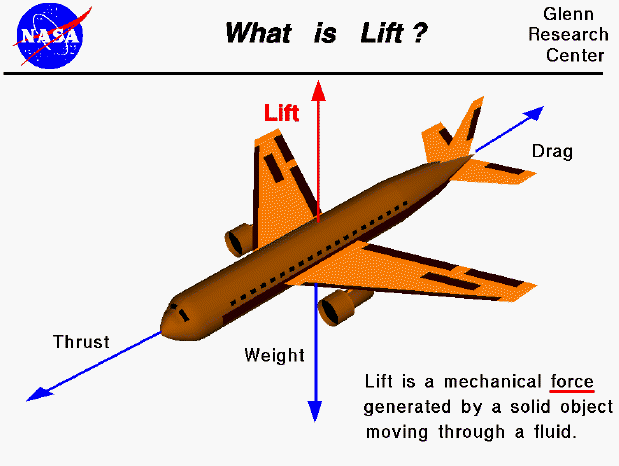
Aerodynamic lift force is the upward force exerted on an object, such as an airplane wing, as it moves through the air. This force is created by the difference in air pressure above and below the wing, which is designed to produce a region of lower pressure above the wing and a region of higher pressure below it. As the air flows over the curved surface of the wing, it accelerates and its pressure decreases, while the air flowing along the flat bottom surface of the wing decelerates and its pressure increases. The resulting pressure gradient creates an upward force on the wing, known as lift, which counteracts the weight of the aircraft and allows it to fly.
Factors Affecting Aerodynamic Lift Force
The angle of attack, wing shape, and air density are all important factors that affect the magnitude of the aerodynamic lift force. The lift force increases as the angle of attack increases, but if the angle of attack becomes too large, the lift force will decrease and the wing will stall. The wing shape also plays a crucial role in determining the lift force, with curved surfaces producing more lift than flat surfaces. Additionally, the air density affects the lift force, with thicker air producing more lift than thinner air. Some key factors affecting aerodynamic lift force include:
- Angle of attack: The angle between the oncoming airflow and the wing or airfoil.
- Wing shape: The curvature and shape of the wing or airfoil.
- Air density: The density of the air, which affects the lift force.
Applications of Aerodynamic Lift Force
The aerodynamic lift force has numerous applications in various fields, including aviation, aerodynamics, and wind energy. In aviation, the lift force is used to counteract the weight of the aircraft and keep it flying. In aerodynamics, the lift force is used to study the behavior of airflows around objects, such as airfoils and wings. In wind energy, the lift force is used to generate power from wind turbines. Some key applications of aerodynamic lift force include:
- Aviation: The lift force is used to counteract the weight of the aircraft and keep it flying.
- Aerodynamics: The lift force is used to study the behavior of airflows around objects, such as airfoils and wings.
- Wind energy: The lift force is used to generate power from wind turbines.
Theory of Aerodynamic Lift Force
The theory of aerodynamic lift force is based on the principles of fluid dynamics and the behavior of airflows around objects. The lift force is created by the difference in air pressure above and below the wing, which is designed to produce a region of lower pressure above the wing and a region of higher pressure below it. The theory of aerodynamic lift force can be explained by the following key concepts:
- Bernoulli's principle: The pressure of a fluid decreases as its velocity increases.
- Wing curvature: The curved surface of the wing deflects the airflow downward, creating a region of lower pressure above the wing.
- Airflow acceleration: The airflow accelerates as it flows over the curved surface of the wing, creating a region of lower pressure above the wing.
Measurement of Aerodynamic Lift Force
The measurement of aerodynamic lift force is crucial in aerodynamics and aviation. The lift force can be measured using various techniques, including wind tunnel testing and flight testing. The measurement of aerodynamic lift force involves calculating the lift force using equations and algorithms, and validating the results using experimental data. Some key methods for measuring aerodynamic lift force include:
- Wind tunnel testing: The lift force is measured in a wind tunnel using sensors and instruments.
- Flight testing: The lift force is measured during flight using sensors and instruments.
- Computational fluid dynamics: The lift force is calculated using computer simulations and algorithms.
Importance of Aerodynamic Lift Force
The importance of aerodynamic lift force cannot be overstated, as it is a critical factor in aviation and aerodynamics. The lift force is responsible for counteracting the weight of the aircraft and keeping it flying, and it plays a crucial role in determining the performance and efficiency of aircraft and wind turbines. The importance of aerodynamic lift force can be seen in the following key areas:
- Aviation: The lift force is critical for flight, as it counteracts the weight of the aircraft.
- Aerodynamics: The lift force is essential for understanding the behavior of airflows around objects.
- Wind energy: The lift force is vital for generating power from wind turbines.
What is the aerodynamic lift of the wing?
The aerodynamic lift of the wing is the upward force exerted on the wing by the air as it flows over and under it. This force is created by the shape of the wing, which is curved on top and flat on the bottom. As the air flows over the curved top surface, it must travel faster than the air flowing along the flat bottom surface. This difference in speed creates a difference in pressure, with the pressure being lower above the wing and higher below it. The resulting force, the aerodynamic lift, acts perpendicular to the wing and is responsible for counteracting the weight of the aircraft and keeping it flying.
Introduction to Aerodynamic Lift
The aerodynamic lift is a fundamental concept in aerodynamics, and it is essential for the flight of aircraft. The lift is created by the wing, which is designed to produce a difference in pressure between the upper and lower surfaces. The shape of the wing, including its cambered surface and angle of attack, plays a crucial role in determining the amount of lift generated. Some key factors that affect the aerodynamic lift include:
- Wing shape: The curved upper surface and flat lower surface of the wing create a difference in pressure that generates lift.
- Angle of attack: The angle at which the wing meets the oncoming air affects the amount of lift generated.
- Air density: The density of the air affects the amount of lift generated, with denser air producing more lift.
Factors Affecting Aerodynamic Lift
Several factors can affect the aerodynamic lift of a wing, including the wing shape, angle of attack, air density, and air velocity. The wing shape is critical, as it determines the pressure distribution over the wing. The angle of attack also plays a significant role, as it affects the amount of lift generated. Additionally, the air density and air velocity can impact the amount of lift produced. Some key factors that affect the aerodynamic lift include:
- Cambered surface: The curved upper surface of the wing creates a longer path for the air to follow, resulting in a faster flow and lower pressure.
- Flat bottom surface: The flat lower surface of the wing creates a shorter path for the air to follow, resulting in a slower flow and higher pressure.
- Wingtip vortices: The vortices created at the wingtips can affect the lift distribution and reduce the overall efficiency of the wing.
Aerodynamic Lift and Wing Design
The aerodynamic lift is closely related to the design of the wing, including its shape, size, and angle of attack. The wing shape is designed to produce a specific lift distribution, with the cambered surface creating a faster flow over the top and a slower flow over the bottom. The wing size and aspect ratio also affect the amount of lift generated, with larger wings producing more lift. Some key considerations in wing design include:
- Lift-to-drag ratio: The ratio of lift to drag is critical in determining the efficiency of the wing.
- Wing loading: The weight of the aircraft divided by the wing area affects the amount of lift required.
- Control surfaces: The design of control surfaces, such as ailerons and flaps, affects the lift distribution and roll characteristics of the aircraft.
Aerodynamic Lift and Flight Regimes
The aerodynamic lift varies depending on the flight regime, including takeoff, cruise, and landing. During takeoff, the lift must be sufficient to counteract the weight of the aircraft and accelerate it to rotation speed. In cruise, the lift must be balanced with the weight and thrust to maintain a steady altitude and airspeed. Some key considerations in different flight regimes include:
- Takeoff and landing: The lift must be sufficient to counteract the weight and drag during these critical phases of flight.
- Cruise and climb: The lift must be balanced with the thrust and drag to maintain a steady altitude and airspeed.
- Stall and spin: The lift can be reduced or lost during stall and spin conditions, requiring careful recovery techniques.
Aerodynamic Lift and Aircraft Performance
The aerodynamic lift has a significant impact on the performance of an aircraft, including its range, endurance, and maneuverability. The lift affects the fuel efficiency and climb rate of the aircraft, as well as its ability to turn and roll. Some key considerations in aircraft performance include:
- Fuel efficiency: The lift and drag characteristics of the wing affect the fuel efficiency of the aircraft.
- Climb rate: The lift and thrust characteristics of the aircraft affect its climb rate and ceiling.
- Maneuverability: The lift and roll characteristics of the aircraft affect its ability to turn and roll during aerobatic maneuvers.
Why is there a 1/2 in the lift formula?

The lift formula is a fundamental concept in aerodynamics and physics, and it is used to calculate the amount of lift generated by an airfoil or a wing. The formula is given by: L = (1/2)ρv^2ClA, where L is the lift, ρ is the air density, v is the velocity of the air, Cl is the lift coefficient, and A is the area of the wing. The 1/2 in the formula is a result of the integration of the pressure distribution over the surface of the wing.
Introduction to the Lift Formula
The lift formula is a mathematical representation of the lift generated by an airfoil or a wing. The formula takes into account the physical properties of the air and the wing, such as the air density, velocity, and area. The 1/2 in the formula is a result of the assumptions made in the derivation of the formula. Some key points to consider are:
- The lift is proportional to the square of the velocity of the air.
- The lift is also proportional to the area of the wing.
- The lift coefficient is a dimensionless quantity that depends on the shape of the wing.
Derivation of the Lift Formula
The derivation of the lift formula involves the integration of the pressure distribution over the surface of the wing. The pressure distribution is a result of the flow of air around the wing, and it is affected by the shape of the wing and the velocity of the air. The 1/2 in the formula arises from the averaging of the pressure distribution over the surface of the wing. Some key steps in the derivation are:
- The pressure distribution is integrated over the surface of the wing to obtain the total lift.
- The integration involves the use of calculus and the assumption of a two-dimensional flow.
- The result is a formula that relates the lift to the physical properties of the air and the wing.
Physical Interpretation of the Lift Formula
The lift formula can be interpreted physically as a representation of the force exerted on the wing by the air. The 1/2 in the formula represents the fact that the lift is proportional to the square of the velocity of the air. The formula also shows that the lift is proportional to the area of the wing and the density of the air. Some key points to consider are:
- The lift is a vector quantity that can be resolved into components perpendicular to the wing.
- The lift is opposed by the weight of the aircraft and the drag force.
- The lift must be greater than the weight for the aircraft to fly.
Assumptions and Limitations of the Lift Formula
The lift formula is based on several assumptions and has some limitations. The 1/2 in the formula is a result of the assumptions made in the derivation of the formula. Some key points to consider are:
- The formula assumes a two-dimensional flow, which is not realistic for most aircraft.
- The formula also assumes a steady flow, which is not realistic for most aircraft.
- The result is a formula that is simplified and approximate.
Applications and Extensions of the Lift Formula
The lift formula has many applications and extensions in aerodynamics and physics. The 1/2 in the formula is a fundamental aspect of the formula and is used in many calculations. Some key points to consider are:
- The formula can be used to design and .optimize aircraft wings.
- The formula can also be used to predict the performance of aircraft in different flight regimes.
- The result is a formula that is widely used in industry and research.
Frequently Asked Questions (FAQs)
What is the Aerodynamic Lift Force of Airfoil Calculator and how does it work?
The Aerodynamic Lift Force of Airfoil Calculator is a tool used to calculate the lift force generated by an airfoil as it moves through the air. This calculator takes into account various parameters such as the airfoil's shape, size, angle of attack, and the velocity of the air flowing over it. The calculator uses these parameters to calculate the lift coefficient and then multiplies it by the dynamic pressure of the air to obtain the lift force. This calculation is based on the principles of aerodynamics and the Bernoulli's principle, which states that the pressure of a fluid decreases as its velocity increases.
What are the key parameters that affect the Aerodynamic Lift Force of an Airfoil?
The key parameters that affect the aerodynamic lift force of an airfoil include the airfoil's shape, size, angle of attack, and the velocity of the air flowing over it. The airfoil's shape is crucial in determining the lift coefficient, as it affects the pressure distribution around the airfoil. The size of the airfoil also plays a significant role, as it affects the scale of the lift force generated. The angle of attack is also critical, as it determines the direction of the lift force and the stall point of the airfoil. Additionally, the velocity of the air flowing over the airfoil affects the dynamic pressure and therefore the lift force generated.
How is the Aerodynamic Lift Force of Airfoil Calculator used in real-world applications?
The Aerodynamic Lift Force of Airfoil Calculator is used in various real-world applications, including aircraft design, wind turbine design, and automotive engineering. In aircraft design, the calculator is used to determine the lift force generated by the wings and control surfaces of an aircraft, allowing designers to optimize the aerodynamic performance of the aircraft. In wind turbine design, the calculator is used to determine the lift force generated by the blades of a wind turbine, allowing designers to optimize the energy production of the turbine. In automotive engineering, the calculator is used to determine the lift force generated by the spoilers and wings of a car, allowing designers to optimize the downforce and handling of the vehicle.
What are the limitations and assumptions of the Aerodynamic Lift Force of Airfoil Calculator?
The Aerodynamic Lift Force of Airfoil Calculator is based on several assumptions and limitations, including the assumption of incompressible flow and the neglect of viscous effects. The calculator assumes that the air flowing over the airfoil is incompressible, which means that the density of the air is constant. This assumption is valid for most aerodynamic applications, but may not be accurate for high-speed or high-altitude applications. The calculator also neglects viscous effects, which can be significant for airfoils with complex shapes or rough surfaces. Additionally, the calculator assumes a two-dimensional flow, which means that the airfoil is assumed to be infinitely long and the flow is uniform in the spanwise direction. This assumption may not be accurate for three-dimensional airfoils or airfoils with significant tip effects.
Deja una respuesta
Entradas Relacionadas