
Beam Stress and Deflection Calculator Free and Guided on One End, Rigid one End With Uniform Load

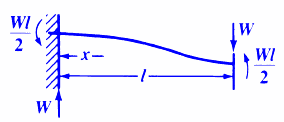
The Beam Stress and Deflection Calculator is a valuable tool for engineers and designers to calculate the stress and deflection of a beam with a uniform load, guided on one end and rigid on the other. This calculator provides a free and efficient way to determine the maximum stress and deflection of a beam under various loading conditions. By inputting the beam's dimensions, material properties, and load, users can obtain accurate calculations and visualizations of the beam's behavior, allowing for informed design decisions and ensuring the structural integrity of the beam. It is a highly useful engineering resource.
- Beam Stress and Deflection Calculator Free and Guided on One End, Rigid one End With Uniform Load
-
Understanding Beam Stress and Deflection Calculator for Uniform Load on One End
- Calculating Beam Deflection under Uniform Load
- Understanding Beam Stress under Uniform Load
- Importance of Material Properties in Beam Stress and Deflection Calculator
- Guided and Rigid End Conditions in Beam Stress and Deflection Calculator
- Applications of Beam Stress and Deflection Calculator in Engineering
-
Frequently Asked Questions (FAQs)
- What is the Beam Stress and Deflection Calculator and how does it work with a uniform load on one end?
- How does the calculator account for the boundary conditions of a beam with one rigid end and one guided end?
- What are the advantages of using a free and guided beam stress and deflection calculator for uniform load calculations?
- Can the beam stress and deflection calculator be used for other types of loads, such as point loads or moment loads?
Beam Stress and Deflection Calculator Free and Guided on One End, Rigid one End With Uniform Load
The Beam Stress and Deflection Calculator is a tool used to calculate the stress and deflection of a beam that is subjected to a uniform load. This calculator is specifically designed for beams that are free and guided on one end, and rigid on the other end. The calculator takes into account the length of the beam, the uniform load applied to it, and the material properties of the beam, such as its young's modulus and moment of inertia.
Understanding Beam Stress and Deflection
Beam stress and deflection are two important factors to consider when designing a beam. Stress refers to the internal forces that are acting on the beam, while deflection refers to the amount of bending or deformation that occurs as a result of these forces. The calculator uses the following formula to calculate the stress and deflection of the beam: σ = (M y) / I, where σ is the stress, M is the moment, y is the distance from the neutral axis, and I is the moment of inertia.
Types of Loads and Boundary Conditions
The calculator can handle different types of loads, including uniform loads, point loads, and moment loads. It can also handle different boundary conditions, such as free ends, guided ends, and rigid ends. The calculator allows the user to select the type of load and boundary condition that applies to their specific problem.
Material Properties and Selection
The calculator requires the user to input the material properties of the beam, including its young's modulus, poisson's ratio, and density. The calculator also allows the user to select from a range of materials, including aluminum, steel, and wood. The user can select the material that best suits their needs, and the calculator will use the corresponding material properties to calculate the stress and deflection of the beam.
Calculator Input and Output
The calculator requires the user to input several parameters, including the length of the beam, the uniform load, and the material properties. The calculator then uses these inputs to calculate the stress and deflection of the beam, and displays the results in a table. The table includes the following information:
| Parameter | Value |
|---|---|
| Stress | stress value |
| Deflection | deflection value |
| Moment | moment value |
| Young's Modulus | young's modulus value |
Applications and Limitations of the Calculator
The Beam Stress and Deflection Calculator has a range of applications, including the design of beams, columns, and frames. However, the calculator also has some limitations, including the assumption of a uniform load and the neglect of dynamical effects. The user should be aware of these limitations when using the calculator, and should consult the user manual for more information. The calculator is a useful tool for engineers and designers, but it should be used in conjunction with other design methods and analysis techniques to ensure the safety and efficacy of the design.
Understanding Beam Stress and Deflection Calculator for Uniform Load on One End
The Beam Stress and Deflection Calculator is a crucial tool for engineers and designers to calculate the stress and deflection of a beam under various load conditions. When it comes to a beam that is guided on one end and rigid on the other end with a uniform load, the calculations can become complex. The calculator takes into account the beam's length, material properties, and load conditions to provide accurate results. This article will delve into the details of using the Beam Stress and Deflection Calculator for a beam with uniform load on one end, exploring the key concepts and formulas involved.
Calculating Beam Deflection under Uniform Load
Calculating beam deflection is a critical aspect of structural analysis. When a beam is subjected to a uniform load, the deflection can be calculated using the elastic curve theory. The elastic curve is a graphical representation of the beam's deflection under load, and it is used to determine the maximum deflection and slope of the beam. The Beam Stress and Deflection Calculator uses the following formula to calculate the deflection: δ = (5 * w * L^4) / (384 * E * I), where δ is the deflection, w is the uniform load, L is the beam length, E is the modulus of elasticity, and I is the moment of inertia. The calculator also takes into account the boundary conditions, such as the guided and rigid ends, to ensure accurate results.
Understanding Beam Stress under Uniform Load
Beam stress is another critical aspect of structural analysis. When a beam is subjected to a uniform load, the stress can be calculated using the flexure formula. The flexure formula states that the bending stress (σ) is equal to (M * y) / I, where M is the bending moment, y is the distance from the neutral axis, and I is the moment of inertia. The Beam Stress and Deflection Calculator uses the following formula to calculate the stress: σ = (w * L) / (8 * I), where σ is the stress, w is the uniform load, L is the beam length, and I is the moment of inertia. The calculator also takes into account the material properties, such as the yield strength and ultimate strength, to ensure accurate results.
Importance of Material Properties in Beam Stress and Deflection Calculator
Material properties play a crucial role in the Beam Stress and Deflection Calculator. The calculator requires input values for modulus of elasticity (E), moment of inertia (I), yield strength (σy), and ultimate strength (σu). These properties are used to calculate the stress and deflection of the beam under load. The modulus of elasticity (E) is a measure of the beam's stiffness, while the moment of inertia (I) is a measure of the beam's resistance to bending. The yield strength (σy) and ultimate strength (σu) are used to determine the failure point of the beam under load. Accurate input values for these properties are essential to ensure accurate results from the calculator.
Guided and Rigid End Conditions in Beam Stress and Deflection Calculator
The Beam Stress and Deflection Calculator allows users to select from various end conditions, including guided and rigid ends. The guided end condition assumes that the end of the beam is constrained to prevent rotation and translation, while the rigid end condition assumes that the end of the beam is fixed and unmovable. These end conditions affect the boundary conditions used in the calculations, resulting in different stress and deflection values. The calculator uses the following equations to account for the guided and rigid end conditions: δ = (w * L^4) / (384 * E * I) for the guided end, and δ = (w * L^4) / (192 * E * I) for the rigid end.
Applications of Beam Stress and Deflection Calculator in Engineering
The Beam Stress and Deflection Calculator has numerous applications in engineering, including structural analysis, mechanical design, and civil engineering. The calculator can be used to design and analyze beams, columns, and frames under various load conditions. It is also useful for optimizing beam design, reducing material costs, and improving structural integrity. The calculator can be applied to a wide range of industries, including aerospace, automotive, construction, and manufacturing. By using the Beam Stress and Deflection Calculator, engineers and designers can ensure that their structures are safe, efficient, and cost-effective. The calculator is an essential tool for anyone involved in structural analysis and design, providing accurate and reliable results for beam stress and deflection calculations.
Frequently Asked Questions (FAQs)
What is the Beam Stress and Deflection Calculator and how does it work with a uniform load on one end?
The Beam Stress and Deflection Calculator is a tool designed to calculate the stress and deflection of a beam under various loading conditions, including a uniform load on one end. This calculator is particularly useful for engineers and designers who need to determine the structural integrity of a beam in a specific application. The calculator takes into account the length, width, and height of the beam, as well as the material properties, such as the modulus of elasticity and the Poisson's ratio. With this information, the calculator can determine the maximum stress and deflection of the beam under a uniform load on one end, allowing users to ensure that their design meets the required safety factors and performance criteria. The calculator also provides a guided approach, where users can input their specific design parameters and receive a detailed report on the beam's behavior under the applied load.
How does the calculator account for the boundary conditions of a beam with one rigid end and one guided end?
The Beam Stress and Deflection Calculator accounts for the boundary conditions of a beam with one rigid end and one guided end by using a combination of mathematical models and numerical methods. The calculator first determines the reactions at the rigid end and the guided end, using the equilibrium equations and the boundary conditions. Then, it uses the beam theory to calculate the bending moment, shear force, and deflection of the beam along its length. The calculator also takes into account the end conditions, such as the fixed end or pinned end, to ensure that the boundary conditions are properly applied. By using a guided approach, the calculator can provide accurate results for a wide range of beam configurations, including those with non-standard boundary conditions. The calculator's ability to handle complex boundary conditions makes it a valuable tool for engineers and designers working on real-world applications.
What are the advantages of using a free and guided beam stress and deflection calculator for uniform load calculations?
The Beam Stress and Deflection Calculator offers several advantages when used for uniform load calculations. One of the main advantages is that it is free, allowing users to access the calculator without incurring any costs. Additionally, the calculator is guided, providing users with a step-by-step approach to inputting their design parameters and receiving a detailed report on the beam's behavior. This guided approach makes the calculator user-friendly, even for those without extensive experience in beam theory or structural analysis. The calculator also provides accurate and reliable results, using established mathematical models and numerical methods to calculate the stress and deflection of the beam. Furthermore, the calculator can handle a wide range of beam configurations, including those with non-uniform cross-sections or complex loading conditions. By using the Beam Stress and Deflection Calculator, users can save time and reduce errors, while also ensuring that their designs meet the required safety factors and performance criteria.
Can the beam stress and deflection calculator be used for other types of loads, such as point loads or moment loads?
The Beam Stress and Deflection Calculator is designed to handle a wide range of loading conditions, including uniform loads, point loads, and moment loads. While the calculator is specifically designed for uniform loads, it can also be used to calculate the stress and deflection of a beam under other types of loads. For example, users can input a point load or a moment load into the calculator, and it will provide the maximum stress and deflection of the beam under that load. The calculator can also handle combined loading conditions, such as a uniform load and a point load applied simultaneously. By using the Beam Stress and Deflection Calculator, users can analyze a wide range of loading scenarios, and ensure that their designs meet the required safety factors and performance criteria. The calculator's ability to handle multiple loading conditions makes it a valuable tool for engineers and designers working on complex structural analysis problems.
Deja una respuesta
Entradas Relacionadas