
Weld Shear Stress for Applied Bending Force on Rectanguler Beam Calculator

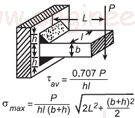
Calculating weld shear stress is crucial in ensuring the structural integrity of rectangular beams subjected to bending forces. The Weld Shear Stress for Applied Bending Force on Rectangular Beam Calculator is a tool designed to simplify this process. By inputting the necessary parameters such as beam dimensions, weld size, and applied force, engineers can quickly determine the shear stress on the weld. This calculator is essential for designing and analyzing rectangular beams in various engineering applications, including construction and mechanical engineering. It provides accurate and efficient calculations, saving time and reducing errors. Accurate calculations are vital.
- Calculating Weld Shear Stress for Applied Bending Force on Rectangular Beam
- Understanding Weld Shear Stress in Rectangular Beams under Applied Bending Forces
-
Frequently Asked Questions (FAQs)
- What is Weld Shear Stress for Applied Bending Force on Rectangular Beam Calculator and how does it work?
- How do I input the values into the Weld Shear Stress for Applied Bending Force on Rectangular Beam Calculator to get accurate results?
- What are the limitations and assumptions of the Weld Shear Stress for Applied Bending Force on Rectangular Beam Calculator?
- How can I use the results from the Weld Shear Stress for Applied Bending Force on Rectangular Beam Calculator in my design or analysis?
Calculating Weld Shear Stress for Applied Bending Force on Rectangular Beam
The calculation of weld shear stress is crucial in ensuring the structural integrity of rectangular beams under applied bending forces. This involves understanding the mechanics of materials and the stress distributions within the beam. The weld shear stress calculator is a tool used to determine the maximum shear stress that a weld can withstand when a bending force is applied to a rectangular beam. This calculator takes into account the beam's dimensions, the weld's characteristics, and the applied load to provide an accurate calculation of the weld shear stress.
Understanding the Weld Shear Stress Formula
The weld shear stress formula is based on the beam theory and the weld's properties. The formula takes into account the moment of inertia of the beam, the distance from the neutral axis to the weld, and the applied bending moment. The formula is as follows: τ = (M y) / I, where τ is the shear stress, M is the bending moment, y is the distance from the neutral axis, and I is the moment of inertia. This formula is used to calculate the maximum shear stress that the weld can withstand.
Importance of Beam Dimensions in Weld Shear Stress Calculation
The beam dimensions play a crucial role in the calculation of weld shear stress. The width and height of the beam, as well as the thickness of the weld, are all important factors in determining the moment of inertia and the distance from the neutral axis. These dimensions are used to calculate the section modulus of the beam, which is then used to calculate the weld shear stress. The following table outlines the importance of beam dimensions in weld shear stress calculation:
| Beam Dimension | Importance in Weld Shear Stress Calculation |
|---|---|
| Width | Used to calculate the moment of inertia and section modulus |
| Height | Used to calculate the moment of inertia and section modulus |
| Weld Thickness | Used to calculate the distance from the neutral axis |
Effects of Applied Bending Force on Weld Shear Stress
The applied bending force has a significant impact on the weld shear stress. As the bending force increases, the shear stress on the weld also increases. This is because the bending moment increases with the applied force, resulting in a higher shear stress on the weld. The weld shear stress calculator takes into account the applied bending force to provide an accurate calculation of the maximum shear stress that the weld can withstand. The stress distribution within the beam is also affected by the applied bending force, with the maximum stress occurring at the neutral axis.
Weld Characteristics and Their Impact on Weld Shear Stress
The weld characteristics, such as the weld size and weld type, also play a crucial role in the calculation of weld shear stress. The weld size affects the distance from the neutral axis, while the weld type affects the shear strength of the weld. The weld shear stress calculator takes into account these weld characteristics to provide an accurate calculation of the maximum shear stress that the weld can withstand. The weld's properties, such as its yield strength and ultimate strength, are also important factors in determining the weld shear stress.
Applications of Weld Shear Stress Calculator in Engineering
The weld shear stress calculator has numerous applications in engineering, particularly in the design and analysis of structural components. The calculator is used to ensure that the welds in a structure can withstand the applied loads and stresses. The calculator is also used to optimize the design of welds and to determine the minimum weld size required to withstand a given load. The weld shear stress calculator is an essential tool in engineering design, as it helps to ensure the structural integrity of welded components. The calculator is used in a variety of industries, including aerospace, automotive, and construction, where welded structures are commonly used.
Understanding Weld Shear Stress in Rectangular Beams under Applied Bending Forces
The calculation of weld shear stress for applied bending forces on rectangular beams is a critical aspect of engineering design, particularly in the fields of mechanical, civil,! and aerospace engineering. When a rectangular beam is subjected to a bending force, it experiences stress and strain along its length and cross-section. The welds that connect the beam to other structural elements or that hold the beam together internally must be designed to withstand these forces. The shear stress in the welds due to bending can be calculated using specific formulas that take into account the beam's geometry, the bending moment, and the weld's properties. This calculation is essential to ensure that the welds do not fail under the expected loads, which could lead to structural failure and potentially catastrophic consequences.
Calculating the Weld Shear Stress due to Bending Moment
Calculating the weld shear stress due to a bending moment involves understanding the beam theory and how bending stresses are distributed across the cross-section of the beam. The bending moment causes the beam to curve, resulting in tensile stresses on one side of the neutral axis and compressive stresses on the other side. The shear stress in the welds is a result of the shear force that accompanies the bending moment. The calculation typically involves determining the moment of inertia of the beam's cross-section, the section modulus, and applying the flexure formula to find the maximum bending stress. For welds, the shear stress is critical because it can lead to shear failure if the weld material or design is inadequate.
Factors Influencing Weld Shear Stress in Rectangular Beams
Several factors can influence the weld shear stress in rectangular beams, including the beam's dimensions, the material properties of both the beam and the weld, the type of weld, and the loading conditions. The geometry of the beam, such as its width, height, and length, affects the moment of inertia and thus the bending stress distribution. The material properties, including the yield strength and ultimate strength of the beam and weld materials, are crucial in determining the stress that the weld can withstand. The type of weld, whether it is a fillet weld or a butt weld, also influences the shear stress calculation due to differences in weld area and efficiency. Additionally, the loading conditions, including the magnitude and direction of the applied forces, can significantly affect the shear stress in the welds.
Design Considerations for Welds under Bending Forces
Designing welds to withstand bending forces requires careful consideration of several factors to ensure the structural integrity of the beam and the welds. The size and shape of the weld must be determined based on the calculated shear stress and the strength of the weld material. The orientation of the weld relative to the direction of the bending force is also critical, as it affects the shear stress distribution within the weld. Furthermore, the weld process used, such as shielded metal arc welding (SMAW) or gas metal arc welding (GMAW), can influence the weld quality and strength. Inspection and testing of the welds are also essential design considerations to validate the weld integrity and ensure that the welds meet the required standards and codes.
Applications of Weld Shear Stress Calculations in Engineering
The calculation of weld shear stress due to applied bending forces has numerous applications in various fields of engineering. In civil engineering, it is used in the design of bridges, buildings, and other structures where beams are subjected to bending forces. In mechanical engineering, it applies to the design of machinery, equipment, and vehicles where welded beams are common. In aerospace engineering, the calculation is critical for the design of aircraft and spacecraft structures that must withstand extreme loading conditions. Understanding and accurately calculating weld shear stress is essential for ensuring the safety, efficiency, and reliability of these structures and machines.
Tools and Software for Calculating Weld Shear Stress
The calculation of weld shear stress due to bending forces can be facilitated by various tools and software designed for engineering applications. Spreadsheet programs like Microsoft Excel can be used to perform calculations based on formulas and data input by the user. Specialized engineering software such as Autodesk Inventor, SolidWorks, and ANSYS offer more advanced capabilities, including finite element analysis (FEA), which can provide detailed insights into the stress distribution within complex geometries. Online calculators and apps are also available for simpler calculations, offering quick estimates of weld shear stress based on limited input parameters. These tools can significantly reduce the time and effort required for calculations, allowing engineers to focus on design optimization and analysis.
Frequently Asked Questions (FAQs)
What is Weld Shear Stress for Applied Bending Force on Rectangular Beam Calculator and how does it work?
The Weld Shear Stress for Applied Bending Force on Rectangular Beam Calculator is a tool designed to calculate the shear stress that occurs in a rectangular beam when a bending force is applied. This calculator uses the beam's dimensions, such as its length, width, and height, as well as the magnitude and location of the applied force, to determine the shear stress at the weld. The calculator takes into account the material properties of the beam, including its modulus of elasticity and Poisson's ratio, to provide an accurate calculation of the shear stress. By using this calculator, engineers and designers can quickly and easily determine the shear stress in a rectangular beam and ensure that the weld is designed to withstand the applied forces.
How do I input the values into the Weld Shear Stress for Applied Bending Force on Rectangular Beam Calculator to get accurate results?
To get accurate results from the Weld Shear Stress for Applied Bending Force on Rectangular Beam Calculator, it is essential to input the correct values for the beam's dimensions, applied force, and material properties. The user should start by entering the length, width, and height of the rectangular beam, as well as the magnitude and location of the applied force. The user should also select the unit system they are using, such as SI or US Customary, to ensure that the calculator uses the correct units for the calculations. Additionally, the user should input the material properties, including the modulus of elasticity and Poisson's ratio, to account for the beam's material behavior. By carefully inputting these values, the user can ensure that the calculator provides an accurate calculation of the shear stress at the weld.
What are the limitations and assumptions of the Weld Shear Stress for Applied Bending Force on Rectangular Beam Calculator?
The Weld Shear Stress for Applied Bending Force on Rectangular Beam Calculator is based on several assumptions and has some limitations that the user should be aware of. One of the primary assumptions is that the rectangular beam is subject to a pure bending moment, and that the shear force is negligible. The calculator also assumes that the material is isotropic and homogeneous, and that the weld is perfectly rigid. Additionally, the calculator uses a simplified model of the beam's behavior, which may not account for all the complexities of the real-world scenario. The user should also be aware that the calculator is only applicable to rectangular beams and may not be suitable for other beam shapes or configurations. By understanding these limitations and assumptions, the user can use the calculator effectively and interpret the results with caution.
How can I use the results from the Weld Shear Stress for Applied Bending Force on Rectangular Beam Calculator in my design or analysis?
The results from the Weld Shear Stress for Applied Bending Force on Rectangular Beam Calculator can be used in a variety of ways to inform the design or analysis of a rectangular beam. The calculated shear stress can be used to determine the required weld size or reinforcement needed! to ensure that the weld can withstand the applied forces. The results can also be used to optimize the beam's design, by adjusting the dimensions or material properties to minimize the shear stress and reduce the weight or cost of the beam. Additionally, the results can be used to validate or compare with other analysis methods, such as finite element analysis, to ensure that the design is safe and reliable. By using the results from the calculator effectively, engineers and designers can create more efficient, cost-effective, and safe designs for rectangular beams subject to bending forces.
Deja una respuesta
Entradas Relacionadas