
Pressure Vessel, Thin Wall Hoop and Longitudinal Stresses Equation and Calculator

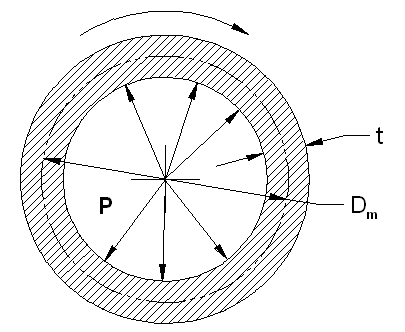
Pressure vessels are containers designed to withstand internal pressure, and their design requires careful consideration of stress factors to ensure safety and structural integrity. Two primary stresses that occur in pressure vessels are hoop stress and longitudinal stress, which are caused by the internal pressure exerted on the vessel's walls. The calculation of these stresses is crucial in the design and construction of pressure vessels, and various equations and calculators are used to determine the thin wall hoop and longitudinal stresses, enabling engineers to create safe and reliable vessels for various industrial applications. Accurate calculations are essential.
- Understanding Pressure Vessel, Thin Wall Hoop and Longitudinal Stresses Equation and Calculator
- What is the formula for hoop and longitudinal stress?
- How do you calculate hoop stress on a thin wall?
- What is the formula for hoop stress in thin cylinders?
- What is longitudinal stress in thin walled pressure vessel?
-
Frequently Asked Questions (FAQs)
- What is the Pressure Vessel, Thin Wall Hoop and Longitudinal Stresses Equation and Calculator?
- How does the Pressure Vessel, Thin Wall Hoop and Longitudinal Stresses Equation and Calculator work?
- What are the advantages of using the Pressure Vessel, Thin Wall Hoop and Longitudinal Stresses Equation and Calculator?
- What are the limitations of the Pressure Vessel, Thin Wall Hoop and Longitudinal Stresses Equation and Calculator?
Understanding Pressure Vessel, Thin Wall Hoop and Longitudinal Stresses Equation and Calculator
The pressure vessel is a container designed to withstand internal or external pressure, and it is widely used in various industries such as chemical, petroleum, and power generation. The thin wall hoop and longitudinal stresses are two types of stresses that occur in a pressure vessel due to internal pressure. The hoop stress is a tensile stress that occurs in the circumferential direction of the vessel, while the longitudinal stress is a tensile stress that occurs in the axial direction of the vessel. The equation and calculator for these stresses are essential tools for designing and analyzing pressure vessels.
Introduction to Pressure Vessel Design
The design of a pressure vessel involves calculating the wall thickness and material properties to ensure that it can withstand the internal or external pressure. The ASME Boiler and Pressure Vessel Code provides guidelines and standards for designing pressure vessels. The design pressure and design temperature are two critical parameters that must be considered in the design process. The pressure vessel must be designed to withstand the maximum allowable working pressure (MAWP) and the maximum allowable working temperature (MAWT).
Thin Wall Hoop Stress Equation
The thin wall hoop stress equation is given by: σh = (P r) / t, where σh is the hoop stress, P is the internal pressure, r is the radius of the vessel, and t is the wall thickness. This equation is used to calculate the hoop stress in a thin-walled pressure vessel. The hoop stress is a critical parameter in designing pressure vessels, as it can lead to rupture or failure if it exceeds the allowable stress.
| Variable | Unit | Description |
|---|---|---|
| σh | psi | Hoop stress |
| P | psi | Internal pressure |
| r | in | Radius of the vessel |
| t | in | Wall thickness |
Longitudinal Stress Equation
The longitudinal stress equation is given by: σl = (P r) / (2 t), where σl is the longitudinal stress, P is the internal pressure, r is the radius of the vessel, and t is the wall thickness. This equation is used to calculate the longitudinal stress in a thin-walled pressure vessel. The longitudinal stress is also a critical parameter in designing pressure vessels, as it can lead to rupture or failure if it exceeds the allowable stress.
Pressure Vessel Materials and Properties
The materials and properties of a pressure vessel are critical in determining its strength and durability. The yield strength, ultimate tensile strength, and elongation are some of the key properties that must be considered in selecting a material for a pressure vessel. The ASME Boiler and Pressure Vessel Code provides guidelines and standards for selecting materials and properties for pressure vessels.
Pressure Vessel Calculator and Software
There are various calculators and software available for designing and analyzing pressure vessels. These tools can be used to calculate the wall thickness, hoop stress, and longitudinal stress in a pressure vessel. The calculators and software can also be used to optimize the design of a pressure vessel and to reduce the weight and cost of the vessel. Some of the popular calculators and software for pressure vessels include ASME Boiler and Pressure Vessel Code, Pressure Vessel Calculator, and Finite Element Analysis (FEA) software.
What is the formula for hoop and longitudinal stress?

The formula for hoop stress is given by: σh = (p r) / t, where σh is the hoop stress, p is the internal pressure, r is the radius of the cylinder, and t is the thickness of the cylinder wall. The formula for longitudinal stress is given by: σl = (p r) / (2 t), where σl is the longitudinal stress.
Calculating Hoop Stress
To calculate the hoop stress, we need to know the internal pressure, radius, and thickness of the cylinder. The formula for hoop stress is used to determine the stress that occurs in the circumferential direction of a cylindrical vessel. This stress is important because it can cause the vessel to burst if it is not designed to withstand the internal pressure.
- The pressure inside the vessel is the primary cause of hoop stress.
- The radius of the vessel also affects the hoop stress, with larger vessels experiencing higher stresses.
- The thickness of the vessel wall is critical in determining the hoop stress, with thicker walls reducing the stress.
Calculating Longitudinal Stress
The longitudinal stress is calculated using the formula: σl = (p r) / (2 t). This stress occurs in the axial direction of a cylindrical vessel and is also important in determining the integrity of the vessel.
- The longitudinal stress is typically half the value of the hoop stress.
- The longitudinal stress is affected by the pressure, radius, and thickness of the vessel.
- A higher thickness of the vessel wall can reduce the longitudinal stress.
Factors Affecting Hoop and Longitudinal Stress
Several factors can affect the hoop and longitudinal stress in a cylindrical vessel. These include the material properties, temperature, and internal pressure.
- The material properties, such as elastic modulus and poisson's ratio, can affect the stress calculations.
- The temperature can also affect the stress calculations, with high temperatures potentially reducing the strength of the material.
- The internal pressure is the primary cause of hoop and longitudinal stress, and should be carefully controlled to avoid vessel failure.
Importance of Hoop and Longitudinal Stress
The hoop and longitudinal stress are critical in determining the safety and integrity of a cylindrical vessel. If the stresses are not properly managed, the vessel can fail, resulting in injury or damage.
- The hoop stress can cause the vessel to burst if it is not designed to withstand the internal pressure.
- The longitudinal stress can cause the vessel to fail in the axial direction, resulting in a catastrophic failure.
- Proper design and testing can help to ensure that the vessel can withstand the hoop and longitudinal stress.
Applications of Hoop and Longitudinal Stress
The hoop and longitudinal stress formulas have numerous applications in engineering and industry. These include the design of pipes, tanks, and pressure vessels.
- The hoop stress formula is used to design pipes that can withstand internal pressure.
- The longitudinal stress formula is used to design tanks and pressure vessels that can withstand axial loads.
- Both formulas are critical in ensuring the safety and reliability of industrial equipment.
How do you calculate hoop stress on a thin wall?

To calculate hoop stress on a thin wall, you need to use the formula: hoop stress (σ) = (p r) / t, where p is the internal pressure, r is the radius of the cylinder, and t is the thickness of the wall. This formula is derived from the Lame's equation, which describes the stress distribution in a cylinder under internal pressure. The hoop stress is a tensile stress that acts on the circumferential direction of the cylinder, and it is a critical factor in determining the structural integrity of the cylinder.
Understanding the Formula
The formula for calculating hoop stress on a thin wall is based on the assumption that the wall thickness is much smaller than the radius of the cylinder. This assumption allows for a simplification of the stress calculations, making it easier to predict the behavior of the cylinder under internal pressure. The formula can be broken down into the following components:
- Internal pressure (p): This is the pressure applied to the inside of the cylinder.
- Radius (r): This is the distance from the center of the cylinder to the inside surface.
- Thickness (t): This is the distance between the inside and outside surfaces of the cylinder.
Factors Affecting Hoop Stress
There are several factors that can affect the hoop stress on a thin wall, including the material properties, geometry, and loading conditions. The material properties, such as the yield strength and ultimate strength, can influence the stress that the cylinder can withstand. The geometry of the cylinder, including the radius and thickness, can also affect the hoop stress. Additionally, the loading conditions, such as the internal pressure and external loads, can impact the stress distribution in the cylinder. Some of the key factors to consider are:
- Material properties: The yield strength, ultimate strength, and modulus of elasticity of the material.
- Geometry: The radius, thickness, and length of the cylinder.
- Loading conditions: The internal pressure, external loads, and temperature.
Applications of Hoop Stress Calculation
The calculation of hoop stress on a thin wall has numerous applications in engineering and design. It is crucial in the design of pressure vessels, pipelines, and tanks, where the internal pressure can be high. The hoop stress calculation can also be used to optimize the design of these structures, by minimizing the weight and cost while maximizing the structural integrity. Some of the key applications are:
- Pressure vessels: Boilers, tanks, and reactors.
- Pipelines: Gas transmission lines, oil pipelines, and water pipelines.
- Tanks: Storage tanks, fuel tanks, and chemical tanks.
Limitations of the Formula
The formula for calculating hoop stress on a thin wall has some limitations. It is based on the assumption that the wall thickness is much smaller than the radius of the cylinder, which may not always be the case. Additionally, the formula does not take into account the effects of external loads, temperature, and material nonlinearities, which can affect the stress distribution in the cylinder. Some of the key limitations are:
- Thin wall assumption: The wall thickness must be much smaller than the radius.
- Linear elastic behavior: The material must behave in a linear elastic manner.
- No external loads: The formula does not account for external loads or temperature effects.
Software for Hoop Stress Calculation
There are many software packages available that can be used to calculate the hoop stress on a thin wall. These packages can perform complex calculations and simulations, taking into account the nonlinear behavior of the material and the effects of external loads and temperature. Some of the key software packages are:
- Finite element analysis (FEA) software: ANSYS, ABAQUS, and NASTRAN.
- Computational fluid dynamics (CFD) software: FLUENT, CFX, and OPENFOAM.
- Structural analysis software: SAP2000, ETABS, and STAAD.Pro.
What is the formula for hoop stress in thin cylinders?

The formula for hoop stress in thin cylinders is given by the equation: σh = (p r) / t, where σh is the hoop stress, p is the internal pressure, r is the radius of the cylinder, and t is the thickness of the cylinder wall. This formula is derived from the theory of elasticity and is used to calculate the stress in the circumferential direction of a thin-walled cylinder.
Derivation of the Hoop Stress Formula
The derivation of the hoop stress formula involves the use of equilibrium equations and the stress-strain relationships for a thin-walled cylinder. The formula can be derived by applying the principal of equilibrium to a small element of the cylinder wall, which results in the following equation: σh = (p r) / t. This equation can be used to calculate the hoop stress in a thin-walled cylinder, given the internal pressure, radius, and thickness of the cylinder.
- The hoop stress is a critical parameter in the design of thin-walled cylinders, such as pipes and tubes.
- The formula is widely used in engineering applications, including the design of pipelines, pressure vessels, and other cylindrical structures.
- The derivation of the hoop stress formula is based on the theory of elasticity and the stress-strain relationships for a thin-walled cylinder.
Assumptions and Limitations of the Hoop Stress Formula
The hoop stress formula is based on several assumptions and has some limitations. One of the main assumptions is that the cylinder is thin-walled, meaning that the thickness of the wall is small compared to the radius of the cylinder. Another assumption is that the material is isotropic and homogeneous. The limitations of the formula include the fact that it does not account for stress concentrations or material nonlinearities.
- The thin-walled assumption is a critical limitation of the hoop stress formula, as it may not be applicable to thick-walled cylinders.
- The material properties of the cylinder, such as the elastic modulus and Poisson's ratio, can affect the accuracy of the hoop stress formula.
- The formula does not account for dynamic loads or time-dependent effects, which can be important in certain engineering applications.
Applications of the Hoop Stress Formula
The hoop stress formula has a wide range of applications in engineering and industry. One of the main applications is in the design of pipelines and pressure vessels, where the hoop stress is a critical parameter in determining the safety factor and reliability of the system. The formula is also used in the design of chemical processing equipment and power generation systems.
- The hoop stress formula is used to calculate the stress in pipelines and pressure vessels due to internal pressure.
- The formula is also used to design chemical processing equipment, such as reactors and separators.
- The hoop stress is an important parameter in the design of power generation systems, including boilers and heat exchangers.
Comparison with Other Stress Formulas
The hoop stress formula is one of several stress formulas used in engineering and industry. Other stress formulas include the longitudinal stress formula and the radial stress formula. The hoop stress formula is unique in that it calculates the stress in the circumferential direction of a thin-walled cylinder.
- The hoop stress formula is used to calculate the stress in the circumferential direction of a thin-walled cylinder.
- The longitudinal stress formula calculates the stress in the longitudinal direction of a thin-walled cylinder.
- The radial stress formula calculates the stress in the radial direction of a thin-walled cylinder.
Experimental Verification of the Hoop Stress Formula
The hoop stress formula has been experimentally verified through a number of tests and experiments. These tests have shown that the formula is accurate and reliable, and can be used to predict the hoop stress in a thin-walled cylinder with a high degree of accuracy.
- The hoop stress formula has been experimentally verified through pressure testing and strain measurement.
- The formula has been shown to be accurate and reliable, and can be used to predict the hoop stress in a thin-walled cylinder.
- The experimental verification of the hoop stress formula is an important aspect of engineering design and safety analysis.
What is longitudinal stress in thin walled pressure vessel?

Longitudinal stress in a thin-walled pressure vessel refers to the tensile stress that occurs in the longitudinal direction of the vessel, typically due to the internal pressure. This type of stress is a result of the pressure exerted on the vessel walls, causing them to expand and stretch. The longitudinal stress is significant in thin-walled vessels because it can lead to failure if the material is not strong enough to withstand the forces.
Causes of Longitudinal Stress
The causes of longitudinal stress in thin-walled pressure vessels are primarily due to the internal pressure and the geometry of the vessel. The internal pressure exerted on the vessel walls causes them to expand, resulting in tensile forces in the longitudinal direction. Other factors, such as temperature fluctuations and mechanical loads, can also contribute to longitudinal stress. The key factors that influence longitudinal stress are:
- Internal pressure: The pressure inside the vessel is the primary cause of longitudinal stress.
- Vessel geometry: The shape and size of the vessel can affect the distribution of longitudinal stress.
- Material properties: The strength and ductility of the material used to manufacture the vessel can influence its ability to withstand longitudinal stress.
Effects of Longitudinal Stress
The effects of longitudinal stress on thin-walled pressure vessels can be significant, leading to deformation, cracking, or even rupture. Prolonged exposure to high longitudinal stress can cause the material to fatigue, reducing its lifespan. The effects of longitudinal stress can be mitigated by using stronger materials, optimizing the vessel design, and monitoring the internal pressure. The key effects of longitudinal stress are:
- Deformation: Longitudinal stress can cause the vessel to elongate or bow.
- Cracking: High longitudinal stress can lead to cracks or fissures in the material.
- Rupture: Extreme longitudinal stress can cause the vessel to burst or rupture.
Calculation of Longitudinal Stress
The calculation of longitudinal stress in thin-walled pressure vessels involves using formulas and equations that take into account the internal pressure, vessel geometry, and material properties. The Lame equation is commonly used to calculate the longitudinal stress in cylindrical vessels. The key factors to consider when calculating longitudinal stress are:
- Internal pressure: The pressure inside the vessel is a critical input for calculating longitudinal stress.
- Vessel dimensions: The diameter, thickness, and length of the vessel are necessary for calculating longitudinal stress.
- Material properties: The elastic modulus and Poisson's ratio of the material are required for accurate calculations.
Material Selection for Longitudinal Stress
The selection of materials for thin-walled pressure vessels is critical to ensure that they can withstand longitudinal stress. Strong, ductile materials with high tensile strength and yield strength are preferred. Stainless steel, titanium, and high-strength steel are commonly used materials for pressure vessels due to their ability to resist longitudinal stress. The key material properties to consider are:
- Tensile strength: The ultimate tensile strength of the material is essential for withstanding longitudinal stress.
- Yield strength: The yield strength of the material determines its ability to resist deformation.
- Ductility: The ductility of the material is crucial for absorbing energy and preventing brittle fracture.
Design Considerations for Longitudinal Stress
The design of thin-walled pressure vessels requires careful consideration of longitudinal stress to ensure safe and reliable operation. Optimizing the vessel geometry, selecting the right materials, and monitoring the internal pressure are essential design considerations. The key design factors to consider are:
- Vessel shape: The shape of the vessel can affect the distribution of longitudinal stress.
- Size and thickness: The size and thickness of the vessel can influence the magnitude of longitudinal stress.
- Supports and attachments: The supports and attachments can affect the stresses and strains in the vessel.
Frequently Asked Questions (FAQs)
What is the Pressure Vessel, Thin Wall Hoop and Longitudinal Stresses Equation and Calculator?
The Pressure Vessel is a container designed to withstand internal pressure, and it is widely used in various industries such as chemical processing, power generation, and oil and gas production. The Thin Wall Hoop and Longitudinal Stresses Equation is a mathematical formula used to calculate the stresses in a pressure vessel due to internal pressure. The equation takes into account the radius of the vessel, the thickness of the wall, and the pressure inside the vessel. The calculator is a tool used to simplify the calculation process and provide accurate results. It is an essential tool for engineers and designers who work with pressure vessels, as it helps them to determine the strength and safety of the vessel.
How does the Pressure Vessel, Thin Wall Hoop and Longitudinal Stresses Equation and Calculator work?
The Pressure Vessel, Thin Wall Hoop and Longitudinal Stresses Equation and Calculator works by using the Lame equation, which is a mathematical formula that describes the stresses in a thick-walled cylinder. The equation is based on the principles of mechanics and materials science, and it takes into account the hoop stress and longitudinal stress in the vessel. The calculator uses the equation to calculate the stresses in the vessel, and it provides the results in a graphical and tabular format. The input parameters include the radius of the vessel, the thickness of the wall, the pressure inside the vessel, and the material properties of the vessel. The calculator then uses these parameters to calculate the stresses in the vessel and provides the results in a clear and concise manner.
What are the advantages of using the Pressure Vessel, Thin Wall Hoop and Longitudinal Stresses Equation and Calculator?
The Pressure Vessel, Thin Wall Hoop and Longitudinal Stresses Equation and Calculator has several advantages, including the ability to quickly and accurately calculate the stresses in a pressure vessel. The calculator is also easy to use, and it provides detailed and comprehensive results. Additionally, the calculator can be used to design and optimize pressure vessels, which can help to reduce costs and improve safety. The calculator is also flexible, and it can be used to calculate the stresses in a variety of pressure vessels, including spherical and cylindrical vessels. Overall, the Pressure Vessel, Thin Wall Hoop and Longitudinal Stresses Equation and Calculator is a valuable tool for engineers and designers who work with pressure vessels.
What are the limitations of the Pressure Vessel, Thin Wall Hoop and Longitudinal Stresses Equation and Calculator?
The Pressure Vessel, Thin Wall Hoop and Longitudinal Stresses Equation and Calculator has several limitations, including the assumption that the pressure vessel is a thin-walled cylinder. This means that the calculator is not suitable for thick-walled vessels or vessels with complex geometries. Additionally, the calculator assumes that the material properties of the vessel are isotropic and homogeneous, which may not be the case in practice. The calculator also assumes that the pressure inside the vessel is uniform, which may not be the case in real-world applications. Furthermore, the calculator does not take into account other factors that can affect the stresses in a pressure vessel, such as temperature and corrosion. Overall, the Pressure Vessel, Thin Wall Hoop and Longitudinal Stresses Equation and Calculator is a useful tool, but it should be used with caution and in conjunction with other methods to ensure accurate and reliable results.
Deja una respuesta
Entradas Relacionadas