
Area Moment of Inertia Section Properties Tube/Pipe Calculator

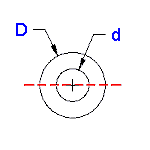
The Area Moment of Inertia Section Properties Tube/Pipe Calculator is a valuable tool for engineers and designers. It calculates the moment of inertia, section modulus, and other properties of tubular or pipe sections. This calculator is essential for determining the structural integrity and stability of tubes and pipes under various loads. With its ability to calculate section properties, it helps in selecting the appropriate size and material for tubes and pipes in construction, mechanical, and other engineering applications, ensuring safety and efficiency in design and analysis. It simplifies complex calculations, saving time and effort.
- Understanding the Area Moment of Inertia Section Properties Tube/Pipe Calculator
-
Understanding the Significance of Area Moment of Inertia in Section Properties Tube/Pipe Calculator
- Introduction to Area Moment of Inertia and its Importance in Tube/Pipe Design
- Calculating Area Moment of Inertia using the Section Properties Tube/Pipe Calculator
- Factors Affecting the Area Moment of Inertia of Tubes and Pipes
- Applications of the Section Properties Tube/Pipe Calculator in Various Industries
- Advantages of Using the Section Properties Tube/Pipe Calculator for Area Moment of Inertia Calculations
-
Frequently Asked Questions (FAQs)
- What is the Area Moment of Inertia and how is it used in the calculator?
- How does the calculator account for different types of tubes and pipes, such as circular, rectangular, and elliptical shapes?
- What are the limitations and assumptions of the calculator, and how can users ensure accurate results?
- How can the calculator be used in conjunction with other engineering tools and software to optimize the design of tubes and pipes?
Understanding the Area Moment of Inertia Section Properties Tube/Pipe Calculator
The Area Moment of Inertia Section Properties Tube/Pipe Calculator is a tool used to calculate the moment of inertia and other section properties of a tube or pipe. This calculator is essential in various engineering fields, including mechanical engineering, civil engineering, and aerospace engineering, as it helps designers and engineers determine the stiffness and strength of a tube or pipe under different loading conditions.
What is the Moment of Inertia?
The moment of inertia is a measure of an object's resistance to changes in its rotation. It depends on the object's mass distribution and the axis of rotation. The moment of inertia is an important property in engineering, as it affects the stability and dynamics of a system. In the context of a tube or pipe, the moment of inertia is used to calculate the section modulus, which is a measure of the bending strength of the tube or pipe.
How to Use the Calculator
To use the Area Moment of Inertia Section Properties Tube/Pipe Calculator, the user needs to input the outer diameter, inner diameter, and wall thickness of the tube or pipe. The calculator then uses these values to calculate the moment of inertia, section modulus, and other section properties. The user can also select the units of measurement and the material properties of the tube or pipe.
Section Properties of a Tube or Pipe
The section properties of a tube or pipe include the area, perimeter, moment of inertia, and section modulus. These properties are used to determine the stiffness and strength of the tube or pipe under different loading conditions. The section properties are also used to calculate the stress and strain in the tube or pipe.
| Section Property | Formula | Units |
|---|---|---|
| Area | A = π(R^2 - r^2) | m^2 |
| Perimeter | P = 2π(R + r) | m |
| Moment of Inertia | I = π(R^4 - r^4)/4 | m^4 |
| Section Modulus | Z = I/y | m^3 |
Applications of the Calculator
The Area Moment of Inertia Section Properties Tube/Pipe Calculator has various applications in engineering, including pipe design, tube design, and structural analysis. The calculator is used to determine the stiffness and strength of a tube or pipe under different loading conditions, such as bending, torsion, and axial loading.
Limitations and Assumptions
The Area Moment of Inertia Section Properties Tube/Pipe Calculator assumes that the tube or pipe is circular and symmetrical. The calculator also assumes that the material properties are constant and isotropic. The user should be aware of these limitations and assumptions when using the calculator, as they can affect the accuracy of the results.
Understanding the Significance of Area Moment of Inertia in Section Properties Tube/Pipe Calculator
The Area Moment of Inertia is a crucial parameter in the design and analysis of tubes and pipes, as it plays a significant role in determining their stiffness and resistance to bending and twisting loads. The Section Properties Tube/Pipe Calculator is a valuable tool that helps engineers and designers calculate the Area Moment of Inertia, along with other essential section properties, to ensure the integrity and performance of their designs.
Introduction to Area Moment of Inertia and its Importance in Tube/Pipe Design
The Area Moment of Inertia, denoted by the symbol I, is a measure of the distribution of the area of a cross-section around a specific axis. It is an important property that affects the behavior of a tube or pipe under various types of loading conditions. A higher Area Moment of Inertia indicates a greater resistance to bending and twisting, which is critical in applications where tubes and pipes are subject to external forces. The Section Properties Tube/Pipe Calculator takes into account the geometry of the tube or pipe, including the radius, thickness, and material properties, to calculate the Area Moment of Inertia.
Calculating Area Moment of Inertia using the Section Properties Tube/Pipe Calculator
The Section Properties Tube/Pipe Calculator uses formulas and algorithms to calculate the Area Moment of Inertia based on the input parameters. The calculator takes into account the shape and size of the tube or pipe, as well as the material properties, to provide accurate calculations. The input parameters may include the outer diameter, inner diameter, wall thickness, and material density, among others. The calculator then uses these parameters to calculate the Area Moment of Inertia, as well as other section properties, such as the section modulus and polar moment of inertia.
Factors Affecting the Area Moment of Inertia of Tubes and Pipes
Several factors can affect the Area Moment of Inertia of tubes and pipes, including the geometry, material properties, and loading conditions. The shape and size of the tube or pipe can significantly impact the Area Moment of Inertia, with circular shapes generally providing a higher resistance to bending and twisting. The material properties, such as the elastic modulus and Poisson's ratio, can also influence the Area Moment of Inertia. Additionally, the loading conditions, including the type and magnitude of the forces applied, can affect the behavior of the tube or pipe and its Area Moment of Inertia.
Applications of the Section Properties Tube/Pipe Calculator in Various Industries
The Section Properties Tube/Pipe Calculator has a wide range of applications in various industries, including aerospace, automotive, construction, and energy. In these industries, tubes and pipes are used in critical applications, such as fuel lines, hydraulic systems, and structural frames. The calculator helps engineers and designers ensure the integrity and performance of these systems by providing accurate calculations of the Area Moment of Inertia and other section properties. The calculator can also be used to optimize designs, reduce material costs, and improve overall system efficiency.
Advantages of Using the Section Properties Tube/Pipe Calculator for Area Moment of Inertia Calculations
The Section Properties Tube/Pipe Calculator offers several advantages over traditional manual calculations, including accuracy, speed, and efficiency. The calculator can perform complex calculations quickly and accurately, reducing the risk of errors and inconsistencies. Additionally, the calculator can handle a wide range of input parameters and loading conditions, making it a versatile tool for design and analysis applications. The calculator can also provide detailed reports and visualizations, helping engineers and designers to better understand the behavior of their designs and make informed decisions. The use of the Section Properties Tube/Pipe Calculator can also help to reduce material waste, minimize prototyping costs, and accelerate the design and development process.
Frequently Asked Questions (FAQs)
What is the Area Moment of Inertia and how is it used in the calculator?
The Area Moment of Inertia is a fundamental concept in engineering and physics that describes the resistance of an object to changes in its rotation. It is a measure of the distribution of the object's mass or area around its axis of rotation. In the context of the Tube/Pipe Calculator, the Area Moment of Inertia is used to calculate the section properties of a tube or pipe, such as its moment of inertia, section modulus, and radius of gyration. These properties are essential in determining the structural integrity and behavior of the tube or pipe under various loads and stresses. By inputting the geometric dimensions of the tube or pipe, the calculator can compute the Area Moment of Inertia and other relevant section properties, allowing users to analyze and design their structures with accuracy and confidence.
How does the calculator account for different types of tubes and pipes, such as circular, rectangular, and elliptical shapes?
The calculator is designed to accommodate various types of tubes and pipes, including circular, rectangular, and elliptical shapes. To account for these different shapes, the calculator uses specific formulas and equations that take into account the unique geometric characteristics of each shape. For example, the calculator uses the formula for the moment of inertia of a circular section to calculate the section properties of a circular tube or pipe. Similarly, it uses the formula for the moment of inertia of a rectangular section to calculate the section properties of a rectangular tube or pipe. By using these shape-specific formulas, the calculator can provide accurate and reliable results for a wide range of tube and pipe shapes and sizes, allowing users to analyze and design their structures with precision and confidence.
What are the limitations and assumptions of the calculator, and how can users ensure accurate results?
The calculator is based on simplifying assumptions and mathematical models that assume the tube or pipe is a prismatic member with a constant cross-sectional area. The calculator also assumes that the material is homogeneous and isotropic, and that the loads are static and axial. To ensure accurate results, users must carefully input the geometric dimensions and material properties of the tube or pipe, and select the correct shape and orientation. Users should also be aware of the limitations of the calculator, such as its inability to account for non-linear or dynamic behavior, and stress concentrations due to notches or discontinuities. By understanding these limitations and assumptions, users can interpret the results with caution and validate them using other methods or experimental data to ensure the accuracy and reliability of their designs.
How can the calculator be used in conjunction with other engineering tools and software to optimize the design of tubes and pipes?
The calculator can be used in conjunction with other engineering tools and software to optimize the design of tubes and pipes. For example, users can import the section properties calculated by the calculator into finite element analysis (FEA) software to simulate the behavior of the tube or pipe under various loads and stresses. The calculator can also be used to validate the results of computational fluid dynamics (CFD) simulations or structural analysis software. Additionally, users can export the geometric dimensions and material properties of the tube or pipe to computer-aided design (CAD) software to create and visualize the design. By integrating the calculator with other engineering tools and software, users can streamline their design workflow, reduce errors, and optimize the performance and efficiency of their tube and pipe designs. This integrated approach can help users to achieve their design goals and meet the requirements of their projects with accuracy and confidence.
Deja una respuesta
Entradas Relacionadas