
Trapezoid Section Properties Calculator

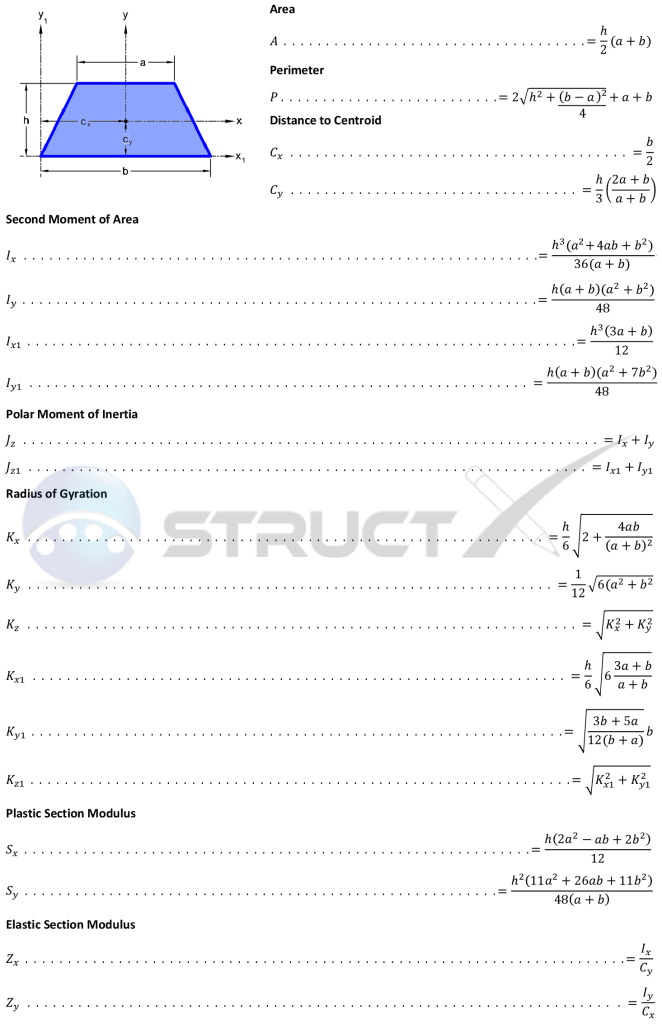
The Trapezoid Section Properties Calculator is a valuable tool for engineers and architects, providing essential calculations for trapezoidal shapes. This calculator determines key properties such as area, perimeter, and centroid, making it easier to design and analyze structures. With its user-friendly interface, the calculator allows for quick and accurate computations, saving time and reducing errors. By inputting the necessary dimensions, users can obtain vital information about the trapezoid's characteristics, facilitating informed decision-making in various engineering and architectural applications. The calculator's capabilities make it an indispensable resource for professionals working with trapezoidal shapes.
-
Trapezoid Section Properties Calculator: Understanding its Importance and Applications
- Introduction to Trapezoid Section Properties Calculator
- Calculating Trapezoid Properties using the Calculator
- Applications of Trapezoid Section Properties Calculator
- Benefits of Using Trapezoid Section Properties Calculator
- Limitations and Future Developments of Trapezoid Section Properties Calculator
- Understanding the Trapezoid Section Properties Calculator
-
Frequently Asked Questions (FAQs)
- What is the Trapezoid Section Properties Calculator and how does it work?
- What are the key features of the Trapezoid Section Properties Calculator?
- How can I use the Trapezoid Section Properties Calculator in real-world applications?
- What are the limitations and potential sources of error in the Trapezoid Section Properties Calculator?
Trapezoid Section Properties Calculator: Understanding its Importance and Applications
The Trapezoid Section Properties Calculator is a valuable tool for calculating the properties of a trapezoid, including its area, perimeter, and moments of inertia. This calculator is essential in various fields such as engineering, architecture, and physics, where the properties of trapezoids are crucial in designing and analyzing structures.
Introduction to Trapezoid Section Properties Calculator
The Trapezoid Section Properties Calculator is a software tool that calculates the geometric properties of a trapezoid, including its area, perimeter, and moments of inertia. The calculator uses the dimensions of the trapezoid, such as its length, width, and height, to calculate its properties. The calculator is user-friendly and can be used by engineers, architects, and students to calculate the properties of trapezoids.
Calculating Trapezoid Properties using the Calculator
To calculate the properties of a trapezoid using the calculator, the user needs to input the dimensions of the trapezoid, such as its length, width, and height. The calculator then uses these dimensions to calculate the area, perimeter, and moments of inertia of the trapezoid. The calculator also provides graphs and diagrams to visualize the trapezoid and its properties.
Applications of Trapezoid Section Properties Calculator
The Trapezoid Section Properties Calculator has various applications in fields such as engineering, architecture, and physics. The calculator is used to design and analyze structures such as bridges, buildings, and machines. The calculator is also used to calculate the stress and strain on materials and to determine the stability of structures.
Benefits of Using Trapezoid Section Properties Calculator
The Trapezoid Section Properties Calculator has several benefits, including accuracy, speed, and ease of use. The calculator provides accurate calculations of the properties of trapezoids, which is essential in engineering and architecture. The calculator also saves time and effort by providing quick and easy calculations. Additionally, the calculator is user-friendly and can be used by students and professionals alike.
Limitations and Future Developments of Trapezoid Section Properties Calculator
The Trapezoid Section Properties Calculator has some limitations, including its complexity and cost. The calculator requires advanced mathematical formulas and algorithms to calculate the properties of trapezoids, which can be challenging to understand and implement. Additionally, the calculator can be expensive to purchase and maintain. However, future developments are expected to address these limitations and provide new features and improvements to the calculator.
| Property | Formula | Description |
|---|---|---|
| Area | A = (1/2)h(b1 + b2) | The area of a trapezoid is calculated using the height and bases of the trapezoid. |
| Perimeter | P = b1 + b2 + 2h | The perimeter of a trapezoid is calculated using the bases and height of the trapezoid. |
| Moment of Inertia | I = (1/12)h(b1^2 + b2^2 + b1b2) | The moment of inertia of a trapezoid is calculated using the height and bases of the trapezoid. |
Understanding the Trapezoid Section Properties Calculator
The Trapezoid Section Properties Calculator is a mathematical tool designed to calculate various properties of a trapezoid, including its area, perimeter, and moments of inertia. This calculator is essential for engineers, architects, and designers who work with trapezoidal structures, such as bridges, buildings, and tunnels. By using this calculator, users can quickly and accurately determine the geometric properties of a trapezoid, which is crucial for ensuring the safety and stability of these structures.
Calculating the Area of a Trapezoid
Calculating the area of a trapezoid is a fundamental property that can be determined using the Trapezoid Section Properties Calculator. The area of a trapezoid is calculated using the formula: A = (1/2) * (a + b) * h, where A is the area, a and b are the lengths of the two parallel sides, and h is the height of the trapezoid. This calculator takes into account the dimensions of the trapezoid and provides an accurate calculation of its area. The area is an essential property in various engineering applications, such as calculating the volume of a trapezoidal prism or determining the load-carrying capacity of a trapezoidal structure.
Understanding the Perimeter of a Trapezoid
The perimeter of a trapezoid is another crucial property that can be calculated using the Trapezoid Section Properties Calculator. The perimeter is the total distance around the trapezoid and is calculated by adding the lengths of all four sides. The formula for calculating the perimeter is: P = a + b + c + d, where P is the perimeter, and a, b, c, and d are the lengths of the four sides. This calculator provides an accurate calculation of the perimeter, which is essential for determining the boundary of a trapezoidal structure and calculating the amount of material required to construct it.
Determining the Moments of Inertia of a Trapezoid
The moments of inertia of a trapezoid are critical properties that can be calculated using the Trapezoid Section Properties Calculator. The moments of inertia are measures of the resistance of a trapezoid to bending and torsion. The calculator uses the following formula to calculate the moment of inertia about the x-axis: Ix = (1/12) * (a + b) * h^3, and about the y-axis: Iy = (1/12) * (a^3 + b^3) * h. These moments of inertia are essential for determining the stability and rigidity of a trapezoidal structure under various loading conditions.
Calculating the Section Modulus of a Trapezoid
The section modulus of a trapezoid is a property that can be calculated using the Trapezoid Section Properties Calculator. The section modulus is a measure of the bending resistance of a trapezoid and is calculated using the formula: S = (1/6) * (a + b) * h^2. This calculator provides an accurate calculation of the section modulus, which is essential for determining the maximum bending moment that a trapezoidal structure can withstand without failing.
Using the Trapezoid Section Properties Calculator in Engineering Applications
The Trapezoid Section Properties Calculator has numerous applications in engineering, including civil engineering, mechanical engineering, and aerospace engineering. This calculator can be used to design and analyze trapezoidal structures, such as bridges, buildings, and tunnels. By using this calculator, engineers can quickly and accurately determine the geometric properties of a trapezoid, which is crucial for ensuring the safety and stability of these structures. The calculator can also be used to optimize the design of trapezoidal structures, reducing materials and costs while maintaining structural integrity. The Trapezoid Section Properties Calculator is an essential tool for any engineer working with trapezoidal structures, providing accurate and reliable calculations of various properties and parameters.
Frequently Asked Questions (FAQs)
What is the Trapezoid Section Properties Calculator and how does it work?
The Trapezoid Section Properties Calculator is an online tool designed to calculate the geometric properties of a trapezoid, including its area, perimeter, and moments of inertia. This calculator uses the input values provided by the user, such as the lengths of the bases and the height of the trapezoid, to calculate the desired properties. The calculator employs mathematical formulas and algorithms to perform the calculations, providing accurate and reliable results. The user-friendly interface of the calculator makes it easy to use, even for those without extensive mathematical knowledge. By using the Trapezoid Section Properties Calculator, users can save time and effort in calculating the properties of trapezoids, which is especially useful in engineering and architecture applications.
What are the key features of the Trapezoid Section Properties Calculator?
The Trapezoid Section Properties Calculator has several key features that make it a valuable tool for calculating the properties of trapezoids. One of the most important features is its ability to calculate the area of the trapezoid, which is a fundamental property in geometry and engineering. The calculator also calculates the perimeter of the trapezoid, which is essential in design and construction applications. Additionally, the calculator provides the moments of inertia of the trapezoid, which are critical in structural analysis and mechanics. The calculator also allows users to input the units of measurement, making it versatile and convenient to use. Furthermore, the calculator provides detailed explanations and formulas used in the calculations, which can help users understand the theoretical background of the calculations. Overall, the Trapezoid Section Properties Calculator is a comprehensive tool that provides a wide range of features and calculations, making it an essential resource for students, engineers, and architects.
How can I use the Trapezoid Section Properties Calculator in real-world applications?
The Trapezoid Section Properties Calculator has a wide range of real-world applications in engineering, architecture, and construction. For example, in building design, the calculator can be used to calculate the area and perimeter of trapezoidal roofs and walls, which is essential in determining the materials and resources required for construction. In bridge design, the calculator can be used to calculate the moments of inertia of trapezoidal beams, which is critical in ensuring the stability and safety of the bridge. Additionally, the calculator can be used in mechanical engineering to calculate the properties of trapezoidal gears and shafts, which is essential in designing efficient and reliable mechanical systems. The calculator can also be used in academic research to study the geometric properties of trapezoids and their applications in various fields. Overall, the Trapezoid Section Properties Calculator is a valuable tool that can be used in a wide range of real-world applications, making it an essential resource for professionals and students alike.
What are the limitations and potential sources of error in the Trapezoid Section Properties Calculator?
The Trapezoid Section Properties Calculator is a mathematical tool that relies on input values and algorithms to calculate the properties of trapezoids. While the calculator is designed to provide accurate and reliable results, there are limitations and potential sources of error that users should be aware of. One of the main limitations is the accuracy of the input values, which can affect the accuracy of the calculated results. Additionally, the calculator assumes that the trapezoid is a perfect geometric shape, which may not always be the case in real-world applications. The calculator also uses simplified formulas and algorithms, which can introduce approximations and errors in the calculations. Furthermore, the calculator does not account for external factors such as material properties and loading conditions, which can affect the behavior and performance of the trapezoid in real-world applications. To minimize errors and ensure accurate results, users should carefully review and verify the input values and calculated results, and consult relevant references and experts in the field if necessary.
Deja una respuesta
Entradas Relacionadas