
Poiseuille Law Formula and Calculator

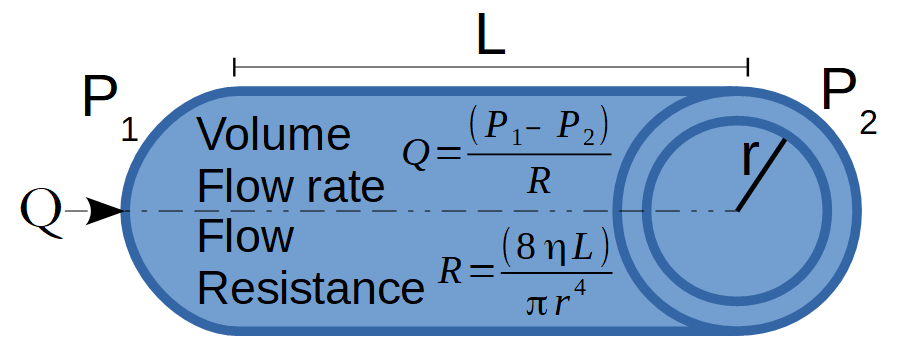
The Poiseuille Law is a fundamental principle in fluid dynamics that describes the laminar flow of fluids through cylindrical pipes. It is widely used in various fields, including engineering, physics, and chemistry. The formula, derived by Jean Léonard Marie Poiseuille, relates the flow rate of a fluid to its viscosity, the length and radius of the pipe, and the pressure difference between the two ends. This article will provide an overview of the Poiseuille Law formula and offer a calculator to simplify the calculation process for users. The formula is Q = (π r^4 ΔP) / (8 η L).
- Poiseuille Law Formula and Calculator
- How do you calculate Poiseuille's law?
- What is Poiseuille's formula?
-
Frequently Asked Questions (FAQs)
- What is the Poiseuille Law Formula and how is it used in fluid dynamics?
- How does the Poiseuille Law Calculator work and what are its limitations?
- What are some common applications of the Poiseuille Law Formula in real-world scenarios?
- How can the Poiseuille Law Formula be derived from first principles, and what are the underlying assumptions?
Poiseuille Law Formula and Calculator
The Poiseuille law formula and calculator are essential tools in the field of fluid dynamics, particularly in the study of laminar flow through cylindrical pipes. The Poiseuille law, also known as the Hagen-Poiseuille law, is a mathematical equation that describes the flow of a viscous fluid through a long, narrow pipe. The law is named after the French physicist Jean Léonard Marie Poiseuille, who first derived the equation in the 19th century.
Introduction to Poiseuille Law
The Poiseuille law is based on the assumption that the flow of a fluid through a pipe is laminar, meaning that the fluid flows in parallel layers, with no turbulence or mixing between layers. The law states that the volume flow rate of a fluid through a pipe is proportional to the pressure difference between the two ends of the pipe, and inversely proportional to the viscosity of the fluid and the length of the pipe.
Poiseuille Law Formula
The Poiseuille law formula is given by the equation: Q = (π r^4 ΔP) / (8 η L), where Q is the volume flow rate, r is the radius of the pipe, ΔP is the pressure difference, η is the viscosity of the fluid, and L is the length of the pipe. This formula is widely used in engineering and scientific applications, such as in the design of pipelines and fluid transport systems.
Poiseuille Law Calculator
A Poiseuille law calculator is a tool that allows users to calculate the volume flow rate of a fluid through a pipe, given the radius, pressure difference, viscosity, and length of the pipe. These calculators are often available online or as part of engineering software packages. They are useful for engineers and researchers who need to design and optimize fluid transport systems.
Applications of Poiseuille Law
The Poiseuille law has a wide range of applications in fields such as chemical engineering, mechanical engineering, and biomedical engineering. It is used to design and optimize pipelines, fluid transport systems, and medical devices, such as blood pumps and dialysis machines. The law is also used in research applications, such as in the study of fluid dynamics and heat transfer.
Limitations of Poiseuille Law
The Poiseuille law is based on several assumptions, including that the flow is laminar and that the pipe is long and narrow. In reality, many fluid transport systems do not meet these assumptions, and the law may not be applicable. Additionally, the law does not account for turbulence or non-Newtonian fluids, which can significantly affect the flow of fluids through pipes. Therefore, the Poiseuille law should be used with caution and in conjunction with other tools and techniques.
| Variable | Unit | Description |
|---|---|---|
| Q | m^3/s | Volume flow rate |
| r | m | Radius of the pipe |
| ΔP | Pa | Pressure difference between the two ends of the pipe |
| η | Pa·s | Viscosity of the fluid |
| L | m | Length of the pipe |
How do you calculate Poiseuille's law?

To calculate Poiseuille's law, we need to understand the formula and the variables involved. The law states that the laminar flow of a fluid through a cylindrical pipe is directly proportional to the pressure difference and the fourth power of the pipe's radius, and inversely proportional to the length of the pipe and the fluid's viscosity. The formula is: Q = (π (r ^ 4)) / (8 η L) (ΔP), where Q is the flow rate, r is the radius of the pipe, η is the viscosity of the fluid, L is the length of the pipe, and ΔP is the pressure difference.
Understanding the Variables
To calculate Poiseuille's law, we need to understand the variables involved. The variables are:
- The flow rate (Q) is the volume of fluid that flows through the pipe per unit time.
- The radius (r) of the pipe is a critical factor in determining the flow rate.
- The viscosity (η) of the fluid is a measure of its resistance to flow.
Derivation of the Formula
The formula for Poiseuille's law can be derived from the Navier-Stokes equations, which describe the motion of fluids. By making certain assumptions, such as laminar flow and a cylindrical pipe, we can simplify the equations and derive the formula. The formula is a simplified expression of the more complex Navier-Stokes equations. The key steps in the derivation are:
- Assuming laminar flow and a cylindrical pipe.
- Using the Navier-Stokes equations to describe the motion of the fluid.
- Simplifying the equations to derive the formula for Poiseuille's law.
Applications of Poiseuille's Law
Poiseuille's law has many practical applications, including:
- Designing pipelines for oil and gas transmission.
- Understanding the flow of blood through blood vessels.
- Designing microfluidic devices for lab-on-a-chip applications.
Limitations of Poiseuille's Law
While Poiseuille's law is a powerful tool for understanding the flow of fluids, it has certain limitations. For example:
- The law assumes laminar flow, which may not always be the case in real-world applications.
- The law does not account for turbulence or non-Newtonian fluids.
- The law assumes a cylindrical pipe, which may not always be the case in real-world applications.
Experimental Verification
The experimental verification of Poiseuille's law involves measuring the flow rate of a fluid through a cylindrical pipe and comparing it to the predicted value using the formula. The key steps in the experimental verification are:
- Measuring the flow rate of the fluid using a flow meter.
- Measuring the pressure difference between the two ends of the pipe using a pressure gauge.
- Comparing the measured flow rate to the predicted value using the formula for Poiseuille's law.
What is Poiseuille's formula?
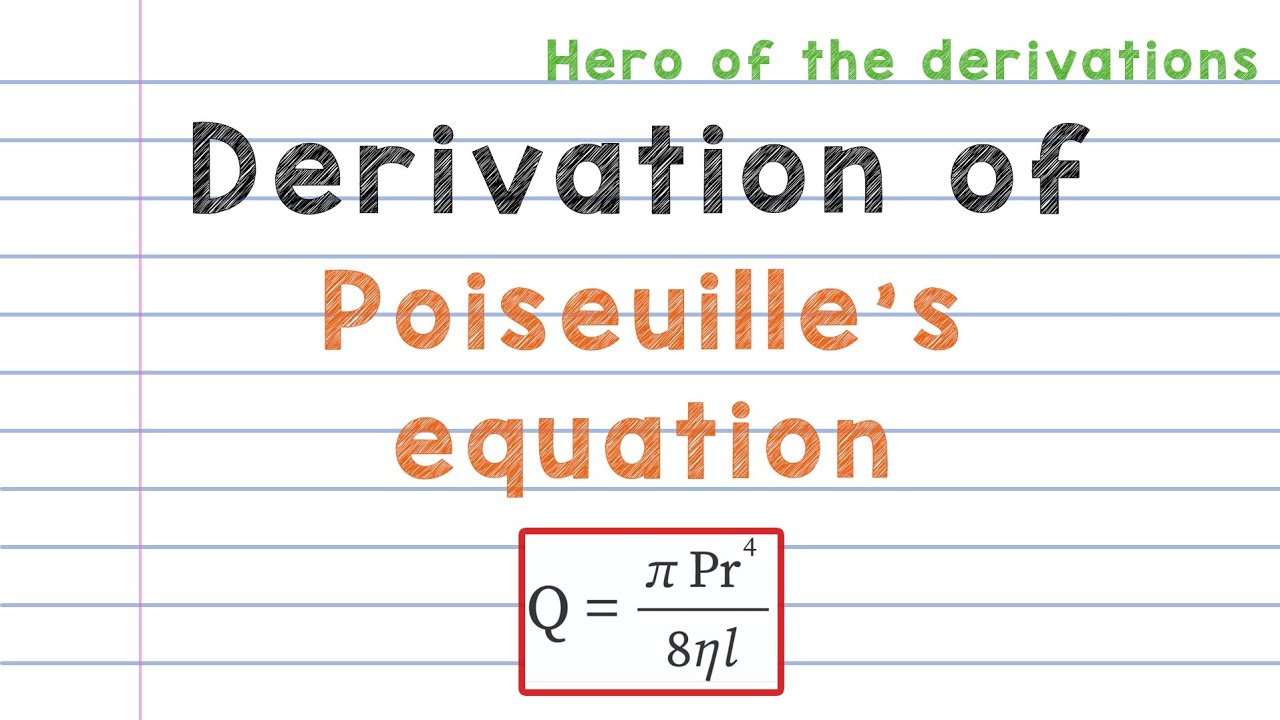
Poiseuille's formula is a mathematical equation used to calculate the laminar flow of a Newtonian fluid through a cylindrical pipe. The formula is given by the equation Q = (π r^4 ΔP) / (8 η L), where Q is the volumetric flow rate, π is a mathematical constant, r is the radius of the pipe, ΔP is the pressure difference between the two ends of the pipe, η is the dynamic viscosity of the fluid, and L is the length of the pipe.
Derivation of Poiseuille's Formula
The derivation of Poiseuille's formula is based on the Navier-Stokes equations, which describe the motion of a fluid. By making several simplifying assumptions, such as assuming a steady-state flow and a fully developed flow, the Navier-Stokes equations can be reduced to a simpler equation that describes the flow of a fluid through a cylindrical pipe. The resulting equation is Poiseuille's formula, which can be used to calculate the flow rate of a fluid through a pipe.
- The Navier-Stokes equations are a set of nonlinear partial differential equations that describe the motion of a fluid.
- The simplifying assumptions made in the derivation of Poiseuille's formula include assuming a steady-state flow and a fully developed flow.
- The resulting equation is Poiseuille's formula, which can be used to calculate the flow rate of a fluid through a pipe.
Assumptions of Poiseuille's Formula
Poiseuille's formula is based on several assumptions about the flow of a fluid through a cylindrical pipe. These assumptions include steady-state flow, fully developed flow, laminar flow, and constant viscosity. If these assumptions are not met, the formula may not be accurate. For example, if the flow is turbulent, the formula will not be valid.
- The steady-state flow assumption means that the flow is not changing with time.
- The fully developed flow assumption means that the flow has reached a stable state and is not changing with distance along the pipe.
- The laminar flow assumption means that the flow is smooth and continuous, rather than turbulent.
Applications of Poiseuille's Formula
Poiseuille's formula has many practical applications in fields such as engineering and physics. For example, it can be used to calculate the flow rate of a fluid through a pipe, or to determine the pressure drop across a pipe. It is also used in the design of pipelines and fluid systems.
- Poiseuille's formula can be used to calculate the flow rate of a fluid through a pipe.
- The formula can be used to determine the pressure drop across a pipe.
- Poiseuille's formula is used in the design of pipelines and fluid systems.
Limitations of Poiseuille's Formula
Poiseuille's formula has several limitations that must be considered when using it. For example, it is only valid for laminar flow, and it assumes a constant viscosity and a fully developed flow. If these assumptions are not met, the formula may not be accurate. Additionally, the formula is only valid for cylindrical pipes, and it does not account for turbulence or non-Newtonian fluids.
- Poiseuille's formula is only valid for laminar flow.
- The formula assumes a constant viscosity and a fully developed flow.
- Poiseuille's formula is only valid for cylindrical pipes.
Extensions of Poiseuille's Formula
There are several extensions of Poiseuille's formula that can be used to model more complex fluid flows. For example, the Hagen-Poiseuille equation can be used to model non-Newtonian fluids, and the Darcy-Weisbach equation can be used to model turbulent flow. These extensions can be used to improve the accuracy of the formula and to model more complex systems.
- The Hagen-Poiseuille equation can be used to model non-Newtonian fluids.
- The Darcy-Weisbach equation can be used to model turbulent flow.
- These extensions can be used to improve the accuracy of the formula and to model more complex systems.
Frequently Asked Questions (FAQs)
What is the Poiseuille Law Formula and how is it used in fluid dynamics?
The Poiseuille Law Formula is a fundamental equation in fluid dynamics that describes the laminar flow of a Newtonian fluid through a long, narrow cylinder. The formula is named after the French physician Jean Léonard Marie Poiseuille, who first derived it in the 19th century. The formula is given by: Q = (π r^4 ΔP) / (8 η L), where Q is the volumetric flow rate, r is the radius of the cylinder, ΔP is the pressure difference between the two ends of the cylinder, η is the dynamic viscosity of the fluid, and L is the length of the cylinder. This formula is widely used in various fields, including engineering, physics, and biomedical research, to calculate the flow rate of fluids through pipes, tubes, and other conduits.
How does the Poiseuille Law Calculator work and what are its limitations?
The Poiseuille Law Calculator is a mathematical tool that uses the Poiseuille Law Formula to calculate the volumetric flow rate of a fluid through a cylinder. The calculator typically requires input values for the radius, length, pressure difference, and dynamic viscosity of the fluid. The calculator then uses these values to solve for the flow rate, which is typically expressed in units of cubic meters per second. However, the Poiseuille Law Calculator has several limitations, including the assumption of laminar flow, which may not always be the case in real-world applications. Additionally, the calculator assumes that the fluid is incompressible and that the cylinder is rigid and non-porous. In practice, turbulent flow and other factors can affect the accuracy of the calculations, and the calculator should be used with caution and in conjunction with other engineering and physical principles.
What are some common applications of the Poiseuille Law Formula in real-world scenarios?
The Poiseuille Law Formula has numerous practical applications in various fields, including engineering, biomedical research, and physics. For example, the formula is used to design and optimize pipelines and tubing systems for the transportation of fluids, such as oil, gas, and water. It is also used to calculate the flow rate of blood through arteries and veins in the human body, which is essential for understanding cardiovascular disease and developing medical treatments. Additionally, the formula is used in aerospace engineering to calculate the flow rate of fuels and oxidizers in rocket engines, and in chemical engineering to design and optimize process equipment, such as pumps, valves, and tanks.
How can the Poiseuille Law Formula be derived from first principles, and what are the underlying assumptions?
The Poiseuille Law Formula can be derived from first principles by using the Navier-Stokes equations, which describe the motion of fluids. The derivation involves assuming a laminar flow regime, where the fluid flows in parallel streams with no turbulence or mixing. The derivation also assumes that the fluid is incompressible and that the cylinder is rigid and non-porous. By using these assumptions and the Navier-Stokes equations, it is possible to derive the Poiseuille Law Formula as a special case of the more general equations of motion. The underlying assumptions of the formula include the no-slip boundary condition, which states that the fluid velocity is zero at the wall of the cylinder, and the continuity equation, which states that the mass flow rate of the fluid is constant throughout the cylinder. These assumptions are simplifications of the more complex physics of fluid flow, but they are reasonable approximations in many practical applications.
Deja una respuesta
Entradas Relacionadas