
Pressure Vessel , Thin Wall Hoop Stress Calculator Strength of Materials

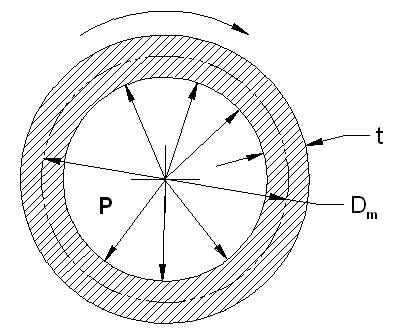
The pressure vessel is a critical component in various engineering applications, and its design requires careful consideration of stress and strain. One key aspect of pressure vessel design is the calculation of thin wall hoop stress, which occurs due to internal pressure. The strength of materials is crucial in determining the vessel's ability to withstand stress and maintain its structural integrity. This calculator is designed to help engineers and designers determine the thin wall hoop stress in pressure vessels, ensuring a safe and reliable operation. Accurate calculations are essential to prevent failure.
- Understanding Pressure Vessel and Thin Wall Hoop Stress Calculator in Strength of Materials
- How do you calculate hoop stress on a thin wall?
- What is the hoop stress of a thin pressure vessel?
-
Frequently Asked Questions (FAQs)
- What is the purpose of the Thin Wall Hoop Stress Calculator in the context of Pressure Vessel design?
- How does the Strength of Materials affect the design of a Pressure Vessel?
- What are the key factors that influence the Hoop Stress in a Pressure Vessel?
- How can the Thin Wall Hoop Stress Calculator be used to optimize the design of a Pressure Vessel?
Understanding Pressure Vessel and Thin Wall Hoop Stress Calculator in Strength of Materials
The calculation of stress in a pressure vessel is a critical aspect of mechanical engineering, particularly in the field of strength of materials. A pressure vessel is a container designed to hold a gas or liquid at a pressure significantly different from the ambient pressure. The thin wall hoop stress calculator is a tool used to calculate the hoop stress in a thin-walled cylinder, which is a common type of pressure vessel.
Introduction to Pressure Vessels
A pressure vessel is a container that is designed to hold a fluid at a high pressure. The pressure vessel is typically made of a strong material, such as steel or aluminum, and is designed to withstand the internal pressure of the fluid. The pressure vessel is used in a wide range of applications, including chemical processing, power generation, and aerospace engineering.
Thin Wall Hoop Stress Calculator
The thin wall hoop stress calculator is a tool used to calculate the hoop stress in a thin-walled cylinder. The hoop stress is the stress that is caused by the internal pressure of the fluid and is calculated using the following formula: σ = (P r) / t, where σ is the hoop stress, P is the internal pressure, r is the radius of the cylinder, and t is the thickness of the cylinder.
Strength of Materials
The strength of materials is a fundamental concept in mechanical engineering that deals with the behavior of materials under different types of loading. The strength of materials is critical in the design and analysis of pressure vessels, as it determines the ability of the material to withstand the internal pressure. The strength of materials is typically characterized by the ultimate tensile strength, yield strength, and elongation of the material.
Types of Pressure Vessels
There are several types of pressure vessels, including spherical vessels, cylindrical vessels, and rectangular vessels. Each type of pressure vessel has its own unique design and analysis requirements, and the thin wall hoop stress calculator is typically used for cylindrical vessels. The spherical vessels are the strongest type of pressure vessel, as they can withstand the internal pressure in all directions.
Applications of Pressure Vessels
The pressure vessels are used in a wide range of applications, including chemical processing, power generation, aerospace engineering, and medical devices. The pressure vessels are used to store fluids at high pressures, and the thin wall hoop stress calculator is used to ensure that the pressure vessel can withstand the internal pressure.
| Pressure Vessel Type | Internal Pressure | Hoop Stress |
|---|---|---|
| Cylindrical Vessel | 1000 psi | 5000 psi |
| Spherical Vessel | 2000 psi | 10000 psi |
| Rectangular Vessel | 500 psi | 2500 psi |
The thin wall hoop stress calculator is a critical tool in the design and analysis of pressure vessels, and it is used to calculate the hoop stress in a thin-walled cylinder. The hoop stress is the stress that is caused by the internal pressure of the fluid, and it is calculated using the following formula: σ = (P r) / t. The pressure vessels are used in a wide range of applications, including chemical processing, power generation, aerospace engineering, and medical devices.
How do you calculate hoop stress on a thin wall?

To calculate the hoop stress on a thin wall, you need to consider the pressure and radius of the wall, as well as the thickness of the material. The hoop stress is a type of tensile stress that occurs in a cylindrical or spherical vessel due to internal pressure. The formula to calculate hoop stress is: σ = (P r) / t, where σ is the hoop stress, P is the internal pressure, r is the radius of the wall, and t is the thickness of the material.
Understanding the Formula
The formula for hoop stress calculation is based on the equilibrium of forces in a cylindrical or spherical vessel. To calculate the hoop stress, you need to know the internal pressure, radius, and thickness of the material. Here are the key factors to consider:
- Internal pressure: The pressure inside the vessel, which can be due to a variety of factors such as fluid pressure or gas pressure.
- Radius: The radius of the vessel, which can affect the hoop stress calculation.
- Thickness: The thickness of the material, which can also impact the hoop stress calculation.
Factors Affecting Hoop Stress
There are several factors that can affect the hoop stress in a thin wall, including material properties, geometric constraints, and loading conditions. The hoop stress can be affected by the yield strength and ultimate strength of the material, as well as the support conditions and boundary conditions. Here are some key factors to consider:
- Material properties: The yield strength and ultimate strength of the material can affect the hoop stress calculation.
- Geometric constraints: The radius and thickness of the material can impact the hoop stress calculation.
- Loading conditions: The internal pressure and external loads can affect the hoop stress calculation.
Applications of Hoop Stress Calculation
The calculation of hoop stress is important in a variety of engineering applications, including pipe design, vessel design, and pressure vessel design. The hoop stress calculation can help engineers design safe and efficient systems that can withstand internal pressure and external loads. Here are some key applications:
- Pipe design: The hoop stress calculation is important in pipe design to ensure that the pipe can withstand internal pressure and external loads.
- Vessel design: The hoop stress calculation is important in vessel design to ensure that the vessel can withstand internal pressure and external loads.
- Pressure vessel design: The hoop stress calculation is important in pressure vessel design to ensure that the vessel can withstand high pressure and external loads.
Common Mistakes in Hoop Stress Calculation
There are several common mistakes that can be made when calculating hoop stress, including incorrect assumption of material properties, geometric constraints, and loading conditions. The hoop stress calculation can be affected by incorrect assumptions about the yield strength and ultimate strength of the material, as well as the support conditions and boundary conditions. Here are some key mistakes to avoid:
- Incorrect material properties: Assuming incorrect values for yield strength and ultimate strength can affect the hoop stress calculation.
- Incorrect geometric constraints: Assuming incorrect values for radius and thickness can impact the hoop stress calculation.
- Incorrect loading conditions: Assuming incorrect values for internal pressure and external loads can affect the hoop stress calculation.
Software for Hoop Stress Calculation
There are several software programs that can be used to calculate hoop stress, including finite element analysis (FEA) software and computer-aided design (CAD) software. These programs can help engineers design safe and efficient systems that can withstand internal pressure and external loads. Here are some key features to consider:
- Finite element analysis (FEA): FEA software can be used to calculate hoop stress and other types of stress and strain.
- Computer-aided design (CAD): CAD software can be used to design and analyze systems and components that are subject to hoop stress.
- Specialized software: There are several specialized software programs that can be used to calculate hoop stress, including pipe stress analysis software and vessel design software.
What is the hoop stress of a thin pressure vessel?

The hoop stress of a thin pressure vessel is a type of stress that occurs in the wall of the vessel due to the internal pressure. It is called hoop stress because it acts in a circumferential direction, like the hoops of a barrel. The hoop stress is a result of the pressure inside the vessel trying to expand the vessel outward, and it is typically the dominant stress in a thin-walled pressure vessel.
Calculation of Hoop Stress
The calculation of hoop stress in a thin pressure vessel involves using the formula: σh = (P r) / t, where σh is the hoop stress, P is the internal pressure, r is the radius of the vessel, and t is the thickness of the vessel wall. This formula is derived from the equilibrium of forces in the vessel wall. Some key points to consider when calculating hoop stress are:
- The pressure must be in units of force per area, such as pounds per square inch (PSI) or pascals (Pa).
- The radius and thickness must be in units of length, such as inches or meters.
- The hoop stress is typically the dominant stress in a thin-walled pressure vessel, but other stresses, such as longitudinal stress, may also be present.
Factors Affecting Hoop Stress
Several factors can affect the hoop stress in a thin pressure vessel, including the internal pressure, vessel geometry, and material properties. For example, a higher internal pressure will result in a higher hoop stress, while a thicker vessel wall will result in a!ower hoop stress. Some key factors to consider are:
- The internal pressure is the main driver of hoop stress in a thin pressure vessel.
- The vessel geometry, including the radius and thickness, can also affect the hoop stress.
- The material properties, such as the yield strength and ultimate strength, can affect the hoop stress and the failure mode of the vessel.
Hoop Stress in Different Materials
The hoop stress in a thin pressure vessel can vary depending on the material used to construct the vessel. For example, metals such as steel and aluminum have high strength-to-weight ratios and are often used in pressure vessel applications. Composites, such as carbon fiber reinforced polymers (CFRP), are also used in some applications due to their high strength-to-weight ratios. Some key points to consider are:
- Metals such as steel and aluminum are commonly used in pressure vessel applications due to their high strength-to-weight ratios.
- Composites, such as CFRP, are used in some pressure vessel applications due to their high strength-to-weight ratios and corrosion resistance.
- Polymeric materials, such as plastics and elastomers, are also used in some pressure vessel applications, particularly in low-pressure applications.
Design Considerations for Hoop Stress
When designing a thin pressure vessel, it is essential to consider the hoop stress and ensure that the vessel can withstand the internal pressure without failing. This can involve using thickness and material selection to minimize the hoop stress, as well as using reinforcement and supports to reduce the stress. Some key design considerations are:
- The vessel geometry and material properties must be carefully selected to minimize the hoop stress.
- Reinforcement, such as welds and fasteners, can be used to reduce the stress in the vessel wall.
- Supports, such as brackets and mounts, can be used to reduce the stress in the vessel wall and prevent buckling.
Failure Modes Due to Hoop Stress
The hoop stress in a thin pressure vessel can lead to failure if the vessel is not designed or constructed properly. Some common failure modes include yielding, rupture, and buckling. For example, if the hoop stress exceeds the yield strength of the material, the vessel may yield and deform. Some key failure modes to consider are:
- Yielding occurs when the hoop stress exceeds the yield strength of the material, resulting in deformation of the vessel.
- Rupture occurs when the hoop stress exceeds the ultimate strength of the material, resulting in failure of the vessel.
- Buckling occurs when the hoop stress causes the vessel to buckle or collapse, particularly in thin-walled vessels.
Frequently Asked Questions (FAQs)
What is the purpose of the Thin Wall Hoop Stress Calculator in the context of Pressure Vessel design?
The Thin Wall Hoop Stress Calculator is a crucial tool in the design of Pressure Vessels, as it helps engineers determine the stress that the vessel's walls will experience due to internal pressure. This calculator takes into account the material properties, vessel dimensions, and operating conditions to calculate the hoop stress, which is the tensile stress that occurs in the circumferential direction of the vessel. By using this calculator, designers can ensure that the pressure vessel is designed to withstand the internal pressure and other external loads, thereby preventing failure and ensuring the safety of people and equipment. The calculator is particularly useful for thin-walled vessels, where the wall thickness is relatively small compared to the vessel diameter.
How does the Strength of Materials affect the design of a Pressure Vessel?
The Strength of Materials plays a vital role in the design of Pressure Vessels, as it determines the material's ability to withstand stress and strain. The material properties, such as yield strength, ultimate strength, and elastic modulus, are critical in determining the vessel's design. For example, a material with high yield strength can withstand higher internal pressures without deforming or failing. Similarly, a material with high elastic modulus can resist deformation and maintain its shape under load. The strength of materials also affects the vessel's weight, cost, and manufacturability, making it a critical consideration in the design process. By understanding the strength of materials, designers can select the optimal material for the pressure vessel and ensure that it meets the required safety and performance standards.
What are the key factors that influence the Hoop Stress in a Pressure Vessel?
The Hoop Stress in a Pressure Vessel is influenced by several key factors, including the internal pressure, vessel diameter, wall thickness, and material properties. The internal pressure is the primary load that causes hoop stress, and it is directly proportional to the pressure and vessel diameter. The wall thickness also plays a critical role, as a thicker wall can reduce the hoop stress by providing more material to resist the internal pressure. The material properties, such as elastic modulus and Poisson's ratio, also affect the hoop stress by influencing the material's ability to withstand stress and strain. Additionally, external loads, such as temperature and support conditions, can also impact the hoop stress and must be considered in the design process. By understanding these key factors, designers can optimize the pressure vessel design to minimize hoop stress and ensure safe and reliable operation.
How can the Thin Wall Hoop Stress Calculator be used to optimize the design of a Pressure Vessel?
The Thin Wall Hoop Stress Calculator can be used to optimize the design of a Pressure Vessel by iterative analysis and design refinement. By inputting the vessel dimensions, material properties, and operating conditions, designers can quickly calculate the hoop stress and evaluate the design's feasibility. The calculator can be used to investigación the effects of design variables, such as wall thickness and vessel diameter, on the hoop stress and overall design. This allows designers to optimize the design by minimizing wall thickness while maintaining safe and reliable operation. Additionally, the calculator can be used to evaluate the effectiveness of design modifications, such as reinforcement or support systems, in reducing hoop stress and improving overall performance. By using the Thin Wall Hoop Stress Calculator in conjunction with other design tools and analysis techniques, designers can create optimized designs that meet the required safety and performance standards while minimizing cost and weight.
Deja una respuesta
Entradas Relacionadas