
Petroffs Hydrodynamic Lubrication Formula and Calculator

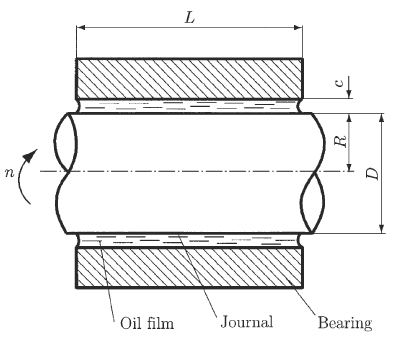
The Petroff's hydrodynamic lubrication formula is a fundamental concept in tribology, enabling the calculation of frictional losses in lubricated bearings. This formula, developed by Petroff, takes into account the viscosity of the lubricant, the bearing's geometry, and the rotational speed. By using this formula, engineers can design more efficient bearings, reducing friction and increasing the lifespan of mechanical components. The Petroff's hydrodynamic lubrication calculator is a valuable tool for quick and accurate calculations, allowing users to optimize their designs and improve overall system performance. It is widely used in various industries, including automotive and aerospace.
- Petroff's Hydrodynamic Lubrication Formula and Calculator: Understanding the Fundamentals
- What is the formula for the Petroff's equation?
- What does the Petroff equation assumed that the lubricant film is?
- What is the Trumpler's criteria?
- What is the significance of Sommerfeld number in journal bearing lubrication?
-
Frequently Asked Questions (FAQs)
- What is Petroff's Hydrodynamic Lubrication Formula and how does it work?
- What are the key factors that affect the accuracy of Petroff's Hydrodynamic Lubrication Formula?
- How does the Petroff's Hydrodynamic Lubrication Calculator work and what are its limitations?
- What are the applications of Petroff's Hydrodynamic Lubrication Formula and Calculator in industry?
Petroff's Hydrodynamic Lubrication Formula and Calculator: Understanding the Fundamentals
Petroff's hydrodynamic lubrication formula is a widely used mathematical model that calculates the coefficient of friction in journal bearings. This formula is essential in understanding the behavior of fluids in lubrication systems and is crucial in the design and optimization of mechanical systems. The formula is named after its developer, Petroff, who first introduced it in the late 19th century. The formula is based on the Reynolds equation, which describes the fluid flow and pressure distribution in the lubricant film.
Introduction to Petroff's Formula
Petroff's formula is used to calculate the frictional torque in journal bearings. The formula takes into account the viscosity of the lubricant, the speed of the journal, and the clearance between the journal and the bearing. The formula is given by: T = (2 π μ N R^3) / (c (1 + (ε^2) / (4 c^2))), where T is the frictional torque, μ is the viscosity of the lubricant, N is the speed of the journal, R is the radius of the journal, c is the clearance between the journal and the bearing, and ε is the eccentricity ratio.
Understanding the Variables
The variables in Petroff's formula are crucial in understanding the behavior of the lubrication system. The viscosity of the lubricant plays a significant role in determining the coefficient of friction. The speed of the journal affects the fluid flow and pressure distribution in the lubricant film. The clearance between the journal and the bearing affects the lubricant film thickness and the frictional torque.
Applications of Petroff's Formula
Petroff's formula has numerous applications in mechanical engineering. It is used to design and optimize journal bearings in rotating machinery such as pumps, turbines, and gearboxes. The formula is also used to predict the frictional torque and power loss in lubrication systems.
Limits of Petroff's Formula
While Petroff's formula is widely used, it has some limitations. The formula assumes a laminar flow in the lubricant film, which may not always be the case. The formula also neglects the inertia effects and turbulence in the lubricant film.
Calculator for Petroff's Formula
A calculator for Petroff's formula can be used to simplify the calculations and provide quick results. The calculator typically takes the viscosity of the lubricant, the speed of the journal, and the clearance between the journal and the bearing as inputs and provides the frictional torque and coefficient of friction as outputs.
| Variable | Unit | Description |
|---|---|---|
| μ | Pa·s | Viscosity of the lubricant |
| N | rpm | Speed of the journal |
| R | m | Radius of the journal |
| c | m | Clearance between the journal and the bearing |
| ε | - | Eccentricity ratio |
What is the formula for the Petroff's equation?
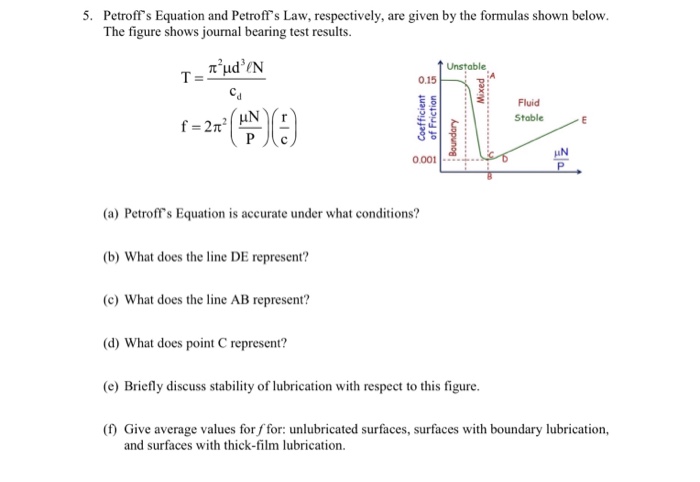
The formula for Petroff's equation is given by: T = (16/3) (μ^3) (N^2) / (ρ d^2), where T is the torque, μ is the coefficient of friction, N is the speed, ρ is the density of the fluid, and d is the diameter of the bearing.
Introduction to Petroff's Equation
Petroff's equation is used to calculate the torque required to overcome the frictional resistance in a journal bearing. The equation takes into account the viscosity of the lubricant, the speed of the shaft, and the geometry of the bearing. The formula is widely used in the design and analysis of journal bearings in various engineering applications.
- The equation is derived from the Navier-Stokes equations, which describe the motion of fluids.
- The coefficient of friction is a critical parameter in Petroff's equation, as it determines the frictional resistance in the bearing.
- The density of the fluid and the diameter of the bearing are also important parameters in the equation.
Assumptions and Limitations of Petroff's Equation
Petroff's equation is based on several assumptions, including the laminar flow of the lubricant and the negligible effect of inertia on the fluid motion. The equation is also limited to journal bearings with a circular cross-section and a uniform clearance.
- The equation assumes that the lubricant is incompressible and isoviscous.
- The bearing is assumed to be rigid and non-deformable.
- The equation does not account for the effects of thermal expansion and elastic deformation on the bearing.
Applications of Petroff's Equation
Petroff's equation has numerous applications in the design and analysis of journal bearings in various engineering fields, including mechanical engineering, aerospace engineering, and automotive engineering. The equation is used to calculate the torque required to overcome the frictional resistance in bearings, as well as to determine the power loss and heat generation in the bearing.
- The equation is used in the design of engine bearings, gearbox bearings, and turbocharger bearings.
- The equation is also used in the analysis of bearings in aerospace applications, such as aircraft engines and spacecraft propulsion systems.
- The equation has been used to optimize the design of bearings for high-speed and high-temperature applications.
Derivation of Petroff's Equation
Petroff's equation is derived from the Navier-Stokes equations, which describe the motion of fluids. The derivation involves several assumptions and simplifications, including the laminar flow of the lubricant and the negligible effect of inertia on the fluid motion. The equation is also based on the Reynolds equation, which describes the pressure distribution in a thin film of lubricant.
- The Navier-Stokes equations are used to describe the motion of the lubricant in the bearing.
- The Reynolds equation is used to describe the pressure distribution in the bearing.
- The equation is derived by integrating the shear stress over the surface of the bearing.
Comparison with Other Bearing Equations
Petroff's equation is compared to other bearing equations, such as the Reynolds equation and the Sommerfeld equation. The equations are compared in terms of their accuracy, simplicity, and applicability to different bearing designs and operating conditions.
- The Reynolds equation is a more general equation that describes the pressure distribution in a thin film of lubricant.
- The Sommerfeld equation is a more simplified equation that describes the torque required to overcome the frictional resistance in a journal bearing.
- Petroff's equation is a specialized equation that is optimized for journal bearings with a circular cross-section and a uniform clearance.
What does the Petroff equation assumed that the lubricant film is?
The Petroff equation assumes that the lubricant film is incompressible and isoviscous, meaning its viscosity remains constant throughout the film. This assumption is crucial in deriving the equation, which is used to calculate the frictional torque and power loss in journal bearings. The equation is based on the hydrodynamic lubrication theory, which describes the behavior of fluids in narrow gaps.
Assumptions of the Petroff Equation
The Petroff equation is based on several assumptions, including that the lubricant film is thin and continuous, and that the bearing surfaces are smooth and circular. The equation also assumes that the lubricant flow is laminar and that the inertia effects are negligible.
- The lubricant film is incompressible, meaning its density remains constant throughout the film.
- The lubricant film is isoviscous, meaning its viscosity remains constant throughout the film.
- The bearing surfaces are smooth and circular, which ensures a uniform lubricant film.
Hydrodynamic Lubrication Theory
The Petroff equation is based on the hydrodynamic lubrication theory, which describes the behavior of fluids in narrow gaps. This theory explains how the lubricant film is formed and how it reduces friction between the bearing surfaces. The theory also explains how the lubricant flow is affected by the bearing geometry and the operating conditions.
- The hydrodynamic lubrication theory explains how the lubricant film is formed and how it reduces friction.
- The theory describes the behavior of fluids in narrow gaps, such as those found in journal bearings.
- The lubricant flow is affected by the bearing geometry and the operating conditions.
Journal Bearing Applications
The Petroff equation is commonly used in journal bearing applications, where it is used to calculate the frictional torque and power loss. The equation is also used to optimize bearing design and to predict bearing performance.
- The Petroff equation is used to calculate the frictional torque and power loss in journal bearings.
- The equation is used to optimize bearing design and to predict bearing performance.
- The journal bearing applications include engine main bearings, gearbox bearings, and turbine bearings.
Lubricant Film Characteristics
The Petroff equation assumes that the lubricant film has certain characteristics, including being thin and continuous. The equation also assumes that the lubricant film has a uniform thickness and that the lubricant flow is laminar.
- The lubricant film is thin and continuous, which ensures a uniform lubricant film.
- The lubricant film has a uniform thickness, which affects the frictional torque and power loss.
- The lubricant flow is laminar, which ensures a stable lubricant film.
Limitations of the Petroff Equation
The Petroff equation has several limitations, including that it assumes the lubricant film is incompressible and isoviscous. The equation also assumes that the bearing surfaces are smooth and circular, which may not always be the case.
- The Petroff equation assumes that the lubricant film is incompressible, which may not always be the case.
- The equation assumes that the lubricant film is isoviscous, which may not always be the case.
- The bearing surfaces may not always be smooth and circular, which can affect the lubricant film.
What is the Trumpler's criteria?

Trumpler's criteria are a set of standards used to classify star clusters based on their density and concentration. Developed by Robert Trumpler, these criteria help astronomers distinguish between different types of star clusters, such as open clusters, globular clusters, and associations. The criteria take into account the distribution of stars within the cluster, as well as the brightness and color of the stars.
Classification of Star Clusters
The classification of star clusters using Trumpler's criteria involves evaluating the concentration of stars towards the center of the cluster, as well as the density of stars within the cluster. This is done by assigning a letter grade (I, II, III, or IV) to the cluster based on its concentration, and a number grade (1, 2, 3, or 4) based on its density. For example:
- The concentration of stars towards the center of the cluster is evaluated, with I indicating a highly concentrated cluster and IV indicating a loosely concentrated cluster.
- The density of stars within the cluster is evaluated, with 1 indicating a very dense cluster and 4 indicating a very loose cluster.
- The combined classification is then used to determine the overall type of star cluster, with I 1 indicating a highly concentrated and dense cluster, and IV 4 indicating a loosely concentrated and loose cluster.
Characteristics of Open Clusters
Open clusters are a type of star cluster that is characterized by a loose concentration of stars and a low density of stars. They are often found in the disk of the galaxy and are thought to be the birthplace of many star-forming regions. Some key characteristics of open clusters include:
- A low concentration of stars towards the center of the cluster, with many stars scattered throughout the cluster.
- A low density of stars within the cluster, with few stars per unit area.
- A young age, with many young stars that are still in the process of forming.
Characteristics of Globular Clusters
Globular clusters are a type of star cluster that is characterized by a high concentration of stars and a high density of stars. They are often found in the halo of the galaxy and are thought to be some of the oldest structures in the universe. Some key characteristics of globular clusters include:
- A high concentration of stars towards the center of the cluster, with many stars packed tightly together.
- A high density of stars within the cluster, with many stars per unit area.
- An old age, with many old stars that have been around for billions of years.
Importance of Trumpler's Criteria
Trumpler's criteria are important because they allow astronomers to classify star clusters into different types, which can provide insights into the formation and evolution of the cluster. By studying the properties of star clusters, astronomers can gain a better understanding of the history of the galaxy and the processes that shape the universe. Some key reasons why Trumpler's criteria are important include:
- They allow astronomers to identify different types of star clusters, which can have different properties and evolutionary histories.
- They provide a framework for understanding the formation and evolution of star clusters, which can be used to test different theoretical models.
- They have implications for our understanding of the galaxy and the universe as a whole, and can be used to inform cosmological models.
Limitations of Trumpler's Criteria
While Trumpler's criteria are useful for classifying star clusters, they also have some limitations. For example, the criteria are based on visual inspections of the cluster, which can be subjective and dependent on the quality of the observations. Additionally, the criteria do not take into account other factors that can affect the appearance of the cluster, such as interstellar dust and gas. Some key limitations of Trumpler's criteria include:
- The subjective nature of the classification, which can lead to disagreements between different astronomers.
- The limited range of parameters that are considered, which can make it difficult to distinguish between different types of clusters.
- The sensitivity of the criteria to observational biases, which can affect the accuracy of the classification.
What is the significance of Sommerfeld number in journal bearing lubrication?

The Sommerfeld number is a dimensionless quantity used to characterize the performance of journal bearings in lubrication. It is defined as the ratio of the viscous forces to the inertial forces in the lubricant. The Sommerfeld number is significant in journal bearing lubrication because it helps to determine the lubrication regime and the coefficient of friction.
Importance of Sommerfeld Number in Journal Bearing Design
The Sommerfeld number is crucial in the design of journal bearings as it helps to determine the optimal lubricant viscosity and the clearance between the journal and the bearing. A high Sommerfeld number indicates a high-viscosity lubricant and a low-clearance bearing, which can lead to high friction and heat generation. The following are some key points to consider:
- The Sommerfeld number can be used to predict the transition from laminar to turbulent flow in the lubricant.
- A low Sommerfeld number indicates a low-viscosity lubricant and a high-clearance bearing, which can lead to low friction and low heat generation.
- The Sommerfeld number can be used to optimize the design of journal bearings for specific applications.
Effect of Sommerfeld Number on Lubrication Regime
The Sommerfeld number has a significant effect on the lubrication regime in journal bearings. A high Sommerfeld number indicates a hydrodynamic lubrication regime, where the viscous forces dominate the inertial forces. The following are some key points to consider:
- A high Sommerfeld number indicates a hydrodynamic lubrication regime, where the lubricant film is thick and stable.
- A low Sommerfeld number indicates a boundary lubrication regime, where the inertial forces dominate the viscous forces.
- The transition from hydrodynamic to boundary lubrication can be predicted using the Sommerfeld number.
Relationship between Sommerfeld Number and Coefficient of Friction
The Sommerfeld number has a significant relationship with the coefficient of friction in journal bearings. A high Sommerfeld number indicates a high coefficient of friction, which can lead to high energy losses and heat generation. The following are some key points to consider:
- A high Sommerfeld number indicates a high coefficient of friction, which can lead to high energy losses.
- A low Sommerfeld number indicates a low coefficient of friction, which can lead to low energy losses.
- The coefficient of friction can be optimized using the Sommerfeld number to minimize energy losses.
Application of Sommerfeld Number in Journal Bearing Analysis
The Sommerfeld number is widely used in the analysis of journal bearings to predict the performance and behavior of the bearing. The following are some key points to consider:
- The Sommerfeld number can be used to predict the load-carrying capacity of the bearing.
- The Sommerfeld number can be used to analyze the stability of the bearing under different operating conditions.
- The Sommerfeld number can be used to optimize the design of journal bearings for specific applications.
Limitations of Sommerfeld Number in Journal Bearing Lubrication
While the Sommerfeld number is a useful tool in the analysis and design of journal bearings, it has some limitations. The following are some key points to consider:
- The Sommerfeld number is sensitive to the accuracy of the input parameters used in its calculation.
- The Sommerfeld number assumes a fully developed flow in the lubricant, which may not always be the case.
- The interpretation of the Sommerfeld number requires a good understanding of the underlying physics of journal bearing lubrication.
Frequently Asked Questions (FAQs)
What is Petroff's Hydrodynamic Lubrication Formula and how does it work?
Petroff's Hydrodynamic Lubrication Formula is a mathematical model used to calculate the friction coefficient and temperature rise in hydrodynamic lubrication systems. This formula is based on the assumption that the lubricant is a Newtonian fluid and that the surface roughness of the contacting surfaces is negligible. The formula takes into account the viscosity of the lubricant, the speed of the moving surfaces, and the load applied to the contacting surfaces. By using Petroff's formula, engineers can design and optimize hydrodynamic lubrication systems to reduce friction and wear, and improve the overall efficiency and reliability of the system.
What are the key factors that affect the accuracy of Petroff's Hydrodynamic Lubrication Formula?
The accuracy of Petroff's Hydrodynamic Lubrication Formula depends on several key factors, including the viscosity of the lubricant, the speed of the moving surfaces, and the load applied to the contacting surfaces. The formula also assumes that the lubricant is a Newtonian fluid, which means that its viscosity remains constant regardless of the shear rate. However, in real-world applications, the viscosity of the lubricant can vary depending on the temperature and pressure. Additionally, the surface roughness of the contacting surfaces can also affect the accuracy of the formula, as it can increase the friction coefficient and reduce the hydrodynamic lubrication effect. Therefore, engineers must carefully consider these factors when using Petroff's formula to design and optimize hydrodynamic lubrication systems.
How does the Petroff's Hydrodynamic Lubrication Calculator work and what are its limitations?
The Petroff's Hydrodynamic Lubrication Calculator is a software tool that uses Petroff's formula to calculate the friction coefficient and temperature rise in hydrodynamic lubrication systems. The calculator takes into account the viscosity of the lubricant, the speed of the moving surfaces, and the load applied to the contacting surfaces, and provides a quick and easy way to estimate the performance of the system. However, the calculator has several limitations, including the assumption that the lubricant is a Newtonian fluid and that the surface roughness of the contacting surfaces is negligible. Additionally, the calculator does not take into account other factors that can affect the hydrodynamic lubrication effect, such as the elastic deformation of the contacting surfaces and the non-Newtonian behavior of the lubricant. Therefore, engineers must carefully consider these limitations when using the calculator to design and optimize hydrodynamic lubrication systems.
What are the applications of Petroff's Hydrodynamic Lubrication Formula and Calculator in industry?
Petroff's Hydrodynamic Lubrication Formula and Calculator have a wide range of applications in industry, including the design and optimization of bearings, gears, and other mechanical components that rely on hydrodynamic lubrication. The formula and calculator can be used to predict the friction coefficient and temperature rise in these systems, and to identify the optimal operating conditions for minimum friction and maximum efficiency. Additionally, the formula and calculator can be used to analyze the performance of existing systems and to identify areas for improvement. In particular, the formula and calculator are widely used in the aerospace, automotive, and industrial machinery industries, where high-performance and reliable hydrodynamic lubrication systems are critical to the operation of complex mechanical systems. By using Petroff's formula and calculator, engineers can design and optimize hydrodynamic lubrication systems that are more efficient, more reliable, and more cost-effective.
Deja una respuesta
Entradas Relacionadas