
Mohr's Circle Stress Equation and Calculator

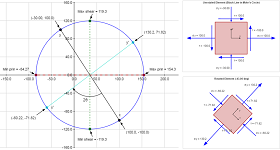
Mohr's Circle is a graphical method used to determine the principal stresses and principal planes of a given stress state. The Mohr's Circle Stress Equation is a mathematical representation of this method, allowing engineers to calculate the principal stresses and angles using a set of equations. This article provides an overview of the Mohr's Circle Stress Equation and introduces a calculator tool that simplifies the calculation process, enabling users to easily determine the principal stresses and angles for a given stress state, making it a valuable resource for engineers and students alike in the field of mechanics.
- Mohr's Circle Stress Equation and Calculator: A Comprehensive Guide
-
Understanding Mohr's Circle Stress Equation and Calculator for Effective Stress Analysis
- Introduction to Mohr's Circle Theory and Its Application in Stress Analysis
- Calculating Principal Stresses and Strains Using Mohr's Circle Stress Equation
- Understanding the Importance of Maximum Shear Stresses in Material Failure
- Applying Mohr's Circle Stress Equation and Calculator in Real-World Engineering Applications
- Limitations and Assumptions of Mohr's Circle Stress Equation and Calculator
-
Frequently Asked Questions (FAQs)
- What is Mohr's Circle Stress Equation and how is it used in engineering?
- How does the Mohr's Circle Stress Calculator work and what are its advantages?
- What are the limitations and assumptions of the Mohr's Circle Stress Equation?
- How can the Mohr's Circle Stress Equation be applied in real-world engineering problems?
Mohr's Circle Stress Equation and Calculator: A Comprehensive Guide
The Mohr's Circle is a graphical method used to determine the stress components acting on a material at a given point. It is a powerful tool for analyzing the stress state of a material under various types of loading conditions. In this section, we will delve into the Mohr's Circle Stress Equation and explore how to use a calculator to simplify the process.
Introduction to Mohr's Circle
Mohr's Circle is a circular diagram that represents the stress state of a material at a given point. It is constructed by plotting the normal stresses and shear stresses acting on the material, and then using the circle to determine the principal stresses and principal angles. The Mohr's Circle is a useful tool for visualizing the stress state of a material and for determining the maximum and minimum stresses acting on the material.
Understanding the Mohr's Circle Stress Equation
The Mohr's Circle Stress Equation is a mathematical equation that describes the relationship between the stresses and strains acting on a material. The equation is given by:
| Stress Component | Formula |
|---|---|
| Normal Stress | σ = (σx + σy) / 2 ± sqrt(((σx - σy) / 2)^2 + τ^2) |
| Shear Stress | τ = sqrt(((σx - σy) / 2)^2 + τ^2) |
The Mohr's Circle Stress Equation is used to determine the principal stresses and principal angles of a material under various types of loading conditions.
Using a Calculator to Simplify the Mohr's Circle Stress Equation
A calculator can be used to simplify the Mohr's Circle Stress Equation and to determine the principal stresses and principal angles of a material. By inputting the normal stresses and shear stresses acting on the material, the calculator can quickly and accurately determine the principal stresses and principal angles. This can save time and reduce the likelihood of errors.
Applications of Mohr's Circle in Engineering
The Mohr's Circle has numerous applications in engineering, including:
| Application | Description |
|---|---|
| Structural Analysis | Used to determine the stress state of buildings and bridges |
| Machine Design | Used to determine the stress state of machines and mechanisms |
The Mohr's Circle is a powerful tool for analyzing the stress state of a material and for determining the maximum and minimum stresses acting on the material.
Limitations and Assumptions of Mohr's Circle
The Mohr's Circle has several limitations and assumptions, including:
| Limitation | Description |
|---|---|
| Linear Elastic Behavior | Assumes that the material behaves in a linear elastic manner |
| No Plastic Deformation | Assumes that the material does not undergo plastic deformation |
The Mohr's Circle is a useful tool for analyzing the stress state of a material, but it is not applicable to all types of materials and loading conditions.
Understanding Mohr's Circle Stress Equation and Calculator for Effective Stress Analysis
The Mohr's Circle Stress Equation and Calculator is a fundamental tool in the field of mechanics of materials, allowing engineers to analyze the stress and strain states of materials under various loading conditions. This tool is based on the Mohr's Circle theory, which provides a graphical representation of the stress state of a material. The calculator is used to determine the principal stresses, principal strains, and maximum shear stresses that occur in a material.
Introduction to Mohr's Circle Theory and Its Application in Stress Analysis
The Mohr's Circle theory is a mathematical framework that describes the relationship between the stress and strain states of a material. This theory is based on the concept of stress tensors, which are mathematical objects that describe the normal and shear stresses acting on a material. The Mohr's Circle is a graphical representation of the stress tensor, which allows engineers to visualize the stress state of a material and determine the principal stresses and principal strains. The application of Mohr's Circle theory is crucial in stress analysis, as it enables engineers to predict the failure of materials under various loading conditions.
Calculating Principal Stresses and Strains Using Mohr's Circle Stress Equation
The Mohr's Circle Stress Equation is a mathematical formula that is used to calculate the principal stresses and principal strains of a material. This equation is based on the stress tensor and the orientation of the material. The calculator uses this equation to determine the maximum and minimum principal stresses, as well as the maximum shear stresses. The principal stresses are the normal stresses that act on the material, while the principal strains are the deformations that occur in the material. The calculation of these values is essential in stress analysis, as it enables engineers to predict the behavior of materials under various loading conditions.
Understanding the Importance of Maximum Shear Stresses in Material Failure
The maximum shear stresses are a critical factor in determining the failure of materials. Shear stresses occur when a material is subjected to tangential forces, which cause the material to deform. The maximum shear stresses occur when the material is subjected to a combination of normal and shear stresses. The calculator is used to determine the maximum shear stresses that occur in a material, which is essential in predicting the failure of materials. Material failure can occur due to yielding, fracture, or buckling, and the calculation of maximum shear stresses is crucial in determining the safety factor of a material.
Applying Mohr's Circle Stress Equation and Calculator in Real-World Engineering Applications
The Mohr's Circle Stress Equation and Calculator have numerous applications in real-world engineering. This tool is used in the design of structures, such as bridges and buildings, to determine the stress and strain states of materials under various loading conditions. The calculator is also used in the aerospace and automotive industries to determine the stress and strain states of materials in aircraft and vehicles. Additionally, the calculator is used in the biomechanical field to determine the stress and strain states of biological tissues, such as bone and muscle.
Limitations and Assumptions of Mohr's Circle Stress Equation and Calculator
The Mohr's Circle Stress Equation and Calculator are based on several assumptions and limitations. One of the main assumptions is that the material is isotropic, meaning that its properties are the same in all directions. The calculator also assumes that the material is linear elastic, meaning that it follows Hooke's Law. Additionally, the calculator assumes that the loading conditions are static, meaning that they do not change over time. These assumptions and limitations can affect the accuracy of the results obtained from the calculator, and engineers must carefully consider these factors when using the Mohr's Circle Stress Equation and Calculator in stress analysis.
Frequently Asked Questions (FAQs)
What is Mohr's Circle Stress Equation and how is it used in engineering?
Mohr's Circle Stress Equation is a mathematical formula used to calculate the principal stresses and principal planes of a given stress tensor. This equation is widely used in mechanics of materials and structural analysis to determine the stress state of a material or structure under different types of loading. The equation is based on the Mohr's circle, which is a graphical representation of the stress state of a material. By using this equation, engineers can determine the maximum and minimum principal stresses, as well as the orientation of the principal planes, which is essential for designing and analyzing structural components. The Mohr's Circle Stress Equation is a powerful tool that helps engineers to understand the behavior of materials under different types of loading, and to design safe and efficient structures.
How does the Mohr's Circle Stress Calculator work and what are its advantages?
The Mohr's Circle Stress Calculator is a software tool that uses the Mohr's Circle Stress Equation to calculate the principal stresses and principal planes of a given stress tensor. This calculator works by inputting the stress components into the equation and solving for the principal stresses and principal planes. The calculator has several advantages, including its ability to quickly and accurately calculate the stress state of a material, its user-friendly interface, and its ability to visualize the Mohr's circle. The calculator is also versatile, allowing users to input different types of stress tensors, such as 2D and 3D stress tensors. Additionally, the calculator can be used to analyze the stress state of different materials, including isotropic and anisotropic materials. Overall, the Mohr's Circle Stress Calculator is a valuable tool for engineers and researchers working in the field of mechanics of materials.
What are the limitations and assumptions of the Mohr's Circle Stress Equation?
The Mohr's Circle Stress Equation is a simplified model that assumes a linear elastic material behavior and a homogeneous stress state. This means that the equation is only applicable to materials that exhibit linear elastic behavior, and not to materials that exhibit non-linear or plastic behavior. Additionally, the equation assumes that the stress state is homogeneous, meaning that the stress components are uniform throughout the material. In reality, the stress state of a material can be non-uniform, due to factors such as material defects or geometric irregularities. Another limitation of the equation is that it only provides average values of the principal stresses and principal planes, and does not account for local variations in the stress state. Furthermore, the equation assumes that the material is isotropic, meaning that its properties are independent of direction. However, many materials exhibit anisotropic behavior, meaning that their properties vary with direction. Despite these limitations, the Mohr's Circle Stress Equation remains a widely used and valuable tool in the field of mechanics of materials.
How can the Mohr's Circle Stress Equation be applied in real-world engineering problems?
The Mohr's Circle Stress Equation can be applied in a wide range of real-world engineering problems, including the design and analysis of structural components, such as beams, columns, and shafts. The equation can be used to determine the stress state of these components under different types of loading, such as tension, compression, and torsion. Additionally, the equation can be used to analyze the stress concentration around holes and notches, which is critical in designing safe and efficient structures. The equation can also be used to optimize the design of machine components, such as gears and bearings, by minimizing the stress and deformation of these components. Furthermore, the equation can be used to analyze the failure of materials and structures, by determining the maximum and minimum principal stresses that a material can withstand. Overall, the Mohr's Circle Stress Equation is a powerful tool that can be used to improve the design and analysis of structural components and machine components, and to ensure the safety and efficiency of engineering systems.
Deja una respuesta
Entradas Relacionadas