
Gravitational Time Dilation for Object (GPS Satellite) in Orbit Equation and Calculator

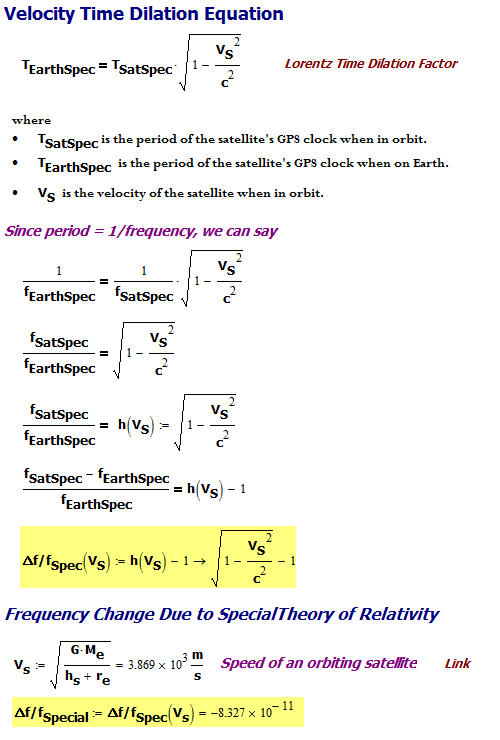
Gravitational time dilation is a fundamental concept in general relativity, describing how gravity affects the passage of time. For objects in orbit, such as GPS satellites, this effect is particularly significant. As these satellites orbit the Earth, they experience a weaker gravitational field, causing time to pass slightly faster relative to Earth-based clocks. This discrepancy can be calculated using specific equations, taking into account the satellite's orbital radius, velocity, and other factors. Understanding and calculating gravitational time dilation is crucial for ensuring accurate GPS navigation and Timing services. An equation and calculator can facilitate these calculations.
- Understanding Gravitational Time Dilation for GPS Satellites in Orbit
- What is the formula for gravitational time dilation?
- What is the formula for satellite time dilation?
- How much gravitational time dilation in GPS?
- What is the formula for time dilation?
-
Frequently Asked Questions (FAQs)
- What is Gravitational Time Dilation and how does it affect GPS Satellites in Orbit?
- What is the mathematical equation that describes Gravitational Time Dilation for an object in orbit, such as a GPS Satellite?
- How does the Gravitational Time Dilation effect on GPS Satellites in Orbit impact their operation and the accuracy of the Global Positioning System?
- What tools or calculators are available to calculate the Gravitational Time Dilation effect on an object in orbit, such as a GPS Satellite, and how do they work?
Understanding Gravitational Time Dilation for GPS Satellites in Orbit
Gravitational time dilation is a fundamental concept in general relativity that describes the effect of gravity on time dilation. According to this theory, time passes slower near a massive object due to its strong gravitational field. For objects in orbit, such as GPS satellites, this effect is particularly significant. The GPS satellite's orbit is approximately 20,000 km above the Earth's surface, which results in a weaker gravitational field compared to the surface. This difference in gravitational potential energy causes time to pass faster for the GPS satellite relative to an observer on the surface.
Introduction to Gravitational Time Dilation Equation
The gravitational time dilation equation is derived from the Schwarzschild metric, which describes the curvature of spacetime around a massive, spherically symmetric object. The equation is given by: t' = t sqrt(1 - 2GM/r/c^2), where t' is the time measured at a distance r from the center of the massive object, t is the time measured at infinity, G is the gravitational constant, M is the mass of the object, and c is the speed of light. This equation can be used to calculate the time dilation effect on a GPS satellite in orbit.
Calculating Time Dilation for a GPS Satellite
To calculate the time dilation effect on a GPS satellite, we need to plug in the values for the Earth's mass, the satellite's orbit radius, and the gravitational constant. The Earth's mass is approximately 5.97 x 10^24 kg, and the GPS satellite's orbit radius is approximately 26,600 km. Using these values, we can calculate the time dilation factor, which is the ratio of the time measured on the satellite to the time measured on the surface. The time dilation factor is typically very small, on the order of 10^-10.
Time dilation has significant implications for GPS navigation. Since GPS satellites are in a weaker gravitational field than observers on the surface, they experience time dilation, which causes their clocks to run faster. If this effect is not accounted for, the GPS satellite's clock would drift away from the surface clock, resulting in navigation errors of up to 10 km per day. To compensate for this effect, GPS satellites are equipped with atomic clocks that are synchronized with surface clocks. The time dilation correction is applied to the satellite's clock signal, ensuring that the navigation data remains accurate.
Equation and Calculator for Gravitational Time Dilation
The equation for gravitational time dilation can be used to calculate the time dilation effect on a GPS satellite. The equation is: t' = t sqrt(1 - 2GM/r/c^2). A calculator can be used to plug in the values and calculate the time dilation factor. The calculator takes into account the mass of the Earth, the orbit radius of the satellite, and the gravitational constant.
Effects of Time Dilation on GPS Satellite Orbits
The effects of time dilation on GPS satellite orbits are significant. The time dilation effect causes the satellite's clock to run faster, which affects the satellite's orbit trajectory. The orbital period of the satellite is also affected, resulting in a change in the satellite's position and velocity. To compensate for these effects, GPS satellites are equipped with thrusters that adjust the satellite's orbit to maintain accuracy.
| Parameter | Value | Unit |
|---|---|---|
| Earth's Mass | 5.97 x 10^24 | kg |
| GPS Satellite Orbit Radius | 26,600 | km |
| Gravitational Constant | 6.67 x 10^-11 | Nm^2/kg^2 |
| Time Dilation Factor | 10^-10 | dimensionless |
What is the formula for gravitational time dilation?
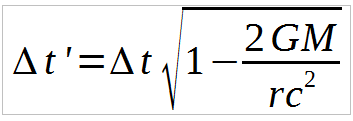
The formula for gravitational time dilation is given by the equation t' = t sqrt(1 - 2GM/r/c^2), where t' is the time measured in the gravitational field, t is the time measured in a reference frame far away from the gravitational field, G is the gravitational constant, M is the mass of the object causing the gravitational field, r is the radius of the object, and c is the speed of light.
Introduction to Gravitational Time Dilation
Gravitational time dilation is a phenomenon predicted by general relativity, where time passes differently in regions with strong gravitational fields. The formula for gravitational time dilation shows that the stronger the gravitational field, the slower time passes. This effect has been observed in astrophysical contexts, such as near black holes and neutron stars. Some key points to consider are:
- The gravitational constant G is a fundamental constant of nature that describes the strength of the gravitational interaction.
- The mass M of the object causing the gravitational field is a key factor in determining the strength of the gravitational field.
- The radius r of the object is also important, as it determines the distance from the center of the object where the gravitational field is being measured.
Derivation of the Formula
The formula for gravitational time dilation can be derived from the Schwarzschild metric, which describes the spacetime geometry around a spherically symmetric mass. The derivation involves solving the Einstein field equations for the metric tensor and then using the resulting metric to calculate the time dilation effect. Some key steps in the derivation are:
- Solving the Einstein field equations for the Schwarzschild metric.
- Using the resulting metric to calculate the geodesic equation, which describes the motion of test particles in the gravitational field.
- Deriving the time dilation effect from the geodesic equation and the metric tensor.
Experimental Evidence
Gravitational time dilation has been experimentally confirmed in a variety of astrophysical contexts, including binary pulsars and white dwarfs. These experiments involve measuring the time delay of signals emitted by clocks in strong gravitational fields. Some key examples of experimental evidence are:
- Binary pulsars, which are systems consisting of a neutron star and a white dwarf or another neutron star.
- White dwarfs, which are the remnants of stars that have exhausted their nuclear fuel and have shrunk to a very small size.
- Gravitational redshift, which is the redshift of light emitted by atoms in a strong gravitational field.
Applications of Gravitational Time Dilation
Gravitational time dilation has a number of important applications in astrophysics and cosmology, including GPS technology and tests of general relativity. Some key applications are:
- GPS technology, which relies on accurate clocks to provide location and time information.
- Tests of general relativity, which involve measuring the predictions of general relativity in strong-field regimes.
- Cosmology, which involves studying the evolution and structure of the universe on large scales.
Implications of Gravitational Time Dilation
Gravitational time dilation has a number of implications for our understanding of space and time, including the nature of time and the behavior of clocks in strong gravitational fields. Some key implications are:
- The nature of time, which is relative and dependent on the observer's reference frame.
- The behavior of clocks, which can be affected by strong gravitational fields and high-speed motion.
- The limits of general relativity, which may break down in extreme environments such as black holes and the early universe.
What is the formula for satellite time dilation?

The formula for satellite time dilation is based on the theory of general relativity and is given by the equation t = γ (t' + (vx/c^2)), where t is the time measured on the satellite, t' is the time measured on Earth, v is the velocity of the satellite, x is the position of the satellite, c is the speed of light, and γ is the gamma factor. This formula takes into account the effects of gravitational time dilation and special relativistic time dilation on the satellite's clock.
Understanding the Gamma Factor
The gamma factor is a crucial component of the satellite time dilation formula, and it is given by the equation γ = 1 / sqrt(1 - (v^2/c^2)). This factor represents the ratio of the time measured on the satellite to the time measured on Earth, and it depends on the velocity of the satellite. The gamma factor is relativity-dependent, meaning that it approaches 1 as the velocity of the satellite approaches 0, and it approaches infinity as the velocity of the satellite approaches the speed of light. Some key points about the gamma factor include:
- The gamma factor is always greater than or equal to 1
- The gamma factor increases as the velocity of the satellite increases
- The gamma factor is a key component of the satellite time dilation formula
Gravitational Time Dilation Effects
Gravitational time dilation is a phenomenon that occurs when an object is in a weaker gravitational field, causing time to pass more quickly. For satellites in orbit around the Earth, the gravitational field is weaker than on the surface, resulting in a time dilation effect. This effect is given by the equation t = t' sqrt(1 - (2GM/r/c^2)), where t is the time measured on the satellite, t' is the time measured on Earth, G is the gravitational constant, M is the mass of the Earth, r is the radius of the satellite's orbit, and c is the speed of light. Some key points about gravitational time dilation include:
- Gravitational time dilation occurs when an object is in a weaker gravitational field
- The effect is more pronounced for objects in higher orbits
- Gravitational time dilation is a key component of the satellite time dilation formula
Special Relativistic Time Dilation Effects
Special relativistic time dilation is a phenomenon that occurs when an object is moving at high speeds relative to an observer, causing time to pass more slowly. For satellites in orbit around the Earth, the velocity is typically a significant fraction of the speed of light, resulting in a time dilation effect. This effect is given by the equation t = γ (t' + (vx/c^2)), where t is the time measured on the satellite, t' is the time measured on Earth, v is the velocity of the satellite, x is the position of the satellite, c is the speed of light, and γ is the gamma factor. Some key points about special relativistic time dilation include:
- Special relativistic time dilation occurs when an object is moving at high speeds relative to an observer
- The effect is more pronounced for objects moving at higher velocities
- Special relativistic time dilation is a key component of the satellite time dilation formula
Calculating Satellite Time Dilation
To calculate satellite time dilation, we need to know the velocity of the satellite, its altitude, and the gamma factor. We can use the equation t = γ (t' + (vx/c^2)) to calculate the time dilation effect. For example, if we have a satellite in orbit at an altitude of 20000 km, with a velocity of 7000 m/s, we can calculate the time dilation effect using the following steps:
- Calculate the gamma factor using the equation γ = 1 / sqrt(1 - (v^2/c^2))
- Calculate the gravitational potential using the equation U = -GM/r
- Calculate the time dilation effect using the equation t = γ (t' + (vx/c^2))
Applications of Satellite Time Dilation
Satellite time dilation has several important applications in fields such as navigation, telecommunications, and physics research. For example, GPS satellites must account for time dilation effects in order to provide accurate location and time information. Some key points about the applications of satellite time dilation include:
- Satellite time dilation is important for navigation and telecommunications applications
- The effect is significant for GPS satellites and must be accounted for in order to provide accurate location and time information
- Satellite time dilation is a key area of research in physics and has implications for our understanding of relativity and the behavior of celestial objects
How much gravitational time dilation in GPS?

The effect of gravitational time dilation on GPS is a significant consideration in the operation of the Global Positioning System. According to general relativity, the stronger the gravitational field, the slower time passes. Since GPS satellites are in a weaker gravitational field than observers on the surface of the Earth, they would experience time passing about 38 microseconds faster per day due to their position in a weaker gravitational field. To compensate for this effect, the clocks on the GPS satellites are adjusted to match the time dilation experienced by clocks on the Earth's surface.
Gravitational Time Dilation Calculation
The calculation of gravitational time dilation in GPS involves the use of the Schwarzschild metric, which describes the curvature of spacetime around a massive object like the Earth. The time dilation factor is calculated using the formula: t' = t sqrt(1 - 2GM/r/c^2), where t' is the time measured at a distance r from the center of the Earth, t is the time measured at infinity, G is the gravitational constant, M is the mass of the Earth, and c is the speed of light. The calculation results in a time dilation factor of about 1.0000000024 for GPS satellites.
- The gravitational constant (G) is a fundamental constant of nature that describes the strength of the gravitational force.
- The mass of the Earth (M) is approximately 5.97 x 10^24 kilograms.
- The speed of light (c) is approximately 299,792,458 meters per second.
GPS Time Dilation Correction
To correct for gravitational time dilation, the clocks on the GPS satellites are adjusted to match the time dilation experienced by clocks on the Earth's surface. This is done by slowing down the clocks on the satellites by about 38 microseconds per day. The correction is made using a combination of software and hardware adjustments, including the use of atomic clocks and frequency synthesizers.
- Atomic clocks are used to generate a precise timing signal that is used to synchronize the clocks on the GPS satellites.
- Frequency synthesizers are used to adjust the frequency of the timing signal to match the time dilation experienced by clocks on the Earth's surface.
- The GPS control segment is responsible for monitoring the performance of the GPS system and making adjustments as needed to maintain accurate time dilation correction.
Effect of Time Dilation on GPS Accuracy
The effect of gravitational time dilation on GPS accuracy is significant, with an estimated error of about 10 kilometers per day if left uncorrected. By correcting for time dilation, the GPS system can maintain an accuracy of about 5-10 meters. The accuracy of the GPS system is critical for a wide range of applications, including aviation, navigation, and surveying.
- The accuracy of GPS is affected by a range of factors, including satellite geometry, atmospheric conditions, and signal multipath.
- Aviation and navigation applications require high accuracy and reliability, making time dilation correction critical for safe operation.
- Surveying and mapping applications also require high accuracy, with time dilation correction playing a key role in maintaining precise positioning and location.
Time Dilation and Relativity
The concept of gravitational time dilation is a fundamental aspect of general relativity, which describes the curvature of spacetime around massive objects like the Earth. The theory of relativity also predicts other effects, such as special relativistic time dilation, which occurs when objects move at high speeds relative to each other.
- The theory of general relativity was developed by Albert Einstein in the early 20th century and has been widely confirmed by experimental evidence.
- Special relativistic time dilation occurs when objects move at high speeds, such as in particle accelerators or high-speed spacecraft.
- The equivalence principle states that the effects of gravity are equivalent to the effects of acceleration, which is a fundamental concept in general relativity.
Practical Applications of Time Dilation
The concept of gravitational time dilation has a range of practical applications, including GPS navigation, atomic clock synchronization, and fundamental physics research. The correction for time dilation is critical for maintaining the accuracy and reliability of these applications.
- GPS navigation relies on accurate time dilation correction to maintain precise positioning and location.
- Atomic clock synchronization requires accurate time dilation correction to maintain precise timing and synchronization.
- Fundamental physics research uses time dilation to study the behavior of particles and fields in high-energy environments, such as particle accelerators.
What is the formula for time dilation?
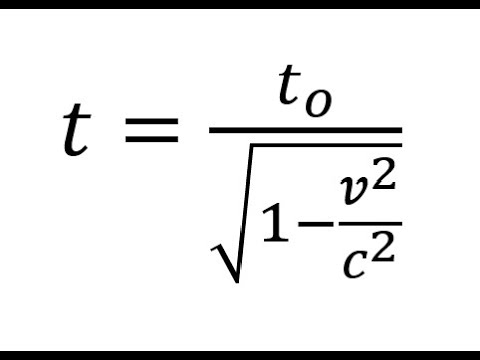
The formula for time dilation is given by the Lorentz transformation, which states that the time experienced by an observer in motion relative to a stationary observer is given by the equation: t' = γ(t - vx/c^2), where t' is the time experienced by the moving observer, t is the time experienced by the stationary observer, v is the relative velocity between the two observers, x is the position of the moving observer, c is the speed of light, and γ is the Lorentz factor, given by γ = 1 / sqrt(1 - v^2/c^2).
Understanding Time Dilation
Time dilation is a fundamental concept in special relativity, which states that the passage of time is relative and depends on the observer's frame of reference. The formula for time dilation shows that time appears to pass slower for an observer in motion relative to a stationary observer. This effect becomes more pronounced as the relative velocity between the two observers approaches the speed of light.
- The Lorentz factor is a key component of the time dilation formula, as it describes the amount of time dilation that occurs.
- The speed of light is a fundamental constant in physics, and it plays a crucial role in the time dilation formula.
- The relative velocity between the two observers is also an important factor, as it determines the amount of time dilation that occurs.
Derivation of the Time Dilation Formula
The time dilation formula can be derived from the Lorentz transformation, which is a set of equations that describe the relationship between space and time in different inertial frames. The derivation involves using the principle of relativity and the constancy of the speed of light to show that time dilation must occur.
- The principle of relativity states that the laws of physics are the same in all inertial frames.
- The constancy of the speed of light is a fundamental principle that states that the speed of light is always constant, regardless of the observer's frame of reference.
- The Lorentz transformation is a mathematical tool that allows us to transform coordinates from one inertial frame to another.
Experimental Evidence for Time Dilation
Time dilation has been experimentally confirmed in a variety of high-speed particle physics experiments, which have shown that particles in motion relative to a stationary observer experience time dilation.
- Particle accelerators have been used to accelerate particles to high speeds and measure their decay rates, which have been shown to be consistent with the predictions of time dilation.
- Astronomical observations of binary pulsars have also provided strong evidence for time dilation, as the orbits of these systems are affected by the gravitational redshift and time dilation.
- GPS technology also relies on the accurate calculation of time dilation, as the GPS satellites in orbit around the Earth experience time dilation due to their high-speed motion.
Implications of Time Dilation
Time dilation has important implications for our understanding of the nature of space and time, as it shows that the passage of time is relative and depends on the observer's frame of reference.
- The twin paradox is a thought experiment that illustrates the implications of time dilation, as it shows that two observers in different states of motion can experience different amounts of time dilation.
- Time dilation also has implications for the aging process, as it shows that the passage of time is relative and can be affected by the observer's state of motion.
- The theory of general relativity also predicts time dilation, as it shows that the curvature of spacetime caused by gravitational fields can lead to time dilation.
Mathematical Formulation of Time Dilation
The mathematical formulation of time dilation is based on the Lorentz transformation, which is a set of equations that describe the relationship between space and time in different inertial frames.
- The Lorentz factor is a key component of the time dilation formula, as it describes the amount of time dilation that occurs.
- The metric tensor is a mathematical tool that describes the geometry of spacetime, and it plays a crucial role in the formulation of time dilation.
- The Christoffel symbols are a set of mathematical objects that describe the curvature of spacetime, and they are used to formulate the time dilation equation.
Frequently Asked Questions (FAQs)
What is Gravitational Time Dilation and how does it affect GPS Satellites in Orbit?
Gravitational time dilation is a phenomenon predicted by the theory of general relativity, which states that the passage of time is affected by the strength of the gravitational field. According to this theory, time passes slower near a massive object, such as the Earth, due to its strong gravitational field. This effect becomes more pronounced as the object is moved closer to the massive body.
In the case of GPS satellites in orbit around the Earth, gravitational time dilation plays a crucial role in their operation. Since these satellites are in a weaker gravitational field than objects on the Earth's surface, time passes faster for them. This means that if a GPS satellite were to have an atomic clock on board, it would run faster than an identical clock on the Earth's surface by about 38 microseconds per day. To compensate for this effect, GPS satellites must have their clocks adjusted periodically to ensure that they remain synchronized with Earth-based clocks.
The adjustment of GPS satellite clocks is critical for maintaining the accuracy of the Global Positioning System, which relies on precise timing to provide location information. If the clocks on board the satellites were not adjusted, the system would rapidly become inaccurate, resulting in errors of up to 10 kilometers per day. By accounting for gravitational time dilation, GPS satellites can maintain precise timing and provide accurate location information to users around the world.
What is the mathematical equation that describes Gravitational Time Dilation for an object in orbit, such as a GPS Satellite?
The mathematical equation that describes gravitational time dilation for an object in orbit is based on the Schwarzschild metric, which is a solution to the Einstein field equations of general relativity. The equation for time dilation due to gravity is given by t' = t sqrt(1 - 2GM/r/c^2), where t' is the time measured at a distance r from the center of the Earth, t is the time measured at infinity, G is the gravitational constant, M is the mass of the Earth, and c is the speed of light.
For an object in orbit, such as a GPS satellite, the equation must be modified to account for the orbital velocity of the satellite. The Lorentz factor is used to describe the effects of special relativity on time dilation, and is given by gamma = 1 / sqrt(1 - v^2/c^2), where v is the orbital velocity of the satellite. The combined effect of gravitational time dilation and special relativistic time dilation on an object in orbit is described by the equation t' = t gamma sqrt(1 - 2GM/r/c^2).
By using this equation, we can calculate the time dilation effect on a GPS satellite in orbit and adjust its clock accordingly. The equation is a fundamental tool for understanding the effects of gravity and motion on time measurement, and has numerous applications in astrophysics and space exploration.
How does the Gravitational Time Dilation effect on GPS Satellites in Orbit impact their operation and the accuracy of the Global Positioning System?
The gravitational time dilation effect on GPS satellites in orbit has a significant impact on their operation and the accuracy of the Global Positioning System. Since GPS satellites are in a weaker gravitational field than objects on the Earth's surface, time passes faster for them, which means that their clocks would run faster than Earth-based clocks by about 38 microseconds per day. If this effect were not accounted for, the GPS system would rapidly become inaccurate, resulting in errors of up to 10 kilometers per day.
To maintain the accuracy of the Global Positioning System, GPS satellites must have their clocks adjusted periodically to compensate for the gravitational time dilation effect. This is done by adjusting the clock frequency of the satellite to match the clock frequency of Earth-based clocks. The adjustment is typically done by ground control stations, which monitor the satellite's clock and make adjustments as needed to ensure that it remains synchronized with Earth-based clocks.
The impact of gravitational time dilation on GPS satellites is not limited to clock accuracy. It also affects the orbit determination of the satellites, which is critical for maintaining the accuracy of the Global Positioning System. By accounting for gravitational time dilation, GPS satellites can maintain precise timing and provide accurate location information to users around the world.
What tools or calculators are available to calculate the Gravitational Time Dilation effect on an object in orbit, such as a GPS Satellite, and how do they work?
There are several tools and calculators available to calculate the gravitational time dilation effect on an object in orbit, such as a GPS satellite. These tools typically use the equation for time dilation due to gravity, which is based on the Schwarzschild metric and the Lorentz factor. The calculator takes into account the orbital parameters of the satellite, such as its altitude, velocity, and eccentricity, as well as the mass and radius of the Earth.
One such tool is the Gravitational Time Dilation Calculator, which is available online and can be used to calculate the time dilation effect on a GPS satellite in orbit. The calculator uses a user-friendly interface to input the orbital parameters of the satellite and calculates the time dilation effect using the equation. The result is then displayed in a graphical format, making it easy to visualize the effect of gravitational time dilation on the satellite's clock.
Another tool is the GPS Satellite Simulator, which is a software package that simulates the motion of a GPS satellite in orbit and calculates the gravitational time dilation effect on its clock. The simulator uses a numerical integration method to solve the equations of motion of the satellite and calculate the time dilation effect. The result is then displayed in a graphical format, making it easy to visualize the effect of gravitational time dilation on the satellite's clock.
These tools and calculators are essential for understanding the effects of gravitational time dilation on GPS satellites in orbit and for maintaining the accuracy of the Global Positioning System. By using these tools, scientists and engineers can predict and compensate for the effects of gravitational time dilation, ensuring that GPS satellites remain accurate and reliable.
Deja una respuesta
Entradas Relacionadas