
Capillary Liquid Rise and Fall Equations and Calculator


The phenomenon of capillary action is a fundamental concept in physics, where a liquid rises or falls in a narrow tube or channel due to surface tension and adhesive forces. Understanding the equations that govern capillary liquid rise and fall is crucial in various fields, including chemistry, biology, and engineering. This article provides an overview of the key equations and a calculator to determine the height of capillary rise or fall, enabling researchers and scientists to accurately predict and analyze this complex phenomenon in different materials and environments. The equations and calculator are essential tools.
- Understanding Capillary Liquid Rise and Fall Equations and Calculator
- What is the formula to calculate capillary rise and capillary fall?
- How to calculate the capillary rise?
- How will you determine whether a liquid will rise or fall in a capillary tube?
- What is the simplified capillary equation?
-
Frequently Asked Questions (FAQs)
- What is the concept of Capillary Liquid Rise and Fall Equations and Calculator?
- How do the Capillary Liquid Rise and Fall Equations and Calculator work?
- What are the applications of the Capillary Liquid Rise and Fall Equations and Calculator?
- What are the limitations and challenges of the Capillary Liquid Rise and Fall Equations and Calculator?
Understanding Capillary Liquid Rise and Fall Equations and Calculator
The capillary action is a fundamental concept in physics that describes the ability of a liquid to flow through a narrow space, such as a tube or a channel, without the need for external pressure. The capillary rise and fall equations are used to predict the behavior of a liquid in a capillary tube, taking into account factors such as the surface tension of the liquid, the contact angle between the liquid and the tube, and the radius of the tube.
Introduction to Capillary Action
Capillary action is a result of the intermolecular forces between the liquid molecules and the molecules of the surrounding material. The adhesion between the liquid and the material causes the liquid to climb up the tube, while the cohesion between the liquid molecules causes the liquid to minimize its surface area. The capillary rise equation is used to calculate the height to which the liquid will rise in the tube, and is given by: h = (2 γ cos(θ)) / (ρ g r), where h is the height, γ is the surface tension, θ is the contact angle, ρ is the density of the liquid, g is the acceleration due to gravity, and r is the radius of the tube.
Derivation of Capillary Rise Equation
The capillary rise equation can be derived by considering the forces acting on the liquid in the tube. The upward force due to the adhesion between the liquid and the tube is given by: F_up = 2 π r γ cos(θ), where r is the radius of the tube, γ is the surface tension, and θ is the contact angle. The downward force due to the weight of the liquid is given by: F_down = π r^2 ρ g h, where ρ is the density of the liquid, g is the acceleration due to gravity, and h is the height of the liquid. By equating these two forces, we can derive the capillary rise equation.
Capillary Fall Equation
The capillary fall equation is used to calculate the height to which the liquid will fall in the tube, and is given by: h = (2 γ cos(θ)) / (ρ g r), where h is the height, γ is the surface tension, θ is the contact angle, ρ is the density of the liquid, g is the acceleration due to gravity, and r is the radius of the tube. The capillary fall equation is similar to the capillary rise equation, but with a negative sign.
Calculator for Capillary Liquid Rise and Fall
A calculator can be used to calculate the height of the liquid in the tube using the capillary rise and fall equations. The calculator takes into account the surface tension, contact angle, density of the liquid, acceleration due to gravity, and radius of the tube. The calculator can be used to predict the behavior of the liquid in a variety of situations, including capillary tubes, channels, and pores.
Applications of Capillary Liquid Rise and Fall Equations
The capillary liquid rise and fall equations have a wide range of applications, including physics, engineering, and biology. The equations can be used to understand the behavior of liquids in narrow spaces, such as tubes, channels, and pores. The equations can also be used to design systems that take advantage of capillary action, such as water purification systems and medical devices.
| Parameter | Symbol | Unit |
|---|---|---|
| Surface Tension | γ | N/m |
| Contact Angle | θ | degrees |
| Density of Liquid | ρ | kg/m^3 |
| Acceleration due to Gravity | g | m/s^2 |
| Radius of Tube | r | m |
What is the formula to calculate capillary rise and capillary fall?

The formula to calculate capillary rise and capillary fall is based on the Young-Laplace equation, which describes the behavior of fluids in capillary tubes. The formula is given by: h = (2 γ cos(θ)) / (ρ g r), where h is the height of the capillary rise or fall, γ is the surface tension of the fluid, θ is the contact angle between the fluid and the tube, ρ is the density of the fluid, g is the acceleration due to gravity, and r is the radius of the tube.
Factors Affecting Capillary Rise and Fall
The capillary rise and fall of a fluid are affected by several factors, including the surface tension of the fluid, the contact angle between the fluid and the tube, and the radius of the tube. These factors can be summarized as follows:
- Surface tension: The surface tension of a fluid is a measure of its ability to resist external forces, such as gravity, and is a key factor in determining the capillary rise or fall of the fluid.
- Contact angle: The contact angle between a fluid and a tube is a measure of the angle at which the fluid meets the tube, and can affect the capillary rise or fall of the fluid.
- Radius of the tube: The radius of a tube can also affect the capillary rise or fall of a fluid, with smaller tubes resulting in a greater capillary rise or fall.
Capillary Rise in Different Materials
The capillary rise of a fluid can vary depending on the material of the tube. For example, a fluid may exhibit a greater capillary rise in a glass tube compared to a plastic tube due to the different surface properties of the materials. The capillary rise in different materials can be summarized as follows:
- Glass tubes: Glass tubes typically exhibit a high surface energy, resulting in a greater capillary rise for fluids with a high surface tension.
- Plastic tubes: Plastic tubes typically exhibit a lower surface energy compared to glass tubes, resulting in a lower capillary rise for fluids with a high surface tension.
- Other materials: The capillary rise of a fluid can also be affected by the surface properties of other materials, such as metals and ceramics.
Applications of Capillary Rise and Fall
The capillary rise and fall of fluids have several practical applications, including the design of microfluidic devices and the separation of fluids. These applications can be summarized as follows:
- Microfluidic devices: The capillary rise and fall of fluids are important considerations in the design of microfluidic devices, which are used in a variety of applications, including biomedical research and chemical analysis.
- Separation of fluids: The capillary rise and fall of fluids can be used to separate mixtures of fluids based on their surface tension and density.
- Other applications: The capillary rise and fall of fluids also have applications in textile industry, paper industry, and construction materials.
Measurement of Capillary Rise and Fall
The capillary rise and fall of a fluid can be measured using a variety of techniques, including the use of capillary tubes and high-speed cameras. These techniques can be summarized as follows:
- Capillary tubes: Capillary tubes can be used to measure the capillary rise and fall of a fluid by observing the height of the fluid in the tube over time.
- High-speed cameras: High-speed cameras can be used to measure the capillary rise and fall of a fluid by observing the movement of the fluid in a capillary tube.
- Other techniques: Other techniques, such as interferometry and ellipsometry, can also be used to measure the capillary rise and fall of a fluid.
Theoretical Models of Capillary Rise and Fall
The theoretical models of capillary rise and fall are based on the Young-Laplace equation and the Navier-Stokes equations, which describe the behavior of fluids in capillary tubes. These models can be summarized as follows:
- Young-Laplace equation: The Young-Laplace equation is a mathematical equation that describes the behavior of fluids in capillary tubes, and is used to predict the capillary rise and fall of a fluid.
- Navier-Stokes equations: The Navier-Stokes equations are a set of mathematical equations that describe the behavior of fluids in general, and can be used to model the capillary rise and fall of a fluid.
- Other models: Other models, such as the lattice Boltzmann model, can also be used to simulate the capillary rise and fall of a fluid.
How to calculate the capillary rise?
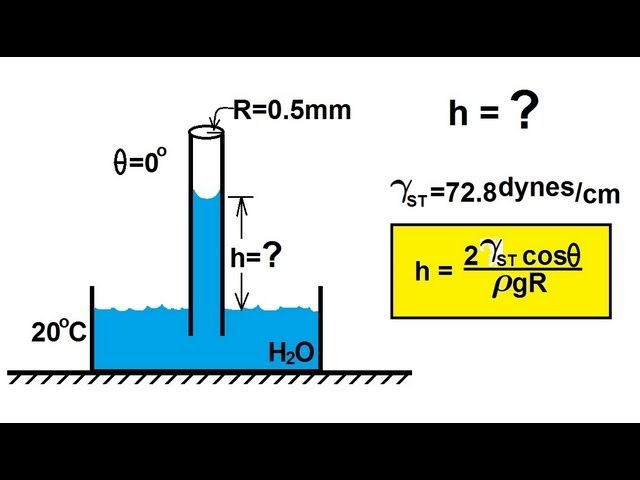
To calculate the capillary rise, we need to understand the physical principles behind it. The capillary rise is the height to which a liquid rises in a capillary. It is an important phenomenon in various fields, including physics, chemistry, and engineering. The capillary rise is influenced by several factors, including the surface tension of the liquid, the contact angle between the liquid and the capillary, and the radius of the capillary.
Understanding the Capillary Rise Formula
The capillary rise can be calculated using the formula: h = (2 γ cos(θ)) / (ρ g r), where h is the capillary rise, γ is the surface tension, θ is the contact angle, ρ is the density of the liquid, g is the acceleration due to gravity, and r is the radius of the capillary. To apply this formula, we need to know the values of these parameters.
- The surface tension of the liquid can be measured using a tensiometer.
- The contact angle can be measured using a goniometer.
- The density of the liquid can be measured using a densitometer.
Factors Affecting Capillary Rise
The capillary rise is affected by several factors, including the surface tension of the liquid, the contact angle between the liquid and the capillary, and the radius of the capillary. The surface tension is a measure of the energy per unit area at the surface of a liquid. The contact angle is a measure of the wettability of the capillary by the liquid.
- A higher surface tension results in a higher capillary rise.
- A smaller contact angle results in a higher capillary rise.
- A smaller radius results in a higher capillary rise.
Applications of Capillary Rise
The capillary rise has several applications in various fields, including physics, chemistry, and engineering. It is used to study the properties of liquids and capillaries. It is also used to design capillary tubes and wicking systems.
- Capillary tubes are used in thermometers and barometers.
- Wicking systems are used in textiles and paper products.
- Capillary rise is used to study the behavior of liquids in porous materials.
Capillary Rise in Porous Materials
The capillary rise in porous materials is more complex than in capillary tubes. It is influenced by the pore size and pore shape. The capillary rise in porous materials is used to study the behavior of liquids in soils and rocks.
- The pore size affects the rate of capillary rise.
- The pore shape affects the path of capillary rise.
- The capillary rise in porous materials is used to study the movement of groundwater.
Measurement of Capillary Rise
The capillary rise can be measured using various techniques, including the capillary tube method and the absorbency test method. The capillary tube method involves measuring the height of the liquid in a capillary tube. The absorbency test method involves measuring the amount of liquid absorbed by a porous material.
- The capillary tube method is simple and inexpensive.
- The absorbency test method is more accurate but also more expensive.
- The choice of method depends on the specific application and the required accuracy.
How will you determine whether a liquid will rise or fall in a capillary tube?
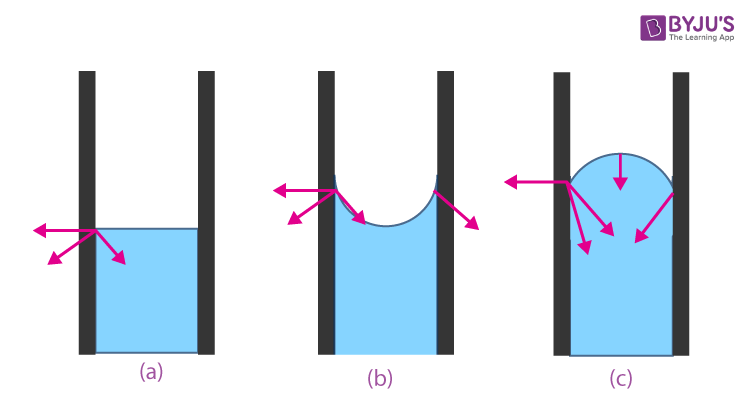
To determine whether a liquid will rise or fall in a capillary tube, we need to consider the interactions between the liquid and the tube's material. The behavior of the liquid in the capillary tube depends on the adhesion and cohesion forces between the liquid molecules and the tube's surface. If the adhesion force is greater than the cohesion force, the liquid will rise in the tube, while if the cohesion force is greater, the liquid will fall.
Understanding Capillary Action
To understand how a liquid behaves in a capillary tube, we need to consider the surface tension of the liquid and the contact angle between the liquid and the tube's surface. The surface tension is a measure of the intermolecular forces between the liquid molecules, while the contact angle determines the wetting behavior of the liquid.
- The surface tension of the liquid is a critical factor in determining its behavior in the capillary tube.
- The contact angle between the liquid and the tube's surface also plays a significant role in determining the direction of the liquid's movement.
- The material of the capillary tube can also affect the behavior of the liquid, with some materials attracting or repelling the liquid more than others.
Factors Affecting Capillary Rise
The height to which a liquid rises in a capillary tube depends on several factors, including the radius of the tube, the surface tension of the liquid, and the density of the liquid. By understanding these factors, we can predict whether a liquid will rise or fall in a capillary tube.
- The radius of the capillary tube is a critical factor in determining the height to which the liquid rises.
- The surface tension of the liquid also affects the height of the liquid column in the capillary tube.
- The density of the liquid is another important factor that influences its behavior in the capillary tube.
Measuring Capillary Rise
To measure the capillary rise of a liquid, we can use a capillary tube with a narrow diameter and a precise measurement scale. By carefully measuring the height to which the liquid rises, we can determine whether the liquid has risen or fallen in the tube.
- The capillary tube should have a narrow diameter to ensure accurate measurements.
- The measurement scale should be precise to allow for accurate readings.
- The liquid should be carefully measured to ensure accurate results.
Applications of Capillary Action
The capillary action of liquids has many practical applications, including water purification, textile manufacturing, and medical devices. By understanding how liquids behave in capillary tubes, we can design more efficient and effective systems for a wide range of applications.
- Water purification systems rely on capillary action to remove impurities from water.
- Textile manufacturing uses capillary action to treat and dye fabrics.
- Medical devices such as pipettes and cannulas rely on capillary action to deliver precise amounts of liquid.
Limitations of Capillary Action
While capillary action is a useful phenomenon, it also has some limitation, including the limited range of liquids that exhibit capillary rise and the sensitivity of the phenomenon to temperature and humidity. By understanding these limitations, we can design more robust and reliable systems that take into account the complexities of capillary action.
- The range of liquids that exhibit capillary rise is limited to those with low viscosity and high surface tension.
- The temperature and humidity of the environment can affect the behavior of the liquid in the capillary tube.
- The material of the capillary tube can also influence the behavior of the liquid, with some materials inhibiting or enhancing capillary rise.
What is the simplified capillary equation?

The simplified capillary equation is a mathematical model used to describe the behavior of capillary systems, which are networks of tiny blood vessels that play a crucial role in the exchange of oxygen, nutrients, and waste products between the bloodstream and the surrounding tissue. This equation is a simplified version of the more complex Navier-Stokes equations, which describe the behavior of fluids in general. The simplified capillary equation is often used to model the behavior of capillary beds in various physiological and pathological conditions.
Introduction to Capillary Equations
The simplified capillary equation is based on several assumptions, including the assumption that the capillary is a cylindrical tube with a uniform cross-sectional area. The equation also assumes that the flow of blood through the capillary is laminar, meaning that it is smooth and continuous. The equation is often written in terms of the pressure and flow rate of blood through the capillary, as well as the resistance to flow offered by the capillary wall. Some key factors that influence the behavior of capillary systems include:
- Viscosity of the blood, which affects the resistance to flow through the capillary
- Radius of the capillary, which affects the cross-sectional area and the resistance to flow
- Length of the capillary, which affects the resistance to flow and the pressure drop along the capillary
Derivation of the Simplified Capillary Equation
The simplified capillary equation can be derived from the Navier-Stokes equations by making several simplifying assumptions. One key assumption is that the flow of blood through the capillary is steady, meaning that it does not change over time. Another assumption is that the capillary is rigid, meaning that it does not deform or change shape in response to the flow of blood. The equation is often written in terms of the pressure and flow rate of blood through the capillary, as well as the resistance to flow offered by the capillary wall. Some key steps in the derivation of the simplified capillary equation include:
- Linearization of the Navier-Stokes equations, which involves approximating the nonlinear terms in the equations using linear approximations
- Simplification of the boundary conditions, which involves assuming that the velocity of the blood at the wall of the capillary is zero
- Integration of the equations, which involves integrating the simplified equations over the length of the capillary to obtain the simplified capillary equation
Applications of the Simplified Capillary Equation
The simplified capillary equation has a number of applications in physiology and medicine. One key application is in the study of capillary function in health and disease. The equation can be used to model the behavior of capillary systems in various physiological and pathological conditions, such as hypertension, diabetes, and cancer. The equation can also be used to design and optimize medical devices, such as dialyzers and oxygenators. Some key applications of the simplified capillary equation include:
- Modeling of capillary function in health and disease, which involves using the equation to simulate the behavior of capillary systems in different physiological and pathological conditions
- Design and optimization of medical devices, which involves using the equation to design and optimize dialyzers, oxygenators, and other medical devices that rely on capillary function
- Simulation of capillary function in surgical and medical procedures, which involves using the equation to simulate the behavior of capillary systems during surgery and other medical procedures
Limitations of the Simplified Capillary Equation
The simplified capillary equation has a number of limitations, which can affect its accuracy and applicability. One key limitation is that the equation assumes that the flow of blood through the capillary is laminar, which may not always be the case. The equation also assumes that the capillary is rigid, which may not always be the case. The equation can also be sensitive to parameters such as the viscosity of the blood and the radius of the capillary. Some key limitations of the simplified capillary equation include:
- Assumption of laminar flow, which may not always be the case in physiological and pathological conditions
- Assumption of a rigid capillary, which may not always be the case in physiological and pathological conditions
- Sensitivity to parameters such as the viscosity of the blood and the radius of the capillary, which can affect the accuracy of the equation
Future Directions for Research and Development
The simplified capillary equation is a useful tool for modeling the behavior of capillary systems, but there are still many opportunities for research and development. One key area of research is the development of more advanced and realistic models of capillary function, which can account for nonlinear effects and complex interactions between the blood and the capillary wall. Another area of research is the application of the simplified capillary equation to clinical and medical problems, such as the diagnosis and treatment of diseases that affect the capillary system. Some key areas of research and development include:
- Development of more advanced and realistic models of capillary function, which can account for nonlinear effects and complex interactions between the blood and the capillary wall
Frequently Asked Questions (FAQs)
What is the concept of Capillary Liquid Rise and Fall Equations and Calculator?
The concept of Capillary Liquid Rise and Fall Equations and Calculator is based on the physics of capillary action, which is the ability of a liquid to flow through a narrow space, such as a tube or a channel, without the need for pressure or external force. This phenomenon occurs due to the surface tension of the liquid, which creates an upward force that allows the liquid to rise through the narrow space. The Capillary Liquid Rise and Fall Equations and Calculator is a tool used to predict and calculate the height to which a liquid will rise or fall in a capillary tube, taking into account various parameters such as the radius of the tube, the surface tension of the liquid, and the contact angle between the liquid and the tube material. By using these equations and calculator, scientists and engineers can design and optimize systems that involve capillary action, such as lab-on-a-chip devices, microfluidic systems, and nanotechnology applications.
How do the Capillary Liquid Rise and Fall Equations and Calculator work?
The Capillary Liquid Rise and Fall Equations and Calculator work by using a set of mathematical equations that describe the behavior of a liquid in a capillary tube. These equations take into account the physical properties of the liquid, such as its density, viscosity, and surface tension, as well as the geometric parameters of the tube, such as its radius and length. The calculator uses these equations to predict the height to which the liquid will rise or fall in the tube, as well as the time it takes for the liquid to reach equilibrium. The equations and calculator can also be used to study the effects of gravity, temperature, and pressure on the behavior of the liquid in the capillary tube. By using the Capillary Liquid Rise and Fall Equations and Calculator, researchers can gain insights into the fundamental principles of capillary action and design new experiments and applications that exploit this phenomenon.
What are the applications of the Capillary Liquid Rise and Fall Equations and Calculator?
The Capillary Liquid Rise and Fall Equations and Calculator have a wide range of applications in various fields, including biotechnology, nanotechnology, microfluidics, and materials science. For example, in biotechnology, the equations and calculator can be used to design and optimize lab-on-a-chip devices, which are used to analyze and manipulate biological samples at the microscale. In nanotechnology, the equations and calculator can be used to study the behavior of nanoparticles and nanofluids in confined spaces, such as nanotubes and nanochannels. In microfluidics, the equations and calculator can be used to design and optimize microfluidic systems, which are used to manipulate and analyze small volumes of fluids. By using the Capillary Liquid Rise and Fall Equations and Calculator, researchers and engineers can develop new technologies and applications that exploit the principles of capillary action.
What are the limitations and challenges of the Capillary Liquid Rise and Fall Equations and Calculator?
The Capillary Liquid Rise and Fall Equations and Calculator are powerful tools for predicting and calculating the behavior of liquids in capillary tubes, but they also have some limitations and challenges. One of the main limitations is that the equations and calculator are based on simplifying assumptions, such as the assumption of a circular tube and a constant surface tension. In real-world applications, the tubes may not be circular, and the surface tension may vary with temperature and concentration. Additionally, the equations and calculator do not take into account other factors that can affect the behavior of the liquid, such as gravity, viscosity, and pressure. Furthermore, the calculator requires accurate input of physical properties and geometric parameters, which can be difficult to measure or estimate. By addressing these limitations and challenges, researchers and engineers can improve the accuracy and reliability of the Capillary Liquid Rise and Fall Equations and Calculator, and expand their range of applications.
Deja una respuesta
Entradas Relacionadas