
Capacitance Discharge Calculator


The Capacitance Discharge Calculator is a valuable tool for engineers and technicians working with electrical circuits. It calculates the time it takes for a capacitor to discharge its stored energy, taking into account the capacitance, initial voltage, and resistance of the circuit. This calculator is essential for designing and optimizing electronic circuits, ensuring safe and efficient operation. With its simple and intuitive interface, users can quickly and accurately determine the discharge time, making it an indispensable resource for professionals in the field of electrical engineering and electronics design. Accurate calculations are crucial for reliable circuit performance.
- Understanding the Capacitance Discharge Calculator
- How do you calculate capacitance discharge?
- How many ohms does it take to discharge a capacitor?
- What is the formula for discharging?
-
Frequently Asked Questions (FAQs)
- What is a Capacitance Discharge Calculator and how does it work?
- How do I use a Capacitance Discharge Calculator to determine the discharge time of a capacitor?
- What are the applications of a Capacitance Discharge Calculator in real-world scenarios?
- What are the limitations of a Capacitance Discharge Calculator and how can they be overcome?
Understanding the Capacitance Discharge Calculator
The Capacitance Discharge Calculator is a tool used to calculate the time it takes for a capacitor to discharge its energy through a resistor. This calculator is essential in various electronic circuits, including power supplies, filters, and timing circuits. The calculator takes into account the capacitance of the capacitor, the resistance of the resistor, and the initial voltage across the capacitor.
How the Capacitance Discharge Calculator Works
The Capacitance Discharge Calculator works by using the formula for capacitor discharge: V(t) = V0 e^(-t/RC), where V(t) is the voltage across the capacitor at time t, V0 is the initial voltage, e is the base of the natural logarithm, t is time, R is the resistance, and C is the capacitance. By plugging in the values for R, C, and V0, the calculator can determine the time it takes for the capacitor to discharge to a certain voltage.
Applications of the Capacitance Discharge Calculator
The Capacitance Discharge Calculator has various applications in electronic circuits, including:
| Application | Description |
|---|---|
| Power Supplies | Calculating the discharge time of filter capacitors to ensure stable output voltage |
| Filters | Designing filters with capacitors and resistors to remove unwanted frequencies |
| Timing Circuits | Calculating the discharge time of capacitors to control the timing of electronic events |
Factors Affecting Capacitor Discharge
Several factors can affect the discharge of a capacitor, including the temperature, humidity, and age of the capacitor. These factors can impact the capacitance and leakage current of the capacitor, which in turn affect the discharge time. The Capacitance Discharge Calculator can take these factors into account to provide a more accurate calculation.
Benefits of Using the Capacitance Discharge Calculator
Using the Capacitance Discharge Calculator can provide several benefits, including:
Improved accuracy: The calculator can provide a more accurate calculation of the discharge time than manual calculations.
Increased efficiency: The calculator can help designers optimize their circuits for power efficiency and reliability.
Reduced prototyping time: The calculator can reduce the time and cost associated with prototyping and testing electronic circuits.
Limitations of the Capacitance Discharge Calculator
The Capacitance Discharge Calculator has some limitations, including:
Assumes ideal components: The calculator assumes that the capacitor and resistor are ideal components, which may not be the case in real-world circuits.
Does not account for non-linear effects: The calculator does not account for non-linear effects, such as voltage-dependent capacitance, which can affect the discharge time.
How do you calculate capacitance discharge?

To calculate capacitance discharge, you need to understand the concept of capacitor discharge, which is the process by which a capacitor releases its stored energy. The capacitance of a capacitor is the ability of the capacitor to store electric charge, and the discharge of a capacitor is the process by which this stored charge is released. The discharge of a capacitor can be calculated using the formula: Q = C V, where Q is the charge stored in the capacitor, C is the capacitance of the capacitor, and V is the voltage across the capacitor.
Calculating Capacitance Discharge Time Constant
The time constant of a capacitor discharge circuit is an important parameter that determines how quickly the capacitor discharges. The time constant can be calculated using the formula: τ = R C, where τ is the time constant, R is the resistance of the circuit, and C is the capacitance of the capacitor. The time constant is the time it takes for the capacitor to discharge to 63% of its initial voltage. Some key points to consider when calculating the time constant are:
- The resistance of the circuit should be measured in ohms (Ω)
- The capacitance of the capacitor should be measured in farads (F)
- The time constant should be measured in seconds (s)
Understanding Capacitance Discharge Curve
The discharge curve of a capacitor is a graph that shows how the voltage across the capacitor changes over time as it discharges. The discharge curve can be used to determine the time constant of the circuit and to predict how quickly the capacitor will discharge. Some key features of the discharge curve are:
- The initial voltage of the capacitor is the maximum !voltage that the capacitor can store
- The discharge rate is the rate at which the voltage across the capacitor decreases over time
- The discharge time is the time it takes for the capacitor to discharge to a certain voltage level
Factors Affecting Capacitance Discharge
There are several factors that can affect the discharge of a capacitor, including the resistance of the circuit, the capacitance of the capacitor, and the voltage across the capacitor. Some key factors to consider are:
- The resistance of the circuit can affect the time constant of the circuit and the discharge rate of the capacitor
- The capacitance of the capacitor can affect the amount of energy stored in the capacitor and the discharge time
- The voltage across the capacitor can affect the discharge rate and the discharge time
Capacitance Discharge Applications
Capacitance discharge has several applications in electronics and engineering, including:
- Power supplies: Capacitors are often used to filter and regulate the voltage in power supplies
- Audio equipment: Capacitors are used in audio equipment to filter and regulate the voltage and to reduce noise
- Medical devices: Capacitors are used in medical devices to filter and regulate the voltage and to reduce interference
Measuring Capacitance Discharge
To measure the discharge of a capacitor, you can use an oscilloscope or a multimeter to measure the voltage across the capacitor over time. Some key points to consider when measuring the discharge are:
- The oscilloscope or multimeter should be set to measure the voltage in volts (V)
- The time base of the oscilloscope should be set to measure the time in seconds (s)
- The trigger of the oscilloscope should be set to trigger on the voltage across the capacitor
How many ohms does it take to discharge a capacitor?
The number of ohms required to discharge a capacitor depends on several factors, including the capacitor's voltage rating, capacitance value, and the desired discharge time. In general, a resistor with a value of 1 kilo-ohm to 1 mega-ohm is used to discharge a capacitor, but the exact value depends on the specific application and the circuit design.
Understanding Capacitor Discharge
The process of discharging a capacitor involves allowing the electric charge to flow out of the capacitor through a resistor or other circuit element. The discharge time is determined by the RC time constant, which is the product of the resistance and capacitance values. To understand how many ohms it takes to discharge a capacitor, it's essential to consider the following factors:
- The voltage rating of the capacitor, which determines the maximum voltage that can be applied across the capacitor.
- The capacitance value,! which determines the amount of electric charge stored in the capacitor.
- The desired discharge time, which determines how quickly the capacitor should be discharged.
Calculating the Discharge Time
To calculate the discharge time, you need to know the resistance and capacitance values. The discharge time can be calculated using the formula: discharge time = RC time constant = resistance x capacitance. For example, if you have a capacitor with a capacitance value of 100 micro-farads and a resistor with a value of 1 kilo-ohm, the discharge time would be 0.1 seconds. The following are the steps to calculate the discharge time:
- Determine the resistance value of the resistor.
- Determine the capacitance value of the capacitor.
- Calculate the RC time constant using the formula: RC time constant = resistance x capacitance.
Factors Affecting Discharge Time
Several factors can affect the discharge time of a capacitor, including the temperature, humidity, and voltage rating of the capacitor. Additionally, the resistance value of the resistor and the circuit design can also impact the discharge time. The following are some of the key factors that can affect the discharge time:
- Temperature: High temperatures can increase the leakage current of the capacitor, reducing the discharge time.
- Humidity: High humidity can increase the leakage current of the capacitor, reducing the discharge time.
- Voltage rating: The voltage rating of the capacitor can affect the discharge time, with higher voltage ratings resulting in longer discharge times.
Safe Discharge Practices
When discharging a capacitor, it's essential to follow safe discharge practices to avoid electric shock or other injuries. This includes using a resistor with a value that is high enough to prevent overheating or arcing, and ensuring that the circuit is designed to handle the discharge current. The following are some safe discharge practices to follow:
- Use a resistor with a value that is high enough to prevent overheating or arcing.
- Ensure that the circuit is designed to handle the discharge current.
- Use insulating materials to prevent electric shock.
Applications of Capacitor Discharge
Capacitor discharge is used in a variety of applications, including power supplies, audio equipment, and medical devices. In these applications, the capacitor is used to store electric energy, which is then released through a resistor or other circuit element. The following are some examples of applications that use capacitor discharge:
- Power supplies: Capacitor discharge is used to regulate the output voltage of power supplies.
- Audio equipment: Capacitor discharge is used to filter audio signals and reduce noise.
- Medical devices: Capacitor discharge is used to power medical devices, such as defibrillators.
What is the formula for discharging?
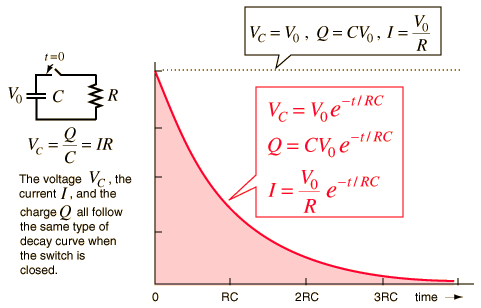
The formula for discharging is a concept that applies to various fields, including electricity, fluid dynamics, and thermodynamics. In general, discharging refers to the process of releasing energy or a substance from a system. The formula for discharging can be expressed in different ways depending on the specific context. For example, in electricity, the discharging of a capacitor can be described by the formula: Q = CV, where Q is the charge, C is the capacitance, and V is the voltage.
Discharging in Electrical Systems
In electrical systems, discharging refers to the process of releasing electrical energy from a capacitor or a battery. The formula for discharging in electrical systems can be expressed as: I = C(dV/dt), where I is the current, C is the capacitance, and dV/dt is the rate of change of voltage. This formula describes the relationship between the current flowing out of a capacitor and the rate of change of voltage across it. Some key points to consider when dealing with discharging in electrical systems include:
- The capacity of the capacitor or battery affects the rate of discharging.
- The voltage and current levels also impact the discharging process.
- The efficiency of the discharging process can be affected by resistance and other energy losses.
Discharging in Fluid Dynamics
In fluid dynamics, discharging refers to the process of releasing a fluid or gas from a container or system. The formula for discharging in fluid dynamics can be expressed as: Q = A√(2gh), where Q is the flow rate, A is the cross-sectional area, g is the acceleration due to gravity, and h is the height of the fluid. This formula describes the relationship between the flow rate of a fluid and the height of the fluid in a container. Some key points to consider when dealing with discharging in fluid dynamics include:
- The viscosity of the fluid affects the rate of discharging.
- The pressure and temperature levels also impact the discharging process.
- The geometry of the container or system can affect the flow rate and efficiency of the discharging process.
Discharging in Thermodynamics
In thermodynamics, discharging refers to the process of releasing thermal energy from a system. The formula for discharging in thermodynamics can be expressed as: Q = mcΔT, where Q is the heat transferred, m is the mass, c is the specific heat capacity, and ΔT is the change in temperature. This formula describes the relationship between the heat transferred and the change in temperature of a system. Some key points to consider when dealing with discharging in thermodynamics include:
- The specific heat capacity of the material affects the rate of discharging.
- The temperature and pressure levels also impact the discharging process.
- The efficiency of the discharging process can be affected by heat losses and other energy losses.
Factors Affecting Discharging
Several factors can affect the discharging process, including resistance, capacitance, and inductance. In electrical systems, resistance can slow down the discharging process, while capacitance can affect the rate of discharging. In fluid dynamics, viscosity and turbulence can impact the discharging process. Some key points to consider when dealing with factors affecting discharging include:
- Resistance can reduce the efficiency of the discharging process.
- Capacitance can affect the rate of discharging.
- Inductance can also impact the discharging process, particularly in electrical systems.
Applications of Discharging
Discharging has various applications in different fields, including energy storage, power generation, and industrial processes. In energy storage, discharging is used to release electrical energy from batteries and capacitors. In power generation, discharging is used to release thermal energy from fossil fuels and nuclear reactors. Some key points to consider when dealing with applications of discharging include:
- Energy storage systems rely on discharging to release electrical energy.
- Power generation systems use discharging to release thermal energy.
- Industrial processes also rely on discharging to release chemical energy and other forms of energy.
Frequently Asked Questions (FAQs)
What is a Capacitance Discharge Calculator and how does it work?
A Capacitance Discharge Calculator is an online tool used to calculate the time it takes for a capacitor to discharge through a resistor. This calculator is essential in electronic engineering and physics applications where capacitors are used to store energy. The calculator takes into account the initial voltage of the capacitor, the capacitance value, and the resistance value of the circuit to determine the discharge time constant. The discharge time constant is the time it takes for the capacitor to discharge to 36.8% of its initial voltage. The calculator uses the formula RC, where R is the resistance and C is the capacitance, to calculate the discharge time constant.
How do I use a Capacitance Discharge Calculator to determine the discharge time of a capacitor?
To use a Capacitance Discharge Calculator, you need to enter the initial voltage of the capacitor, the capacitance value, and the resistance value of the circuit. The calculator will then calculate the discharge time constant using the formula RC. You can use this value to determine the time it takes for the capacitor to discharge to a specific voltage. For example, if you want to know the time it takes for the capacitor to discharge to 10% of its initial voltage, you can use the discharge time constant to calculate this value. The calculator can also be used to determine the current flowing through the resistor during the discharge process.
What are the applications of a Capacitance Discharge Calculator in real-world scenarios?
A Capacitance Discharge Calculator has several applications in real-world scenarios. One of the main applications is in power supply design, where capacitors are used to filter and regulate the output voltage. The calculator can be used to determine the discharge time constant of the capacitor, which is essential in designing a stable power supply. Another application is in audio equipment, where capacitors are used to filter out unwanted frequencies. The calculator can be used to determine the current flowing through the resistor during the discharge process, which is essential in designing audio equipment with optimal performance. The calculator can also be used in medical devices, such as defibrillators, where capacitors are used to store energy.
What are the limitations of a Capacitance Discharge Calculator and how can they be overcome?
A Capacitance Discharge Calculator has several limitations that need to be considered. One of the main limitations is that it assumes a simple RC circuit, where the capacitor is discharging through a single resistor. In real-world scenarios, the circuit may be more complex, with multiple resistors and capacitors. To overcome this limitation, you can use more advanced calculators that can handle complex circuits. Another limitation is that the calculator assumes an ideal capacitor, where the capacitor has no leakage current or other losses. In real-world scenarios, capacitors may have leakage current or other losses that can affect the discharge time constant. To overcome this limitation, you can use more advanced calculators that can take into account the non-ideal characteristics of the capacitor. Additionally, you can use simulation software to model the behavior of the capacitor and resistor in a more accurate way.
Deja una respuesta
Entradas Relacionadas