
Cantilevered Beam Natural Frequency Formulas and Calculator

The natural frequency of a cantilevered beam is a critical parameter in various engineering applications, including vibration analysis and structural design. Calculating this frequency is essential to ensure the beam's stability and performance under different loading conditions. This article provides a comprehensive overview of the formulas and calculations involved in determining the natural frequency of a cantilevered beam, along with a handy calculator to simplify the process. The formulas presented are based on established theories and are applicable to a wide range of beam configurations and boundary conditions.
- Cantilevered Beam Natural Frequency Formulas and Calculator
- What is the formula for the natural frequency of a cantilever beam?
- What is the formula for natural frequency?
- What is the formula for cantilever beam?
- What is the natural frequencies of a uniform cantilever?
-
Frequently Asked Questions (FAQs)
- What is the Cantilevered Beam Natural Frequency and why is it important?
- How do I calculate the natural frequency of a cantilevered beam using formulas and calculators?
- What are the factors that affect the natural frequency of a cantilevered beam?
- Can I use online calculators and software tools to determine the natural frequency of a cantilevered beam?
Cantilevered Beam Natural Frequency Formulas and Calculator
The natural frequency of a cantilevered beam is a crucial parameter in various engineering applications, including vibration analysis, structural dynamics, and mechanical design. The cantilevered beam is a type of beam that is fixed at one end and free at the other end, which makes it a classic example of a single-degree-of-freedom system. The natural frequency of a cantilevered beam can be calculated using various formulas and calculators, which take into account the beam's physical properties, such as its length, width, thickness, and material density.
Introduction to Cantilevered Beam Natural Frequency
The natural frequency of a cantilevered beam is the frequency at which the beam vibrates when it is excited by an external force. The natural frequency is a function of the beam's stiffness, mass, and boundary conditions. The stiffness of the beam is related to its Young's modulus, which is a measure of the beam's resistance to deformation. The mass of the beam is related to its density and volume. The boundary conditions of the beam, such as the fixed end and free end, also affect the natural frequency.
Cantilevered Beam Natural Frequency Formulas
There are several formulas available to calculate the natural frequency of a cantilevered beam. One of the most commonly used formulas is the Rayleigh-Ritz method, which is a variational method that uses the principle of minimum potential energy to determine the natural frequency. Another formula is the finite element method, which divides the beam into a series of elements and solves the equations of motion using a matrix formulation. The natural frequency can be calculated using the following formula:
| Formula | Description |
|---|---|
| f = (m K) / (2 π) | Natural frequency formula, where f is the natural frequency, m is the mass, and K is the stiffness |
Cantilevered Beam Natural Frequency Calculator
A calculator can be used to calculate the natural frequency of a cantilevered beam. The calculator typically requires input of the beam's physical properties, such as its length, width, thickness, and material density. The calculator then uses a formula or algorithm to calculate the natural frequency. There are several types of calculators available, including online calculators, spreadsheet calculators, and software calculators. The calculator can be used to calculate the natural frequency of a cantilevered beam with different boundary conditions, such as a fixed-free beam or a fixed-fixed beam.
Applications of Cantilevered Beam Natural Frequency
The natural frequency of a cantilevered beam has several applications in engineering, including vibration analysis, structural dynamics, and mechanical design. The natural frequency is used to design vibration isolators, vibration dampers, and vibration absorbers. The natural frequency is also used to analyze the stability of structures, such as bridges, buildings, and towers. The natural frequency can be used to predict the response of a structure to dynamic loads, such as earthquakes, wind, and waves.
Limitations of Cantilevered Beam Natural Frequency Formulas and Calculators
The natural frequency formulas and calculators have several limitations, including assumptions and simplifications. The formulas and calculators assume that the beam is a linear system, which means that the beam's response to a load is proportional to the load. The formulas and calculators also assume that the beam is a single-degree-of-freedom system, which means that the beam has only one mode of vibration. The limitation of the formulas and calculators can be overcome by using more advanced methods, such as finite element methods or computational fluid dynamics methods.
What is the formula for the natural frequency of a cantilever beam?
The natural frequency of a cantilever beam can be calculated using the formula: ωn = (β^2 √(EI / ρA)) / L^2, where ωn is the natural frequency, β is the mode shape coefficient, EI is the flexural rigidity, ρ is the density of the material, A is the cross-sectional area, and L is the length of the beam.
Natural Frequency Calculation
The calculation of the natural frequency of a cantilever beam involves several parameters, including the material properties and the geometric dimensions of the beam. The formula for the natural frequency can be derived using the equations of motion and the boundary conditions of the beam. The calculation can be simplified by using approximations and simplifications, such as assuming a uniform cross-section and neglecting the effects of damping.
- Mode shape coefficient (β) depends on the boundary conditions and the mode number.
- Flexural rigidity (EI) depends on the material properties and the geometric dimensions.
- Density (ρ) and cross-sectional area (A) depend on the material properties and the geometric dimensions.
Mode Shape Coefficient
The mode shape coefficient (β) is a dimensionless parameter that depends on the boundary conditions and the mode number. The mode shape coefficient can be calculated using numerical methods or approximations, such as the Rayleigh-Ritz method or the Galerkin method. The mode shape coefficient is used to calculate the natural frequency and the mode shape of the beam.
- Clamped-free boundary conditions have a mode shape coefficient of 1.875.
- Simply-supported boundary conditions have a mode shape coefficient of 3.142.
- Fixed-fixed boundary conditions have a mode shape coefficient of 4.730.
Flexural Rigidity
The flexural rigidity (EI) is a measure of the stiffness of the beam and depends on the material properties and the geometric dimensions. The flexural rigidity can be calculated using the elastic modulus (E) and the moment of inertia (I) of the beam. The flexural rigidity is used to calculate the natural frequency and the deflection of the beam.
- Elastic modulus (E) depends on the material properties.
- Moment of inertia (I) depends on the geometric dimensions.
- Cross-sectional area (A) depends on the geometric dimensions.
Natural Frequency Applications
The natural frequency of a cantilever beam has several applications in engineering and design, including the vibration analysis and the dynamic response of structures. The natural frequency can be used to calculate the resonance frequency and the damping ratio of the beam.
- Vibration analysis is used to calculate the dynamic response of structures.
- Resonance frequency is used to calculate the amplitude of the vibration.
- Damping ratio is used to calculate the decay of the vibration.
Material Properties
The material properties of a cantilever beam, such as the density (ρ) and the elastic modulus (E), play a crucial role in determining the natural frequency of the beam. The material properties can be measured using experimental methods or theoretical models. The material properties are used to calculate the flexural rigidity and the natural frequency of the beam.
- Density (ρ) depends on the material composition.
- Elastic modulus (E) depends on the material composition.
- Poisson's ratio (ν) depends on the material composition.
What is the formula for natural frequency?
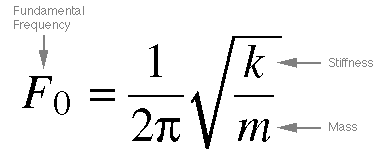
The formula for natural frequency is given by the equation: f = (1 / 2π) √(k / m), where f is the natural frequency, k is the spring constant, and m is the mass of the object. This formula is used to calculate the natural frequency of a simple harmonic motion system, such as a mass-spring system.
Natural Frequency Calculation
The calculation of natural frequency involves determining the spring constant and the mass of the object. The spring constant can be determined by measuring the force required to compress or stretch the spring by a certain distance. The mass of the object can be measured using a balance or other weighing device. Once these values are known, they can be plugged into the formula to calculate the natural frequency.
- The spring constant is a measure of the stiffness of the spring.
- The mass of the object is a measure of its inertia.
- The natural frequency is a measure of the frequency at which the object will oscillate when subjected to a disturbance.
Importance of Natural Frequency
The natural frequency of a system is an important parameter in vibration analysis. It is used to determine the response of a system to external forces and to predict the behavior of the system under different loading conditions. The natural frequency is also used to design vibration isolation systems and to optimize the performance of mechanical systems.
- The natural frequency is used to predict the response of a system to harmonic excitation.
- The natural frequency is used to design vibration isolation systems to reduce the transmission of vibration.
- The natural frequency is used to optimize the performance of mechanical systems by minimizing the effects of resonance.
Factors Affecting Natural Frequency
The natural frequency of a system can be affected by several factors, including the spring constant, the mass of the object, and the damping ratio. The spring constant affects the stiffness of the system, while the mass affects the inertia. The damping ratio affects the amount of energy lost by the system during each cycle of oscillation.
- The spring constant affects the stiffness of the system and the natural frequency.
- The mass of the object affects the inertia and the natural frequency.
- The damping ratio affects the amount of energy lost by the system during each cycle.
Measurement of Natural Frequency
The natural frequency of a system can be measured using several methods, including experimental methods and analytical methods. Experimental methods involve measuring the response of the system to a known input, while analytical methods involve using mathematical models to predict the natural frequency.
- Experimental methods involve measuring the response of the system to a known input.
- Analytical methods involve using mathematical models to predict the natural frequency.
- Numerical methods involve using computer simulations to predict the natural frequency.
Applications of Natural Frequency
The natural frequency has several applications in engineering and physics, including the design of vibration isolation systems, the optimization of mechanical systems, and the prediction of the response of systems to external forces. The natural frequency is also used in the design of bridges, buildings, and other structures to ensure that they can withstand wind and earthquake loads.
- The natural frequency is used in the design of vibration isolation systems.
- The natural frequency is used to optimize the performance of mechanical systems.
- The natural frequency is used to predict the response of systems to external forces.
What is the formula for cantilever beam?

The formula for a cantilever beam is used to calculate the deflection and stress on the beam due to a load applied at the free end. The formula for the deflection of a cantilever beam is given by: δ = (W L^3) / (3 E I), where δ is the deflection, W is the load, L is the length of the beam, E is the modulus of elasticity, and I is the moment of inertia.
Beam Deflection Formula
The beam deflection formula is used to calculate the deflection of a cantilever beam. The formula takes into account the load, length, modulus of elasticity, and moment of inertia of the beam. The formula is: δ = (W L^3) / (3 E I). Here are some key points to consider:
- The load applied at the free end of the beam is a key factor in determining the deflection.
- The length of the beam also plays a crucial role in determining the deflection.
- The modulus of elasticity and moment of inertia of the beam material are also important factors in determining the deflection.
Cantilever Beam Stress
The stress on a cantilever beam is an important factor to consider when designing the beam. The stress can be calculated using the formula: σ = (M c) / I, where σ is the stress, M is the moment, c is the distance from the neutral axis, and I is the moment of inertia. This formula is used to calculate the maximum stress on the beam. Here are some key points to consider:
- The maximum stress occurs at the fixed end of the beam.
- The stress decreases as you move towards the free end of the beam.
- The stress is also affected by the load and length of the beam.
Beam Load Calculation
The load calculation for a cantilever beam is an important step in designing the beam. The load can be calculated using the formula: W = (σ I) / (M c), where W is the load, σ is the stress, I is the moment of inertia, M is the moment, and c is the distance from the neutral axis. Here are some key points to consider:
- The load calculation depends on the stress and moment of the beam.
- The load calculation also depends on the moment of inertia and distance from the neutral axis.
- The load calculation is important for determining the deflection and stress on the beam.
Moment of Inertia Calculation
The moment of inertia calculation for a cantilever beam is an important step in designing the beam. The moment of inertia can be calculated using the formula: I = (b h^3) / 12, where I is the moment of inertia, b is the width of the beam, and h is the height of the beam. Here are some key points to consider:
- The moment of inertia calculation depends on the width and height of the beam.
- The moment of inertia calculation is important for determining the deflection and stress on the beam.
- The moment of inertia is a key factor in determining the stiffness of the beam.
Design Considerations for Cantilever Beams
When designing a cantilever beam, there are several design considerations to keep in mind. These include the load, length, material, and support conditions of the beam. The design considerations will affect the deflection, stress, and stability of the beam. Here are some key points to consider:
- The load and length of the beam will affect the deflection and stress.
- The material properties, such as modulus of elasticity and yield strength, will affect the deflection and stress.
- The support conditions, such as fixed or simply supported, will affect the deflection and stress.
What is the natural frequencies of a uniform cantilever?
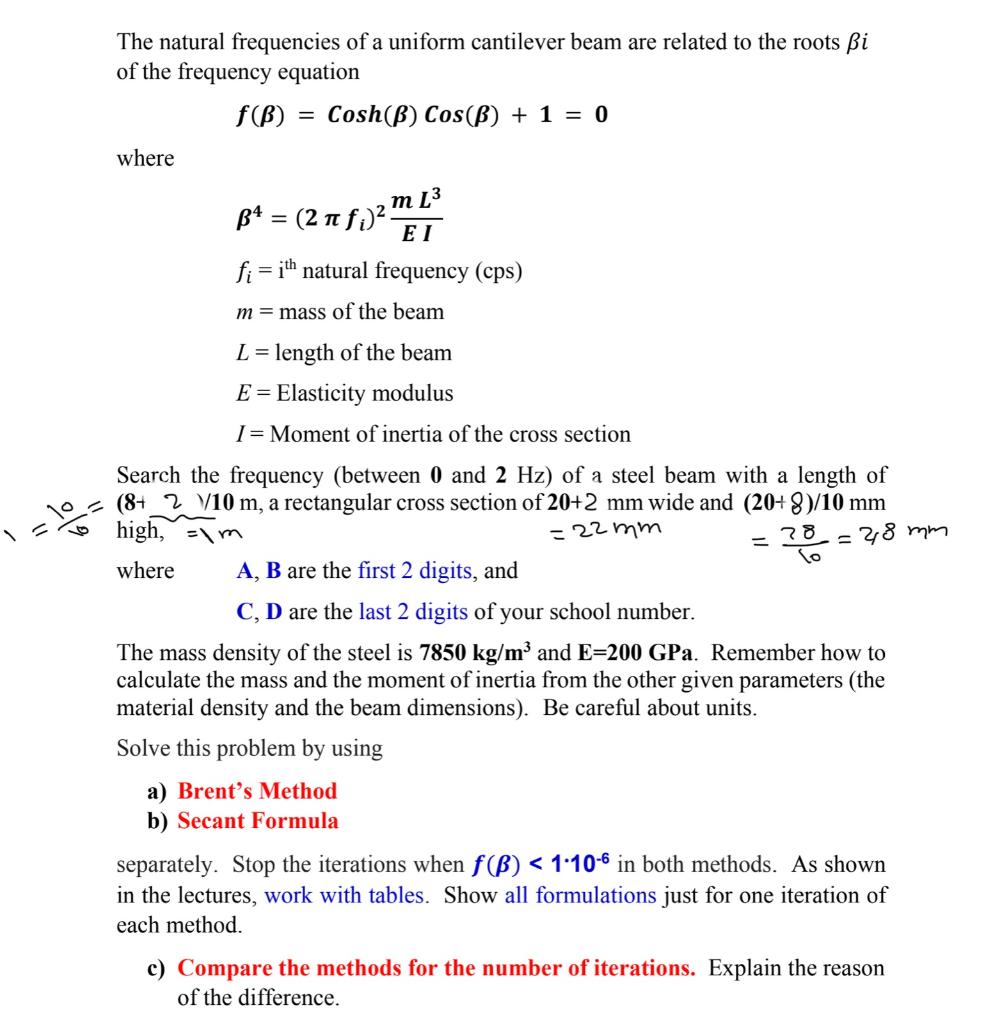
The natural frequencies of a uniform cantilever can be determined using the equations of motion and the boundary conditions of the system. The cantilever is a type of beam that is fixed at one end and free at the other, which makes it a classic problem in vibrations and dynamics. The natural frequencies of the cantilever depend on its length, mass, and stiffness, which are all important parameters in determining the frequency response of the system.
Derivation of Natural Frequencies
The derivation of the natural frequencies of a uniform cantilever involves solving the partial differential equation that governs the motion of the beam. The equation of motion is a fourth-order differential equation that can be solved using separation of variables and boundary conditions. The resulting eigenvalues and eigenvectors can be used to determine the natural frequencies and mode shapes of the cantilever. Some key steps in the derivation include:
- Solving the partial differential equation using separation of variables
- Applying the boundary conditions to determine the eigenvalues and eigenvectors
- Using the eigenvalues to determine the natural frequencies of the cantilever
Mode Shapes and Natural Frequencies
The mode shapes and natural frequencies of a uniform cantilever are determined by the eigenvalues and eigenvectors of the system. The mode shapes describe the deflection of the beam at different points along its length, while the natural frequencies describe the frequency at which the beam vibrates. The mode shapes and natural frequencies are related to each other through the equations of motion and the boundary conditions of the system. Some key aspects of mode shapes and natural frequencies include:
- The mode shapes describe the deflection of the beam at different points along its length
- The natural frequencies describe the frequency at which the beam vibrates
- The mode shapes and natural frequencies are related to each other through the equations of motion and the boundary conditions
Effects of Parameters on Natural Frequencies
The natural frequencies of a uniform cantilever are affected by several parameters, including the length, mass, and stiffness of the beam. The length of the beam affects the natural frequencies by changing the wavelength of the vibrations, while the mass and stiffness affect the natural frequencies by changing the inertia and elasticity of the beam. Some key effects of parameters on natural frequencies include:
- The length of the beam affects the natural frequencies by changing the wavelength of the vibrations
- The mass of the beam affects the natural frequencies by changing the inertia of the beam
- The stiffness of the beam affects the natural frequencies by changing the elasticity of the beam
Experimental Verification of Natural Frequencies
The natural frequencies of a uniform cantilever can be verified experimentally using various measurement techniques, including accelerometers and laser Doppler vibrometry. These techniques can be used to measure the vibrations of the beam and determine the natural frequencies by fast Fourier transform (FFT) analysis. Some key aspects of experimental verification include:
- Using accelerometers to measure the vibrations of the beam
- Using laser Doppler vibrometry to measure the vibrations of the beam
- Applying fast Fourier transform (FFT) analysis to determine the natural frequencies
Applications of Natural Frequencies in Engineering
The natural frequencies of a uniform cantilever have several applications in engineering, including vibration analysis, structural dynamics, and design optimization. The natural frequencies can be used to predict the response of the beam to different types of loading, including harmonic and impulsive loading. Some key applications of natural frequencies include:
- Predicting the response of the beam to different types of loading
- Designing structures to withstand vibrations and dynamics loads
- Optimizing the design of structures to minimize vibrations and dynamics loads
Frequently Asked Questions (FAQs)
What is the Cantilevered Beam Natural Frequency and why is it important?
The Cantilevered Beam Natural Frequency is a critical parameter in the design and analysis of mechanical systems, particularly in the context of vibration and dynamics. It refers to the frequency at which a cantilevered beam tends to oscillate or vibrate when subjected to an external force or disturbance. The natural frequency is a function of the beam's length, cross-sectional area, material properties, and boundary conditions. Understanding the natural frequency of a cantilevered beam is essential to ensure that the system operates within a safe and efficient range, avoiding resonance and potential failure. By calculating the natural frequency, engineers can design systems that minimize vibration and noise, and optimize performance.
How do I calculate the natural frequency of a cantilevered beam using formulas and calculators?
Calculating the natural frequency of a cantilevered beam involves using mathematical formulas and algorithms that take into account the beam's geometric and material properties. The most common formula used is the Rayleigh-Ritz method, which provides an approximate solution for the natural frequency. Alternatively, finite element methods can be employed to obtain more accurate results. Online calculators and software tools are also available, which can simplify the calculation process and provide quick results. These tools often require input of the beam's length, width, thickness, density, and Young's modulus, among other parameters. By using these formulas and calculators, engineers can quickly and accurately determine the natural frequency of a cantilevered beam and make informed design decisions.
What are the factors that affect the natural frequency of a cantilevered beam?
Several factors can influence the natural frequency of a cantilevered beam, including geometric parameters such as length, width, and thickness. The material properties of the beam, such as density, Young's modulus, and Poisson's ratio, also play a significant role. Additionally, boundary conditions, including the type of support and constraint, can affect the natural frequency. Other factors, such as damping and nonlinearities, can also impact the beam's dynamic behavior. Understanding the relationships between these factors and the natural frequency is crucial for design optimization and performance prediction. By carefully considering these factors, engineers can design cantilevered beams that meet specific performance requirements and safety standards.
Can I use online calculators and software tools to determine the natural frequency of a cantilevered beam?
Yes, there are many online calculators and software tools available that can help determine the natural frequency of a cantilevered beam. These tools often provide a user-friendly interface for inputting the beam's geometric and material properties, and can quickly generate results for the natural frequency. Some popular options include MATLAB, ANSYS, and ABAQUS, which offer advanced finite element analysis capabilities. Online calculators, such as those found on engineering websites and academic portals, can also provide quick estimates of the natural frequency. These tools can be useful for preliminary design and conceptual analysis, but may not provide the same level of accuracy as more advanced simulation software. By leveraging these online resources, engineers can streamline their design process and make more informed decisions about cantilevered beam design.
Deja una respuesta
Entradas Relacionadas